In Pain? Call Caine
Pedestrian Accident Claim: Florida Legal Guide 2026

5 Min read
By: Caine Law
Share

You may be reading this from an ER bed, your couch with an ice pack, or a phone screen while an insurance adjuster keeps calling. You know you were hit. You know you're hurt. What you may not know yet is that a pedestrian accident claim can be won on liability and still leave you with far less money than you expected if the case isn't built carefully from the start.
That gap between the settlement headline and the check you keep is where many people get blindsided. Medical liens, recorded statements, missing camera footage, and arguments over fault can quickly undermine a valid claim. In Florida, the right strategy isn't just about proving the driver was negligent. It's also about protecting your net recovery and avoiding traps that other guides barely mention.
The Legal Foundation of Your Pedestrian Accident Claim
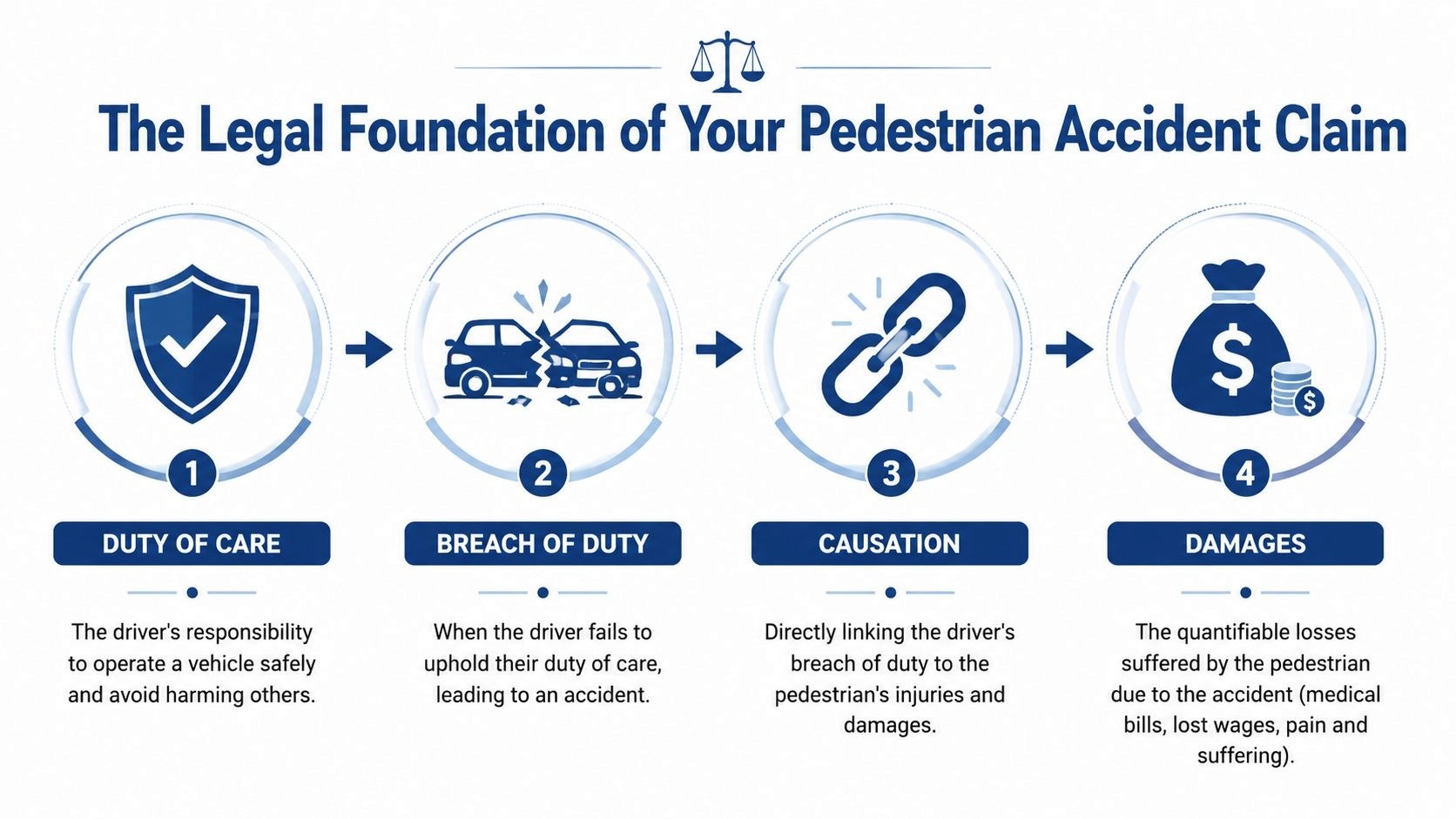
A simple way to think about it is a table. Each leg supports the claim. Remove one, and the whole thing wobbles.
What the four pillars mean in real life
Pillar | What it means | What usually proves it |
Duty of care | The driver had a legal obligation to operate the vehicle safely | Traffic laws, roadway rules, and common driving standards |
Breach | The driver failed to act with reasonable care | Failure to yield, distraction, speeding, poor lookout |
Causation | That failure directly caused your injuries | Crash evidence, medical records, expert analysis |
Damages | You suffered actual losses | Bills, wage records, treatment notes, testimony |
Duty of care is usually the easy part. Drivers don't get to stop paying attention because they're in a hurry, looking at a screen, or turning through a crosswalk. They owe pedestrians reasonable care.
Breach is where the facts start to matter. A driver who rolls through a turn, ignores a signal, or claims “I never saw you” may have breached that duty. The legal question isn't whether the crash felt unfair. It's whether the driver acted below the required standard of care.
Why causation usually becomes the fight
Insurance companies often focus less on whether the impact happened and more on whether their driver's conduct caused all of your injuries. That's where medical timing, scene documentation, and consistent reporting become essential.
If the defense can't defeat liability, it often attacks causation and damages.
For that reason, a case has to be built with both legal and factual discipline. Accident photos, treatment records, witness accounts, and roadway evidence must line up.
Damages are more than the first hospital bill
A valid claim isn't limited to what the ER charged on day one. Damages can include medical expenses, lost wages, pain and suffering, and other harm tied to the collision. But every category has to be documented.
That's the foundation. Not anger. Not assumptions. Proof.
The First 48 Hours After a Pedestrian Accident
The first two days after a collision are chaotic. They're also when some of the best evidence is still available. Camera systems overwrite footage, bruising changes, and people forget details quickly. What you do now affects both your medical care and your pedestrian accident claim.
What to do right away
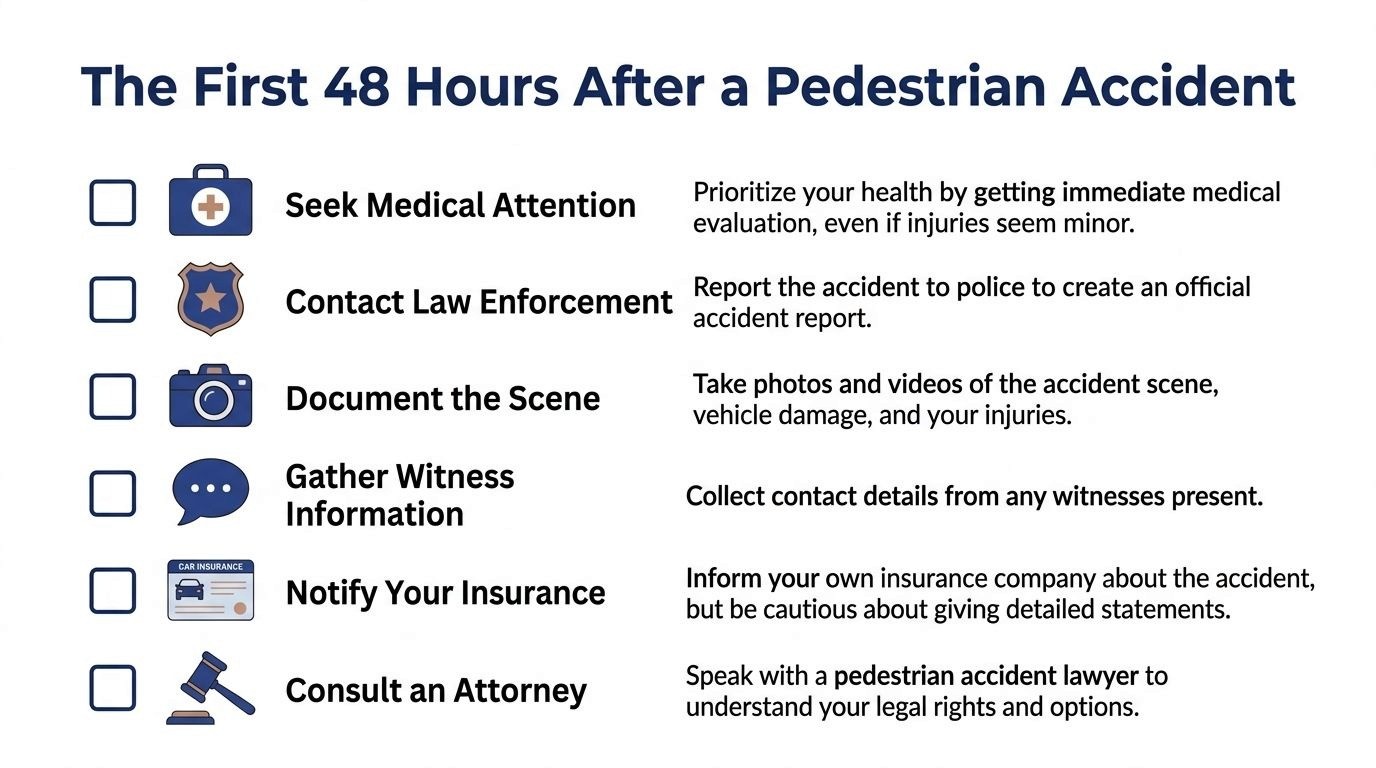
Get medical care first
If you can walk, that doesn't mean you're uninjured. Head trauma, internal injuries, and soft-tissue damage don't always announce themselves immediately. Early care protects your health and creates the first clean record, tying your symptoms to the crash.Make sure law enforcement responds
A police report isn't perfect, but it's a starting point. It identifies the parties, location, and early witness information.Photograph what won't look the same tomorrow
Take wide shots and close-ups. Include the vehicle, skid marks, debris, crosswalk lines, turn lanes, lighting, traffic signals, your clothing, and visible injuries.Collect witness names and numbers
Don't rely on the police to preserve every useful witness. Independent witnesses often make the difference when the driver changes their story.
What people often miss
The biggest mistake in this window is failing to preserve video. For a pedestrian-accident claimant, it's critical to preserve all nearby camera systems, including dashcams, traffic signals, and building security, within 24 to 48 hours, because municipal or private systems often overwrite footage on short cycles. Evidence-preservation letters can help secure chain-of-custody proof.
Ask yourself one question at the scene and again when you get home: “What cameras might have seen this?”
Nearby apartments, restaurants, parking garages, buses, and storefronts may have captured the impact or the seconds leading up to it. If you're trying to organize what to save, this guide on documenting the evidence needed for a personal injury claim in Florida is a practical place to start.
What not to do in those first calls
Don't give a recorded statement to the other driver's insurer. They call early for a reason.
Don't minimize your pain. The phrase “I'm okay” is repeated later.
Don't throw away damaged items. Shoes, phones, backpacks, and torn clothing can matter.
Don't post online about the crash. Defense lawyers read social posts as written and out of context.
A clean first 48 hours won't guarantee success, but a sloppy one gives the insurer room to argue doubt where none should exist.
Proving Fault in Common Pedestrian Accidents
Fault in a pedestrian case is rarely argued in the abstract. It gets argued through specifics. Where were you standing? What signal was showing? Which lane was the driver in? How dark was it? Did the driver stop? Did the vehicle keep going?
The broader safety picture matters because it shows how often these cases involve the same dangerous patterns. In 2023, 7,314 pedestrians were killed in traffic crashes in the United States, accounting for 18% of all motor vehicle crash fatalities, and about 74% occurred in dark conditions, while 25% were hit-and-run crashes, according to the verified pedestrian fatality data cited here. Those facts line up with what gets litigated every day: visibility, speed, failure to yield, and drivers fleeing responsibility.
The usual fact patterns and the proof that matters
Crash scenario | What the insurer may argue | Evidence that helps prove fault |
Crosswalk impact | You stepped out suddenly | Signal timing, witness statements, road markings, surveillance |
Left turn or right turn collision | The driver “didn't see” you | Intersection video, sightline photos, vehicle path analysis |
Nighttime roadway strike | Dark clothing or low visibility caused it | Lighting photos, vehicle speed evidence, headlight range, roadway design |
Hit and run | Identity or contact is uncertain | Debris, nearby cameras, plate fragments, business footage, police follow-up |
Why scene evidence changes the case
A pedestrian claim often turns on whether a driver had enough time and distance to react. Reconstruction work can use photographs, roadway geometry, impact points, and available video to estimate speed and movement. Where skid marks are present, experts may analyze the stopping distance. Where video exists, timing can become far more precise.
That is why early photographs matter more than people think. A phone image of a crosswalk signal, lane striping, or vehicle damage may later become the clearest evidence of breach.
The defense doesn't need to prove an alternative story perfectly. It only needs enough uncertainty to discount your claim.
The most common insurer tactics
Blame the pedestrian's position. If you weren't exactly where the insurer wanted you to be, it may exaggerate that point.
Use darkness as a shield. Night conditions don't excuse careless driving.
Treat a hit-and-run like a proof problem. It becomes one unless evidence is preserved early.
Reduce speed to reduce injury value. Lower-speed arguments often fuel causation disputes.
What works is disciplined proof. Not broad accusations. Not assumptions that “the driver got the ticket, so my case is done.”
How Florida's Comparative Fault Rule Affects Your Case
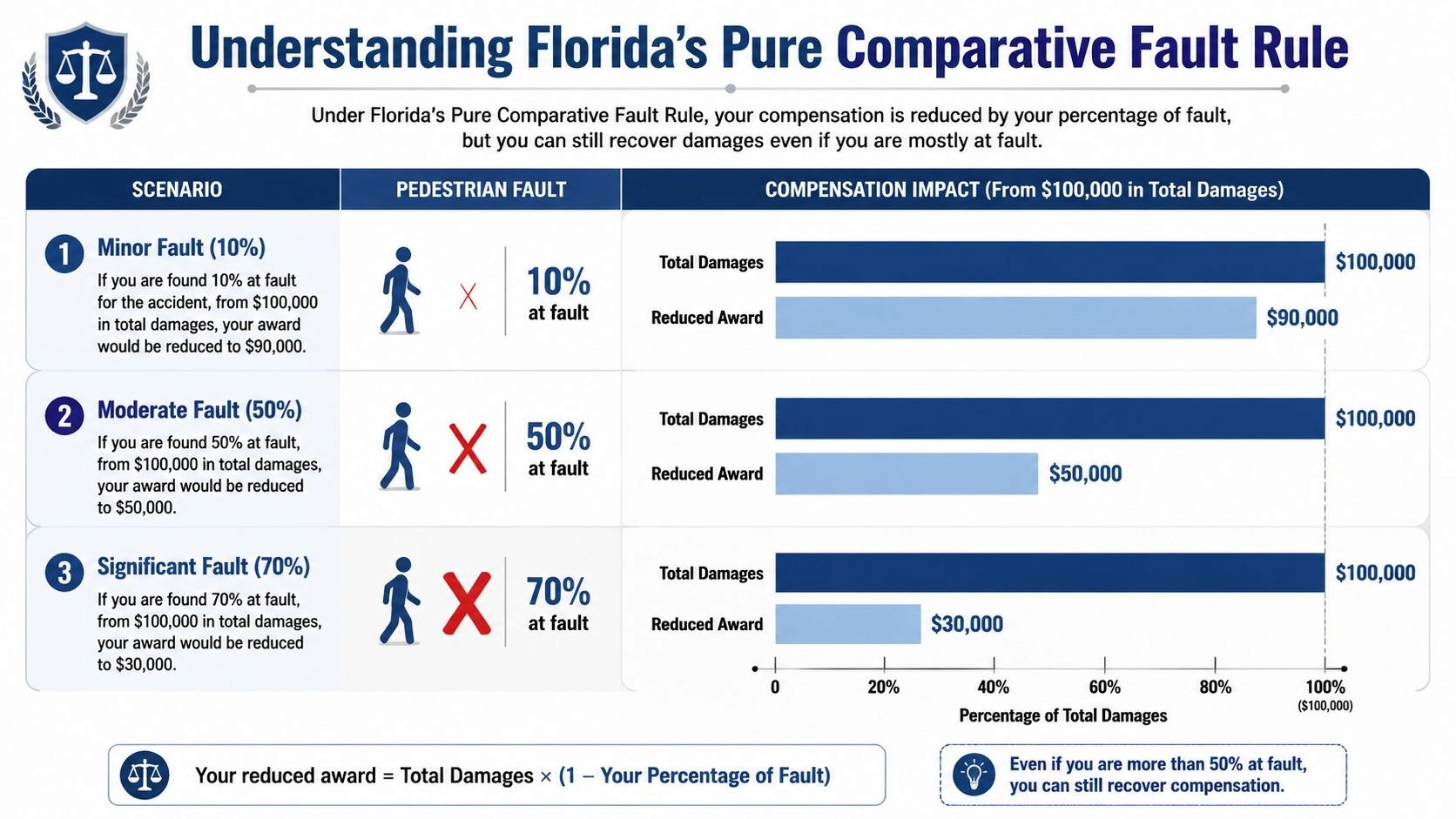
Many injured pedestrians hear the same line early: “You may have been partially at fault, so your case isn't worth much.” That's a negotiation tactic. Fault allocation matters in Florida, but partial fault does not automatically erase a claim.
The easiest way to understand it is to picture a pie chart of blame. One slice belongs to the driver. Another may be assigned to the pedestrian. Your share reduces your recovery.
What does that mean in practice?
If your damages are valued at a certain amount and an insurer argues you share blame, the fight isn't only about fault. It's about how much fault they can pin on you. That percentage directly changes the bottom line.
Where insurers push comparative fault hardest
Crossing location
The adjuster may focus on whether you were in a marked crosswalk, near one, or crossing elsewhere.Attention and visibility
They may argue about headphones, phone use, dark clothing, or movement into the roadway.Signal disputes
If the signal phase is unclear, they may assign equal blame.
How to push back effectively
The answer isn't an emotional argument. It's better evidence.
A strong response usually includes:
Scene documentation that fixes your location
Video preservation that shows timing and movement
Witness statements taken before memories drift
Accident reconstruction when speed, stopping distance, or sightlines are contested
If multiple people or entities may share responsibility, understanding joint and several liability in a Florida injury claim can also help frame the broader liability picture.
A fair evaluation starts with facts, not with the insurer's first percentage.
Calculating the Full Value of Your Claim
People naturally ask, “What is my case worth?” The better question is, “What will I keep?” Those are not the same number.
Gross value is the headline number. Net recovery is what reaches your pocket after medical bills, health insurer reimbursement claims, Medicare or Medicaid interest, case costs, and other deductions are accounted for. That's the hidden math many injured pedestrians don't see coming.
Gross value versus take-home value
Claim component | Why it matters | Common problem |
Medical expenses | Forms the backbone of economic damages | Bills may trigger reimbursement claims |
Lost income | Shows financial disruption from missed work | Informal work or inconsistent records can complicate proof |
Pain and suffering | Reflects human harm beyond invoices | Insurers often downplay it when records are thin |
Future care needs | Protects you if treatment continues | Early settlement can undervalue ongoing symptoms |
Lien resolution | Determines what you actually keep | Many people don't evaluate it until late |
The overlooked issue is lien exposure. Independent analyses show that in personal injury cases, more than a third of the gross settlement can be absorbed by third-party payer liens and fees, leaving the injured person with much less than expected, even when liability is clear.
Why liens change settlement strategy
A quick offer can look reasonable if you're only comparing it to current bills. It may look much worse once health insurance reimbursement, government program claims, or provider balances are factored in.
That changes negotiation in two ways:
The injury side of the case must be properly valued. Settling low hurts twice.
The lien side has to be managed aggressively. A lawyer who never addresses reductions may leave money on the table even after “winning” the claim.
A pedestrian accident claim should be evaluated from the back end forward. Start with what must be paid, then assess what recovery actually serves the client.
What works and what doesn't
What works
Building a complete medical record before serious negotiations
Identifying every potential lienholder early
Challenging unrelated or inflated charges
Negotiating balances before disbursement planning
What doesn't
Accepting a fast offer before treatment stabilizes
Assuming health insurance “handled it” and won't seek repayment
Looking only at the top-line settlement figure
Treating subrogation as a paperwork issue instead of a money issue
If your injuries involve multiple body systems, the value also depends on how clearly the records connect the crash to later symptoms. That is especially true with head injuries, spine complaints, and pelvic pain that can worsen over time.
Navigating the Pedestrian Claim Timeline in Florida
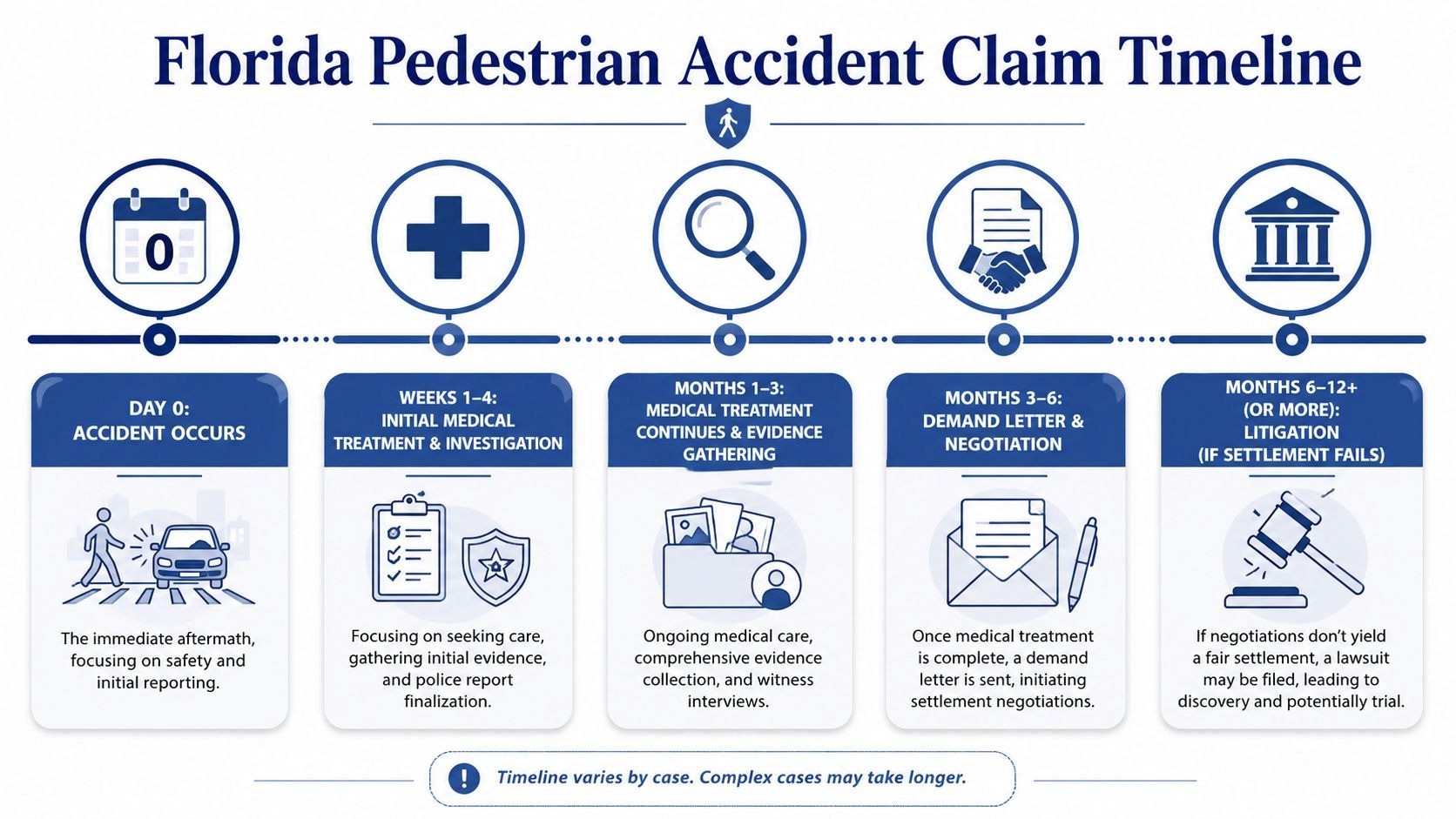
A pedestrian claim doesn't move in one straight line. It moves in phases, and each phase depends on the quality of the one before it. Clients are usually most frustrated when they expect speed, but the case still requires medical clarity, records, or proof of liability.
A realistic timeline starts with triage and investigation, not settlement talk.
A typical case path
Day 0 is about safety, emergency response, and preserving what can disappear. The police report starts. Medical records start. The evidence clock starts, too.
Weeks 1 through 4 often involve follow-up care, imaging, specialist referrals, and scene investigation.
Months 1 through 3 usually bring a clearer picture of the injury pattern. Witnesses are contacted. Surveillance footage is pursued. Employment records and billing records are gathered. This is also where weak cases often show their weaknesses.
When negotiation starts and when litigation follows
A demand package should be sent when the injuries, treatment course, and liability story can be presented coherently. That usually means the lawyer isn't just forwarding bills. The lawyer is explaining why the other side is responsible and why the damages are supported.
If the insurer responds reasonably, negotiation may resolve the case. If it doesn't, litigation may be necessary. Filing suit doesn't mean trial is guaranteed. It means the case enters a more formal process with discovery, sworn testimony, motion practice, and trial preparation.
Some delays protect the value of your case. Rushing before the evidence is ready usually helps the insurer, not the injured person.
The deadline that can't be missed
One timing rule is critical. The statute of limitations varies by state, and missing the applicable deadline can cause a court to dismiss the case. Florida cases need to be reviewed with that filing deadline in mind from the outset.
If you want a broader picture of how lawsuits unfold after settlement talks stall, this practical guide on how long car accident lawsuits take gives a useful comparison.
Patience matters. So does pace. The right timeline is not the fastest one. It's the one that maintains your advantage.
When You Need an Attorney for Your Pedestrian Claim
Some minor claims can be handled without a lawyer. Most pedestrian cases with meaningful injuries should not be. The reason is simple: the insurer has a trained process, a script, and a file strategy from the first phone call. You have pain, appointments, work disruption, and incomplete information.
The red flags are usually obvious once you know what to look for.
Signs you're already in a contested case
The insurer wants a recorded statement immediately. That usually means it is building defenses early.
Fault is being questioned. Once comparative fault enters the conversation, the case gets technical fast.
Your injuries are serious or evolving. Head, spine, pelvic, and multi-system injuries need organized proof.
There may be limited coverage. That raises pressure to document value and identify every possible source of recovery.
A quick offer arrives before your treatment picture is clear. Fast money is often discount money.
What an attorney changes
A lawyer doesn't just “handle paperwork.” In a strong pedestrian accident claim, counsel should preserve video, collect witness statements, organize the medical timeline, frame liability, and evaluate liens before settlement decisions are made.
That also includes knowing how insurers think. CAINE LAW represents injured people in Florida personal injury cases. It draws on defense-side experience to evaluate adjuster tactics, investigate liability disputes, and negotiate or litigate claims involving medical expenses, lost wages, and pain and suffering.
The practical trade-off
You can try to manage the claim yourself. People do. The problem is that most mistakes in pedestrian cases occur early and don't become apparent until later. A missed camera request, a bad recorded statement, an incomplete treatment narrative, or an ignored lien issue can cut thousands from the eventual recovery without any dramatic warning.
If liability is disputed, your injuries are significant, or the settlement math feels unclear, get legal advice before you commit to a number or a story the insurer can use against you.
If you were hit while walking in Florida and need a clear plan, CAINE LAW can review the facts, explain your options, and help you evaluate both the value of the claim and the amount you may take home after liens and fees. Consultations are free. In pain? Call Caine.