In Pain? Call Caine
How Long Do Car Accident Lawsuits Take: A Practical Timeline You Can Expect

5 Min read
By: Caine Law
Share
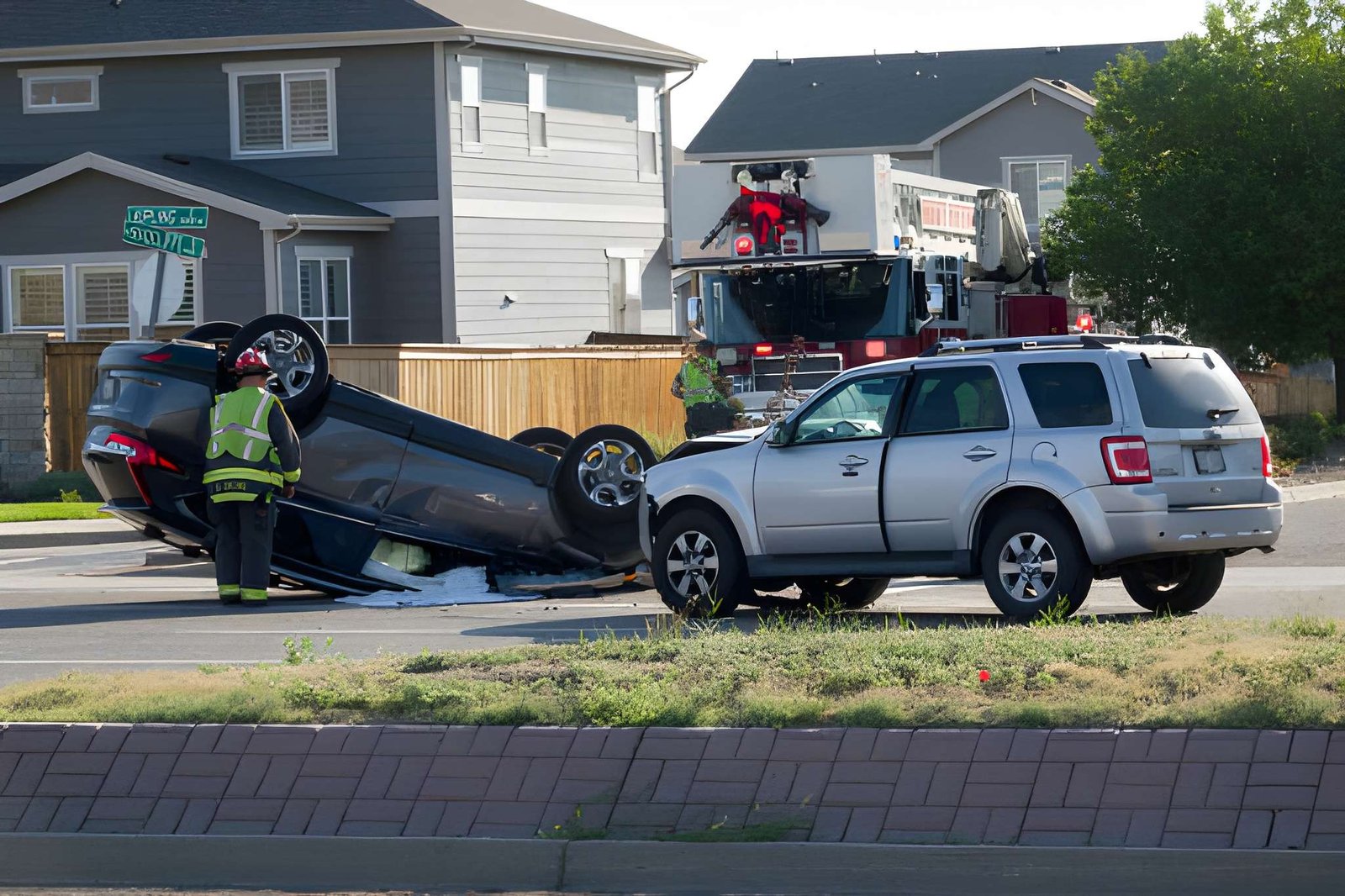
When you're recovering from a car accident, one of the first questions on your mind is almost always, "How long do car accident lawsuits take?" It's a fair question, and the honest answer is: it depends. A straightforward claim with minor injuries might wrap up in a few months, but a complex case that goes all the way to trial can easily take several years to see through to the end.
Your Car Accident Lawsuit Timeline: What to Expect
After a crash, everything can feel uncertain and overwhelming. You're juggling doctor's appointments, mounting medical bills, and a damaged car, all while trying to make sense of a confusing legal system. Getting a handle on the timeline can bring a sense of control back into your life when you need it most.
The time it takes to resolve a car accident lawsuit isn't random. It’s driven by specific, predictable factors. Think of it like a road trip. A short drive across town is quick and simple. A cross-country journey, on the other hand, involves more planning, more stops, and takes a lot longer to complete. Your case's timeline depends entirely on the unique "road map" of your situation.
Key Factors That Shape Your Timeline
A few core elements will have the biggest impact on how long your car accident lawsuit takes. Understanding these from the get-go helps set realistic expectations for the journey ahead.
The Severity of Your Injuries: This is, without a doubt, the most critical factor. Serious injuries mean longer medical treatment. We can't even begin to negotiate a fair settlement until you've reached what's called Maximum Medical Improvement (MMI)—the point where your doctors have a clear picture of your long-term prognosis.
How Clear Fault Is: If it’s obvious who caused the accident (like a rear-end collision), things tend to move much faster. When liability is disputed or shared, expect a much deeper and therefore longer investigation.
The Insurance Company's Tactics: Let's be frank: some insurance companies are notorious for dragging their feet. They use delay tactics, hoping you'll get frustrated and accept a lowball offer out of desperation. An experienced attorney knows how to spot these strategies and push back effectively.
The timeline for resolving these cases can vary dramatically, and it's almost always tied directly to how badly you were hurt. A minor fender-bender with a few scrapes might be settled in 6 to 12 months. A crash that results in broken bones could stretch the timeline to 12 to 24 months. Cases involving life-altering trauma, like amputations or traumatic brain injuries, frequently take 24 to 36 months or even longer to resolve. You can explore more about average settlement times for different injuries to see how your situation might compare.
To give you a clearer picture, here's a quick breakdown of what you can generally expect.
Estimated Timelines Based on Injury Severity
This table provides a quick overview of how the severity of injuries directly impacts the expected duration of a car accident claim, from initial filing to resolution.
Injury Severity | Typical Timeline to Resolution |
Minor (e.g., cuts, bruises) | 6 to 12 months |
Moderate (e.g., broken bones) | 12 to 24 months |
Severe (e.g., TBI, amputation) | 24 to 36+ months |
As you can see, the timelines expand significantly as the injuries become more serious. This isn't about dragging things out; it's about taking the necessary time to ensure you get the full and fair compensation you're entitled to.
The image below gives you a visual of how these timelines play out.
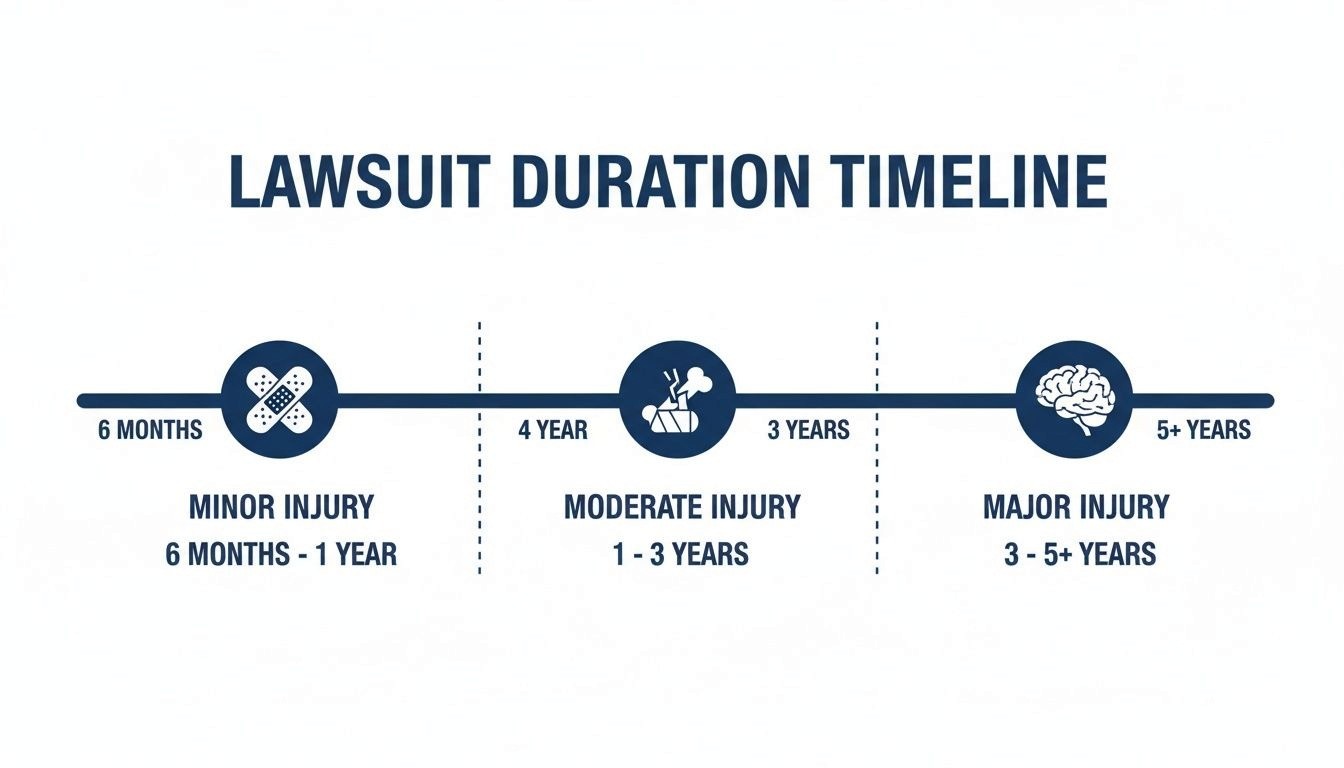
It's clear that the more significant the injury, the more time is needed to build a rock-solid case and fight for the compensation you truly deserve. This guide will walk you through each stage of the process, explaining why patience is often your greatest ally. If you're feeling lost or overwhelmed by all of this, we're here to help. In pain? Call Caine. Contact Caine Law today at 786-206-8726 to get the legal support you deserve. Don’t wait to protect your rights.
The Journey From Accident Claim to Settlement Check
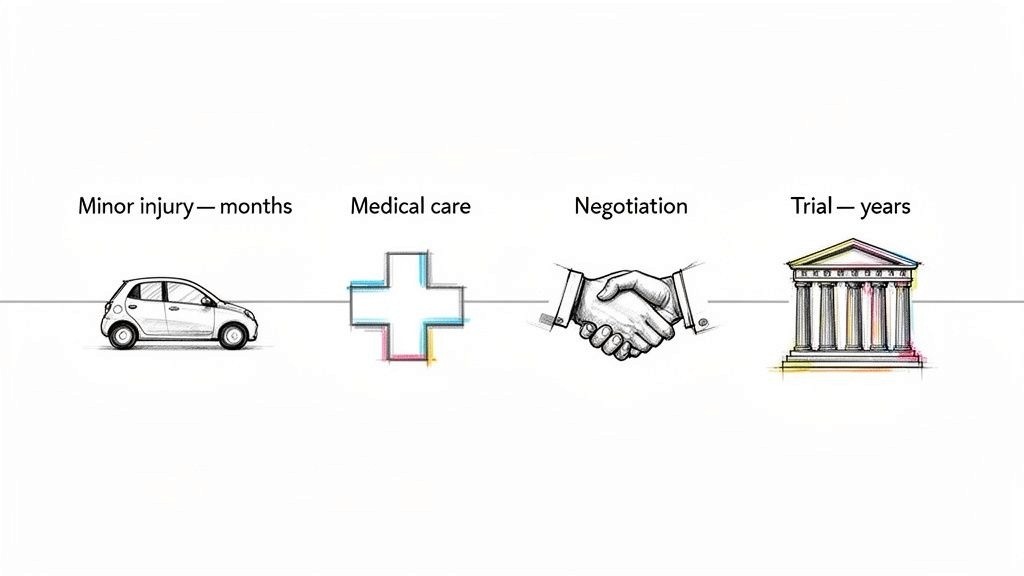
The legal process after a car accident can feel overwhelming. But when you know the path ahead, that anxiety starts to fade, replaced by a sense of control. It’s best to think of your case as a journey with a clear roadmap, marked by distinct milestones from the crash scene to the moment you get your settlement.
Each stage has a purpose, and every step we take is designed to build the strength and value of your claim. Let’s walk through this journey together, so you know exactly what’s happening and why it matters.
Step 1: Medical Treatment and Case Investigation
Right after an accident, nothing is more important than your health. Getting medical attention right away is critical for your recovery, but it also creates the official record we need to link your injuries directly to the crash. While you focus on getting better, our team gets to work building the foundation of your case.
This is the deep-dive phase. We start gathering all the critical evidence, which usually includes:
The official police report.
Photos and videos of the accident scene, vehicle damage, and your injuries.
Statements from any witnesses who saw what happened.
Your complete medical records and bills to prove the full extent of your injuries and treatment.
Following your doctor’s orders is essential. For certain injuries, that might mean exploring options like chiropractic care after a car accident.
This initial phase lays the groundwork for everything that follows. A thorough investigation and complete medical file are the building blocks of a powerful claim, making it much harder for insurance companies to dismiss or downplay what you’ve been through.
Step 2: The Demand Letter and Negotiations
Once you’ve reached what’s called Maximum Medical Improvement (MMI), we have a clear picture of your long-term prognosis. This is a crucial milestone. Settling a case before we know what your future medical needs look like would be a huge mistake.
With a complete accounting of your damages, your attorney will draft a comprehensive demand letter. This is far more than just a request for money; it’s a detailed legal argument. It lays out the facts, proves the other driver was at fault, and presents a full list of your damages—from medical bills and lost wages to pain and suffering.
After we send the demand, the negotiation phase kicks off. Insurance adjusters typically respond within 30 to 45 days, starting a back-and-forth process that can last anywhere from one to three months. The initial treatment and investigation phase can take 1 to 8 weeks on its own. You can get more details on how these timelines work by reading our guide on how long it takes to settle a car accident claim.
Step 3: Reaching a Settlement Agreement
The whole point of negotiation is to secure a fair settlement without ever setting foot in a courtroom. A good attorney knows the tactics insurers use to lowball victims and is prepared to counter them with hard evidence and strong legal arguments. The good news? The vast majority of car accident cases—well over 95%—are resolved at this stage.
When the insurance company makes a fair offer, and you decide to accept it, your case moves toward the finish line. This is the moment we’ve been working toward, where we’ve reached an agreement on the compensation you deserve for your losses.
Step 4: Finalizing and Receiving Your Check
Once everyone agrees to the settlement amount, there are a few final administrative steps. You'll sign a formal settlement and release agreement, which officially closes your claim in exchange for the payment. From there, the insurance company sends the settlement check to your attorney's trust account.
This last part of the process can take a few weeks. After the check clears, your attorney will pay off any outstanding medical liens or bills directly from the settlement funds. Once all those obligations are handled, the remaining money is disbursed to you. It's a clean resolution, leaving you free to finally move forward.
If you’ve been hurt and are facing this long road, you don’t have to do it alone. Call Caine Law today at 786-206-8726 for trusted guidance and a team ready to fight for you.
When Your Claim Becomes a Lawsuit
Most car accident cases settle out of court, but what happens when the insurance company just won't budge on a fair offer? This is the moment your claim has to level up into a formal lawsuit. It’s a major shift, moving from informal back-and-forth negotiations into the official, rule-driven world of the court system.
It’s not a sign that something went wrong; it’s a powerful strategic move. Filing a lawsuit tells the insurance company you’re serious and fully prepared to prove the real value of your case in front of a judge and jury. This transition is also why a car accident lawsuit can take a good deal of time—it’s a much more deliberate and thorough process than simply settling.
Filing the Complaint and Starting the Clock
The lawsuit officially kicks off when your attorney files a Complaint with the court. This is the legal document that formally lays out your case against the at-fault driver. It explains what happened, the injuries you suffered, and the compensation you’re seeking for your damages.
Once it's filed, the person you’re suing (the defendant) is officially "served" with the complaint and a summons. From there, they have a strict deadline to file a formal response, usually called an "Answer." This exchange officially starts the litigation process, a phase that can easily add a year or more to your timeline.
The Discovery Phase: Where Evidence Is Exchanged
After the first round of paperwork, the case moves into what’s called discovery. This is usually the longest, and often most important, part of a lawsuit. It’s a formal process where both sides are required by law to share all their relevant information and evidence with each other. The whole point is to make sure there are no surprises at trial, so everyone knows the strengths and weaknesses of the case.
Discovery relies on a few key tools:
Interrogatories: These are written questions one side sends to the other, which must be answered under oath. For example, they might be asked to list every witness they know of or describe their version of the crash in detail.
Requests for Production: This is a formal request for documents. We might ask for the other driver's cell phone records, vehicle maintenance logs, medical records, or photos.
Requests for Admission: These are simple true/false statements the other party has to either admit or deny. This helps us lock in the facts that aren't really in dispute.
Depositions: This is out-of-court testimony given under oath. Attorneys get to question witnesses, the defendant, and you, with a court reporter transcribing every word.
This evidence-gathering stage is where your attorney builds your case, brick by brick. A single answer in a deposition can completely change the direction of a case and give us incredible leverage. To get a better feel for this crucial step, you can learn more about what happens in a deposition in our detailed guide.
The discovery process is designed to force transparency. It makes both sides lay their cards on the table, which is often what finally paves the way for a fair settlement long before anyone has to step foot in a courtroom.
Mediation and Pre-Trial Motions
Before a case ever gets in front of a jury, Florida courts almost always require both sides to try mediation. Think of it as a formal settlement conference guided by a neutral third-party mediator. The mediator’s only job is to help the two sides find some common ground and hash out a resolution everyone can agree on.
Mediation is a huge checkpoint in the lawsuit timeline. It's one last, structured chance to settle the case without the expense, stress, and uncertainty of a trial. An experienced trial lawyer knows how to use all the evidence we dug up during discovery to create maximum pressure during this negotiation.
If a fair settlement still isn’t on the table, we keep moving toward trial. It's a path we are always prepared to take. If you’re facing a long legal battle, you need a team that’s ready for the fight. In pain? Call Caine.
Factors That Speed Up or Delay Your Lawsuit
No two car accident cases ever follow the exact same timeline. It helps to think of your case like a car on a road trip. Some things act like a green light on an open highway, while others are like hitting a sudden traffic jam that brings everything to a halt.
Getting a handle on these variables is the key to setting realistic expectations. When you understand what can push a case forward or drag it out, you can better appreciate the strategy involved in getting you to the finish line.
What Pushes Your Case Forward?
Certain things can definitely clear the path for a faster resolution. When these elements line up in your favor, the journey toward a fair settlement gets a whole lot shorter and smoother.
Clear-Cut Fault: When there’s little to no argument about who caused the crash, things move much quicker. Solid evidence like a police report citing the other driver, traffic camera footage, or multiple eyewitnesses makes it tough for the other side to fight about who’s to blame.
Airtight Documentation: Having every medical bill, record, and receipt organized and ready to go streamlines the whole process. A clean, well-documented file leaves very little room for an insurance adjuster to poke holes in your claim.
An Experienced Trial Attorney: This is a big one. Insurance companies keep tabs on lawyers. They know who will settle for a lowball offer to avoid a fight and who is ready and willing to take a case all the way to a jury. A lawyer with a reputation for being trial-ready forces the insurance company to negotiate fairly and quickly.
What Slams the Brakes on Your Case?
On the other hand, a few common roadblocks can slow your lawsuit to a crawl. These issues demand more time for investigation, negotiation, and legal maneuvering, often stretching the timeline by months or even years.
One of the most significant factors is the severity of your injuries and how long your recovery takes. For example, knowing how long whiplash takes to heal gives us a better idea of the case's timeline. We almost always advise waiting until you’ve reached what’s called Maximum Medical Improvement (MMI). This ensures your final settlement covers everything, including any future medical needs, but it does mean we can't rush the process.
The single biggest delay in most car accident lawsuits is a dispute over fault or the severity of the injuries. When an insurance company decides to fight on these points, it triggers a much deeper and more prolonged legal battle.
Here are the most common hold-ups we see:
Disputes Over Liability: If the other driver denies they were at fault or, worse, tries to blame you, the case immediately gets more complicated. This forces us to dig deeper, sometimes even hiring accident reconstruction experts to prove what really happened.
Multiple Parties Involved: Crashes with several vehicles or responsible parties (like a commercial trucking company and its driver) create a tangled mess. We have to negotiate with multiple insurance companies, and each one is trying to pin the blame on someone else.
A Stubborn Insurance Adjuster: At the end of the day, insurance companies are for-profit businesses. Their primary goal is to pay out as little as possible. Some adjusters will use delay tactics, making one tiny offer after another or demanding mountains of paperwork, hoping you’ll get frustrated and take less than you deserve.
Think of these factors as either accelerators or brakes on your case's timeline. Some things help us get you to a fair resolution faster, while others are roadblocks we have to navigate carefully.
Factors Influencing Your Lawsuit Timeline
Case Accelerators (Factors That Speed Up Resolution) | Case Brakes (Factors That Slow Down Resolution) |
Undisputed Fault: Evidence clearly shows the other party was at fault. | Disputed Fault: The other side denies responsibility or blames you. |
Organized Records: All medical and financial documents are complete. | Serious or Complex Injuries: Waiting for you to reach Maximum Medical Improvement. |
Straightforward Injuries: Your injuries are well-understood with a clear recovery path. | Multiple At-Fault Parties: Dealing with several defendants and their insurers. |
Proactive Attorney: Your lawyer is known for being aggressive and trial-ready. | Uncooperative Insurance Adjuster: The insurer uses delay tactics to wear you down. |
Clear Insurance Coverage: The at-fault party has sufficient insurance to cover damages. | Pre-existing Conditions: The defense argues your injuries weren't caused by the crash. |
Navigating these delays is exactly what a good legal team is for. We know the insurance companies' playbook and how to counter their tactics to keep your case moving forward.
If you're dealing with a complicated claim and feel like you’re hitting one roadblock after another, don’t try to handle it alone. In pain? Call Caine.
Critical Florida Deadlines You Cannot Miss
In the world of Florida law, time isn't on your side. Think of the legal system as having a series of countdown clocks, and the main one starts ticking the second your accident happens. These aren't just suggested timelines; they are hard-and-fast deadlines. Missing one can slam the door shut on your right to compensation, no matter how clear-cut your case might be.
Getting a handle on these dates is the first, most crucial step to protecting yourself. While a good attorney will manage this for you, knowing the rules yourself empowers you to make smart, quick decisions when it matters most.
The 14-Day Rule for Medical Treatment
Florida is a no-fault state, which means your own Personal Injury Protection (PIP) insurance is your first line of defense for medical bills. But there’s a catch. To even use your own benefits, you have to get medical treatment from a qualified provider within 14 days of the crash.
Wait until day 15, and you could forfeit the right to use your PIP coverage entirely.
This rule is absolute, no exceptions. It doesn’t matter how badly you were hurt or why you delayed. The law is designed to push people toward an immediate medical check-up and cut down on fraudulent claims, which makes getting seen by a doctor an urgent priority.
The Statute of Limitations to File a Lawsuit
The 14-day rule is for your initial medical care, but a much bigger deadline governs your right to file a lawsuit against the at-fault driver. This is the Statute of Limitations, and it’s basically an expiration date on your entire legal claim.
Florida recently changed this law, so the deadline now depends on when your accident happened:
For any accident that took place on or after March 24, 2023, you have two years from that date to file a lawsuit.
If your accident was before March 24, 2023, the old four-year deadline still applies to your case.
This is one of the most unforgiving rules in the entire legal system. If you try to file a lawsuit even a single day late, the court will almost certainly throw your case out. You'll be left with no way to recover a dime for your injuries.
You can dive deeper into this topic in our guide to the personal injury statute of limitations in Florida.
These timelines show exactly why you can't afford to just wait and see. Evidence gets lost, witnesses' memories fade, and your legal rights can simply expire. The best thing you can do after a crash is talk to an attorney right away to keep all your options on the table. Don't let a technicality on the calendar cost you the justice you deserve.
The legal system has a lot of moving parts, and these deadlines are just the start. If you're hurt and worried about the clock ticking, we’re here to bring clarity and take action for you. In pain? Call Caine.
Taking Control of Your Case to Maximize Your Recovery
We know how frustrating it is to wait while the insurance company drags its feet. Those delays aren't accidental; they're a tactic designed to wear you down. An experienced legal team doesn't just sit back and react to these roadblocks. We build a case from day one that’s designed to overcome them.
Our whole approach is built around proactively countering the insurance company's game plan to get you the full and fair compensation you’re owed. It starts with a deep, front-loaded investigation. While you focus on healing, our team is already on the ground gathering critical evidence, tracking down witnesses, securing traffic camera footage, and bringing in accident reconstruction experts when the details get complicated. This builds a powerful foundation that makes it much harder for insurers to argue about who was at fault.
We Handle the Insurance Company, So You Can Heal
One of the biggest sources of delay is the endless back-and-forth with aggressive insurance adjusters. The moment you hire us, we take over all communications. It’s our job to shield you from their high-pressure tactics. This immediately stops them from trying to trick you into a recorded statement that they can twist and use against you later. It also sends a clear signal: your claim is now being handled by serious legal professionals who won't be pushed around.
We then get to work meticulously documenting every penny of your damages. This isn't just about adding up your current medical bills and lost paychecks; it’s about calculating the true, long-term cost of the accident.
Future Medical Needs: We coordinate with your doctors and other medical experts to paint a clear picture of the long-term treatment you'll likely need.
Lost Earning Capacity: If your injuries have permanently affected your ability to work, we calculate that devastating financial loss over your lifetime.
Pain and Suffering: Most importantly, we build a compelling narrative to show the very real, human cost of your injuries and how they've impacted your quality of life.
Preparing for Trial From Day One is Our Secret Weapon
Here's something most people don't know: the secret to getting a faster, fairer settlement is preparing every single case as if it's going to trial. Insurance companies are all about data. They keep detailed files on law firms and know which attorneys will cave and accept a lowball offer just to avoid a fight. They also know which ones are ready and willing to go all the way to a jury verdict.
Our reputation as trial-ready attorneys creates leverage you can't get any other way. When an insurer knows we won't back down and are fully prepared to present your case in court, they are far more motivated to negotiate a fair settlement. It's often cheaper and less risky for them than facing us in front of a jury.
This strategy completely flips the script. Instead of you being stuck on their timeline, they are forced to react to the strength and seriousness of our case. We handle every complex legal detail so you can put your energy where it belongs, recovering from your injuries. Our goal is to manage this process efficiently, maximize what you recover, and give you back your peace of mind.
If you are tired of the delays and ready to take action, our team is here to fight for you. In pain? Call Caine.
A Few Common Questions We Hear
Navigating a car accident lawsuit can feel like a marathon, and it’s completely normal to have questions about the road ahead. We’ve found that giving clients clear, honest answers helps them feel more confident and in control. Here are a few of the most frequent questions we get about how these timelines play out.
Should I Just Take the First Offer to Get Paid Faster?
While it’s tempting, accepting the first settlement offer from an insurance company is almost always a mistake. It might seem like a shortcut to getting money in your pocket, but it’s really the fastest route to an unfair outcome.
Insurers are counting on you being stressed and under financial pressure. They purposefully make lowball initial offers, hoping you’ll take the quick cash and close the case for far less than it’s truly worth. That first number almost never accounts for future medical bills, lost earning potential, or the full extent of your pain and suffering. Rushing it means leaving money on the table—money you are legally entitled to. Our job is to calculate the real, long-term value of your claim and make sure you get every penny you deserve.
Is There Anything I Can Do to Help Speed Up My Case?
Absolutely. Your cooperation is one of the biggest factors in keeping your case moving along without unnecessary hiccups. The best thing you can do is be an active, engaged partner in your own recovery and your legal case.
You can help us prevent delays by:
Showing up for all your scheduled medical appointments.
Following your doctor's treatment plan to the letter.
Keeping all your accident-related paperwork organized and easy to find.
Responding as quickly as you can when our office requests information.
Does Filing a Lawsuit Automatically Mean We’re Going to Trial?
Not at all. In reality, more than 95% of personal injury cases settle long before they ever see the inside of a courtroom.
Filing a lawsuit is a critical strategic step. It sends a clear message to the insurance company that you are serious. More importantly, it officially kicks off the "discovery" process, where we legally require them to exchange evidence with us. This is often the exact motivation the insurer needs to start negotiating a fair settlement, simply to avoid the massive risk and expense of a trial. We prepare every single case as if it's going to court, but our goal is always to get the best possible outcome for you, whether that comes from a settlement or a jury verdict.
At CAINE LAW, we believe an informed client is an empowered client. We’re here to guide you through every stage of this complex process, making sure your questions get answered and your rights are protected every step of the way. If you've been injured and are wondering what to expect from a car accident lawsuit, let our experience work for you. In pain? Call Caine.