In Pain? Call Caine
What Is Joint and Several Liability? A Florida Injury Claim Guide

5 Min read
By: Caine Law
Share

You're hurt, your car is wrecked, and the insurance calls start before you've even figured out which doctor you're supposed to see next. Then you learn something else: more than one person or company may have caused the crash.
That's when people ask a very practical question. Who pays for my injuries?
If you're dealing with a Florida accident, that question matters more than is widely understood. The answer affects whether your medical bills, lost income, and other damages are fully recoverable or whether part of the loss may fall on you if one of the responsible parties can't pay.
After the Crash: Who Is Responsible for Your Injuries
A Florida highway crash rarely feels simple from the inside. One driver brakes late. Another swerves. A delivery truck may have been following too closely. Sometimes, road design, a broken signal, or poor maintenance also becomes part of the story.
When you're the injured person, the scene feels chaotic, but the legal issue becomes very focused. If several people share fault, who is responsible for paying for the harm they caused?
That’s where the concept of joint and several liability comes in. It is the traditional framework many people think of when several wrongdoers cause one injury, but Florida now uses a different rule in most negligence cases.
Why this question matters so much
It is often assumed that the court decides who was careless and then somebody pays the full amount. That isn't always how it works.
In a multi-party crash, you may be dealing with:
A negligent driver who caused the first impact
A company vehicle owner whose employee was on the road
A maintenance issue that made a vehicle unsafe
A property or roadway condition that made the collision worse
Those facts can turn one injury claim into several separate collection problems.
A good liability case isn't only about proving who made mistakes. It's also about proving who can legally be held liable for each part of your loss.
That's one reason early steps matter. If you're still in the first days after a wreck, this guide on what to do when accidents happen, and the legal steps that follow, can help you protect the claim before evidence starts disappearing.
Where people get confused
Clients often mix up two different questions:
Question | What it means |
Who was at fault | Who helped cause the crash |
Who must pay | Who can be required to cover your damages |
Those are related, but they are not identical. A person can be partly at fault yet not end up paying everything. That distinction is the heart of this area of law.
The Classic Rule Joint and Several Liability Explained
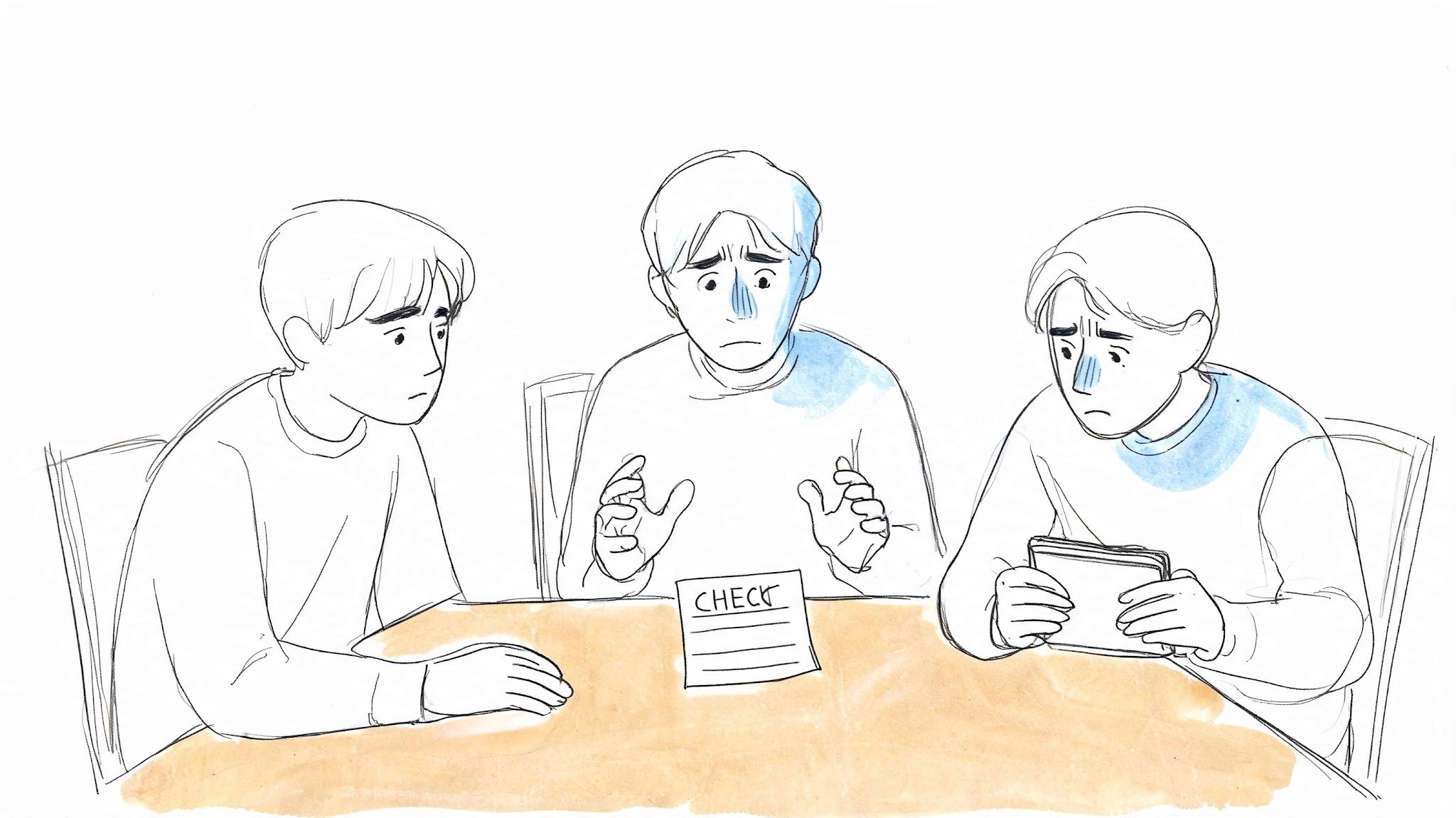
A group dinner is a useful way to illustrate the old rule.
Three friends share a meal. The bill comes as one total. When it is time to pay, one person cannot cover his share. Under a strict group-payment rule, the restaurant could demand the full amount from either of the other two, even if one of them ordered very little.
That is close to how traditional joint and several liability worked in injury cases.
What does joint and several liability mean
The phrase combines two ideas:
Jointly means the defendants can be treated as one group for payment purposes.
Severally means each defendant can also be pursued alone.
If a jury awards damages for one injury and several defendants are legally responsible, the plaintiff does not have to chase each person for only a slice. The plaintiff can seek full payment from the defendant who has insurance, assets, or both.
Why the classic rule existed
The old rule was built to protect the injured person from collection risk.
That matters more than it may seem at first. Winning a case on paper is not the same as getting a check. If one wrongdoer is uninsured, bankrupt, or disappears, a rule that limits each defendant to only a narrow share can leave part of the judgment unpaid. Joint and several liability shifted that risk away from the victim and onto the defendants.
Defendants often objected for the same reason plaintiffs valued the rule. A defendant with money could be required to pay far more than that defendant's percentage of fault, then pursue the others later.
Why this concept matters before you get to Florida law
This older rule is the baseline. Once you understand it, Florida's system makes more sense.
Under the classic model, your lawyer's first question is often, “Can we prove multiple parties contributed to one injury?” Under Florida's modern approach, a second question becomes just as important: “Which of those parties can pay their own share?” That difference can change case value, settlement strategy, and the math of recovery.
A related term you may hear
You may also hear the phrase indivisible injury.
That means the harm cannot realistically be separated into neat parts by the defendant. A multi-vehicle pileup is a good example. If several careless acts combine to cause one serious back injury or one traumatic brain injury, the law may treat that harm as a single injury even though more than one person helped cause it.
How Florida Law Changes the Rules on Shared Fault
A Florida crash can involve more than one careless party, yet that does not mean you can collect the full amount of your damages from whichever defendant has the deepest pocket. In most ordinary negligence cases, Florida generally applies several liability, meaning each defendant is usually responsible only for that defendant’s percentage of fault.
Florida’s shared-fault rule also applies to the injured person. If you are found partly at fault, your recovery may be reduced by your percentage of fault. If you are found more than 50% responsible for your own harm, you generally cannot recover damages in a covered negligence case.
What does that mean in plain English?
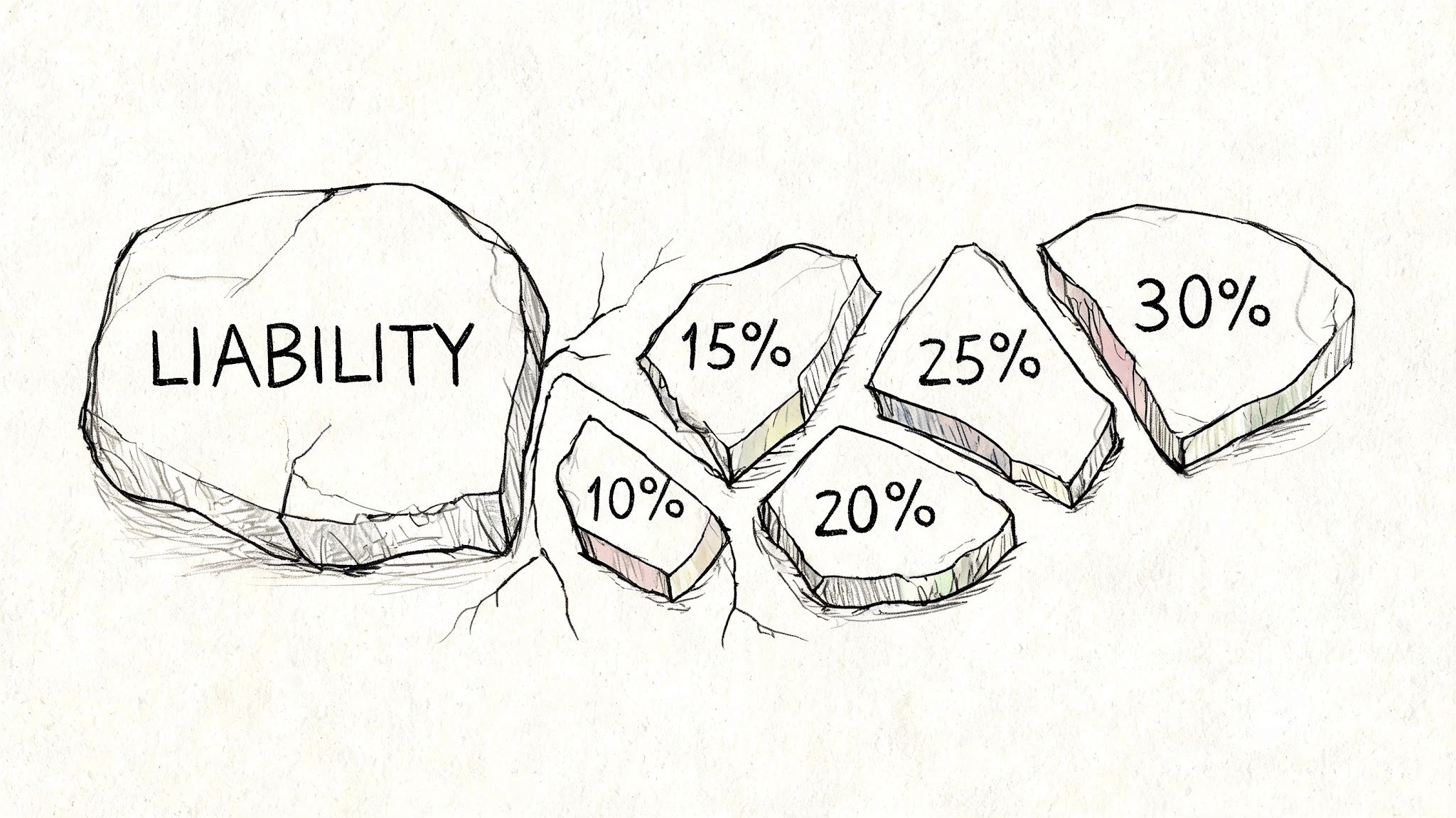
Start with the verdict. A jury decides your total damages, then assigns percentages of fault among the responsible people or businesses. Under Florida's general rule, each defendant pays only that assigned slice.
A simple way to picture it is a restaurant bill split by percentage rather than one person covering the whole table. If one defendant is 20% at fault, that defendant usually pays 20% of the damages, not 100%.
That single rule changes the financial risk in a Florida injury case.
The risk shift that affects your recovery
Under the older joint and several model, the shortfall from an insolvent defendant could often be collected from another defendant. In ordinary negligence cases, Florida’s system often leaves the collection risk with the injured person when one responsible defendant cannot pay.
That matters more than many people expect.
If one at-fault driver has a small policy, no assets, or files for bankruptcy, another defendant usually does not have to cover the missing amount just because your medical bills are high. So your case is not only about proving fault. It is also about identifying defendants who can pay their own shares and documenting damages in a way that supports the highest defensible allocation of fault against collectible parties. That practical issue comes up in many cases discussed in a Florida auto accident settlement guide.
Why Florida's rule changes strategy
In a pure several liability state, fault percentage is money.
A shift from 20% fault to 40% fault for one defendant can double what that defendant owes. That makes accident reconstruction, corporate responsibility evidence, and witness testimony more than academic points. They can directly affect how much of a judgment is realistically recoverable.
It also changes the settlement analysis. A defendant with clear liability and solid insurance may be more valuable to your recovery than a more blameworthy defendant who cannot satisfy a judgment. For injured clients, that is often the hardest part of Florida law to accept because legal fault and collectible dollars are related, but they are not always the same thing.
Florida compared with other systems
System | Basic effect |
Pure joint and several liability | One defendant may be required to pay the full judgment |
Modified systems | Full-share exposure may apply only if a defendant crosses a fault threshold |
Florida's general several liability approach | Each defendant usually pays only that defendant's own share |
So if you read a national article defining joint and several liability, be careful. The definition may be accurate in the abstract, but it still gives the wrong expectation for a Florida case.
Are there exceptions
Yes. The rule is not absolute.
Some claims can fall outside the ordinary negligence framework, including certain intentional torts or statutory causes of action. That is why claim selection matters. Two cases can arise from the same crash facts and still present different collection rules depending on the legal theories pleaded. Florida’s comparative-fault statute does not apply the same way to actions based on intentional torts, and some statutory claims have their own liability rules.
In Florida, proving that several parties contributed to your injury is only half the job. The other half is proving how fault should be divided and whether each responsible party can pay that share.
Who Pays What: A Florida Accident Example
A Florida case often turns on a simple but painful question: if more than one person caused the crash, who writes the checks?
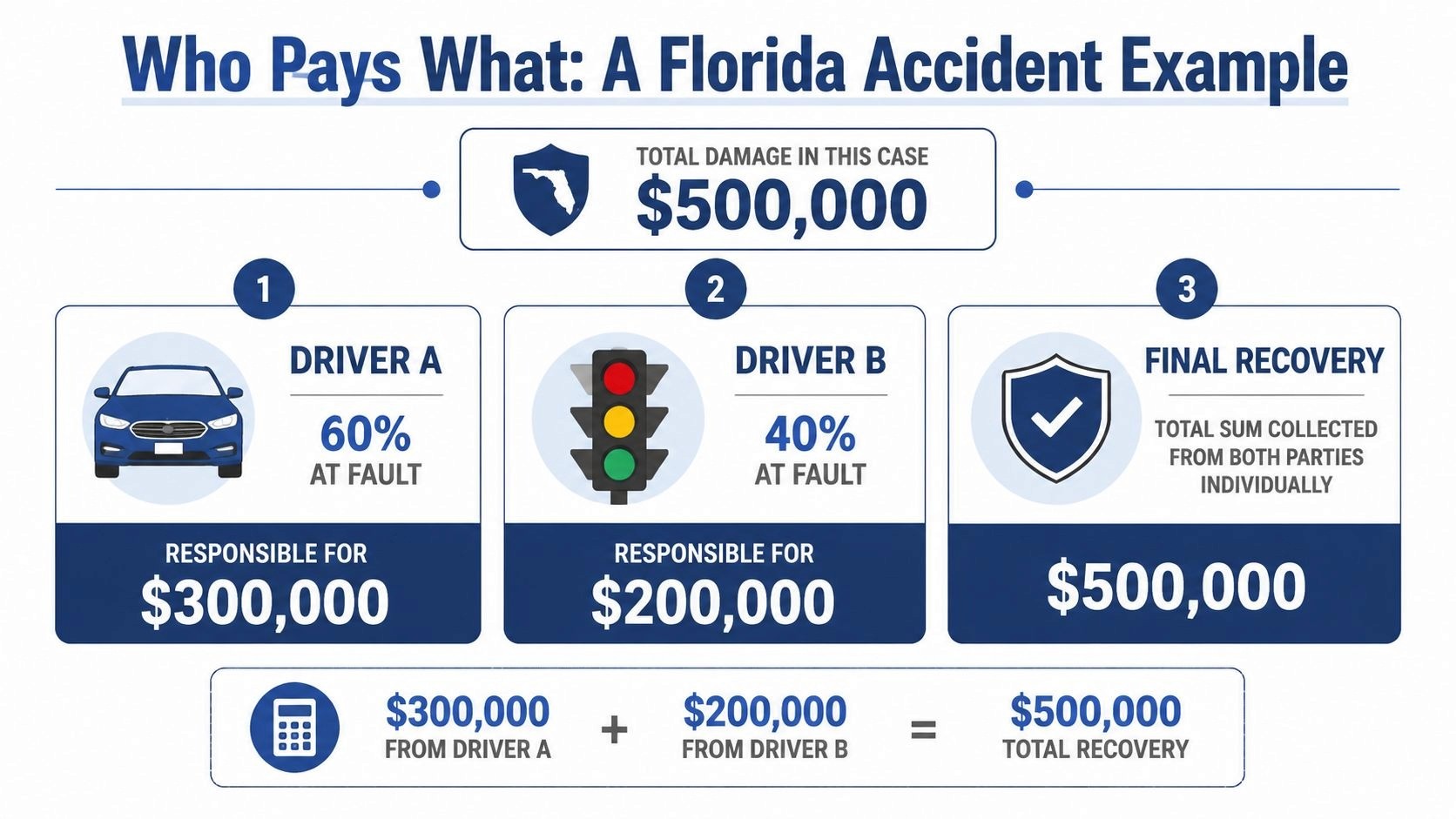
Put real numbers to it. Say an intersection collision leaves you with $500,000 in total damages, including medical bills, lost income, and pain and suffering. A jury agrees that two other drivers caused the crash and assigns fault between them.
Example one with two at-fault parties
Start with the clean version.
Driver A is 60% at fault
Driver B is 40% at fault
Your total damages are $500,000
In Florida, the usual math is tied to each defendant's percentage of fault:
Party | Fault share | Amount owed |
Driver A | 60% | $300,000 |
Driver B | 40% | $200,000 |
That looks straightforward on paper. Florida's pure several liability system treats the verdict like a split restaurant bill. Each person pays only their assigned portion, not the entire table's tab.
What happens if one defendant cannot pay
If Driver A owes $300,000 but carries low insurance and has no meaningful assets, Driver B usually does not have to cover Driver A's unpaid share. You may recover Driver B's $200,000, yet still fall short of the full verdict.
So a court can say you are owed $500,000, while the amount you can realistically collect is much lower.
That gap is what national articles often miss. In Florida, fault allocation affects recovery in practical ways. A 60% defendant with no coverage may be worth less to your case than a 25% defendant backed by a large commercial policy.
Why does this math change the case strategy?
This is not just accounting. It shapes how your lawyer investigates the claim.
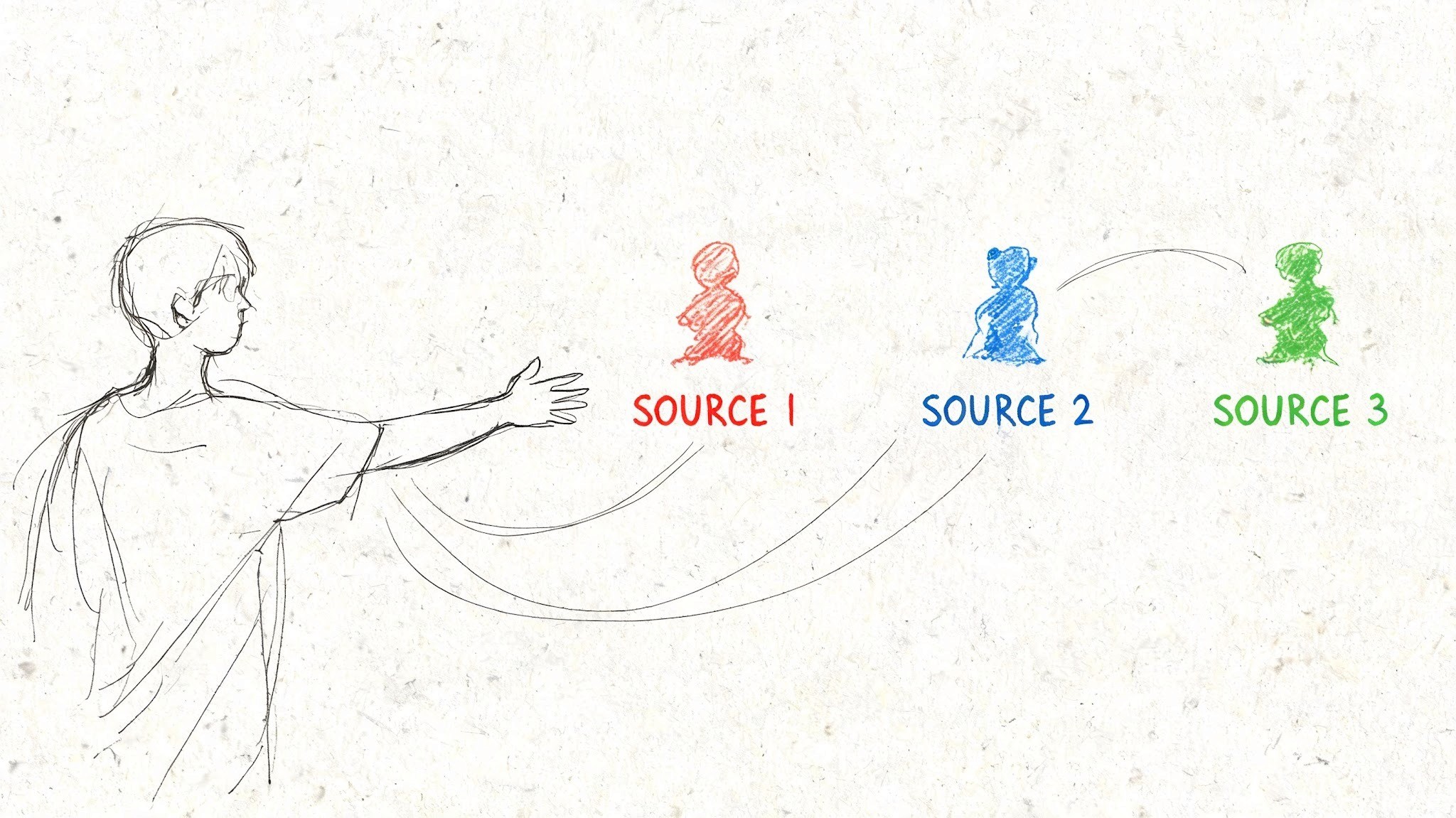
A strong Florida injury case asks two questions at the same time. First, how much harm did the crash cause? Second, which defendant can pay the share assigned to them? That is one reason lawyers look hard at every possible source of insurance, every employer relationship, every vehicle owner, and every business that may share legal responsibility.
If you want a broader explanation of how damages are calculated before fault percentages are applied, this Florida auto accident settlement guide gives helpful background.
The question many clients ask next
Clients often ask, “Why not just sue the biggest company involved and collect everything from them?”
In Florida, that usually is not how ordinary negligence cases work. Even if one defendant has deeper pockets, that defendant is generally responsible only for that defendant's share of fault. That is why identifying every responsible party matters so much. In a several liability system, missing one viable defendant can directly reduce what ends up in your hands. Employer and vehicle-owner liability can involve different rules, including vicarious or derivative liability. Those issues should be analyzed separately from ordinary fault apportionment.
Strategic Impact on Your Florida Injury Claim
Florida's rule changes how a case should be built from the start. In a multi-party injury claim, case value is tied not only to damages but also to how many viable defendants can be identified and how well fault can be proved against each one.
That means legal strategy starts early, sometimes before the vehicles are even repaired or the property condition is fixed.
Where lawyers look beyond the obvious
A serious investigation may look beyond the driver who hit you.
Vehicle ownership issues can matter if the car was being used for work.
Maintenance failures may matter when brakes, tires, or inspections were neglected.
Roadway or premises conditions may matter if the setting itself contributed to the incident.
Corporate relationships matter when one business tries to hide behind another entity.
Those facts shape settlement pressure. The more complete the liability picture, the harder it is for one insurer to point at an empty chair and say someone else was really to blame.
How contribution fights affect settlement
Defendants often disagree sharply about who should bear the loss. One insurer may say another carrier should pay more. A business may blame a contractor. A vehicle owner may blame a driver. Those conflicts create strategic advantages.
That is one reason documentation matters from day one. Photos, repair records, witness names, incident reports, and medical records help pin the fault where it belongs. If you're gathering evidence now, this guide on documenting evidence for a Florida personal injury claim provides a practical roadmap.
A simple way to think about strategy
In Florida, the plaintiff's job is often twofold:
Task | Why it matters |
Prove each defendant's fault | To secure that defendant's share of liability |
Find every collectible source | To reduce the chance that unpaid damages stay unpaid |
That's why these cases aren't just about courtroom arguments. They're about investigation, insurance analysis, business records, and timing.
What to Do After an Accident with Multiple At-Fault Parties
If more than one person may be responsible for your injuries, don't assume the legal system will automatically sort it out in a way that protects you. In Florida, that assumption can cost you real money.
The challenge is practical. Under Florida's several liability approach, the law was meant to create fairness for defendants, but it can leave victims exposed. In multi-defendant cases, even a low-fault defendant can matter if that party has meaningful insurance coverage or if other defendants are underinsured. That makes early investigation and insurance analysis important.
Steps to protect your recovery
Get medical care first
Your health comes before the claim. Prompt treatment also creates medical records that connect the crash to your injuries.Collect information from everyone involved
Get names, insurance details, company names on trucks or vans, photos of all vehicles, and contact information for witnesses. In a shared-fault case, the overlooked party can become a major issue later.Preserve documents and receipts
Keep discharge papers, prescriptions, invoices, wage-loss information, towing records, and repair paperwork. These details help prove damages and may also reveal other responsible entities.Be careful with insurer statements
If multiple carriers are involved, each one may try to narrow its insured's role. A recorded statement given too early can make that easier.Talk to a lawyer before parties disappear from the case
In a multi-defendant claim, delay can mean lost evidence, missing witnesses, and missed opportunities to identify all available insurance and liability theories.
The bottom line
If you were injured in a Florida accident involving several careless actors, your case is not only about proving negligence. It's about proving negligence against the right defendants, in the right way, with enough evidence to maximize what can be collected.
You can't safely rely on the idea that one “deep pocket” will be forced to make you whole. In many Florida cases, that's not how the rule works.
If you're trying to figure out who should pay after a serious crash, slip and fall, negligent security incident, or other multi-party injury case, CAINE LAW can help you understand your options and protect your claim. A strong case starts with identifying every responsible party, every insurance source, and every piece of evidence before it disappears. In pain? Call Caine.