
In Pain? Call Caine
Statute of Limitations Personal Injury Florida: Explained

5 Min read
By: Caine Law
Share
If you've been hurt in Florida because of someone else's negligence, the clock to file a lawsuit is ticking—and it just got a whole lot faster. Thanks to a major change in state law, the statute of limitations for most personal injury florida claims is now just two years. If your injury happened on or after March 24, 2023, you have a much smaller window to protect your legal rights.
The Countdown Clock Just Got Shorter
Think of it like this: the moment a car crash or a slip and fall happens, a legal countdown clock starts. This clock is called the statute of limitations, and it sets the absolute deadline for filing a lawsuit to get compensation for your injuries. For years, people in Florida had a four-year window for most common injury cases.
But in early 2023, everything changed. A sweeping legal reform cut that critical deadline right in half.
Florida's New Two-Year Deadline Explained
In a massive overhaul of Florida's personal injury laws, Governor Ron DeSantis signed House Bill 837, which took effect on March 24, 2023. This new law sliced the statute of limitations for general negligence claims from four years down to a strict two years. This change applies to any incident that occurs on or after that date. So, if you were hurt in a car wreck or a slip-and-fall after March 24, 2023, you now have only 24 months from that day to file your lawsuit. You can dig deeper into the specifics of this legal shift and its impact on injury claims.
This means you have half the time you used to have to take legal action. The new deadline affects a huge range of common personal injury claims, including:
Car, truck, and motorcycle accidents caused by another driver’s carelessness.
Slip and fall incidents that happen because of unsafe property conditions.
Premises liability cases, like negligent security or dog bites.
The statute of limitations isn't a suggestion; it's a hard deadline. If you miss it, you permanently lose your right to seek compensation in court—no matter how strong your case or how severe your injuries.
To truly understand how dramatic this change is, let’s look at the deadlines side-by-side.
Florida Negligence Claims Statute of Limitations At a Glance
The table below breaks down exactly how the filing deadline has changed based on when the injury occurred.
Date of Incident | Filing Deadline (Statute of Limitations) |
|---|---|
March 23, 2023 (or before) | Four years from the date of the incident |
March 24, 2023 (or after) | Two years from the date of the incident |
This table shows just how urgent the situation is. An injury on March 23rd gives you until 2027 to file, but an identical injury one day later slashes your deadline to 2025. That two-year difference can be the deciding factor between getting fair compensation for your medical bills and lost wages—or getting nothing at all.
Understanding this new statute of limitations for personal injury in Florida is the first, most critical step in protecting your rights. The shorter timeframe leaves zero room for delay. Gathering evidence, documenting your injuries, and building a solid legal claim all take time. Don't let your countdown clock run out. If you've been injured, taking immediate action is more important than ever. In pain? Call Caine.
Navigating Deadlines for Different Types of Injury Claims
It’s a huge mistake to think the recent change to a two-year deadline for most negligence claims applies across the board. The truth is, the statute of limitations for personal injury in Florida is more like a tangled web of different timelines, and each one depends entirely on the specifics of your case.
Applying the wrong deadline is just as fatal to your claim as missing the right one. A slip and fall case doesn't have the same countdown clock as a claim against a negligent surgeon. Knowing these differences is absolutely critical if you want to protect your right to seek justice.
The Special Rules for Medical Malpractice
Medical malpractice claims follow some of the trickiest rules in Florida law. With these cases, the clock doesn't always start ticking the day the doctor made the mistake. Instead, it often begins when you discover the injury—or reasonably should have discovered it. This is what lawyers call the "discovery rule."
This infographic drives home just how significant the recent change to Florida's general negligence law is, and why you can't make assumptions about your specific deadline.
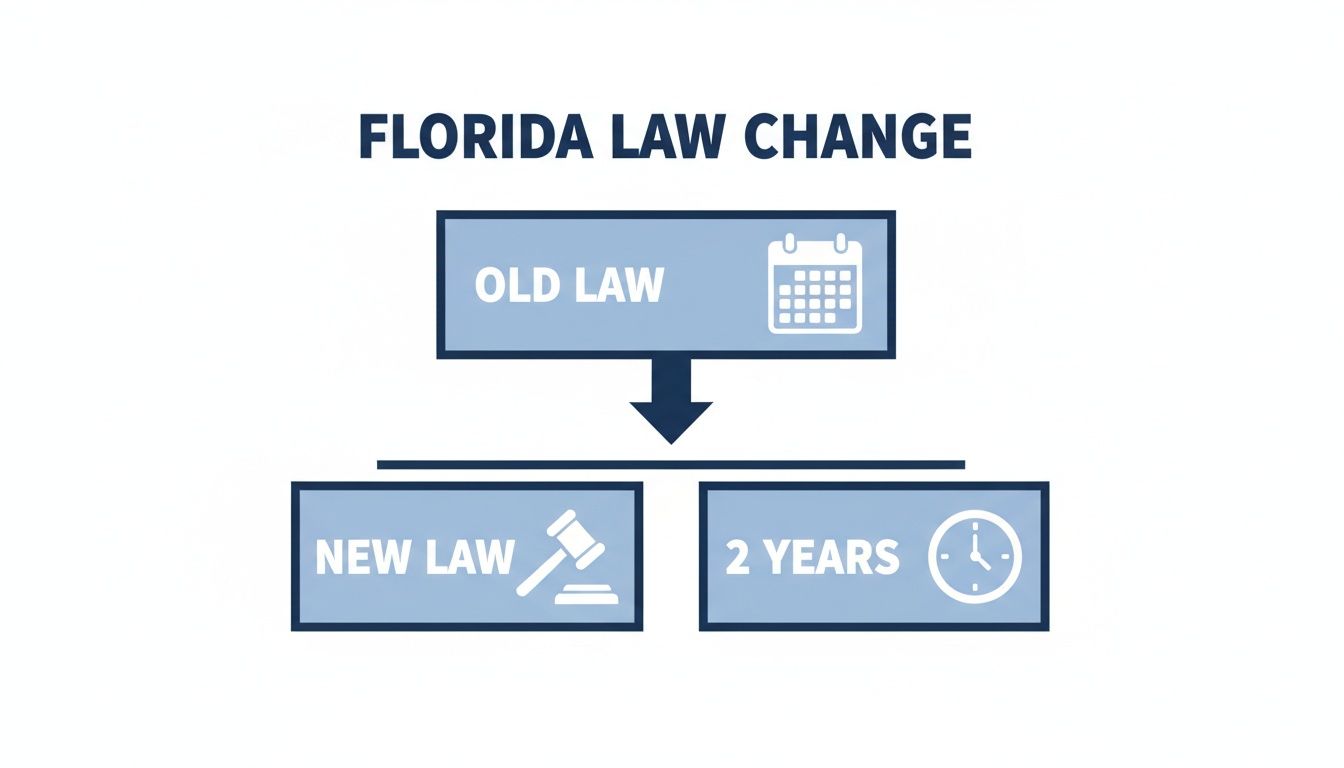
As you can see, the old four-year window was cut in half, leaving injured people with far less time to act on many common claims.
But medical malpractice is a different beast. Florida gives you a two-year window from the date you found (or should have found) the injury. However, there's also a hard stop. You generally cannot file a claim more than four years after the medical procedure happened, no matter when you discovered the harm.
Deadlines for Other Common Injury Claims
Beyond malpractice, plenty of other injury claims have their own unique filing periods. Getting this wrong can mean losing your legal rights for good. For example, if you're suing a city or state government entity, you have to clear extra procedural hurdles that just don't exist when you're filing against a private company or individual.
To make things clearer, let's break down the deadlines for some of the most common personal injury claims in Florida.
Florida Personal Injury Filing Deadlines by Claim Type
This table gives a high-level overview of the time limits you’ll likely face. But remember, every case has its own nuances, and this is no substitute for legal advice.
Type of Claim | Statute of Limitations | Key Considerations |
|---|---|---|
General Negligence (e.g., car accidents, slip and falls) | Two years from the date of the incident (for incidents on/after 3/24/23) | This is the big one that affects most people. You can read more in our guide on auto and motorcycle accidents. |
Medical Malpractice | Two years from the date the malpractice was discovered or should have been discovered. | There's a strict four-year absolute deadline from the date of the incident, with very few exceptions. |
Product Liability | Two years from the date the injury was discovered or should have been discovered. | Like malpractice, this also has a four-year cutoff from when the product was delivered to you. |
Wrongful Death | Two years from the date of the person's death. | This deadline was already two years, so it wasn't affected by the 2023 law change. |
Claims Against Government | Three years for negligence claims against a state or local government entity. | You must give formal written notice of the claim within three years of the incident before you can file a lawsuit. |
The takeaway here is simple: Never assume you know your deadline. The specifics—who hurt you and how it happened—are what dictate which countdown clock applies to your case.
Figuring out the correct deadline isn't just about circling a date on a calendar. It requires a deep understanding of Florida law and how courts have interpreted these rules. With such tight timelines and complicated requirements, especially for malpractice or government claims, there is zero room for error. A single mistake could be irreversible.
An experienced attorney can pinpoint the exact deadline for your unique situation, making sure you don't forfeit your rights by accident. In pain? Call Caine.
When the Countdown Clock Can Be Paused

The deadlines set by the statute of limitations personal injury florida laws might seem rigid, but they aren't written in stone. In a few very specific situations, the law actually allows the countdown clock on your claim to be temporarily paused.
This legal concept is known as tolling.
Think of it like hitting the pause button on a stopwatch. For the entire time the specific tolling condition is met, the clock stops ticking. Once that situation changes, the clock starts running again right from where it left off.
This is all about fairness. It’s designed to protect victims who, through no fault of their own, simply can't file a lawsuit within the normal timeframe. Florida law carves out a few critical exceptions to ensure an injured person’s right to seek justice is protected.
When the Injured Party Is a Minor
One of the most common reasons to pause the clock is when the injured victim is a child. The law recognizes that a minor can't legally go out and file a lawsuit on their own.
So, if a child under the age of 18 is hurt because of someone else's negligence, the clock on their personal injury claim is usually paused. The deadline often won't even start to run until the child’s 18th birthday. This gives them a fair shot at pursuing their claim once they become a legal adult.
Imagine a 12-year-old is injured by faulty playground equipment at school. That two-year clock doesn’t start right away. Tolling protects their right to file a lawsuit until they are old enough to do so themselves.
When the Victim Is Mentally Incapacitated
Another crucial exception comes into play when an injury victim is legally considered mentally incapacitated. This could happen because of a severe traumatic brain injury sustained in the accident itself, or it might be due to a pre-existing condition that prevents them from understanding their legal rights.
In these tough situations, the statute of limitations can be tolled. The clock might stay paused until the person’s mental capacity is restored, or until a legal guardian is appointed to make decisions on their behalf.
This rule is so important because it protects the most vulnerable victims. It stops at-fault parties from getting away with it just because the person they injured is physically or mentally unable to start a legal claim.
Florida law makes it clear: a severe injury that takes away someone's ability to make decisions shouldn't also take away their right to justice.
When the At-Fault Party Cannot Be Found
But what if the person who caused your injuries tries to skip town or hide? Tolling provisions cover this scenario, too. If a defendant intentionally tries to avoid being served with a lawsuit, the clock can be paused.
This could include actions like:
Leaving the State of Florida specifically to dodge the lawsuit.
Using a fake name or otherwise hiding their identity after the accident.
Actively hiding somewhere in the state to avoid a process server.
Think about a hit-and-run crash where the driver speeds off and disappears. The time that police and investigators spend trying to track down the responsible driver might not count against your filing deadline. The clock can be paused until the defendant is finally found, making sure you aren't penalized because the other person was trying to evade responsibility.
These exceptions are legally complex and hinge on the specific details of your case. Figuring out if your situation qualifies for tolling isn't something you should try to do on your own. A simple miscalculation could torpedo your entire case. An experienced attorney can analyze the facts and fight to make sure your right to compensation is fully preserved. In pain? Call Caine.
Wrongful Death Claims and Florida's Two-Year Limit
Losing a family member is one of the hardest things anyone can go through. The grief alone is overwhelming, and the last thing you want to deal with is a maze of legal deadlines and requirements. For families in Florida looking for answers and accountability, it’s critical to understand that the timeline for a wrongful death claim works differently than most other personal injury cases.
While a lot of Florida's personal injury laws just went through a major overhaul, the statute of limitations for wrongful death claims did not change. For a long time, Florida law has maintained a strict two-year window to file these sensitive cases, and that remains the rule today.
This consistency is a small mercy in what can be a very confusing legal environment. The most important thing to know is when that two-year clock starts ticking. Unlike a standard injury case where the countdown might begin on the day of the accident, a wrongful death lawsuit's clock starts on the date of the person's death.
The Clock Starts on the Date of Passing
This is a crucial distinction. Let's say someone is badly hurt in a car wreck on January 1st but, tragically, doesn't survive their injuries and passes away on January 15th. The two-year deadline to file a wrongful death lawsuit starts on January 15th, not the date of the crash.
The law sees it this way: the legal claim for wrongful death can't exist until the death has actually occurred. So, the timeline for seeking justice is tied directly to that final, tragic event.
Even with the recent legal reforms in Florida (specifically House Bill 837 in 2023), this rule hasn't been touched. Those changes created a new two-year deadline for most negligence claims, which simply brought them in line with the wrongful death timeline that was already in place under Florida Statutes Section 95.11(4). So, if a loved one passes away from their injuries on January 1, 2025, the family has until January 1, 2027, to file a lawsuit. You can learn more about how the 2023 reforms impact various claims.
Who Can File a Wrongful Death Lawsuit
There’s a common misconception that any grieving family member can step up and file a wrongful death lawsuit. Florida law is very specific on this point. The claim has to be filed by the personal representative of the deceased person’s estate.
This person is usually named in the deceased’s will. If there wasn’t a will, the court will appoint someone to act as the personal representative for the estate and its survivors.
While only the personal representative can officially file the suit, the action is taken on behalf of the surviving family members. The entire goal is to recover damages that help compensate them for their immense loss.
The survivors who typically stand to benefit include:
The surviving spouse
Minor children
Adult children (if there is no spouse)
The parents of a deceased minor child
Any other blood relatives or adoptive siblings who depended on the deceased for financial support
The damages sought are meant to address both the financial hole and the emotional devastation left behind. This can include compensation for lost income and support, medical and funeral bills, and the profound, intangible loss of companionship, guidance, and love.
Losing a loved one turns your world upside down, and that two-year deadline can fly by while you're just trying to get through each day. It is so important to act quickly to protect your family’s rights. An experienced attorney can take on the legal burdens, giving your family the space you need to focus on healing. In pain? Call Caine.
How to Protect Your Claim Before the Deadline Arrives
Knowing about the statute of limitations for personal injury in Florida is one thing, but that knowledge alone won't protect you. The clock starts ticking the second you're hurt, and the only way to preserve your right to compensation is by taking decisive action.
Think of it this way: you wouldn't just watch the clock while building a house. You'd be laying the foundation, piece by piece. Every step you take in the days and weeks after an accident strengthens your potential claim in the exact same way. That two-year deadline can vanish in a blink, and waiting too long can make it incredibly difficult—if not impossible—to get the justice you deserve.
Your Immediate Post-Accident Checklist
In the chaos and pain following an accident, it’s tough to think clearly. But focusing on a few key steps right away can protect both your health and your legal rights, creating a strong record of what happened and how it has impacted your life.
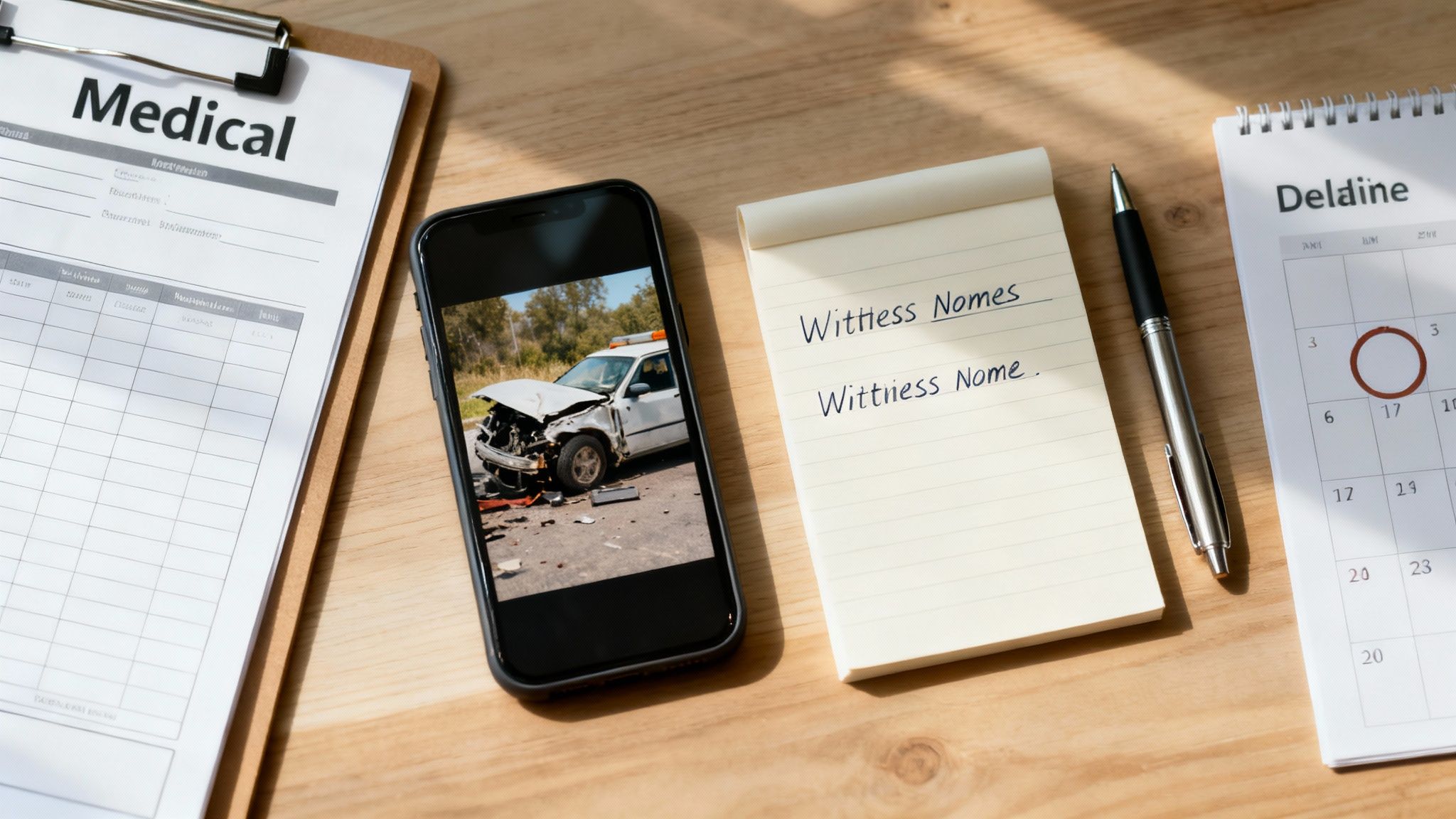
Seek Immediate Medical Attention: Your health is always priority number one. Even if you feel okay, get checked out by a doctor. Serious injuries like internal bleeding or traumatic brain injuries often don't show symptoms right away. A medical record from immediately after the incident creates a powerful, undeniable link between the accident and your injuries, which is critical evidence.
Report the Incident Officially: Never leave the scene of an accident without an official report. If you were in a car crash, call the police. If you slipped and fell, file a report with the store manager or property owner. This document becomes the first official record of the who, what, when, and where of your injury.
Gather Evidence at the Scene: If you’re physically able, use your phone to document everything. Snap photos and take videos of the scene, your injuries, any property damage, and whatever caused the accident (like a puddle on the floor or a broken handrail). Be sure to get the names and contact information of any witnesses—their perspective can be invaluable down the road.
For a more detailed breakdown, check out our guide on what to do when accidents happen and the essential steps to take.
Why Waiting to Call a Lawyer Is a Costly Mistake
Many people see the two-year deadline and think they have plenty of time. They decide to "wait and see" how their injuries heal or how things play out. This is one of the biggest mistakes you can make. The statute of limitations applies to filing a lawsuit, not to building your case. A solid personal injury claim isn't something that can be thrown together in the last few weeks.
A personal injury claim is built piece by piece through meticulous investigation and evidence collection. By the time you hire an attorney, crucial evidence may have already vanished, and witness memories may have faded.
Bringing an attorney on board right away allows them to get to work immediately. This initial phase is incredibly time-consuming and involves a lot of complex steps that need to happen long before a lawsuit is ever filed.
Here’s a quick look at what’s happening behind the scenes:
Independent Investigation: Your legal team will launch its own investigation, often heading to the accident scene, interviewing witnesses, and tracking down surveillance footage before it gets erased.
Evidence Preservation: They will send formal "spoliation letters" to the at-fault parties, which legally require them to preserve critical evidence like maintenance logs, vehicle "black box" data, or employee records.
Expert Consultation: Your case might need an expert—like an accident reconstructionist or a medical specialist—to analyze the evidence and offer a professional opinion. Finding and hiring the right experts takes time.
Pre-Suit Negotiations: Before ever setting foot in a courtroom, your attorney will usually try to negotiate a fair settlement with the insurance company. This involves putting together a detailed demand package and can take months of back-and-forth.
If you wait until you’re a year and a half into your two-year window, you’re putting your attorney at a huge disadvantage. They’re forced to rush a process that demands careful, deliberate work. Don't let the clock work against you. The single best thing you can do to protect your claim is to get an experienced legal professional in your corner from day one.
In pain? Call Caine.
Why You Must Contact a Personal Injury Attorney Now
Think of Florida's statute of limitations as a locked door. Once that deadline passes, the door slams shut for good, and your right to seek justice is permanently lost. It doesn't matter how strong your case is or how badly you've been hurt—the courthouse will be closed to you.
This isn't some minor legal detail; it's the single most critical reason to speak with an experienced lawyer right away. An attorney's first and most important job is to make sure that door never closes on you. They'll analyze every detail of what happened to accurately calculate your deadline, navigating the complex web of rules and exceptions that might apply to your specific situation.
Waiting until the last minute is one of the worst mistakes you can make. A lawyer needs time to properly investigate, gather evidence, talk to experts, and handle all the necessary pre-filing steps. Rushing this process only weakens your claim.
When you hire an attorney, you’re handing off that immense pressure. They take charge of managing the details and hitting every deadline, freeing you up to focus on what truly matters: your recovery.
Exploring your options with a professional is the most important step you can take. You can learn more about how we handle these cases by reviewing our personal injury services. This isn’t just a recommendation; it's a necessity. Your financial future could hang in the balance.
In pain? Call Caine.
Answering Your Questions About Florida’s Injury Deadlines
The laws surrounding Florida’s personal injury deadlines can feel like a tangled web, but getting a clear understanding is absolutely critical for your case. Here are some straightforward answers to the questions we hear most often from our clients.
What Happens if I Miss the Statute of Limitations Deadline?
Missing the filing deadline isn't just a setback—it's the end of the road for your case. The consequences are severe and, unfortunately, permanent.
If you don't file a lawsuit before the statute of limitations expires, you legally forfeit your right to seek compensation for your injuries. It doesn't matter how strong your evidence is or how serious your injuries are. The court will almost certainly dismiss your case, and the insurance company will have no legal or financial reason to continue negotiating. That deadline is a hard stop.
Does the Two-Year Deadline Apply if My Injury Occurred Before March 24, 2023?
No, and this is a major point of confusion for many people. The law that changed the deadline from four years to two years for most negligence claims is not retroactive.
The date of your injury is the only thing that matters in determining which rule applies:
Injury on or before March 23, 2023: Your claim is covered by the old rule, giving you four years from the incident date to file.
Injury on or after March 24, 2023: Your claim falls under the new law, and you now have two years to file.
It all comes down to that specific date on the calendar. An experienced attorney can help you lock down the exact deadline that applies to your unique situation.
How Is the Official "Date of Injury" Determined for the Deadline?
In most personal injury cases, like a car wreck or a slip and fall, the clock starts ticking on the exact date the accident happened. That’s the moment the negligence occurred and caused you harm.
But life isn’t always that simple. Some injuries aren't obvious right away, which is common in medical malpractice or defective product cases. For these situations, Florida's "discovery rule" might come into play. This means the clock could start running on the date you actually discovered your injury, or the date you reasonably should have discovered it.
Never assume you know when your clock started. Miscalculating your start date by even a single day can be a fatal error for your claim. Getting a professional legal opinion is the only sure way to determine your true filing deadline.
Do Negotiations With an Insurance Company Pause the Filing Deadline?
This is one of the most dangerous myths out there. Engaging in settlement talks with an insurance company does not stop the clock on the statute of limitations. It keeps ticking, no matter how productive or promising those conversations seem.
Insurance adjusters know this deadline inside and out. Some will even use delay tactics—making small offers, asking for endless paperwork—to drag things out until your time is up. Once that deadline passes, they can legally deny your claim and walk away, leaving you with nothing. You must file a lawsuit before the deadline to protect your right to compensation, even while you're still negotiating.
Don't let a simple calendar date stand between you and the recovery you deserve. The legal team at CAINE LAW is here to make sure your rights are protected and every deadline is met. In pain? Call Caine. Learn more by visiting us at https://cainelegal.com.
