
In Pain? Call Caine
What happens in deposition: A Florida Injury Guide

5 Min read
By: Caine Law
Share
If you’re moving forward with a personal injury claim, you've probably heard the word "deposition." It sounds formal and a little intimidating, but it’s a standard part of the process.
Let's demystify it right away. A deposition is simply an out-of-court interview where you give sworn testimony. Think of it as a structured Q&A session where the other side’s attorney gets to hear your side of the story, straight from you.
Your First Look Inside the Deposition Room

When clients hear "deposition," their minds often jump to a dramatic courtroom scene from a legal thriller. The reality is far less theatrical. A deposition almost always takes place in a standard conference room, not in front of a judge or jury.
The primary goal here is fact-finding. It gives everyone involved a chance to understand the facts before a potential trial ever begins.
Think of it like building a puzzle. Before you can piece everything together to see the whole picture, you have to dump all the pieces on the table and look at them one by one. A deposition is that step—it's where the opposing side gets to examine the pieces of your story.
Who Will Be in the Room
Knowing who to expect can make the whole experience much more comfortable. The setting is professional, and each person in the room has a very specific job to do.
To help you get a clear picture, here's a quick rundown of who you'll see around the table.
Who's Who in Your Deposition
Participant | Their Role and Purpose |
|---|---|
You (The Deponent) | You are the central figure—the person providing sworn testimony about the incident and your injuries. |
Your Attorney | Your lawyer from Caine Law will be right there with you to offer guidance, object to improper questions, and protect your interests. |
The Opposing Attorney | This is the lawyer representing the at-fault party (or their insurance company). They will be asking you the questions. |
The Court Reporter | This is a neutral professional whose only job is to create an official, word-for-word transcript of everything said during the session. |
As you can see, it's a small and focused group. There's no audience, just the key players in your case.
The Core Purpose of a Deposition
For the opposing attorney, the main goal is discovery. They want to understand what you know about the accident, the full extent of your injuries, and how those injuries have affected your life. In short, they’re trying to size up the strength of your claim and get a sense of who you are as a witness.
A deposition is not a memory test or a game of "gotcha." It is a formal process for gathering facts under oath. Your honesty, consistency, and clarity are the most powerful tools you have.
For our team at Caine Law, your deposition is a critical opportunity to show the strength and validity of your case. A well-prepared, truthful testimony can put you in a much stronger position for settlement negotiations down the road.
Feeling prepared is the key to confidence. In pain? Call Caine. If you have questions about an upcoming deposition, we are here to provide answers.
Why Your Deposition Is a Turning Point
A lot of people think a deposition is just another box to check in the legal process. It’s not. It’s a critical moment—a turning point that can shape the entire direction of your personal injury claim. This is the first, and often the only, chance for the other side's lawyer to meet you, hear your story in your own words, and size you up as a witness.
For the defendant’s attorney, this is more than a simple Q&A. It's a strategic mission. They’re there to dig for facts, probe the details of the accident, and understand the true impact of your injuries. But their most important goal? To lock in your testimony.
Everything you say in that conference room is recorded under oath. It becomes a permanent part of your case, creating a baseline story you have to stick to. That's why being consistent and completely honest is so important.
The Deposition's Impact on Settlement
The opposing attorney isn’t just listening to what you say—they're evaluating how you say it. They are asking themselves, "How will a jury see this person? Are they believable? Are they sympathetic?" A strong, confident, and truthful performance sends a clear and powerful message.
It tells the insurance company you’re a compelling witness who would connect with a jury at trial. That single factor can dramatically change their risk calculation and, in turn, make them far more willing to offer a fair settlement.
Your testimony is the evidence that breathes life into the facts. It turns black-and-white medical records and police reports into a human story of pain, loss, and resilience.
A successful deposition puts the strength of your case on full display. It’s our opportunity at Caine Law to show the defense that we are ready and willing to go to trial, which often gets them to the negotiating table much faster.
Setting the Stage for Negotiations
Think of your deposition as the starting gun for serious settlement talks. In fact, a huge number of personal injury cases are resolved shortly after depositions wrap up. Why? Because for the first time, both sides have a clear, unfiltered picture of the case's strengths and weaknesses.
It’s a well-known reality that very few cases actually make it to a courtroom verdict. Statistics show that around 95% of all personal injury lawsuits in the U.S. settle before trial. This really highlights how crucial your deposition performance is, as it directly influences both the timing and the amount of a settlement offer. You can discover more insights about settlement timelines after a deposition to understand this critical phase.
This high settlement rate isn't a coincidence. It happens because a strong deposition forces the other side to get realistic about their chances of winning in court.
Your Role in Shaping the Outcome
Ultimately, the deposition is your opportunity to tell your story in your own words. While your lawyer is right there to protect you from improper questions and guide you, the real power of your testimony comes from your authenticity.
By being honest about the accident and how your injuries have turned your life upside down, you build the foundation for a powerful claim. This is what makes insurance companies take your case seriously and negotiate a settlement that truly reflects what you've been through.
Our team at Caine Law makes sure you are thoroughly prepared to face this moment with confidence. We go over the facts, anticipate the questions, and give you the tools you need to present your case clearly and effectively. In pain? Call Caine. If you're facing a deposition and need an experienced team on your side, we're ready to help.
A Step-by-Step Walkthrough of Deposition Day
Knowing what to expect on deposition day, step by step, is the best way to walk in feeling prepared and confident. While every case has its own unique twists and turns, the sequence of a deposition is surprisingly structured and predictable. Think of it as a formal roadmap with clearly marked stages.
We’ll make sure you arrive with plenty of time to settle into the conference room. This isn't a race; the real goal is to be calm, centered, and ready to give clear, truthful testimony. The day always kicks off with a few simple but important formalities.
Getting Started: The Oath and Opening Remarks
The very first thing that happens is the court reporter will swear you in. You'll be asked to raise your right hand and take an oath, promising to tell the truth, the whole truth, and nothing but the truth. It's the exact same oath you would take in a courtroom, which highlights just how serious your testimony is.
After you're sworn in, the opposing lawyer will usually give a brief introduction. They might go over the ground rules—like reminding you to give verbal answers instead of just nodding—and confirm you understand how things will work. This is all standard practice and just sets the stage for the day.
The Heart of the Deposition: Questioning
This is the main event. The opposing counsel will start asking you questions about the facts of your case. The topics they cover are usually pretty broad, but you can almost always expect questions about:
The Accident Itself: They will want you to describe what happened, in your own words. Getting the timeline and details right is critical, which is why reviewing any initial reports you made can be a huge help. For more tips, check out our guide on the essential steps to take when accidents happen.
Your Injuries and Medical Treatment: Get ready for questions about every injury you sustained, every doctor you've seen, the treatments you've received, and how you’re feeling now.
The Impact on Your Life: You’ll be asked how the injuries have affected your daily routine, your ability to work, your family life, and your overall well-being.
Your Background: Some general questions about your personal history, education, and job history are also fair game.
This questioning phase isn't just about gathering facts; it's a direct line from your testimony to the insurance company's assessment of your case's value. What you say here heavily influences any settlement talks that follow.
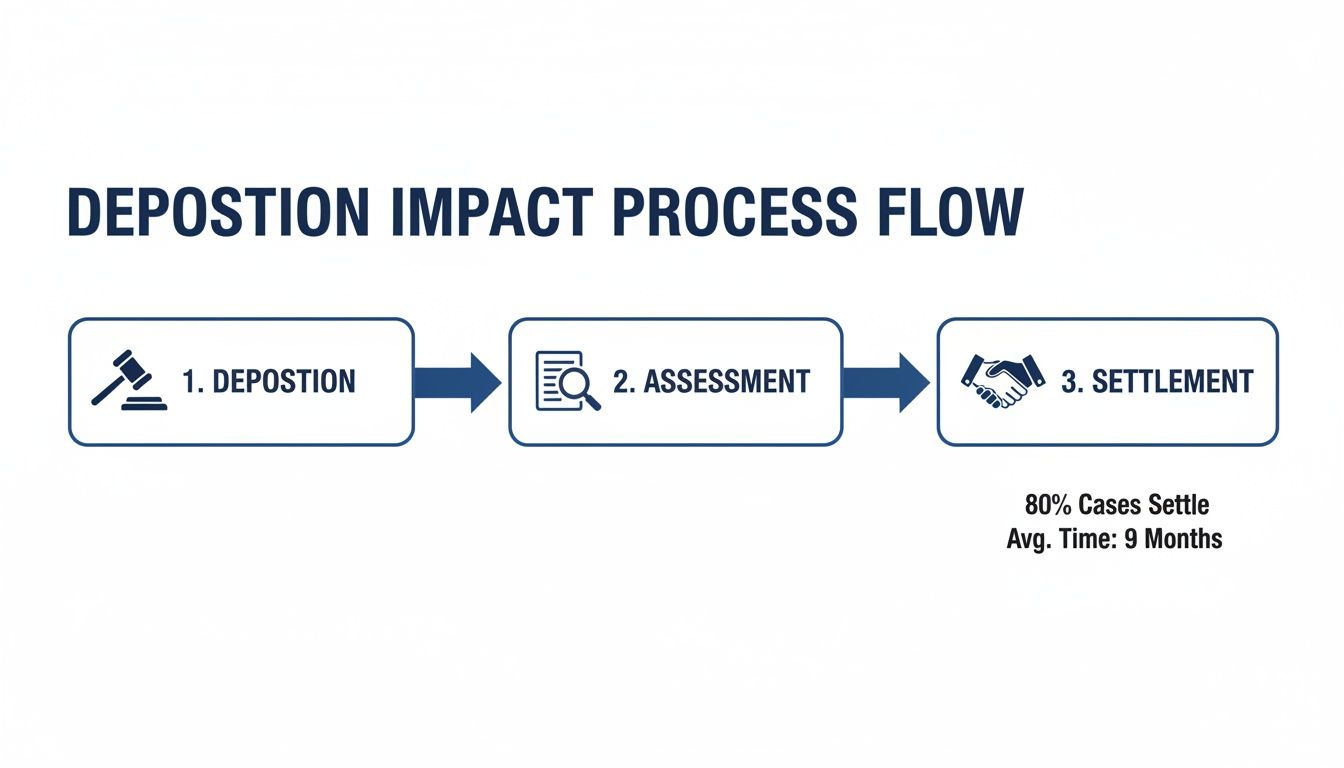
This visual really breaks it down—your testimony is the catalyst that forces the defense to evaluate their position, often triggering meaningful settlement negotiations.
Your Attorney’s Role: Objections and Protection
While you’re focused on answering questions, your Caine Law attorney is right there with you, actively listening and protecting your interests. If the other lawyer asks an improper question, we will make a legal objection.
An objection is your lawyer's way of formally flagging a question as unfair, confusing, or legally inappropriate. Listen for this cue and pause your answer until your attorney tells you what to do next.
Now, here's a key point: even after an objection, you'll often still be instructed to answer the question. The objection's main purpose is to preserve the issue for a judge to rule on later if the case goes to trial. Your job is simple: stop talking the second you hear your lawyer say "objection."
Concluding the Deposition and Next Steps
Once the opposing attorney is done, your lawyer might ask a few follow-up questions to clarify something you said, but that's not always necessary. When all the questioning is finished, the other lawyer will state that the deposition is concluded.
At that point, the court reporter goes "off the record," and your part for the day is done. The process isn't quite over, though. The reporter will type up a word-for-word transcript of everything that was said, and you will have the right to review it to make sure it's accurate. This review is a final, crucial step to ensure the official record perfectly reflects your testimony.
Understanding this flow takes the mystery out of deposition day and lets you focus on one thing: telling your story truthfully. In pain? Call Caine. If you're facing a deposition, our team will be by your side through every single stage.
Anticipating Common Questions and Defense Tactics
The lawyer on the other side of the table has a clear mission: find ways to poke holes in your case. Their job isn't just to hear your story; it's to challenge it, question it, and ultimately find reasons for the insurance company to pay as little as possible.
They come prepared with a playbook of questions and tactics designed to chip away at your claim. Knowing what they’re trying to do ahead of time is your best defense. It strips away the element of surprise, helping you stay calm and answer with confidence. Your Caine Law attorney will run through all of this with you, but here’s a look at what to expect.
Key Areas of Questioning
The opposing attorney will systematically walk through the core parts of your life and your case. They're trying to build their own version of the story, and they'll do it by asking about four main areas.
You can expect them to ask about:
Your Personal Background: This includes where you've lived, your education, and your job history. They're trying to get a sense of who you are.
The Incident Itself: You’ll need to recount exactly what happened. They will want every detail you can remember—from the moments just before the accident to everything that happened right after.
Your Medical History: This is a big one. They'll ask about every injury from this accident, every doctor you've seen, and every treatment you've had. But they won't stop there. They will also dig deep into any prior injuries or medical conditions you've ever had, even if they seem completely unrelated.
Damages and Financial Losses: Be ready to talk about how this injury has hit your wallet. This means lost wages from being out of work, medical bills you've paid, and how this might affect your ability to earn a living down the road. Staying organized here is critical, and our guide on how to document evidence for a personal injury claim is a great resource to get this information in order.
Common Defense Attorney Tactics
It’s not just what they ask, but how they ask it. Defense lawyers use specific techniques to try and trip you up, confuse you, or get you to say something they can twist and use against you later.
Here are a few common tactics to watch for:
Compound Questions: The attorney might fire off a question with two parts, like, "As you approached the intersection and saw the light turn yellow, did you speed up?" It’s a trick because a simple "yes" or "no" doesn't work. Your attorney will likely object, but you should always pause and feel free to ask them to ask one question at a time.
Putting Words in Your Mouth: They might rephrase your answer and try to get you to agree with their more extreme version. For instance, if you say your back was sore, they might follow up with, "So you were in debilitating, excruciating pain, is that right?" Don’t let them put words in your mouth. If their summary isn't accurate, just say so and stick to your own description.
Repeating Questions: An attorney might ask you the same question, phrased slightly differently, at various points during the deposition. They're hoping you’ll give a different answer the second or third time, creating an inconsistency they can point to at trial to make you look unreliable.
When you're facing any question, remember these three simple rules: Listen carefully to the exact question. Pause and think before you speak. And never, ever guess or make something up.
It is perfectly okay—and often the best possible answer—to say "I don't know" or "I don't remember." A simple, honest answer like that is far better than speculating and giving them ammunition to use against you. Our team will practice these strategies with you, making sure you walk into that room feeling prepared and confident. In pain? Call Caine.
How Caine Law Gets You Ready to Win

Your testimony is easily one of the most powerful pieces of evidence in your entire case. Knowing what a deposition is and what happens there is one thing, but being ready to give clear, confident testimony under pressure is something else entirely. At Caine Law, we never leave that to chance.
Our preparation goes way beyond handing you a list of tips. We sit down with you, one-on-one, and build your confidence from the ground up. This isn’t about memorizing a script. It’s about making sure you can tell your story truthfully and effectively.
We Start With a Deep Dive into the Documents
Strong testimony is always built on a solid foundation of facts. Long before you sit down for questioning, we'll meet to review every single key document in your file. This is an absolutely critical step to get us both on the same page.
Our review process covers all the bases:
The Police Report: We'll walk through the official report of the incident to refresh your memory on the timeline and other recorded details.
Your Medical Records: We'll go over your treatment history, diagnoses, and doctor's notes so you can accurately describe your injuries and the road to recovery.
Your Own Prior Statements: We’ll look at any initial statements you might have given to insurance adjusters to ensure your testimony stays consistent.
This exhaustive review gets the facts straight in your mind, which goes a long way toward reducing anxiety and preventing any nasty surprises.
Mock Depositions and Real-World Strategy
Once we've mastered the evidence, we shift into practice mode. We'll simulate the deposition setting and run through the kinds of questions the other side's lawyer is almost certain to ask. Think of it as a dress rehearsal—it helps you get comfortable with the rhythm of the questioning and the pressure of being in the hot seat.
The goal here isn't to feed you answers. It's to give you the tools and strategies to answer honestly and clearly. You are the only expert on what you went through; our job is to help you communicate that experience.
We'll practice how to field those tricky, confusing questions, how to handle common defense attorney tactics, and when it’s perfectly fine to say, "I don't remember." By the time you walk into the real deposition, you'll have the confidence and the skills to handle whatever they throw at you. We provide this same dedicated support for every client, including those navigating a Florida personal injury claim.
When you work with our firm, you are never walking into that room alone. You will be prepared, supported, and ready to make your testimony count.
In pain? Call Caine.
Frequently Asked Questions About Florida Depositions
After walking through the process, it's completely normal to still have some nagging questions. These are the practical, real-world concerns we hear all the time from our clients, and getting them answered is the best way to calm any last-minute nerves. Let's tackle some of the most common ones.
How Long Does a Deposition Usually Take in Florida?
This really depends on how complicated your case is. For a straightforward car accident, you can probably expect to be there for two to four hours. That's usually enough time for the other side to get the core facts about the crash and your injuries.
But for more complex cases—maybe you have catastrophic injuries, there are multiple people at fault, or your medical history is extensive—a deposition can easily take up a full day. The Florida Rules of Civil Procedure set a general limit of seven hours of on-the-record testimony for a single day, though everyone can agree to extend that if needed.
The best advice I can give is to clear your entire schedule for the day. Don't try to squeeze it in. This way, you won't feel rushed or stressed, and you can give the testimony your full, unhurried attention.
During our prep sessions, your Caine Law attorney will give you a much better estimate based on the specifics of your case.
What Should I Do If I Don’t Know the Answer?
This is probably the most important rule of a deposition. If you don't know the answer to a question, the single most powerful thing you can say is, "I don't know." If it's something you simply can't recall, the right answer is, "I don't remember."
It's a classic defense lawyer tactic to push you for an estimate or a "best guess." You have to resist that temptation.
Never Speculate: Guessing is the fastest way to get into trouble. If you guess wrong, they will use it to attack your credibility later, making it seem like you're either a liar or just unreliable.
Stick to Your Knowledge: You are under oath. You are only required to testify to what you personally know and clearly remember. That’s it.
Saying "I don't know" isn't a sign of weakness; it's a sign that you're being honest and careful. We will practice this together so you feel completely comfortable using these phrases when they are the truth.
Can My Deposition Testimony Be Used Against Me at Trial?
Yes. Absolutely. It's critical to understand that everything you say is being taken down by a court reporter, creating an official, sworn transcript. That document is a powerful piece of evidence that can and almost certainly will be used if your case goes to trial.
The main way it’s used is for impeachment. That’s a legal term for catching you in a contradiction. The opposing attorney will look for any inconsistencies between what you said in your deposition and what you say on the witness stand in court.
For instance, if you said in your deposition that the other car was "going fast," but at trial you say it was going "at least 60 miles per hour," the lawyer will pounce on that difference. Even small changes in wording can be framed to make you look untrustworthy to a jury. This is exactly why we prepare so thoroughly and why your honesty is non-negotiable.
What Is My Lawyer's Role During the Deposition?
Think of your Caine Law attorney as your active bodyguard in that room, not just a spectator. We have a multi-part job, and it’s all centered on protecting you and your case.
Here’s what we're doing while you're answering questions:
Making Objections: This is our most critical function. We are there to shield you from improper questions—anything that's confusing, argumentative, harassing, or asks for protected information.
Preserving the Record: Even if you have to answer a question after we object, our objection is now officially in the transcript. This saves the issue so a judge can rule on it later if it becomes important.
Ensuring Accuracy: We are listening intently to every single word, making sure the questions are fair and your answers are being understood and recorded correctly.
Providing Support: Remember, you can ask for a break anytime you need one. If you're tired, confused, or just overwhelmed, you can signal to us, and we'll step outside to talk privately. We’re there to be your guide and your backup.
When the other side is finished, we might ask you a few questions ourselves, but only if we need to clarify something you said that could be twisted later. Our presence guarantees you are never on your own and that the other lawyer has to play by the rules.
Going through a deposition is a major milestone in your personal injury claim, but you don’t have to face it alone. The experienced team at CAINE LAW is here to prepare you, stand by you, and fight for the compensation you deserve.
If you’ve been injured because of someone else's carelessness, let us handle the legal battle while you focus on healing. In pain? Call Caine. Contact us for a free, no-obligation consultation today at https://cainelegal.com.
