In Pain? Call Caine
Florida Distracted Driving Accident: Your 2026 Guide

5 Min read
By: Caine Law
Share

You're driving home in Florida, maybe on US-1, I-95, or a local road you've used a hundred times. Traffic slows. You stop. Then the hit comes from behind, or a car drifts across a lane and slams into your door. A second later, the other driver says something that makes your stomach drop: “I just looked down for a second.”
That “second” can leave you with an ambulance bill, missed work, a wrecked vehicle, and pain that keeps getting worse over the next few days. It also drops you into a legal system that isn't simple. Florida's no-fault rules, insurance requirements, and fault-based injury claims all interact in ways many accident victims don't expect.
A distracted driving accident case isn't just about proving someone was careless. It's about proving what distracted them, locking down evidence before it disappears, and dealing with arguments that you were partly to blame. If you handle those issues correctly early on, your claim gets stronger. If you don't, the insurance company gains an advantage fast.
The Sudden Impact of a Distracted Driver
One of the most common scenes after a distracted driving crash is confusion mixed with anger. The vehicles are damaged. Someone is shaken up. The driver who caused it often doesn't look drunk or reckless in the traditional sense. They may look ordinary, apologetic, and stunned by what they just did.
That's part of what makes these crashes so frustrating. Many victims were doing exactly what they were supposed to do. They were stopped at a light, moving with traffic, or making a lawful turn. The collision came from someone who let a phone, screen, conversation, or moment of inattention override basic driving judgment.
The national numbers show this isn't rare. In 2024, the National Highway Traffic Safety Administration reported 3,208 people were killed in motor vehicle crashes involving a distracted driver, representing roughly 8.2% of all fatal crashes that year.
What victims usually face first
In the first hours after a crash, individuals aren't thinking about evidence. They're thinking about:
Pain setting in later: Neck, back, shoulder, and head symptoms often worsen after adrenaline wears off.
Insurance calls: Adjusters may contact you quickly and frame the crash before all facts are known.
Missing details: You may not know whether the other driver was texting, using GPS, scrolling, or reaching for something.
Self-doubt: Victims often wonder if they did something wrong, even when the other driver caused the collision.
The most dangerous early mistake is assuming the truth will speak for itself. In distracted-driving cases, evidence must be preserved.
Florida law gives you options, but it also puts pressure on you to act carefully. You need medical documentation. You need the crash report. You need to understand when your own PIP coverage applies and when you can pursue the at-fault driver for the losses PIP doesn't cover. Most of all, you need to treat distraction as a provable form of negligence, not just an annoying excuse.
What Legally Constitutes Distracted Driving
Distracted driving isn't limited to texting. Legally, it's broader than generally understood. A driver can be distracted by a phone, a navigation screen, food, a child in the back seat, a passenger's conversation, or being mentally elsewhere.
Lawyers and crash investigators usually break distraction into three categories. That framework matters because it helps identify what evidence to look for and how to explain fault.
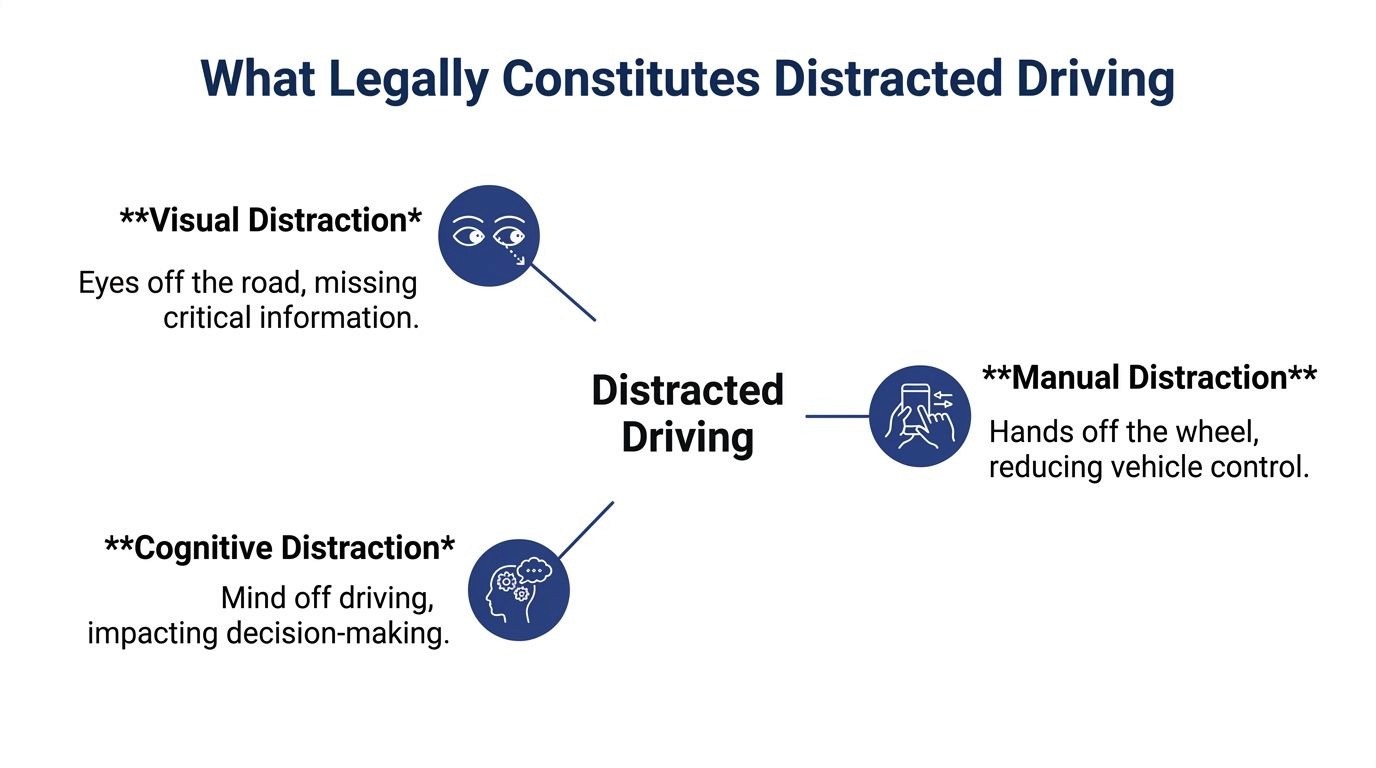
Visual distraction
A visual distraction happens when the driver takes their eyes off the road.
That can include reading a text, checking a GPS route, looking down at a playlist, turning to look at a child, or searching for a dropped item near the floorboard. In a crash case, visual distraction often explains lane departures, delayed braking, and rear-end impacts where the driver never reacted in time.
Manual distraction
A manual distraction happens when the driver takes one or both hands off the wheel.
Typing on a phone is the obvious example, but it's not the only one. Reaching for coffee, adjusting climate controls, picking up a bag, handling food, or trying to plug in a charger can all reduce control at exactly the wrong moment.
Cognitive distraction
A cognitive distraction happens when the driver's mind isn't focused on driving.
This category gets overlooked because it's less visible. A driver may stare straight ahead and still miss traffic conditions because their attention is tied up in a heated phone call, a stressful conversation, or an in-car task that pulls mental focus away from decision-making.
If the driver's eyes, hands, or mind were diverted from driving, that distraction may support a negligence claim.
A widely cited crash-causation review found that some form of distraction was present in 58% of the crashes examined, with speaking to passengers and cell phone use identified as the two most frequent distractions. The same analysis noted that taking your eyes off the road for 5 seconds at 55 mph to read or send a text is like traveling the length of a football field blinded.
Why the category matters in your claim
The category shapes the evidence. A visual distraction may align with dash-cam footage showing no braking. A manual distraction may line up with phone handling or in-vehicle control use. A cognitive distraction may require witness statements, call timing, or the driver's admissions.
That legal framing matters because insurance companies often try to reduce distraction to a vague possibility. A stronger approach is specific: the driver looked away, handled a device, lost attention, or did all three.
Florida Laws on Distraction and Accident Liability
Florida distracted driving claims turn on more than one rule. You're dealing with traffic laws, insurance laws, and fault allocation at the same time. That's why many accident victims get confused. They assume that if the other driver was on a phone, liability is automatic and compensation is straightforward. It usually isn't.
Florida's texting and device reality
Florida restricts texting while driving, but proving a violation in a civil injury case still comes down to evidence. A ticket can help, but many strong claims are built without one. The bigger issue is whether the driver acted unreasonably under the circumstances and whether that conduct caused your injuries.
That question matters even more today because device-related distraction hasn't disappeared. A multi-year National Safety Council observational survey found that while hand-held phone use declined, the share of drivers actively manipulating electronic devices, including texting and app use, increased by about 36% from 2014 to 2023.
A driver doesn't get a pass because they weren't visibly holding a phone to their ear. App use, touchscreens, messaging, and in-car interfaces can all be part of a distracted-driving negligence claim.
No-fault doesn't mean no claim
Florida is a no-fault state for initial medical coverage, which means your Personal Injury Protection (PIP) is usually the first source of benefits after a crash. That surprises many people. They expect the at-fault driver's insurer to pay medical bills immediately.
Instead, your own policy often comes first for qualifying losses. That system creates a practical problem in distracted driving cases. You can know the other driver caused the wreck and still have to start with your own insurance.
For many injured people, the significant legal fight begins after that. If your injuries meet the threshold required under Florida law, you may pursue the at-fault driver for broader damages such as pain and suffering and losses beyond what PIP covers.
Comparative negligence changes the math
Florida also applies comparative negligence, which means fault can be divided, much like slicing a pie. One portion may be assigned to the distracted driver. Another may be assigned to you if the defense claims you were speeding, not signaling, braking suddenly, or otherwise contributing to the crash.
That doesn't automatically defeat your case. It changes how damages are evaluated and what arguments matter most. The insurance company will often use this rule aggressively because even a partial shift in blame can reduce what they have to pay.
Here's what usually works better than arguing in general terms:
Locking in conduct: Establish what the distracted driver was doing before impact.
Matching evidence to timing: Show how phone use, screen interaction, or inattention lines up with the collision.
Blocking blame shifting: Answer claims about your own conduct with scene evidence, vehicle damage, witness statements, and medical records.
If you want a broader policy-level overview of how liability rules have shifted in this state, this resource on understanding Florida tort reform gives useful context.
Where claims often go sideways
Victims lose their advantage when they rely on assumptions instead of proof. “He must have been texting” isn't enough. “She admitted she looked down at the directions” is better. Phone logs timed to the crash are better still.
The legal issue isn't just whether a distraction occurred. It's whether you can show it clearly enough to survive denial, blame-shifting, and low settlement tactics.
How to Prove Fault and Gather Critical Evidence
Distracted driving claims are won with details. Some of those details are in your control at the scene. Others have to be secured later through an attorney's investigation. Both matter.
Research indicates that distracted drivers are up to four times more likely to be involved in road accidents. It also notes that phone logs, dash-cam timestamps showing dialing or texting, and operational data from in-vehicle systems can be cross-referenced against the crash profile and environmental conditions to strengthen causation arguments.
What you should do immediately
If you're physically able, start preserving facts before they disappear.
Call law enforcement: A crash report creates an early record of where, when, and how the collision happened.
Photograph everything: Capture vehicle positions, damage, skid marks, traffic controls, debris, and anything visible inside the other vehicle if it can be seen lawfully from your position.
Get witness information: Independent witnesses can make or break a distraction claim, especially if they saw the other driver looking down.
Seek medical care promptly: Your injuries need to be documented. Waiting gives the insurer room to argue that you weren't hurt or that something else caused your symptoms.
Write down what was said: If the other driver admitted looking at a phone, GPS, child, or screen, record that as soon as possible.
For a stronger record trail, this guide on documenting the evidence needed for a personal injury claim in Florida is worth reviewing.
What your attorney may gather later
Much of the strongest distracted driving evidence isn't available to you on day one.
A lawyer may pursue:
Phone records that show calls, texts, or data activity around the crash.
Vehicle data from onboard systems that can show braking, speed, and driver inputs.
Surveillance or dash-cam footage from nearby businesses, homes, public systems, or other drivers.
Witness interviews taken before memories fade.
Scene analysis explaining how the crash mechanics better fit the distraction theory than the defense theory.
If the other driver denies touching a phone, that denial is only one piece of the case. Digital records and crash timing often tell a more reliable story.
Key Evidence in a Distracted Driving Claim
Evidence Type | Who Gathers It | Why It's Important |
Crash scene photos | You and your attorney | Preserves vehicle positions, damage, roadway conditions, and visible clues before the scene changes |
Police report | Law enforcement, then your attorney obtains it | Creates an official starting point for liability, witnesses, and statements |
Witness statements | You can collect contact info, and your attorney follows up | Confirms whether the driver looked down, drifted, failed to brake, or admitted distraction |
Medical records | You and your providers, then your attorney compiles them | Connects the collision to your injuries and documents the severity |
Phone logs and records | Attorney through formal requests or subpoenas | Helps establish whether device activity occurred near impact |
Dash-cam or surveillance footage | Attorney | Can show lane position, reaction time, and pre-impact behavior |
In-vehicle system data | Attorney with technical support if needed | May reveal braking, speed changes, or control inputs that support causation |
What doesn't work well?
Victims often overestimate weak evidence and underestimate strong evidence.
These points usually don't carry much weight by themselves:
A hunch: You felt the driver “seemed distracted.”
A late accusation: You didn't mention phone use until much later.
A social media post: It may help with leads, but it rarely proves device use at the exact time of impact.
Stronger cases are built from timing, records, physical evidence, and consistent reporting.
The Distracted Driving Accident Claim Timeline
After a serious crash, people want two things right away. They want treatment, and they want answers about how long this will take. The honest answer is that every claim moves at its own pace, but the process usually follows a recognizable sequence.
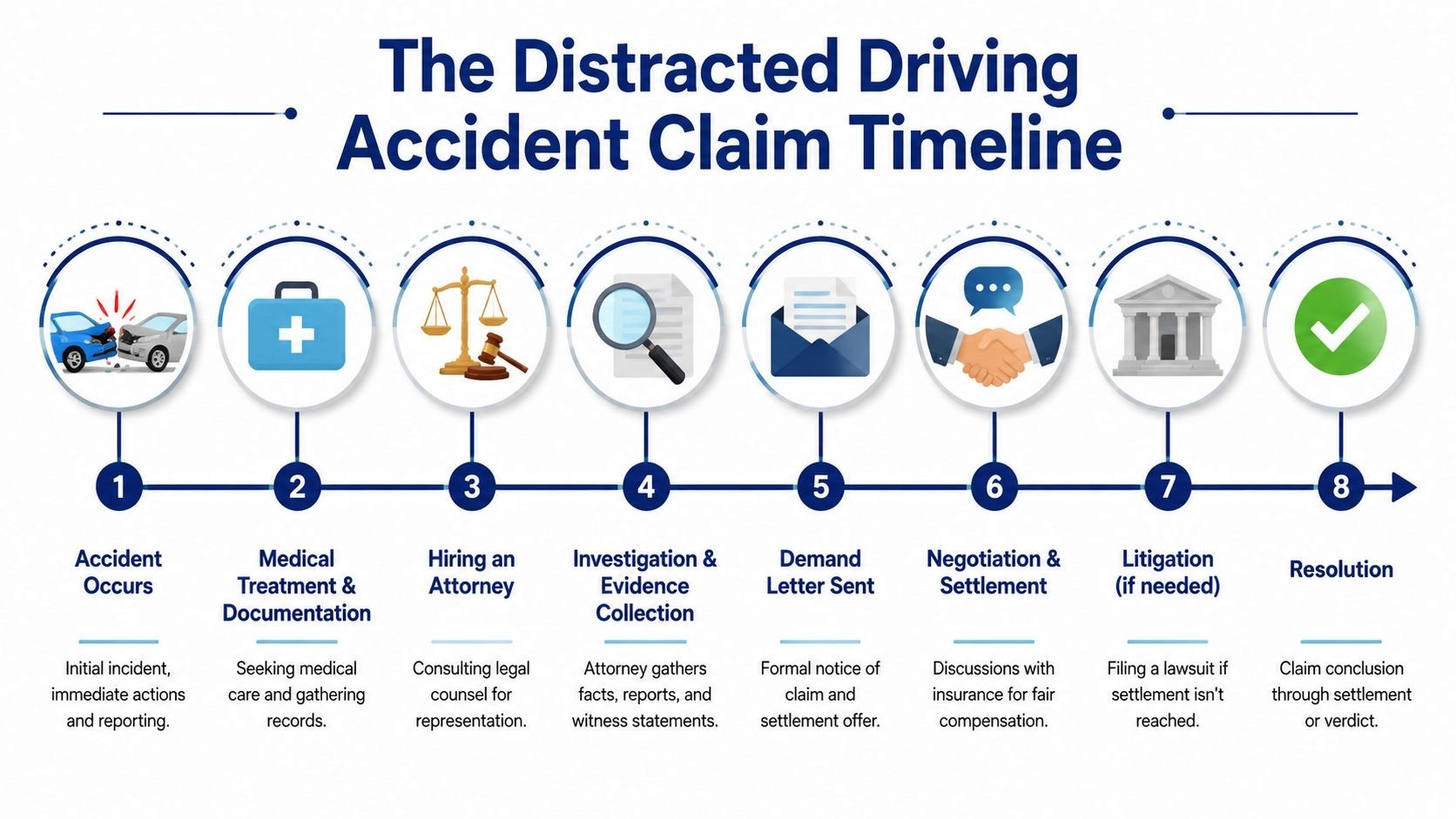
The first days after the crash
The opening phase is practical and medical. You report the collision, open the relevant insurance claims, get evaluated, and begin documenting symptoms and out-of-pocket losses.
This stage matters more than people realize. Early gaps in treatment or inconsistent descriptions of pain can create problems later, even when liability is strong.
The investigation phase
Once representation begins, the legal team builds the claim file. That usually includes collecting records, preserving digital evidence, reviewing the crash report, contacting witnesses, and evaluating whether the distracted driver's conduct can be proven with enough force to support settlement or litigation.
A serious case shouldn't be rushed into a demand before the injury picture is understood. If treatment is ongoing, the value of future care, work restrictions, and long-term pain may still be developing.
Demand and negotiation
When the records are organized and the damage picture is clearer, the attorney may send a demand package to the insurer. That sets out liability, injuries, treatment, losses, and the basis for compensation.
Negotiation often follows in rounds. Adjusters may dispute fault, challenge treatment, or argue your injuries were preexisting. In distracted driving cases, they may also resist the distraction allegation unless the evidence is well developed.
A fast offer isn't always a fair offer. Early settlement proposals often arrive before the full cost of the injury is known.
If the case doesn't settle
If the insurer won't negotiate reasonably, a lawsuit may be filed. That begins formal litigation, including written discovery, depositions, motion practice, mediation, and possibly trial.
That doesn't mean your case will definitely end in a courtroom. Many lawsuits are still resolved before trial, but filing can be necessary to force evidence production and show the defense you're serious.
For a fuller walkthrough of pace, delays, and what usually affects timing, review how long car accident lawsuits take and the practical timeline you can expect.
The deadline you can't ignore
Florida claims are subject to filing deadlines, and missing the statute of limitations can destroy an otherwise valid case. The exact deadline can depend on the type of claim and facts involved, especially if the crash caused a death or involves other unusual issues. That's one reason waiting is risky, even if you think settlement talks are going fine.
A practical timeline view
Early stage: Medical treatment begins, insurers are notified, and basic facts are secured.
Case building: Records, evidence, witness accounts, and liability analysis are developed.
Demand stage: A formal claim is presented once the injuries and losses have been documented.
Negotiation stage: The insurer evaluates, disputes, delays, or counters.
Litigation stage: If needed, the case enters court, and formal discovery begins.
Resolution: Settlement or verdict closes the claim.
The cleanest timeline usually comes from acting early, keeping treatment consistent, and preserving evidence before it's overwritten, deleted, or forgotten.
Understanding Your Potential Compensation
Sooner or later, the same question arises: what is this case worth? The answer depends on your injuries, your evidence, your recovery course, your work losses, and how much fault the defense can credibly place on you.
Distracted driving can produce severe injuries, not just minor impacts.
Economic damages
These are the concrete financial losses tied to the crash.
They may include:
Medical expenses: Emergency care, imaging, specialists, therapy, prescriptions, and future treatment
Lost income: Missed work, reduced hours, or lost earning capacity if your injuries affect your job
Property-related losses: Vehicle damage, rental costs, and related out-of-pocket expenses
Non-economic damages
These losses are real but harder to measure on paper.
They can include pain, physical limitations, emotional distress, loss of enjoyment of daily life, sleep disruption, and the way an injury changes your routine at home and at work.
What drives value up or down
A claim usually becomes stronger when liability is well documented, treatment is consistent, and the medical record clearly connects the crash to your symptoms.
Value usually gets pressured downward when:
There are treatment gaps
The defense argues preexisting conditions
Comparative fault is plausible
The distracted driving proof is thin
For a broader overview of how settlements are evaluated in this state, this Florida auto accident settlement guide can help you see how insurers and attorneys typically approach damages.
The best way to increase claim value isn't dramatic. It's documentation. Clear treatment records, strong evidence of liability, and credible proof of daily impact usually matter more than angry arguments.
Answers to Your Questions and Your Next Step
Common questions after a distracted driving accident
What if the other driver denies using a phone?
That happens all the time. Denial doesn't end the case. Phone records, witness accounts, dash-cam footage, on-scene admissions, and vehicle data may still prove distracting.
Should I talk to the other driver's insurance company?
You can report basic facts, but be careful. Adjusters are trained to ask questions that narrow your claim before your medical condition is fully known.
Will my own insurance go up if I file a claim?
That depends on your policy, your insurer, and the facts. What matters legally is protecting your right to available benefits and avoiding statements that can later be used against you.
What if I were partly at fault?
That doesn't necessarily bar recovery. It does mean the facts need to be handled carefully, because the insurer will try to increase your share of blame.
Do I really need a lawyer if the crash seems obvious?
If distraction caused serious injuries, yes, legal help often makes a major difference. These cases turn on proof, timing, and how well someone pushes back against blame-shifting and undervaluation.
You don't have to solve the legal side of this while you're also dealing with pain, treatment, missed work, and insurance pressure. A distracted driving accident claim in Florida can look simple on the surface and get complicated fast underneath. The right move is to preserve evidence early, protect what you say, and get clear advice before the insurer defines the case for you.
If a distracted driver in Florida hurt you, CAINE LAW can help you take control of the claim before evidence disappears and the insurance company starts shifting blame. You'll get direct guidance on fault, Florida no-fault issues, comparative negligence, medical documentation, and what your case may be worth. In pain? Call Caine.