In Pain? Call Caine
Felony Reckless Driving: A Florida Victim's Guide

5 Min read
By: Caine Law
Share

A violent crash changes the way people talk about what happened. At first, everyone calls it an accident. Then the facts start coming in. The other driver was weaving through traffic, blowing past cars, ignoring obvious danger, and someone ended up in the hospital. That doesn't feel like a simple mistake, because it often isn't one.
If you were seriously hurt in a Florida crash like this, one issue matters more than most victims realize. A criminal case may provide useful evidence for a civil injury claim, including officer observations, witness statements, video, crash reconstruction materials, and sworn testimony. A felony reckless driving charge doesn't just expose the driver to punishment. It can also strengthen your ability to prove fault, push back against insurance company tactics, and pursue full compensation.
The Crash Was No Accident. It Was a Crime.
A driver cuts across lanes at high speed, ignores the traffic stacking up ahead, and slams into your car hard enough to send you to the hospital. In the first few hours, people often call that an accident. From a victim's side of the case, that word can hide what really happened. Some wrecks are the result of a driver making a deliberate choice to act in a way any reasonable person would know could seriously hurt someone.
That distinction matters in more than a moral sense. It matters in court, in the insurance claim, and in the evidence the State gathers. When a driver races on a public road, blasts through traffic, or drives with open disregard for everyone nearby, the crash may be part of a criminal case, not just a traffic investigation.
That point is not academic for injured victims.
The National Highway Traffic Safety Administration's Fatality Analysis Reporting System encyclopedia tracks the facts behind deadly crashes nationwide, including driver-related factors tied to reckless conduct. The larger pattern is familiar to anyone who handles serious injury cases. Dangerous driving choices repeatedly show up when the harm is catastrophic.
Victims usually recognize the difference immediately. They know when the other driver made a mistake, and when the other driver treated the road as if the rules did not apply. Florida law recognizes that difference, too, and that recognition can give an injured person a stronger civil case.
Why victims should care early
A felony reckless driving charge may increase pressure in a civil claim, especially when the facts and evidence supporting the charge are available and admissible. Law enforcement often documents the scene more thoroughly. Prosecutors may secure statements, video, and crash evidence that an insurer would rather argue about later. The insurance company may have less room to downplay the driver’s conduct as a simple lapse in attention.
In practice, that can affect settlement value, fault arguments, and how hard the insurer fights damages. A criminal charge does not guarantee a recovery, and it does not replace the need to prove your losses. It does, however, give your attorney facts, records, and sworn positions that can be used to strengthen the civil claim.
If the driver fled after the collision, the case becomes even more serious. Victims dealing with reckless driving and a fleeing driver should also review how a Florida hit-and-run injury claim works.
Defining Felony Reckless Driving in Florida
Florida law doesn't label every bad driving decision as reckless. The standard is higher. Under Fla. Stat. § 316.192(1), reckless driving means operating a vehicle with willful or wanton disregard for the safety of persons or property.
In plain English, that means more than being careless. It means the driver either knew the risk and ignored it, or acted so aggressively that the danger to others was obvious.
What willful or wanton usually looks like
A simple comparison helps. Negligence is dropping a glass because your hand slipped. Recklessness is throwing the glass into a crowded room. In driving cases, the same idea applies.
Conduct that often raises reckless-driving concerns includes:
Aggressive weaving: cutting across lanes with no safe gap and forcing other drivers to brake or swerve
Street-racing behavior: treating public roads like a contest instead of a shared space
Playing with obvious danger: speeding toward stopped traffic, driving directly into oncoming flow, or passing in places where a crash is highly predictable
Ignoring conditions: continuing dangerous maneuvers in rain, congestion, school zones, or around pedestrians
Not every one of those facts guarantees a felony case. Prosecutors still have to prove the legal standard. But this is the type of conduct that separates a civil traffic issue from criminal exposure.
The injury element changes everything
In Florida, reckless driving can stay a misdemeanor or become much more serious depending on the harm caused. A first-time reckless driving conviction under the statute can be a misdemeanor. But when the same conduct causes serious bodily injury, the offense can be prosecuted as a felony.
That's why these cases often turn on two battles at once. One battle is about behavior. Was the driver merely inattentive, or were they acting with conscious disregard? The second battle is about harm. Did the victim suffer the kind of injury Florida law treats as serious enough to justify a felony charge?
From a victim's standpoint, that distinction matters because criminal recklessness can sharpen the civil case. The more clearly the facts show deliberate danger rather than ordinary carelessness, the harder it becomes for the defense to package the crash as routine.
Misdemeanor vs Felony Reckless Driving: A Critical Distinction
The charge against the other driver affects more than what happens in criminal court. It can change how an insurer values your claim, how a defense lawyer frames the crash, and how much pressure the at-fault driver faces to resolve the case.
That difference matters early.
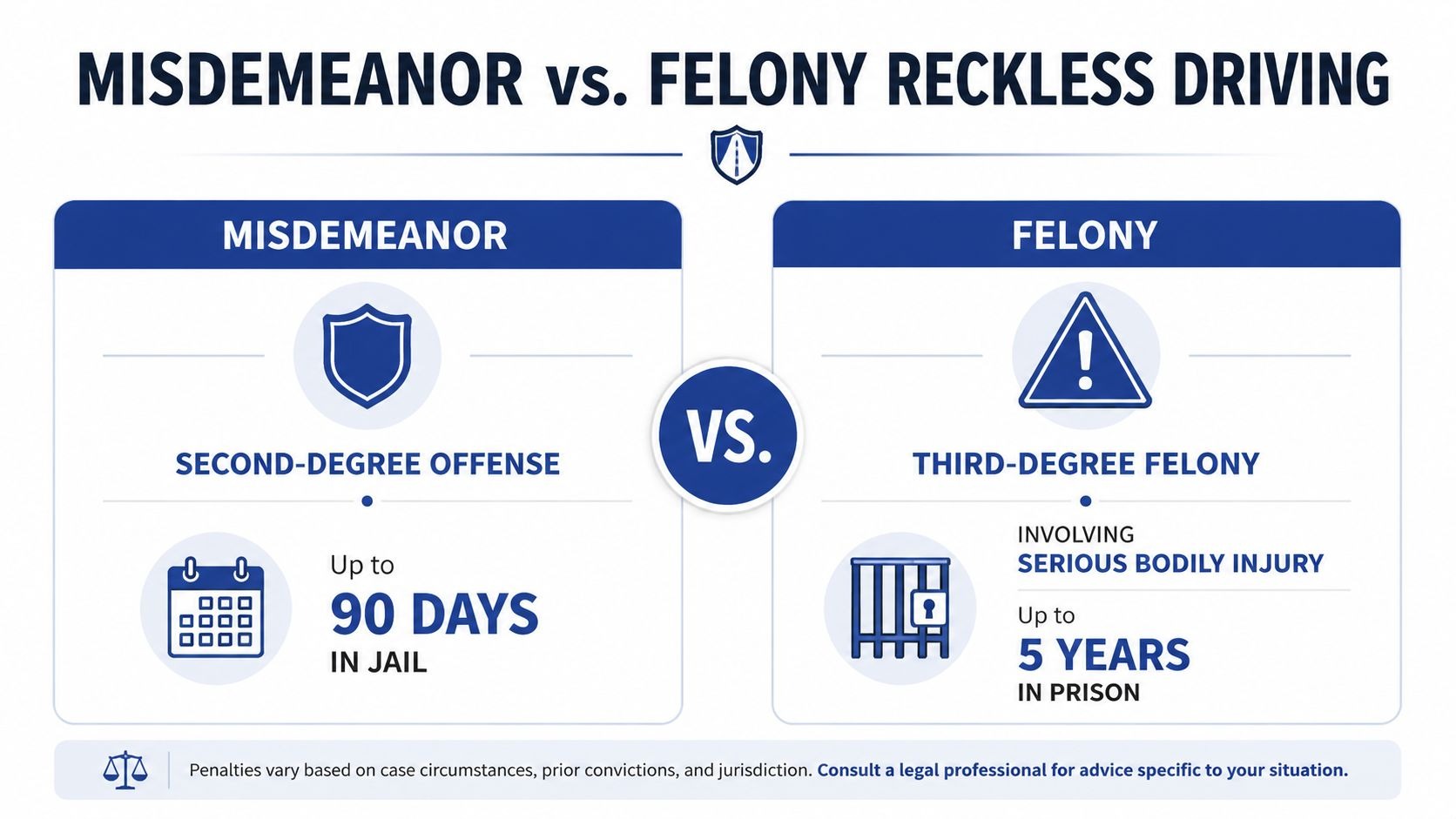
According to the Florida Statutes and an overview from the Ticket Shield legal resource on penalties for reckless driving, a first reckless driving offense in Florida is generally charged as a second-degree misdemeanor, while reckless driving that causes serious bodily injury can be charged as a third-degree felony. In practical terms, that means a case can move from county jail exposure to state prison exposure based on the harm the driver caused.
Reckless Driving Charges in Florida: Misdemeanor vs Felony
Penalty | Misdemeanor Reckless Driving | Felony Reckless Driving |
Level of offense | Second-degree misdemeanor | Third-degree felony |
Incarceration exposure | Up to 90 days in jail | Up to 5 years in state prison |
Fine exposure | Up to $500 | Up to $5,000 |
What typically drives the difference | Reckless conduct alone | Reckless conduct plus serious bodily injury |
Why this matters in your injury claim
From a victim's side, the felony charge can be powerful evidence in the civil case, even though it does not guarantee payment. Insurance carriers pay close attention when the criminal allegation involves serious bodily injury because that usually means the facts are harder to soften and the injuries are harder to dismiss as minor.
I see the same pattern often. In a misdemeanor-level case, the defense may argue that the driver made a bad split-second choice and the injuries are overstated. In a felony case, those arguments usually get narrower. The carrier still fights, but it has less room to portray the wreck as ordinary carelessness.
That changes settlement posture in several ways:
Liability gets harder to blur: a felony filing supports the argument that the driver's conduct went beyond simple inattention.
The injury story gains weight: the criminal case puts the seriousness of the harm at the center of the dispute.
Exposure increases: juries tend to react differently when the same conduct is serious enough to support felony prosecution.
A criminal case and a civil case are never identical. Different burdens apply, and prosecutors are not handling your compensation claim. Still, when the at-fault driver faces felony reckless driving charges, your injury case often starts from a stronger position than a standard crash claim.
The Tipping Point: How Reckless Driving Becomes a Felony
A driver barrels through traffic at high speed, clips another car, and leaves someone in the trauma bay with a fractured spine or a brain injury. In Florida, that is often the point where reckless driving stops being a misdemeanor and becomes a felony.
The turning point is serious bodily injury. Under Florida Statutes section 316.192, reckless driving rises to a felony when the conduct causes serious bodily injury, meaning an injury that creates a substantial risk of death, serious personal disfigurement, or protracted loss or impairment of the function of a bodily member or organ. Cuts, soreness, and temporary pain may support an injury claim, but they usually do not trigger felony treatment. Lasting harm changes the legal picture.
What prosecutors and injury lawyers look for
No single document decides this issue. Prosecutors build the criminal case from the medical proof, the crash facts, and the timeline. Injury lawyers review the same evidence for a different reason. We use it to show the insurer that the damage was severe, well-documented, and directly tied to the wreck.
Common proof includes:
Hospital records and imaging: ER notes, CT scans, MRIs, surgical consults, and discharge instructions often show whether the injury was life-threatening or likely to cause lasting impairment.
Physician opinions: treating doctors and specialists may explain whether the victim faces permanent restrictions, disfigurement, chronic pain, or reduced function.
Crash reconstruction evidence: scene photos, vehicle damage, roadway measurements, and witness statements help connect the force of the collision to the injuries.
Electronic vehicle data: an Event Data Recorder may show speed, braking, and steering inputs shortly before impact.
For readers who want a broader background on the penalties for reckless driving, that overview gives useful context. Florida cases still turn on Florida law and Florida proof.
Why this tipping point matters so much for your civil case
Many victims miss an opportunity in these situations. The same evidence that supports a felony filing can also strengthen the injury claim against the at-fault driver and the insurance company.
A felony allegation based on serious bodily injury makes it harder for the defense to minimize what happened. An insurer can still dispute value, causation, or preexisting conditions. But once the crash has produced injuries serious enough to support felony prosecution, the carrier has a tougher time framing the case as a routine traffic mistake with minor medical complaints.
That matters during settlement talks. It affects how the adjuster evaluates risk, how defense counsel advises the carrier, and how a jury may view the driver's conduct if the case goes to trial. If you are trying to understand how those factors can affect compensation, our Florida auto accident settlement guide explains the damages side in plain terms.
Why early proof matters
Serious injury must be documented clearly and consistently. A victim who delays treatment, skips follow-up visits, or stops therapy early gives the defense room to argue the condition was not as serious as claimed, or was caused by something else.
I tell clients this often. Pain alone is not enough. The records need to show function loss, objective findings, and a clear course of treatment.
The criminal case may focus on whether the injuries meet the felony threshold. Your civil case uses much of that same proof to show the full extent of your losses.
Using the Felony Charge as Leverage in Your Injury Claim
A prosecutor files felony reckless driving after your crash. The criminal case will not pay your medical bills, replace your lost income, or account for what this injury has done to your daily life. But it can give your civil claim a real advantage if your lawyer knows how to use the facts, the charging documents, and the evidence developed in the criminal case.
A felony charge changes the way the defense evaluates risk. It tells the insurer this was not a routine traffic mistake. It was conduct serious enough for the State to treat it as a crime, and that affects settlement discussions, witness credibility, and how a jury may view the driver's choices.
A conviction or statutory violation may help support the civil negligence case, but the effect depends on the statute, the facts, and admissibility rules. The victim still must prove causation and damages. In some situations, violation of a safety statute may help establish breach of duty under a negligence per se theory, although the civil claim still requires proof of causation and damages. The criminal file can also point to useful evidence early, including officer observations, witness statements, body camera footage, and any admissions by the driver.
What that advantage looks like in practice
It limits the defense theme
Insurance carriers often try to frame a serious crash as a momentary lapse or a misunderstanding on the road. A felony reckless driving case makes that framing harder. The charge itself does not prove every part of your injury claim, but it gives the defense less room to argue the driver's conduct was minor or excusable.
It strengthens your settlement position
Cases with criminally reckless conduct tend to be valued differently because the facts are harder to explain away. That matters when you are seeking payment for hospital care, ongoing treatment, lost wages, reduced earning ability, pain and suffering, and future medical needs. If you want a clearer picture of how insurers value these categories of damages, this Florida auto accident settlement guide breaks down the main factors.
It can support a punitive damages argument
Punitive damages are reserved for conduct that goes beyond ordinary carelessness. They are not available in every case, and Florida law sets procedural limits on pursuing them. Still, when the driving conduct is extreme enough to result in a felony prosecution, that record can become part of the argument that compensation alone is not enough.
I tell clients to be realistic here. A felony charge helps, but it does not automatically produce a high settlement.
The civil case still turns on proof. You need clean medical records, consistent treatment, documented wage loss, and evidence that ties the crash to the harm the defense will try to minimize. You also need to account for policy limits and whether the driver has assets beyond insurance. Those trade-offs matter in every serious injury case.
Common mistakes
Waiting for the criminal case to end can cost you evidence. Surveillance footage gets deleted. Witnesses stop answering calls. Vehicles are repaired or destroyed.
Assuming an arrest guarantees compensation is just as dangerous. Criminal court is about punishment by the State. Your civil claim is about making the at-fault driver and the insurer pay for the damage they caused, and that requires its own strategy from the start.
Immediate Steps to Protect Your Case and Your Rights
A felony reckless driving arrest may make headlines within days. Your injury case can still be damaged in those same days if the right evidence is not secured and your statements are not handled carefully.
The State is building a criminal case. You need to protect a civil one.
Preserve proof before it disappears
Start collecting and saving evidence immediately. Do not assume law enforcement, the prosecutor, or the insurance company will gather everything your claim needs to prove the full extent of your losses.
Focus on the facts that tend to get lost first:
Photograph the scene and your injuries. Get the vehicle damage, skid marks, debris, road conditions, airbag deployment, bruising, casts, and any visible cuts or swelling.
Keep damaged personal property. Torn clothing, broken glasses, helmets, child seats, and damaged phones can help show impact force and injury mechanics.
Get the crash report as soon as it is available. It may identify witnesses, citations, responding officers, and observations that help tie the criminal conduct to your civil claim.
Save every medical and wage-loss document. Keep discharge papers, prescriptions, imaging orders, work restrictions, bills, and pay records showing missed time.
For a more detailed evidence checklist, review this guide on documenting evidence for a Florida personal injury claim early.
Treat the insurer like an adverse party
Insurance adjusters often contact injured people before they know the full diagnosis, before they have counsel, and before they understand how a felony driving charge can affect coverage arguments and case value.
One defense tactic is to argue that the driver's conduct was so extreme that it falls outside policy coverage. In some cases, an insurer may raise coverage arguments based on policy exclusions or intentional-conduct language. Whether those arguments succeed depends on Florida law, the policy language, and the specific facts. Do not assume the carrier will accept responsibility because the other driver was arrested.
Watch for these problems:
Recorded statements designed to lock you in early
Quick settlement offers before your treatment picture is clear
Coverage arguments based on exclusions or intentional conduct
Efforts to downplay gaps in care or preexisting conditions
If the insurer is asking for a recorded statement, disputing coverage, or pressing for a fast release, the claim needs legal attention right away.
Follow through with medical care
Consistent treatment does two things at once. It protects your health, and it creates the records needed to prove what this crash caused.
Go to the appointments your doctors recommend. If you cannot make a visit because of cost, work, or transportation, tell the provider so the reason appears in the chart. If a specialist changes your treatment plan, make sure the record explains why.
In serious reckless driving cases, defense lawyers and insurers look for any gap they can use. Do not give them one.
How CAINE LAW Holds Reckless Drivers Accountable
Felony reckless driving cases aren't routine car wreck files. They often involve overlapping criminal and civil issues, serious injuries, insurer resistance, and evidence that needs to be secured early. The lawyer handling the claim needs to understand all of it at once.
CAINE LAW represents Florida injury victims in high-stakes vehicle cases and brings a useful perspective to these fights. Daniel Caine's early career background on the defense side means he understands how insurers evaluate exposure, where they try to create doubt, and which facts move settlement value. That matters when the other driver's conduct crosses from negligence into criminal recklessness.
What effective representation looks like
Strong handling in a felony reckless driving injury case usually includes:
Fast evidence work: securing crash reports, witness statements, medical records, and available vehicle data before key proof is lost
A coordinated strategy: using developments in the criminal case without waiting passively for prosecutors to do the civil lawyer's job
Pressure on the insurer: confronting blame-shifting, minimization of injuries, and coverage defenses directly
Trial readiness: preparing the case as if it may need to be presented to a jury
CAINE LAW also has the litigation experience to back up that approach. Mr. Caine has over 20 years of experience, more than 1,200 handled cases, and over $100 million in recoveries, with notable results that include a $14.4 million settlement and a seven-figure trial verdict. Past results do not guarantee or predict a similar outcome. Each case depends on its facts, evidence, insurance coverage, and applicable law.
When a reckless driver leaves you with surgeries, lost income, lasting pain, or a family crisis, you need more than sympathy. You need a legal team that knows how to turn facts into an advantage and that advantage into recovery.
If you were hurt by a driver facing felony reckless driving allegations, CAINE LAW can help you protect the evidence, deal with the insurer, and pursue the compensation your case deserves. You don't have to sort through criminal charges, insurance issues, and medical fallout on your own. In pain? Call Caine.