In Pain? Call Caine
Hit-and-Run in Florida: A Victim's Complete Guide

5 Min read
By: Caine Law
Share

The other car is gone. Your hands are shaking. You are trying to remember the plate, the color, the direction it turned, and whether your neck pain started immediately or a few minutes later.
That is how hit-and-run cases usually begin. Not with clarity. With noise, adrenaline, and a dozen decisions that suddenly matter.
In a hit-and-run in Florida, many individuals focus first on the driver who fled. That is understandable. But from a victim's standpoint, the urgent question is often different: How do I protect my health and get my bills paid if the person who caused this disappears? The answer usually lies in a mix of fast evidence preservation, smart insurance handling, and a civil recovery strategy that does not depend entirely on the police finding the other driver.
The Shocking Reality of Hit and Run Accidents in Florida
One of the hardest parts of a hit-and-run is how personal it feels. Someone hit you, saw the damage, and left you there to deal with the aftermath alone.
That reaction is not overblown. It is a real violation of the basic duty every driver owes others on the road.
Florida sees this far too often. In 2023, Florida recorded an estimated 105,092 hit-and-run crashes, representing approximately 26% of all vehicle accidents in the state, a rate far exceeding the national average of 11%.
Why these crashes feel different
A standard crash case is difficult enough. A hit-and-run adds a layer of chaos because key information is missing from the start.
You may not know:
Who hit you
Whether nearby cameras captured the vehicle
Whether witnesses saw the plate
Whether your own insurance will treat the claim fairly
That last point catches many people off guard. In a normal liability claim, your lawyer pursues the at-fault driver's coverage. In a hit-and-run in Florida, the financial path often shifts back onto your own policy.
A hit-and-run is not just a traffic crime. It is also an insurance and evidence problem that starts the moment the other vehicle disappears.
You are not overreacting
Clients often apologize for being upset about a crash that "could have been worse." That misses the point. Even when the visible property damage appears manageable, injuries can surface later, and the missing driver complicates everything from repairs to treatment to wage-loss documentation.
The practical response is simple. Treat the case seriously from the first hour. The steps you take immediately can shape both the investigation and your financial recovery.
Your Legal Duties at the Scene of Any Florida Accident
Before discussing the driver who fled, it helps to understand what Florida law requires of any driver involved in a crash. That baseline matters because it shows exactly how far a hit-and-run driver strayed from the law.
What every driver must do
After a crash, a driver must stop, remain at or near the scene, exchange identifying information, and provide reasonable assistance if someone is hurt. That includes giving a name, address, vehicle registration information, and showing a driver's license when requested.
If the crash involves injury, getting emergency help is part of the basic duty. If it involves an unattended vehicle or damaged property, the driver still has obligations. Leaving and hoping no one notices is not a lawful option.
What this means for you as the victim
Even though the other driver ran, your own conduct still matters. The strongest claims usually begin with the victim doing the following:
Stay at the scene if you can do so safely. Moving away without necessity can create confusion later.
Call law enforcement. A formal report gives the claim a foundation.
Identify yourself accurately. Give facts, not guesses.
Accept medical evaluation if you may be injured. Declining help in the moment can complicate the record later.
The mistake people make under stress
Many individuals think, "The other driver left, so this is all obvious." It is not always obvious to an insurer reviewing the file later.
Insurance adjusters look for gaps. If the timing is unclear, if the scene was poorly documented, or if the first medical visit was delayed, they use those issues to question causation and seriousness. That happens even when the victim did nothing wrong.
Give the police and your insurer a factual account. Do not fill in blanks with assumptions about speed, intoxication, motive, or fault unless you know.
Why these duties matter legally
A hit and run is serious because it violates duties that protect injured people in the immediate aftermath of a crash. When a driver stops, identifies themselves, and helps secure emergency care, the system can begin working. When they flee, the victim loses time, evidence can disappear, and proving the claim becomes harder.
That is why your own response should be disciplined. Follow the rules. Preserve the record. Let the evidence do the work.
Florida Hit and Run Laws: A Crime with Severe Penalties
Florida treats leaving the scene as more than careless behavior. The law scales penalties based on the circumstances of the crash.
For victims, understanding that the criminal structure serves two purposes. First, it explains why law enforcement takes certain cases more aggressively. Second, it helps separate the criminal case from the civil recovery case. They are related, but they are not the same thing.
Florida Hit and Run Penalties at a Glance
Type of Damage | Crime Classification | Potential Prison Time | Maximum Fine | License Revocation |
Property damage only | Second-degree misdemeanor | Up to 60 days in jail | $500 | Possible consequences depending on the case |
Injury and Serious Bodily Injury | Third-degree or second-degree felony | Up to 5 years in prison | $5,000 | At least 3 years |
Fatality | First-degree felony | 4 to 30 years in prison | $10,000 | At least 3 years |
What the table does and does not tell you
The table lists the penalty range, but it does not indicate whether police will identify the driver or whether prosecutors can prove the case beyond a reasonable doubt. A criminal charge requires evidence. In hit-and-run cases, that often comes from surveillance footage, witness statements, physical damage patterns, debris, repair records, and later admissions.
That means a victim should never assume that "the police will handle it" is enough. Police and prosecutors focus on criminal liability. Your civil claim requires its own evidence strategy.
Criminal punishment does not pay your bills
This is the trade-off many victims do not see at first. A conviction can punish the person who fled. It does not automatically cover your medical costs, lost income, or pain and suffering.
Even if the driver is arrested, you may still face:
Medical treatment disputes
Repair delays
Coverage fights with your own insurer
Questions about whether your injuries came from this crash
Those are civil and insurance issues, not just criminal ones.
The most useful way to think about the law
For a victim, the criminal side matters. But it is not the center of your recovery plan. The center is evidence and compensation.
If the driver is found, the criminal case can help develop facts. If the driver is never found, the criminal case may stall while your financial losses continue. That is why an experienced lawyer approaches a hit and run in Florida with two tracks in mind from the beginning: the search for the fleeing driver and the immediate path to payment.
What to Do Immediately After a Hit and Run
The first hour matters. So do the first 24 hours.
People lose strong cases by doing ordinary things under stress. They chase the fleeing car, skip the ER because they feel embarrassed, fail to photograph debris, or report the crash to insurance with too many guesses and not enough facts.
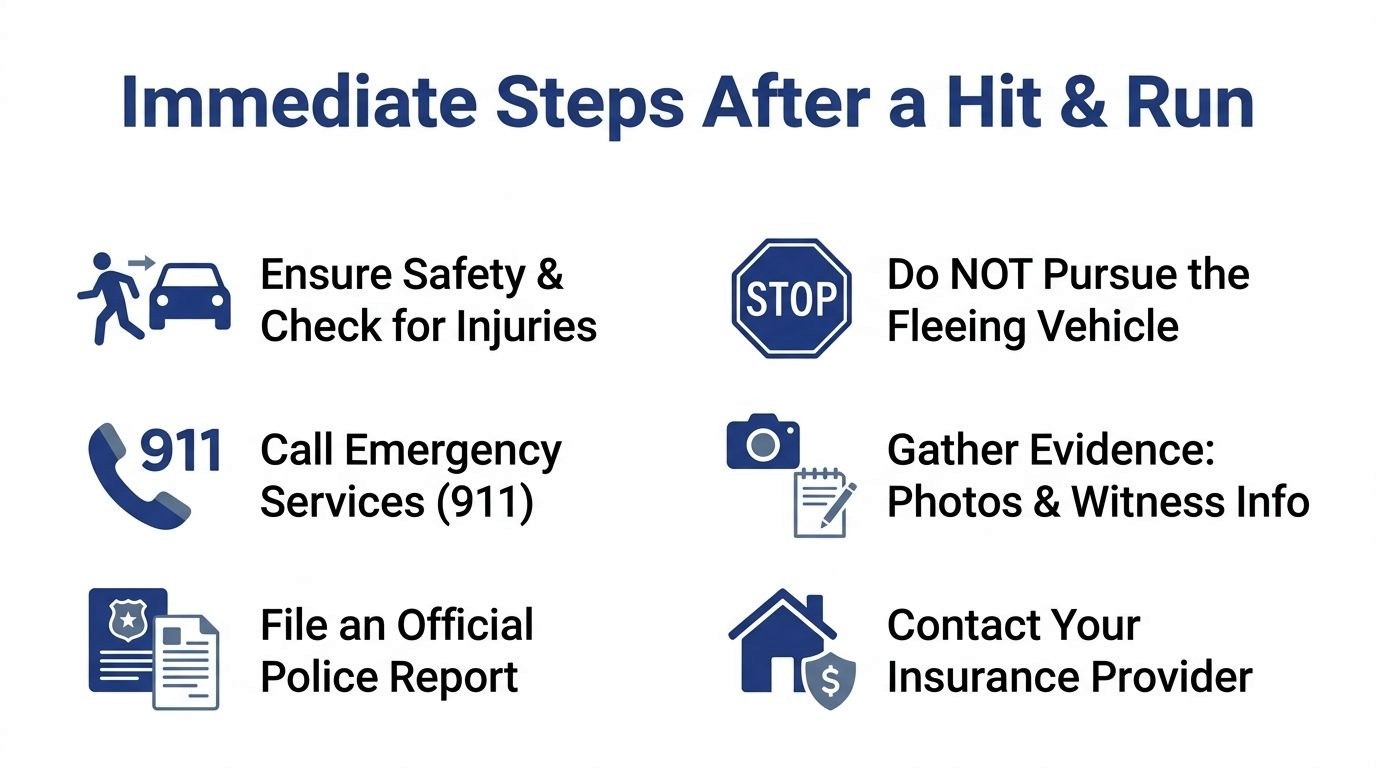
Start with safety, not pursuit
If you can move safely, get out of active traffic. Check yourself and anyone else in your vehicle for injuries.
Do not chase the other driver. Pursuit creates new danger, and it can destroy your credibility if the timeline later becomes muddled.
Call 911 and be specific
When you call, give the dispatcher the basics in a clean order:
Your location
Whether anyone is hurt
The other driver fled
Any details about the vehicle, even partial ones
The direction the vehicle traveled
If you only caught part of a plate, say that. A partial plate, an unusual bumper sticker, a missing hubcap, a delivery logo, a broken headlight, or fresh front-end damage can matter.
Lock down evidence before it disappears
Scenes change quickly. Cars get moved. Rain washes away debris. Nearby businesses overwrite camera footage.
Gather what you can:
Photograph your vehicle from several angles.
Photograph the roadway, skid marks, debris, paint transfer, and nearby intersections.
Take photos of visible injuries.
Ask nearby drivers, pedestrians, or business employees what they saw.
Look for cameras at stores, gas stations, homes, parking lots, and traffic approaches.
If you need a more detailed checklist for preserving evidence, review how to document the evidence needed for a personal injury claim in Florida.
Do not just ask a witness what happened. Get their name, phone number, and a short summary of what they observed before they leave.
Get medical care even if you think you are okay
Adrenaline hides injuries. Neck pain, headaches, dizziness, back pain, and numbness often appear later.
The legal reason for evaluation is as important as the medical one. Early records connect the crash to your symptoms. Delayed care gives insurance adjusters room to argue that something else caused the problem.
Report the crash to your insurance carefully
Notify your insurer promptly. Keep the report factual.
Good examples include:
"I was struck from the rear, and the other vehicle left the scene."
"I saw a dark SUV turn eastbound."
"Police responded, and a report was made."
Bad examples include guessing why the driver ran or downplaying your pain to sound reasonable.
Preserve the damaged vehicle
Do not rush into repairs if the car still holds evidence. Paint transfer, impact points, embedded debris, and crush damage can all help identify what happened.
If the vehicle must be moved, photograph it thoroughly first. Keep two receipts, storage records, and repair estimates in one file.
What usually hurts a claim
These mistakes come up again and again:
Posting about the crash on social media
Giving a recorded statement without preparation
Throwing away damaged personal items
Missing follow-up appointments
Assuming minor property damage means minor injury
A hit and run in Florida can become a strong claim or a messy one very quickly. The difference often comes down to discipline on the first day.
Securing Compensation When the Driver Is Never Found
Most victims ask the same question after the shock wears off: Who pays if the driver is gone?
The answer is usually "no one." But it is also rarely simple.
Your own policy may become the main recovery path
When the at-fault driver is unidentified, victims must rely on their own Uninsured/Underinsured Motorist coverage. That surprises people. They assume their own insurer will step in helpfully because they paid premiums. In practice, once money is on the line, your insurer can start acting like any other adverse party.
How the coverage picture usually works
Florida drivers often begin with PIP, or Personal Injury Protection, for immediate accident-related expenses under the no-fault system. PIP is the first layer.
After that, UM/UIM coverage often becomes the critical tool in a hit-and-run case because the unknown driver is treated like an uninsured one for claim purposes.
Coverage | What it usually does in a hit and run | Common problem |
PIP | Provides an initial layer of benefits after the crash | It may not cover the full loss |
UM/UIM | Steps in when the fleeing driver cannot be identified | The carrier may dispute value, injury, or policy terms |
Collision or property coverage | Can help with vehicle damage, depending on the policy | Deductibles and coverage terms may apply |
What works when filing a UM claim
UM claims are won with proof, consistency, and pressure.
What usually helps:
A prompt police report
Early medical documentation
Photos showing the impact
Witness information
A clear timeline of symptoms and treatment
Complete policy review before speaking loosely with the adjuster
What does not work:
Waiting too long to start treatment
Telling the insurer "I'm fine" before you know
Assuming the adjuster will explain your coverage fully
Sending scattered records with no organized damage narrative
If you want a broader look at how value gets built in an auto claim, this Florida auto accident settlement guide is a useful companion resource.
A UM claim is still a negotiation. The insurer may be your own company, but it still evaluates exposure, defenses, and its negotiating position.
Why policy language matters
Not every policy treats every hit-and-run scenario the same way. Some claims rise or fall on details people miss in the declarations page, endorsements, and exclusions.
That is why one of the first legal tasks is often a line-by-line policy review. The goal is to identify every available source of recovery, preserve notice requirements, and avoid giving the carrier an avoidable denial argument.
One practical option for handling the process
Some injured people handle the initial reporting themselves and bring in counsel once the insurer starts resisting. Others involve a lawyer immediately to manage notice, records, evidence, and negotiation strategy. Firms handling auto and motorcycle injury cases, including Caine Law, often review the policy, coordinate evidence collection, and pursue UM claims when the at-fault driver remains unidentified.
The important point is not to treat a ghost driver as the end of the case. In many hit-and-run claims in Florida, the main conflict is with the insurance file, not the criminal docket.
Your Right to File a Civil Lawsuit for Full Damages
A criminal case punishes wrongdoing. A civil case pursues compensation.
Those are different jobs. If the fleeing driver is identified, you may have the right to sue that person for the losses the crash caused. If your own insurer mishandles a UM claim, there may also be a separate dispute with the carrier.
What a civil claim can recover
A properly prepared civil case can seek damages for harms that go far beyond the first wave of bills.
That may include:
Medical expenses already incurred
Future medical care
Lost wages
Reduced earning ability
Property damage
Pain and suffering
Other human losses tied to the injury
The value of a civil claim depends on proof. Medical records, imaging, provider opinions, wage records, photographs, and testimony all matter.
When a lawsuit becomes necessary
Some cases settle through insurance negotiations. Others do not.
A lawsuit may be the right move when:
The driver has been identified and liability is clear, but the payment is disputed.
The insurer minimizes your injuries or refuses to value the claim fairly.
The policy issues are contested, and informal negotiation goes nowhere.
The point of filing suit is not just to be aggressive. It is to compel disclosure, preserve rights, and create a structure for testing evidence.
Timing matters
Florida deadlines can affect both insurance claims and lawsuits. Acting quickly is not about drama. It is about preserving video, witness memory, vehicle evidence, and legal options before they fade.
Waiting usually helps the defense more than the injured person.
Civil influence is different from criminal influence
Victims sometimes assume that if police have not found the driver, there is nothing left to do. That is often wrong. Civil strategy can move forward through insurance, policy analysis, treatment documentation, and damages development even while the criminal investigation stalls.
If the driver later turns up, that work is not wasted. It often serves as the foundation for a liability case against that person.
Frequently Asked Questions About Florida Hit and Runs
What if I only got part of the license plate
Give police exactly what you have. A partial plate, vehicle color, make, model, damage location, business logo, or travel direction can help narrow the search. Do not guess at missing characters.
Does the Aaron Cohen Act put money in my pocket?
Not directly. It strengthens criminal consequences, which matters for public safety and prosecution. Your financial recovery still usually depends on insurance coverage, evidence, and a civil claim strategy.
I was walking or biking when I got hit. Do I still have a case
Yes. Pedestrians and bicyclists can have strong injury claims after a hit-and-run in Florida. The immediate priorities are medical care, reporting, witness identification, and locating nearby video before it disappears.
What if I think I may have been partly at fault
Do not decide that on your own. People blame themselves too quickly after crashes.
Fault in traffic cases often turns on details such as lane position, lighting, speed, visibility, right-of-way, and witness accounts. Even if your conduct becomes an issue, that does not automatically erase your claim.
Should I give my insurance company a recorded statement
Not before you understand what coverage applies and what facts need to be stated carefully. A recorded statement can lock you into wording that later gets used against you.
Can I still recover if my injuries did not show up right away
Possibly, yes. Delayed symptoms are common. The important step is to seek evaluation promptly once symptoms appear and to describe clearly when they started and how they changed.
What if there was only property damage
You should still report it and document everything. Property-only cases sometimes reveal injury symptoms later, and the physical damage can help identify the fleeing vehicle.
How Caine Law Can Help Your Hit and Run Case
Hit-and-run claims are difficult because two fights often happen at once. One is proving what happened. The other is getting paid despite missing information, skeptical adjusters, and policy language that individuals rarely read closely.
Caine Law handles auto and motorcycle accident cases in Florida, including claims involving unidentified drivers, disputed injuries, and insurance resistance. Daniel Caine brings more than 20 years of experience, defense-side insight from his early career, and a litigation-focused approach to building advantage through documentation, negotiation, and trial preparation when needed.
If you were hurt in a hit-and-run in Florida, the case should be treated as both an injury matter and an evidence matter from day one. That means protecting the vehicle, organizing treatment records, reviewing all applicable policies, and controlling communications with insurers before avoidable mistakes are made.
You do not need to sort this out alone while trying to heal.
If a fleeing driver left you with injuries, bills, and uncertainty, contact Caine Law for a free consultation. We can review the crash, explain your insurance options, and help you pursue every available path to compensation. In pain? Call Caine.