In Pain? Call Caine
Recovery from Car Accident: A Florida Roadmap

5 Min read
By: Caine Law
Share

Recovery from a car accident in Florida starts with medical care, documentation, and smart decisions before the insurance process gets ahead of you. In Florida, most negligence-based car accident lawsuits must be filed within two years. That deadline is separate from insurance deadlines and evidence-preservation concerns, so waiting to “see how it goes” can weaken a valid claim. In Florida, those first hours matter more than many individuals realize.
Recovery from car accident injuries rarely follows a straight line. Some symptoms show up right away. Others surface after the adrenaline drops. On top of that, you're dealing with car damage, missed work, medical appointments, and a legal system that doesn't slow down just because you're hurting.
This helps to remember: you're not facing something unusual or impossible. The World Health Organization notes that 1.19 million people die annually from road traffic crashes, while 20 to 50 million more suffer non-fatal injuries, many with long-term disability. That fact underscores two things at once. Recovery can be a long process, and there is a practical way through it when you make good decisions early.
For Florida drivers, that roadmap has to account for more than medicine. It also has to account for PIP coverage, strict timing requirements, evidence preservation, and how insurers evaluate claims. If you need a broader checklist right away, review these essential steps and legal guidance after accidents. Then come back to the details below.
The First 24 Hours Your Recovery from a Car Accident Begins
The first day is usually disorganized. That's normal. People often think recovery starts when physical therapy begins or when the pain becomes obvious. In reality, recovery from car accident injuries starts with the decisions you make before the tow truck leaves and before the first adjuster calls.
Focus on control, not perfection
You do not need to solve everything in one day. You do need to protect three things immediately:
Your health: Get checked even if you think you're “probably fine.”
Your timeline: Florida PIP rules can make delayed medical care costly because initial treatment is generally required within 14 days.
Your proof: What gets documented early is usually easier to prove later.
If you're dizzy, confused, sore, or emotionally shaken, that doesn't mean you're overreacting. It means your body just absorbed force. Many people minimize symptoms because they want to get home, get the kids settled, or get back to work. That instinct is understandable, but it often creates trouble later.
What the first day should accomplish
Priority | What to do |
Medical care | Get evaluated promptly and follow discharge instructions |
Basic evidence | Save photos, names, insurance details, and crash location |
Insurance notice | Report the crash to your own insurer with basic facts |
Symptom tracking | Start noting pain, stiffness, headaches, numbness, and sleep problems |
The point is not to create a lawsuit on day one. The point is to avoid avoidable damage. A weak medical record, missing scene evidence, or casual statements to insurance can complicate an otherwise valid claim.
There's also an emotional piece people don't talk about enough. After a crash, even routine tasks can feel harder. Driving again may feel different. Sleep may be worse. Family responsibilities may feel heavier. That doesn't make your claim dramatic. It makes it real.
The Florida mindset that helps most
The people who tend to do better after a crash usually adopt one simple mindset: treat the aftermath like a process, not an inconvenience. They don't assume pain will disappear on its own. They don't rely on memory. They don't let insurance define the seriousness of the injury before their doctors do.
That approach doesn't guarantee an easy recovery. It does put you in a stronger position medically, financially, and legally.
At the Scene: Actions to Protect Your Health and Rights
The minutes right after a crash call for simple decisions, in order. Don't try to say the perfect thing. Don't argue about fault. Don't negotiate on the roadside.
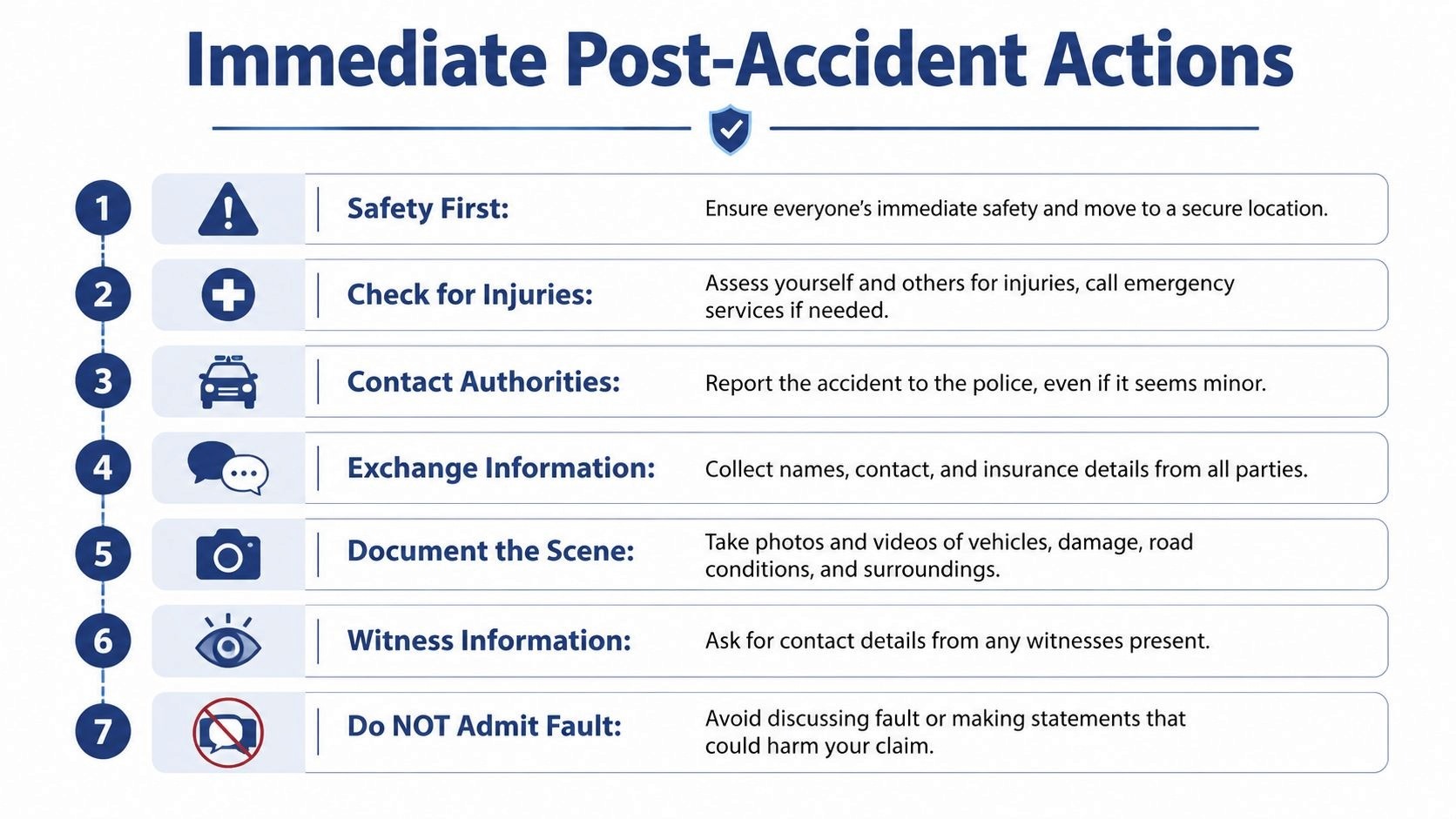
The immediate checklist
Get to safety if you can. If the vehicles can be moved and it's safe to do so, get out of traffic.
Check for injuries. Start with yourself, then passengers, then others nearby.
Call 911. Ask for police and medical help when needed.
Exchange information. Get names, contact information, driver's license details, insurance information, and vehicle information.
Identify witnesses. A neutral witness can matter later if stories change.
Photograph the scene. Take more than you think you need.
Get medical care quickly. In Florida, delay can affect both treatment and insurance benefits.
What to say and what not to say
At the scene, keep your words short and factual.
Use statements like:
“Are you hurt?”
“I'm calling 911.”
“Let's exchange insurance information.”
“The officer can document what happened.”
Avoid statements like:
“I'm sorry, this was my fault.”
“I'm okay.”
“It's just a minor accident.”
“I didn't see you.”
Those comments may seem polite, but they can be interpreted as admissions or later used to downplay your injuries. You don't know the full medical picture in the first few minutes, so please avoid guessing.
The Florida issue people miss
Florida's no-fault system puts unusual pressure on the timing of treatment. Your PIP benefits may depend on getting a medical evaluation quickly after the crash. Waiting because you hope the pain goes away can backfire. It can harm your health and prompt the insurer to question whether the crash caused your condition. Florida’s PIP statute generally requires initial medical care within 14 days after the crash. Missing that window can jeopardize PIP medical benefits, even if the injury is real.
That doesn't mean you need to panic. It does mean you should act promptly. Urgent care, an emergency room, or another qualified medical provider may be appropriate depending on your symptoms.
A short do and don't table
Do | Don't |
Call law enforcement | Settle the fault on the roadside |
Take wide and close-up photos | Rely on memory later |
Ask witnesses for contact details | Assume the police report includes everything |
Seek medical attention promptly | Delay care because pain seems mild |
If the crash happened fast, your memory may already be less reliable than you think. That's one reason these first actions matter so much.
Documenting Everything: The Foundation of Your Claim
A strong claim is usually built, not discovered. The strongest files I see are rarely the ones with the loudest facts. They're the ones with the clearest record.
Your phone is your first evidence tool.
Use your phone deliberately. Don't just take one picture of a bumper and move on. Build a visual record.
Photograph:
All four corners of each vehicle
Close-ups of every damaged area
License plates
Debris, skid marks, broken glass, and fluid on the road
Traffic lights, stop signs, lane markings, and road layout
Weather and lighting conditions
Visible injuries such as bruising, cuts, swelling, or seat belt marks
Take a video too. A slow walkaround can capture angles that still photos miss.
Get records from people, not just the scene
Photos matter, but names matter too. Write down or save:
Witness names and phone numbers
The responding officer's name
The police report number
The tow company name
The location where the vehicle was taken
You also want a copy of the crash report as soon as it's available. Police reports are not perfect, but they create a starting point for the insurance file. If there's an error, it's better to identify it early.
Start a recovery journal on day one
This is one of the most underused tools in a Florida injury claim. Keep a notebook or notes app and update it regularly. You're not writing for drama. You're creating a timeline.
Include entries like:
Pain location: neck, lower back, shoulder, knee, headaches
Daily limits: trouble driving, sleeping, lifting, bending, sitting, or working
Appointments: where you went, who you saw, what was recommended
Medication effects: relief, drowsiness, nausea, or no change
Life impact: missed events, childcare difficulties, inability to exercise, household help needed
A medical chart tells part of the story. Your daily notes show what the injury actually changed.
Organize the file before it gets messy
Create one folder, physical or digital, with sections for photos, bills, prescriptions, referrals, work notes, repair records, and insurance letters. If you wait until the insurer asks for proof, you'll spend more time hunting than recovering.
If you want a more detailed Florida-specific walkthrough, this resource on how to document evidence needed for a personal injury claim in Florida can help you build that file correctly from the start.
Good documentation does two things. It makes your claim harder to dismiss, and it keeps you from relying on memory months later when the details matter most.
Navigating Your Medical Recovery and Rehabilitation
Medical recovery after a crash is rarely a one-appointment-and-done affair. It usually unfolds in stages, and understanding the stage you're in helps you make better decisions about treatment, work, activity, and expectations.
Acute care and the first decisions
In the first phase, the job is simple. Control pain, identify serious problems, and avoid making things worse. Initial exams, imaging when needed, medication guidance, and referral decisions happen during this period.
That phase is not the time to test whether you can “push through it.” If movement suddenly worsens symptoms, or if you develop numbness, severe headaches, confusion, or worsening pain, tell the provider immediately.
Early rehab means measured movement
After the immediate crisis settles, many people enter a frustrating stage where they are hurt but not visibly enough for others to understand. Treatment compliance matters during this phase.
That can include:
Following up with the right specialists when the first provider recommends it
Starting prescribed therapy instead of waiting for symptoms to become persistent
Keeping every appointment unless you have a real reason to reschedule
Saving bills, referrals, and visit summaries as they come in
People often make one of two mistakes here. They either do too little because they're afraid of pain, or they do too much because they're impatient. Neither helps. Good recovery from car accident injuries usually looks boring. Consistent appointments. Gradual progress. Careful tracking.
Functional recovery is about real life, not just pain scores
By the functional phase, the question changes from “Does it hurt?” to “Can you live normally again?” At this point, rehab should address actual tasks: driving, lifting groceries, desk work, stairs, childcare, and job duties.
Recovery focus | What it means |
Pain control | Lowering inflammation and discomfort |
Range of motion | Restoring basic movement safely |
Strength and endurance | Rebuilding support for daily activity |
Task-specific function | Returning to work and home routines |
If treatment isn't addressing real-world limits, ask that question directly. “I still can't sit through a workday.” “Turning my head while driving is difficult.” “Lifting my child hurts.” Those details matter medically and legally.
Preventive work is where many people stop too early
The preventive phase is often ignored because people feel somewhat better and want their lives back. That's understandable, but stopping too early can leave you with recurring stiffness, poor body mechanics, or symptoms that flare up when work and normal stress return.
One more point from a legal perspective: gaps in treatment create two problems. They may slow recovery, and they may give an insurer an argument that your injuries weren't serious. Keep your medical course as clean and consistent as your body allows.
Handling Insurance Calls and Protecting Your Legal Claim
Insurance starts contacting people fast. Sometimes it's your own carrier under Florida's no-fault system. Sometimes it's the other driver's insurer. Either way, the first conversation is not casual, even if the adjuster sounds friendly.
The financial stakes are large. The National Safety Council reports that motor vehicle crashes in the U.S. cost an estimated $513.8 billion in 2023, including medical expenses, lost wages, and property damage. When that much money is at issue nationwide, insurers have every reason to control payouts carefully.
Know the two lanes of a Florida claim
Florida drivers often deal with two separate tracks after a crash:
Claim track | General purpose |
Your PIP claim | Initial medical bills and certain lost wages through your own policy |
Liability claim | Damages against the at-fault driver when the facts and injuries support it |
Your PIP claim may cover certain initial medical expenses and lost wages through your own policy, subject to statutory requirements, policy limits, and medical findings. A liability claim is separate and may pursue damages from the at-fault driver when the facts and injuries support it.
That distinction matters because people often think reporting to one insurer handles everything. It doesn't. Your own policy may provide immediate benefits, but that doesn't resolve the full value of an injury claim.
If you need a more focused explanation of the no-fault system, this Florida PIP guide (2026) is a useful starting point. Florida also follows a modified comparative negligence rule. If you are partly at fault, your recovery may be reduced by your percentage of fault. If you are found more than 50% responsible, you generally cannot recover damages in a negligence case.
How to handle the adjuster call
When an adjuster calls, be polite and brief. Confirm basic identifying information. Confirm the date and location of the crash. Then stop short of guessing.
Helpful phrases include:
“I'm still receiving medical evaluation and treatment.”
“I'm not prepared to discuss my injuries in detail yet.”
“Please send any requests in writing.”
“I'm not giving a recorded statement at this time.”
Avoid these common mistakes:
Speculating about fault
Ranking your injuries too early
Saying you've fully recovered when treatment is ongoing
Signing broad medical authorizations without review
Accepting a quick check before you understand the medical picture
Recent Florida realities change the risk
Florida's legal environment matters here. PIP rules already make timing important. Recent Florida tort changes, including the two-year negligence deadline and modified comparative negligence rule, make timing, evidence, and fault arguments especially important. That doesn't mean every case goes to court. It does mean casual handling of the insurance process is riskier than it used to be.
An early offer may be based on an incomplete medical record, especially if treatment is still ongoing. If your treatment is still unfolding, your claim valuation usually is too.
Counsel can become part of the recovery process, not just the lawsuit process. A Florida personal injury attorney can help coordinate records, communicate with insurers, evaluate offers, and prevent damaging statements. Firms such as CAINE LAW handle that role by gathering medical proof, lost wage documentation, and liability evidence while the client focuses on treatment.
Watch the clock even if you hope to settle
Many people put off legal advice because they want to “see how it goes.” That's understandable, but time affects evidence. Witnesses disappear. Surveillance footage gets erased. Records get harder to obtain. Even a good claim can weaken when people wait too long to preserve it properly.
If you're still treating, still missing work, still getting calls, or still unsure who pays what, those are signs to take the legal side seriously now, not after the file has already developed problems.
Knowing When to Call a Florida Car Accident Attorney
Some cases can be handled without much conflict. Many can't. The hard part is that people usually don't know which kind of case they have until weeks later, after they've already said too much, missed treatment, or accepted too little.
Clear signs you should get legal help
Call a Florida car accident attorney if any of these apply:
Your injuries are more than minor soreness
You were taken by ambulance or needed ongoing treatment
Fault is disputed
The other driver was uninsured or underinsured
The insurer wants a recorded statement
You missed work or can't return to your normal duties
You received a settlement offer before treatment was finished
There are multiple vehicles, commercial vehicles, or unclear witnesses
These are not edge cases. They are common features of claims that become more complicated over time.
Why legal help matters more for some Florida families
Not every injured person has the same room to absorb a crash. In Florida, cost pressure can directly affect medical recovery. Cost, transportation, work schedules, and confusion about coverage can all interfere with consistent treatment. When treatment gaps appear, insurers may argue the injuries were not serious or were not caused by the crash.
That matters in real life. If someone misses therapy because they can't afford the cost, can't take unpaid time off, or doesn't understand how coverage works, the medical problem may deepen, and the insurer may later argue the person “didn't follow through.”
What an attorney actually does in a recovery case
A good attorney should do more than send demand letters. The practical work usually includes:
Issue | Attorney's role |
Insurance confusion | Identify available coverage and communication strategy |
Evidence gaps | Secure records, photos, witness information, and reports |
Medical proof | Organize the treatment history and connect it to the crash |
Settlement pressure | Evaluate whether an offer closes the case too cheaply |
Litigation readiness | Prepare the claim if the insurer won't value it fairly |
This is especially important in light of recent changes in Florida law. Tort reform has changed the advantage in many cases, and insurers know it. Injured people should know it too.
If your recovery is still unfolding, your legal position is still developing. Don't let an insurer freeze the value of your claim before the facts are complete.
A consultation is often most useful before you think the case is “serious enough.” By then, there may already be missing proof or damaging statements in the file. Early legal guidance can help protect treatment, wages, and the claim itself while you recover.
If you were hurt in a Florida crash and you're trying to manage medical care, PIP issues, insurance pressure, and the uncertainty of what comes next,CAINE LAW can help you understand your options and protect your claim. The right legal guidance can support the full recovery process, not just the lawsuit. In pain? Call Caine.