In Pain? Call Caine
Florida Motorcycle Lane Splitting: Your Complete Legal Guide

5 Min read
By: Caine Law
Share

If you’ve ever been stuck in bumper-to-bumper traffic on a motorcycle, you’ve probably considered it: that tempting, open sliver of pavement between the lanes of cars. Weaving through gridlock is a practice called motorcycle lane splitting, and for many riders, it seems like a common-sense way to keep moving.
But before you punch the throttle, it's crucial to know where the law stands. Here in the Sunshine State, the answer is simple and direct: motorcycle lane splitting is illegal in Florida.
What Motorcycle Lane Splitting Means for Florida Riders
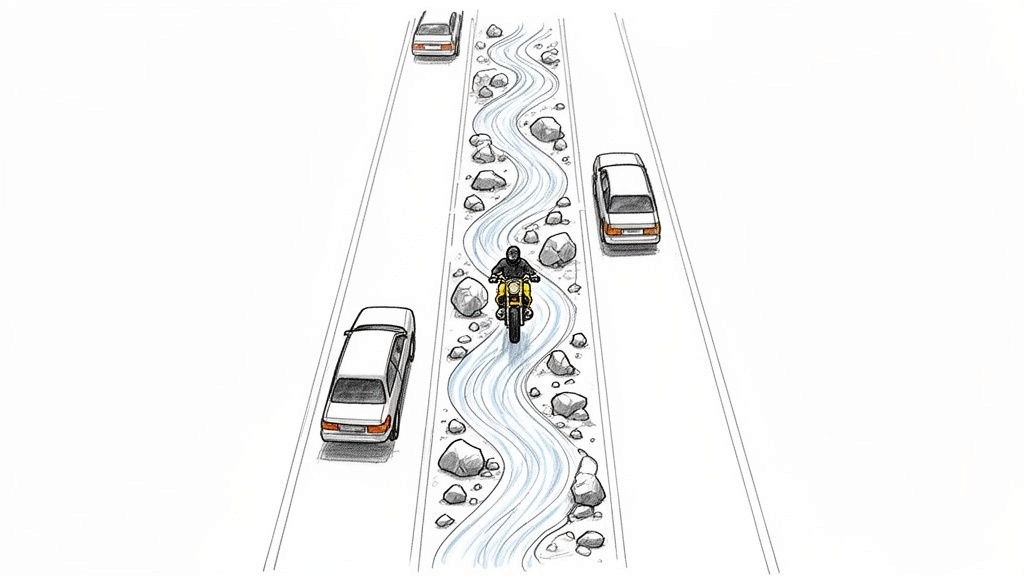
Think of a highway as a river clogged with big logs, the cars. Lane splitting is like trying to navigate a kayak through the narrow, fast-moving gaps between them. Officially, it’s the act of riding a motorcycle between two marked lanes of traffic that are moving in the same direction.
This is often confused with a similar move called lane filtering. While they sound alike, the difference between them is a big deal, both for your safety and from a legal standpoint.
The Difference Between Splitting and Filtering
Getting the terms right is the first step, because they describe two very different actions. People often mix them up, but knowing the distinction is key. To make it crystal clear, here’s a quick breakdown.
Lane Splitting Vs Lane Filtering At A Glance
Aspect | Lane Splitting | Lane Filtering |
Traffic Condition | Traffic is moving, often slowly | Traffic is stopped or barely moving |
Rider's Goal | To bypass slow-moving traffic | To move to the front at a stoplight or stop sign |
Typical Speed | Often faster than surrounding traffic | Very low speed, cautious maneuvering |
Location | Anywhere on a multi-lane road or highway | Primarily at intersections and traffic backups |
Even with these differences, Florida law doesn't distinguish between them. The statutes say a vehicle can't overtake and pass another vehicle in the same lane. Since your motorcycle is considered a vehicle and is entitled to the full lane, riding between cars is considered a violation of that rule. This applies whether you're splitting or filtering.
Although both lane splitting and lane filtering are illegal in Florida, this does not automatically mean a rider is 100% at fault for an accident. An experienced attorney can often prove that a car driver's negligence was the primary cause of the crash.
Why This Matters in an Accident
This is where the rubber really meets the road after a crash. An insurance adjuster will almost certainly seize on the fact that you were lane splitting to argue you are entirely at fault. Their goal is to deny your claim or pay you as little as possible, and they’re banking on you not understanding your rights under Florida's comparative negligence system.
Even if you were given a ticket for lane splitting, you could still be owed significant compensation if the other driver was distracted, made a sudden lane change without looking, or was negligent in some other way. Proving this takes a deep understanding of how to dismantle the insurance company’s arguments.
If you’ve been hurt in a motorcycle wreck while navigating through traffic, getting an expert legal opinion is not just a good idea; it’s critical. In pain? Call Caine.
The Real Safety Data Behind Lane Splitting
Ask anyone who doesn't ride, and they’ll probably tell you lane splitting looks like a death wish. The sight of a motorcycle slipping between lanes of cars just feels reckless, and it’s easy to assume it’s one of the most dangerous things a rider can do.
But as with so many things on two wheels, what looks risky isn’t always the biggest threat. When you push past gut reactions and look at the actual crash data, a very different story emerges. The conversation stops being about whether lane splitting is dangerous and starts being about how, in some of the worst traffic, it might actually be the safest place for a rider to be.
The Rear-End Collision Risk
Picture it: you’re stopped in gridlock traffic on I-95. To the drivers around you, you're a small profile, easily lost between their two-ton steel cages. All it takes is for the driver behind you to glance at a text, and in that split second, they fail to see that traffic has stopped. They plow right into you.
For a motorcyclist, this kind of rear-end collision is devastating. With no crumple zones or airbags, the rider’s body takes the full, brutal force of the impact. This is the exact nightmare scenario where lane splitting can become a life-saving defensive move.
By positioning your bike between slow or stopped lanes, you take yourself out of that direct line of fire. You're no longer a sitting duck waiting for a distracted driver to hit you from behind. That simple shift in position can be the one thing that prevents a catastrophic injury.
Unpacking the Landmark Berkeley Study
This isn't just a hunch from experienced riders; it's backed by hard numbers. The most thorough analysis we have comes from a 2015 study by the University of California, Berkeley. Researchers dug into nearly 6,000 motorcycle crashes and came to a stunning conclusion: when done within certain safety limits, lane splitting in congested traffic was safer than staying in the lane.
The data laid out a clear case:
Fewer Severe Injuries: Lane-splitting riders were far less likely to suffer head injuries (9% vs. 17% for other riders) or torso injuries (19% vs. 29%).
Lower Fatality Rate: Most importantly, riders who lane-split were significantly less likely to be killed in a crash.
Reduced Rear-End Impacts: Lane-splitting riders were less likely to be rear-ended (2.6% vs 4.6%) in that dataset.
This data strongly suggests that the greatest danger in a traffic jam isn't splitting lanes, it's getting hit from behind by a car that never saw you.
The 'How' Matters More Than the 'If'
Now, this doesn’t mean it’s a free-for-all. The Berkeley study was very clear that safety is all about how and when a rider splits lanes. The practice isn't inherently safe; it becomes safe when done correctly.
The risk of injury plummets when riders stick to two key conditions:
Overall Traffic Speed: The surrounding traffic must be moving at 50 mph or less. Trying to split lanes in fast-moving highway traffic is incredibly dangerous and not what the data supports.
Speed Differential: The rider’s speed should be no more than 10-15 mph faster than the cars they are passing. Any faster, and neither the rider nor the other drivers would have enough time to see and react to each other.
When a rider operates within these guidelines, lane splitting stops being a reckless gamble and becomes a calculated defensive riding tactic. It’s a way to navigate the most hazardous parts of a traffic jam while staying out of the way of the most common and severe crash types.
Even though lane splitting is illegal here in Florida, every rider needs to understand this data. It changes the entire conversation and shows why the practice is legal and even encouraged in other parts of the world.
If you were hurt in a motorcycle accident while navigating traffic, you can bet the insurance company will use Florida's law to pin the blame on you. Don't let them be the judge and jury of your claim. You need an advocate who truly understands the dynamics of these crashes. In pain? Call Caine.
How Other Countries Approach Motorcycle Lane Splitting
Here in Florida, the law is clear: lane splitting is illegal. It’s easy to think that’s the end of the story, that the practice is universally seen as reckless. But if you look outside the United States, you'll find a completely different reality.
Across much of Europe and Asia, lane splitting isn't just legal; it's a normal, accepted part of the daily commute. For millions of riders navigating the world's most gridlocked cities, moving between slow or stopped cars isn't an act of rebellion. It’s a practical way to solve two huge problems: crushing traffic and the very real danger of being rear-ended in a traffic jam.
A Worldwide Contrast to US Law
The United States stands out as an outlier for its widespread ban on lane splitting. This is a stark contrast to the legal approach in most of the European Union, the United Kingdom, and many Asian countries, where the practice is either officially legal or, at the very least, widely tolerated.
Those governments often recognize a simple truth: motorcycles take up less room and can keep traffic moving. This begs an important question: if so many other countries accept lane splitting, is the American view that it's inherently dangerous really based in fact? The data suggests that when done the right way, it’s far from the chaotic free-for-all many people picture.
Lessons Florida Could Learn
The global view on lane splitting isn’t about giving riders a free pass to ride recklessly. It's about being realistic about how vulnerable motorcyclists are and creating a system that actually protects them. The consensus abroad seems to be that a blanket ban might cause more harm than good by leaving riders trapped and exposed in traffic.
Here are a few takeaways from how other countries handle it:
Safety Comes from Clear Rules: The most successful systems don't just legalize lane splitting; they regulate it. They set clear guidelines, such as requiring riders to go no more than 10-15 mph faster than surrounding traffic and limiting filtering to lower-speed environments.
Education is a Two-Way Street: In places where filtering is common, drivers are taught to look for motorcycles between lanes. This shared awareness makes the road safer for everyone.
Focus on the Real Dangers: By accepting responsible lane splitting, safety officials can turn their attention to the factors that cause the most motorcycle accidents, such as distracted drivers, cars making unsafe lane changes, and intersection violations.
Florida's law isn't likely to change tomorrow. But looking at how other countries manage traffic shows there's another way, one where common sense, clear rules, and education can make the roads safer for riders and improve traffic for everyone.
If you were hurt in a motorcycle accident while filtering or lane splitting, don't let an insurance company bully you out of the compensation you deserve. You need an attorney who understands the real-world dynamics of these crashes. In pain? Call Caine.
How Splitting Lanes Affects Your Florida Accident Claim
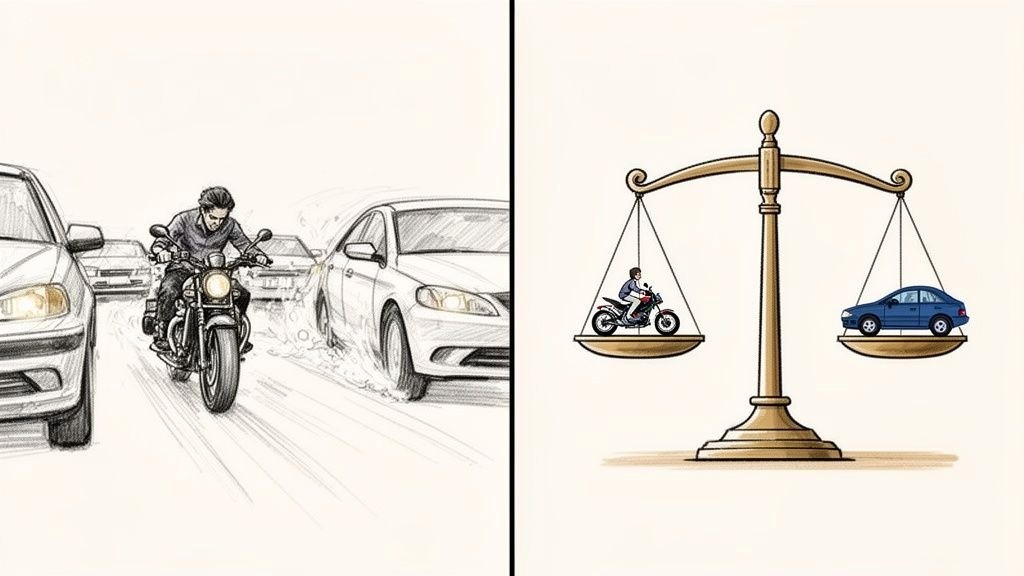
This is the question every Florida rider wants answered: if you get hit while motorcycle lane splitting, what happens to your injury claim? There's a devastating myth out there that if you were breaking a traffic law, you automatically give up all your rights. That’s simply not true.
The outcome of your case hinges on a legal concept called comparative negligence. Think of it as a set of scales. After a crash, a judge or jury weighs the actions of every person involved to determine who was at fault and by how much. One person’s mistake doesn't just erase everyone else's.
Even if you were lane-splitting, the other driver could absolutely be the one most to blame. If they were texting, speeding, or threw their car into another lane without looking, their negligence is a massive factor that can't be ignored.
Florida’s Comparative Negligence Rule Explained
Florida uses a "modified comparative negligence" rule. It’s a system built to be fair when more than one person’s actions contribute to a wreck. It isn't an all-or-nothing game.
Here’s a practical breakdown of how it works:
Assigning Fault: A percentage of fault is assigned to everyone involved. For instance, a jury might find that a car driver was 80% responsible for the crash, while the motorcyclist was 20% responsible.
Reducing Your Compensation: Your final compensation is then reduced by whatever percentage of fault you carry. If your total damages were $100,000, but you were found 20% at fault, your award is cut by $20,000, meaning you’d receive $80,000.
The 51% Bar: This is the critical part. If you are found to be 51% or more at fault for your own accident, you are legally barred from recovering any money at all.
This is precisely why insurance companies will fight so hard to pin the blame on you. Their entire goal is to push your share of the fault past that 50% mark so they don't have to pay a dime.
Just because you got a ticket for an improper pass doesn’t mean you're automatically more than 50% at fault. A ticket is just one piece of evidence that gets weighed against the other driver’s reckless actions.
A Real-World Lane Splitting Accident Example
Let’s bring this into the real world. Imagine you're riding your bike, carefully filtering between two lanes of stopped cars on the Palmetto Expressway during rush hour. Traffic is a parking lot.
Out of nowhere, the driver in the lane to your left, distracted by a text, decides to dart into the right lane without even a glance at their mirror or blind spot. They swerve right into your path, sending you and your bike to the pavement. You’re seriously hurt.
So, how would a jury assign fault here?
The Motorcyclist: You were, technically, breaking the law by lane splitting. A jury would likely assign you some percentage of fault for that, maybe 15% or 25%.
The Car Driver: But the driver was texting while driving and made a dangerous, blind lane change. Those are two huge acts of negligence that directly caused the collision. A jury could easily decide the driver was 75% to 85% at fault.
This shows your case is far from over, even though you were just filtering through traffic. The other driver’s negligence is still the main event. This is why knowing how to document evidence needed for a personal injury claim in FL is so vital after a crash.
Winning these cases comes down to proving the other driver’s actions were the primary reason you got hurt. That takes a skilled legal team to investigate the crash, reconstruct what happened, and powerfully argue against the insurance company’s attempts to make it all your fault.
Don’t ever let an insurance adjuster convince you that you don't have a case. You have rights, and you have a path to justice. In pain? Call Caine.
What To Do After A Motorcycle Lane Splitting Accident
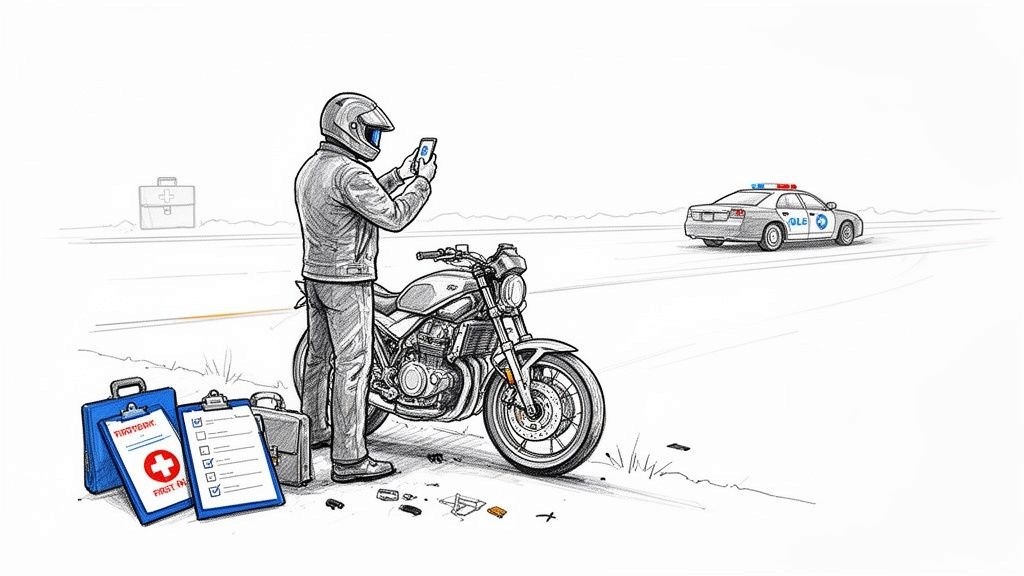
The moments after a motorcycle crash are a blur of adrenaline and confusion. When you get hit while lane splitting, that chaos gets a lot worse because of one immediate fear: you’re going to be blamed for the whole thing.
But the steps you take right then, and there, can be the difference between getting fair compensation and walking away with nothing. Think of this as your game plan for protecting your health and your rights, especially when you know the other driver’s insurer will try to use motorcycle lane splitting against you. What you do at the scene sets the stage for your entire injury claim.
Secure Your Safety And Seek Medical Help
First things first: your well-being. If you can, pull over to avoid getting hit again. Leave your bike where it is unless it’s an immediate hazard to other drivers.
Then, call 911 right away. Getting checked out by a medical professional is non-negotiable, even if you feel like you can just walk it off. Adrenaline is a powerful painkiller and can hide serious injuries. If you wait to see a doctor, the insurance company will argue your injuries couldn’t have been that bad or weren't even from the crash.
A documented medical evaluation from paramedics or an emergency room is one of the most powerful pieces of evidence you can have. It creates a direct, time-stamped link between the accident and your injuries, making it much harder for an insurer to dispute your claim later.
Gather Evidence At The Scene
If you're physically able to, it’s time to start documenting everything. The evidence you gather in the first 30 minutes after a crash is often the most important. Your smartphone is now your best investigative tool.
This checklist is a quick-reference guide to make sure you capture the most critical evidence while the scene is still fresh.
Post-Accident Evidence Checklist
Evidence Type | Why It's Critical | Pro Tip |
Photos & Videos | Captures the immediate aftermath, vehicle damage, and positioning before anything is moved. | Shoot a slow video of yourself walking through the entire scene. It often captures details you might miss in photos. |
Surroundings | Shows road conditions, traffic signals, skid marks, and weather that provide context for the crash. | Get wide shots showing the whole intersection or road section, then zoom in on specific details like potholes or debris. |
Witness Info | An independent third party can confirm your side of the story, especially if the other driver was distracted. | Get their name and number. Ask if they'd be willing to give a brief recorded statement on your phone describing what they saw. |
Driver Details | Ensures you have accurate information for your insurance claim and legal case. | Take photos of their driver's license, insurance card, and license plate. Don't rely on them to write it down for you. |
Collecting these details might feel like a lot when you're shaken up, but it provides the raw material your attorney will use to build a strong case. For an even more detailed list, you can check out our guide to motorcycle accidents in Florida and what to do after a crash.
Talk To The Police But Do Not Admit Fault
When the police show up, give them a calm and factual account of what happened. Stick to the facts only. For example: "I was moving between the lanes of stopped cars, and the blue sedan turned into my path without a signal."
Never say "I'm sorry" or "It might have been my fault." Any kind of apology will be twisted and used against you as an admission of guilt. You don't have all the information yet, so let your lawyer handle the legal arguments about who was at fault later on.
The last and most crucial step is to call an experienced motorcycle accident attorney before you talk to any insurance adjusters. The other driver’s insurance company will likely call you quickly, sounding friendly and concerned. Their only mission is to get you on a recorded line and trick you into saying something that torpedoes your own case.
Don't give them the satisfaction. Let your lawyer do the talking. In pain? Call Caine.
Why an Experienced Motorcycle Attorney Is Essential
If you were lane splitting when the crash happened, you can bet the insurance company has a game plan ready to go. Their first and only move is to blame you. It doesn't matter if the other driver was texting, eating, or just completely oblivious; the adjuster will point to your lane splitting and use it to deny your claim or make a laughably low offer.
This isn't a negotiation. It's a strategy designed to protect their bottom line at your expense.
Fighting back is non-negotiable, and it takes a specific kind of expertise. A true motorcycle accident attorney does more than just file some paperwork. They get to work dismantling the insurance company’s biased narrative, piece by piece. They know that a traffic violation doesn't just give a careless driver a free pass to run you off the road.
The Caine Law Advantage
Going up against an insurance company after a motorcycle crash is like a chess match. The problem is, they know every move and every trap on the board. At Caine Law, we don't just know the moves; we used to sit on their side of the table. Our firm's founder, Daniel Caine, started his career as an insurance defense lawyer, which gives our team a rare look into how their adjusters and legal teams think and operate.
This insider knowledge is our advantage. It lets us see their strategy coming and build a powerful case against it from day one. We know exactly how they’ll try to twist Florida's comparative negligence rules to pin the blame on you. More importantly, we know how to prove the other driver’s recklessness was the real reason you got hurt. With over $100 million recovered for our clients, our results speak for themselves.
An insurance company's goal is to shift blame and pay out as little as possible. The single most powerful tool you can have is an attorney who already knows their playbook inside and out. It’s how you level the playing field and get the justice you deserve.
For those injured in Florida, the data is clear: driver error is the real culprit behind most accidents, not lane splitting. With Daniel Caine’s defense-side savvy and a history of securing seven-figure verdicts, we know how to turn those statistics into a compelling argument for your case. We fight to get you compensation for everything from the ER bills to the lifelong pain and suffering.
The insurance company is counting on you being too overwhelmed to fight back, especially in a lane-splitting case. Don't face them alone. You need a fierce advocate who is ready to go to the mat to secure every dollar you need for your recovery. To learn more, take a look at our guide on auto and motorcycle accidents.
In pain? Call Caine.
Your Top Lane Splitting Questions Answered
Even after getting the basics down, it’s natural to have lingering questions about lane splitting. When you’re a rider, the "what ifs" can be endless. Let's clear up some of the most common concerns we hear from Florida bikers.
Can I Go to Jail for Lane Splitting in Florida?
It’s incredibly rare for a lane-splitting charge to lead to jail time. Think of it more like a standard traffic ticket. In Florida, motorcycle lane splitting is treated as a non-criminal moving violation, so you'll likely just get a citation and a fine.
But don't underestimate that piece of paper. The other driver’s insurance company will definitely wave that citation around, claiming it proves the accident was your fault. This is exactly why having a lawyer who understands motorcycle cases is so critical to protecting your right to fair compensation.
Why Call a Lawyer if the Police Report Puts Me at Fault?
Never assume a police report is the end of the story. An officer’s conclusion about who is to blame is not legally binding in a civil injury claim. It's just their initial take, often made at a chaotic scene without all the facts.
A dedicated motorcycle accident attorney conducts a much deeper, independent investigation. We can:
Subpoena the other driver’s cell phone records to see if they were texting.
Track down and interview witnesses the police may have overlooked.
Bring in accident reconstruction experts to prove what really happened on the road.
Even if you got a ticket for lane splitting, we frequently prove that the other driver’s negligence, like a sudden, unsignaled lane change, was the true cause of your injuries. We know how to challenge the official report and fight for the compensation you rightfully deserve.
If you've been injured in a motorcycle accident, the insurance company will use every trick in the book to deny your claim. Caine Law knows its playbook and is ready to fight for your rights. In pain? Call Caine. Contact us for a free consultation at cainelegal.com.