In Pain? Call Caine
Guide to Motorcycle Accidents in Florida: What to Do After a Crash

5 Min read
By: Caine Law
Share

The moments after a motorcycle crash are pure chaos. Your head is spinning, adrenaline is surging, and it’s tough to think straight. But what you do right then and there on the asphalt is absolutely critical. Those first few actions can make or break your ability to recover, both physically and financially. They lay the groundwork for everything that comes next.
Your First Moves At The Accident Scene
It’s a terrifying, disorienting experience, but a methodical approach can cut through the fog. Even if you're in shock, focusing on a few key steps will help keep you safe and preserve the evidence needed to build your case. The goal is simple: secure the scene and start documenting what happened.
This isn’t just theoretical advice; it’s a vital survival skill in Florida. For years, our state has held the grim title of being the deadliest in America for motorcyclists, and 2022 was no exception, with 668 fatalities. That number is staggering. It’s a direct result of our year-round riding weather, combined with a constant flood of tourists who aren't always looking out for bikes. In fact, motorcycle wrecks account for a shocking 17% of all traffic deaths in Florida, a figure that blows the national average out of the water. You can learn more about Florida's motorcycle crash statistics to see just how serious the risks are.
Secure The Scene And Prioritize Safety
First things first: prevent more harm. If you’re able to move, get yourself and your bike out of the flow of traffic to avoid getting hit again. If you're seriously hurt, stay put. Don’t try to be a hero; wait for the paramedics to arrive.
Once you’re in a safer spot, flip on your bike’s hazard lights. It’s a small thing, but it makes a huge difference in making the scene visible to other drivers, especially after dark or in bad weather.
Immediately Call 911
This is non-negotiable, even for what seems like a "minor" accident. There are two huge reasons why you must make this call:
You Need a Medical Evaluation: Adrenaline is a powerful painkiller. It can easily mask serious injuries like internal bleeding or a concussion that won't show symptoms until later. Let the paramedics check you out.
You Need an Official Police Report: A law enforcement officer will create an official report of the accident. This document is the cornerstone of your entire claim, providing an impartial, third-party account of what went down.
Never let the other driver talk you out of calling the police to "handle it yourselves." That police report is invaluable, objective proof that insurance companies can't easily dismiss.
Gather Crucial Evidence
While you wait for help to arrive, your smartphone becomes your best tool. The evidence you gather in these first few minutes is often the most powerful you'll have.
This simple flowchart breaks down the three most important things to do right after a crash.
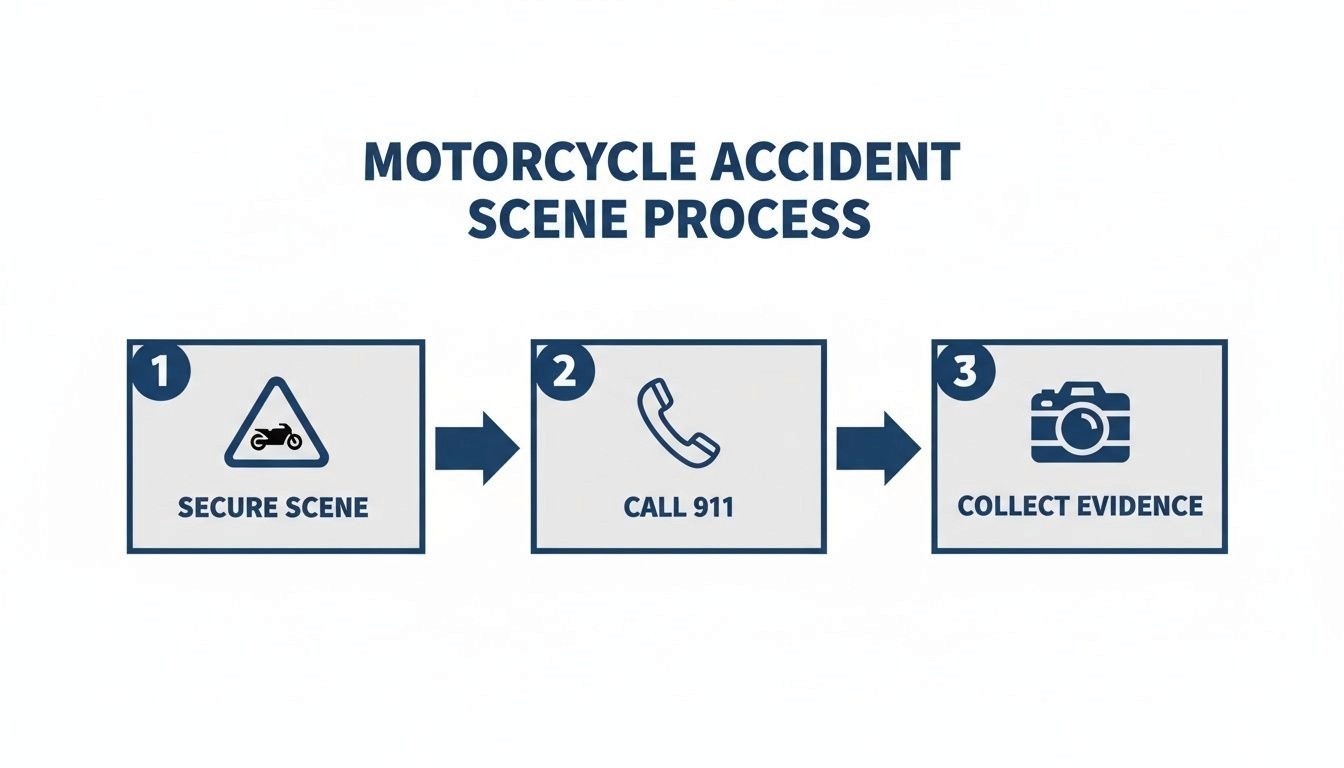
This visual guide drives home the point: secure the area, call for help, and start gathering information. Your ability to act decisively in a moment of crisis can have a massive impact on the outcome of your case.
For a quick reference, here’s a checklist of what to do.
Post-Accident Action Checklist
This table provides a quick, easy-to-follow guide for the immediate actions you should take at the scene of a motorcycle wreck.
Action | Why It's Critical |
Move to Safety | Prevents secondary collisions and further injury. |
Call 911 Immediately | Ensures you get prompt medical attention and an official police report. |
Take Photos & Videos | Documents vehicle damage, road conditions, and injuries before they are cleaned up. |
Get Driver Information | Collect names, contact info, driver's licenses, and insurance details from everyone involved. |
Get Witness Information | Independent witness testimony is incredibly powerful for proving your case. |
Do Not Admit Fault | Avoid saying "I'm sorry" or anything that could be twisted to mean you caused the crash. |
Seek Medical Attention | Creates a medical record linking your injuries directly to the accident. |
Keeping these steps in mind can help you stay focused during a chaotic time. And remember, when you’re hurt and don't know where to turn, In pain? Call Caine. Call 786-206-8726 now to speak with the Caine Law team and protect your rights.
Understanding Florida Motorcycle Laws And Your Rights
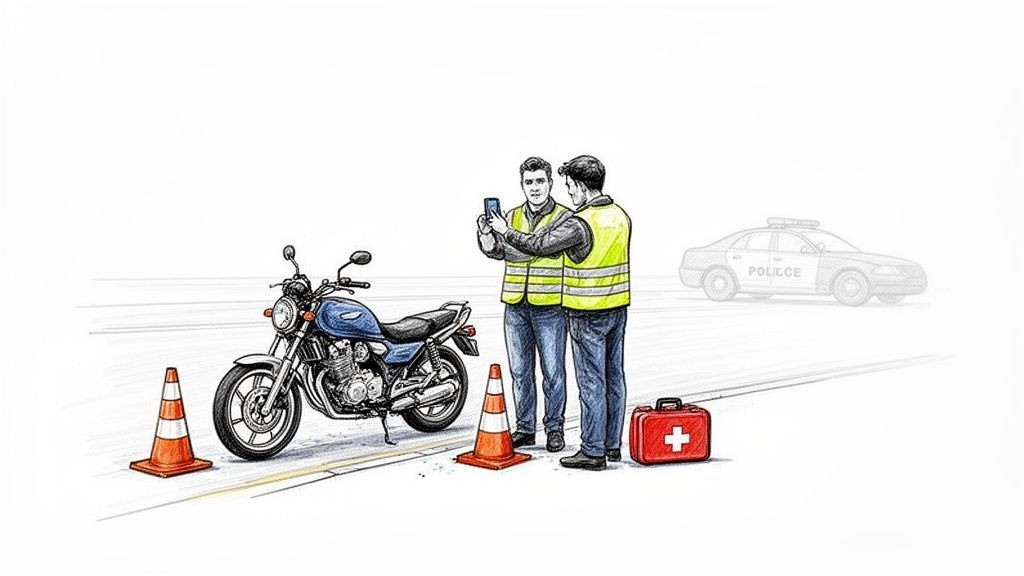
After a crash, you’re dealing with enough physical pain and emotional stress. The last thing you want to do is try to decipher Florida’s complex motorcycle laws. But these rules are the very foundation of your injury claim, and knowing your rights is your best defense against an insurance company that wants to pay you as little as possible.
The legal landscape for a motorcycle accident in Florida has some unique twists that don't apply to your average car wreck. There are critical differences in how fault is determined, how insurance works, and the deadlines you have to meet. Getting these wrong can wreck your chances of recovering the money you need. Let’s break down what you absolutely need to know.
Florida's Comparative Fault System Explained
One of the first moves an insurance adjuster will make is trying to pin some of the blame on you. They do this because of a legal rule called comparative fault. The easiest way to think about it is like a pie. After an accident, a judge or jury has to decide how big of a slice of the "fault pie" belongs to each person involved.
Whatever percentage of fault you're assigned gets sliced right off your final compensation. For instance, if you have $100,000 in damages but a jury decides you were 20% at fault for the crash, your award is cut by $20,000. You’d only walk away with $80,000.
And Florida law recently got even tougher. Now, if you are found to be more than 50% at fault, you get nothing. Zero. This "all-or-nothing" cliff at 51% makes fighting back against any unfair blame absolutely critical.
Helmet Laws And Insurance Rules
Florida's helmet laws can also throw a wrench in your claim. While riders over 21 can legally ride without a helmet if they carry at least $10,000 in medical benefits, this choice gives insurance companies an opening they love to exploit.
If you weren't wearing a helmet and suffered a head injury, you can bet the other side will argue your injuries are your own fault, even if their driver is the one who ran a red light. They'll try to use your decision to drastically slash the value of your claim under that comparative fault rule we just talked about.
An experienced attorney knows how to shut this down. We use expert medical testimony to prove that the sheer force of the impact, not the absence of a helmet, was the true cause of your injuries. This protects your right to full and fair compensation.
Another huge difference is insurance. Unlike car owners, Florida motorcyclists are not required to carry Personal Injury Protection (PIP) insurance. For you, this means there's no "no-fault" buffer. From day one, you have to turn to the at-fault driver's insurance to cover your medical bills and lost paychecks. This makes proving the other driver was at fault immediately essential to your financial survival.
The Statute Of Limitations: A Ticking Clock
Of all the rules, the statute of limitations is the most unforgiving. Think of it as a countdown timer on your right to file a lawsuit. In Florida, you generally have just two years from the date of the motorcycle accident to file a personal injury lawsuit.
If you miss that deadline, your claim is gone for good. It doesn't matter how badly you were hurt or how obvious it was that the other driver was to blame. The courthouse doors will be shut to you forever.
Two years might sound like a long time, but building a strong case moves fast. It involves:
A deep-dive investigation into the crash to lock down every piece of evidence.
Hiring medical and accident reconstruction experts to prove how the crash happened and the true extent of your injuries.
Negotiating with the insurance company, which is almost always a frustrating, drawn-out process.
Waiting too long puts you at a massive disadvantage and risks you losing everything. Don’t let a legal technicality rob you of the justice you deserve. If you’re hurt and worried about these deadlines, we can help.
Calculating The True Cost Of Your Accident
A motorcycle crash in Florida isn't just about a damaged bike and a trip to the ER. It sends out ripples that can disrupt your financial, physical, and emotional well-being for years to come. To get your life back on track, you have to account for every single loss—not just the ones staring you in the face.
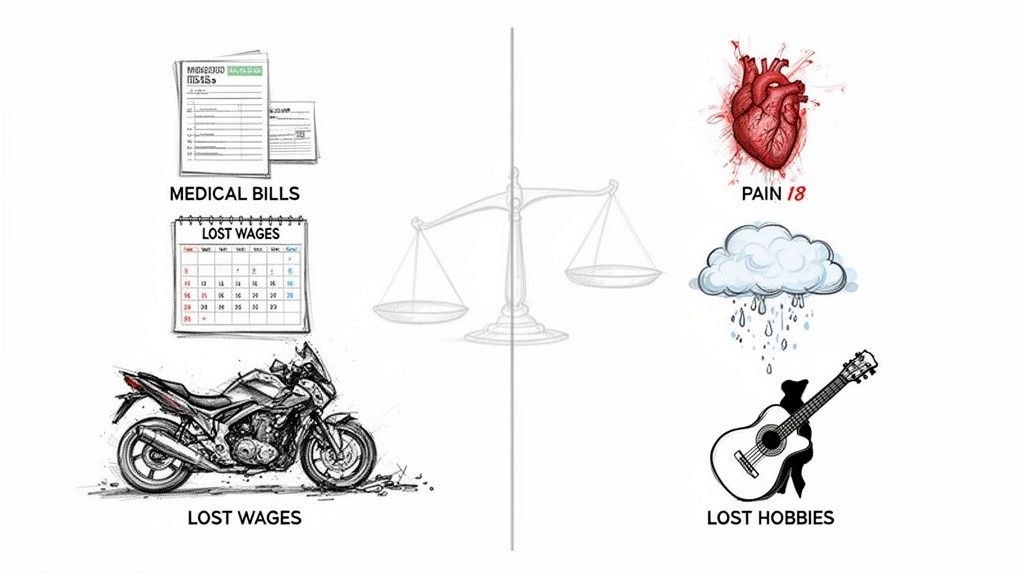
In legal terms, this compensation is called "damages," and it's broken down into two critical categories.
Understanding both is your first line of defense against an insurance company trying to shortchange you. They love to throw out a quick, lowball offer that covers the initial hospital visit and some basic repairs. They’re banking on you taking the money before you grasp the true, long-term cost of the crash. We're here to make sure that doesn't happen by breaking down the full scope of what you are rightfully owed.
Economic Damages: The Tangible Costs
Think of economic damages as everything you can tally up with a calculator and a stack of receipts. These are the direct, out-of-pocket financial hits you've taken because of the accident. They are concrete, provable expenses that form the bedrock of your claim.
But it’s about so much more than that first emergency room bill. A solid claim for a motorcycle accident in Florida must factor in every related cost, both what you've already paid and what you'll need down the road.
This includes:
All Medical Bills: This isn't just the big stuff. It’s everything from the ambulance ride and hospital stay to surgeries, physical therapy, prescriptions, and any medical gear you now need.
Future Medical Care: Serious injuries don't just heal overnight. This category anticipates future surgeries, long-term rehab, chronic pain management, and even in-home nursing care if it's needed.
Lost Wages: You deserve to be paid back for every single dollar of income you lost while you were out of work recovering.
Loss of Earning Capacity: What if your injuries mean you can't go back to your old job? If you're forced into a lower-paying field, you can claim the difference in what you would have earned over your lifetime.
Property Damage: This is the cost to either repair your motorcycle to its pre-crash condition or, if it was totaled, its full replacement value. It also covers your helmet, riding gear, and anything else that was damaged.
Non-Economic Damages: The Human Impact
This is where we put a value on the very real human cost of a motorcycle wreck. Non-economic damages compensate you for the deep, personal suffering that doesn't come with an itemized bill. These losses are just as real—and often more devastating—than the financial ones, but they are much harder to put a number on.
Picture a rider who lived for weekend trips up the coast. After getting hit by a careless driver, chronic back pain makes it impossible to sit on their bike for more than ten minutes. That loss of passion, freedom, and identity has a real, tangible value.
Non-economic damages are an acknowledgment that your life is more than a balance sheet. They are meant to compensate you for the pain, trauma, and lost joy that someone else's negligence forced upon you.
Common examples of non-economic damages include:
Pain and Suffering: This is for the physical pain and daily discomfort your injuries have caused and will continue to cause. Our guide on how to calculate pain and suffering damages breaks this complex topic down even further.
Emotional Distress: This covers the invisible wounds of a crash, including anxiety, depression, a new fear of the road, and even Post-Traumatic Stress Disorder (PTSD).
Loss of Enjoyment of Life: This accounts for your inability to take part in the hobbies, activities, and life experiences you once loved.
Disfigurement and Scarring: This provides compensation for permanent scars or physical changes that impact your appearance and self-confidence.
When adding up the total cost of your accident, remember to look at the long game, including the benefits of ongoing recovery and rehabilitation like specialized chiropractic care after a car accident to help your body heal naturally.
Accurately valuing both the tangible and human costs is a complex job that requires a deep understanding of both law and medicine. An experienced attorney makes sure nothing gets missed, fighting to secure the full and fair compensation you need to truly rebuild. Speak with a compassionate legal team. Call 786-206-8726 to contact Caine Law.
How To Handle Insurance Company Tactics
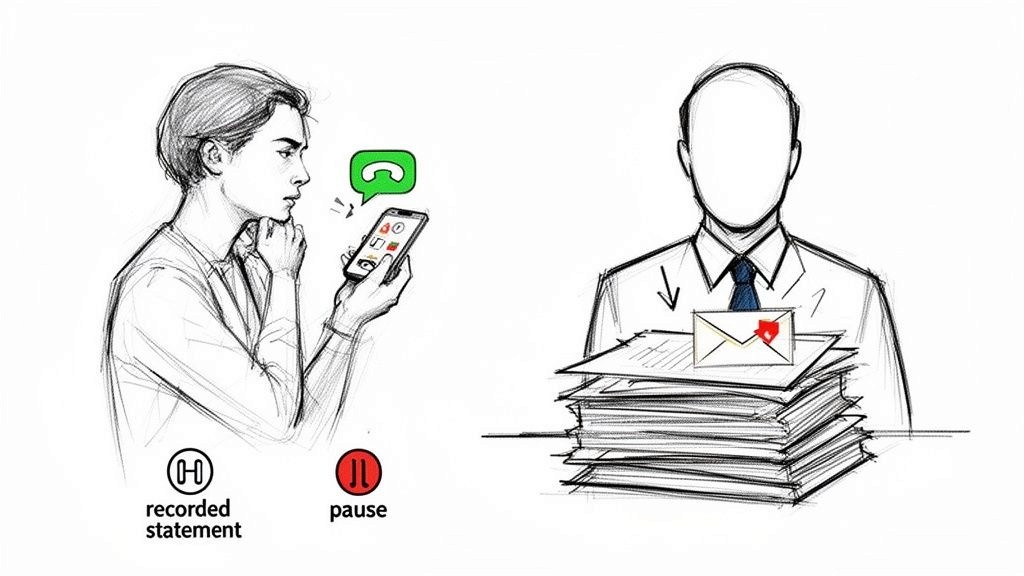
Talking to an insurance adjuster after a crash can feel like you’ve been thrown into a strategic game, but nobody told you the rules. Let's be clear about their goal: it’s not to make sure you get a fair shake. It’s to protect their company’s bottom line by paying out as little as possible.
Knowing their playbook is your first line of defense.
Soon after a motorcycle accident in Florida, you can expect a call from the at-fault driver's insurance company. They almost always sound friendly and concerned, but don’t be fooled. This is a deliberate tactic to build trust and get you to let your guard down.
The Recorded Statement Trap
One of the first things they'll ask for is a recorded statement. Here's a critical piece of advice: you are under no legal obligation to give them one. Saying yes before you've talked to a lawyer is one of the biggest mistakes you can make.
Adjusters are masters at asking leading questions. They're designed to corner you into saying something that suggests you were at fault or that your injuries aren't a big deal.
A simple, polite "I'm doing okay" can be twisted to argue you weren't seriously hurt. If you’re a little fuzzy on the exact sequence of events, they’ll use that to portray you as an unreliable witness. Trust me, anything you say can and will be used to chip away at your claim's value.
The best response is to politely refuse to give a recorded statement until you’ve spoken with your attorney. You can give them the basic facts, but never agree to be recorded.
The Lowball Settlement Offer
Another classic move is the quick, lowball offer. The adjuster might call you just days after the accident with a check for a few thousand dollars to "help with immediate bills." When you’re out of work and the medical costs are already rolling in, that can sound pretty tempting. It's a trap.
This first offer is always a fraction of what your claim is actually worth. If you take it, you’ll have to sign away your right to seek any more money for this accident, period. If you later find out you need surgery or months of physical therapy, it’s too late.
Common Insurer Arguments
Insurance companies have a go-to list of arguments they use to shift blame and slash payouts, especially in motorcycle cases. Get ready to hear things like:
Blaming the Rider: They’ll look for any excuse to use Florida's comparative fault rule against you. They might claim you were speeding, weaving through traffic, or were somehow responsible for the crash.
Downplaying Injuries: They will comb through your medical records, trying to argue your injuries aren't as bad as you say or that they were pre-existing conditions.
Delaying and Denying: Sometimes, the strategy is just to drag their feet. They hope you'll get so frustrated and desperate that you'll eventually accept a terrible offer just to be done with it.
If you find your motorcycle insurance claim has been denied, knowing how to fight back if your insurance claim is denied is crucial.
Trying to counter these tactics on your own is an uphill battle. Having an experienced trial attorney from CAINE LAW on your side completely levels the playing field. We take over all communication with the insurance company, shield you from their traps, and focus on building a powerful case for the full compensation you deserve. In pain? Call Caine.
Why You Need An Experienced Motorcycle Accident Lawyer
Trying to handle the aftermath of a motorcycle wreck by yourself is a huge mistake. Insurance companies aren't on your side; they are massive businesses with armies of adjusters and lawyers whose entire job is to protect profits by paying you as little as possible. An experienced motorcycle accident attorney changes that dynamic from day one.
The moment you hire us, we take over completely. All communication with the insurance companies stops for you and starts for us. This puts an immediate shield between you and their tactics, freeing you to focus on the only thing that matters: your recovery. No more stressful phone calls or confusing letters packed with legal jargon.
Building Your Case From The Ground Up
A strong claim is built on strong evidence. While you’re healing, we’re already hard at work investigating every angle of the crash. Think of us as your personal investigators, piecing everything together to tell the undeniable story of what really happened. We don't just glance at the police report; we go much, much deeper.
Our detailed process includes:
Securing Critical Documents: We move fast to get the official police report, EMS records, and any available traffic or security camera footage that captured the incident.
Interviewing Witnesses: We find and speak with anyone who saw what happened while their memories are still sharp, getting signed statements to back up your account.
Analyzing the Scene: We often go back to the crash site ourselves to document road conditions, sightlines, and any other factors that could have contributed to the accident.
This aggressive, front-end work makes sure crucial evidence doesn't get lost. It's all about building a powerful case from the very beginning, leaving no stone unturned.
Leveraging Insider Knowledge For Maximum Results
What really gives you an edge is working with a firm that understands how the other side thinks. Having spent years on the insurance defense side, we know their playbook. We see their arguments coming, we recognize their stall tactics, and we know exactly what evidence they can’t ignore.
This insider knowledge is your single biggest advantage. We use it to dismantle their arguments before they're even made, building a case so strong that they're often forced to offer a fair settlement instead of risking a fight with us in court.
We bring in a team of experts specifically for your case. This could mean accident reconstructionists who can scientifically prove how the crash happened or medical specialists who can clearly explain the long-term impact of your injuries. Their testimony provides the objective proof needed to demand full and fair compensation for your motorcycle accident in Florida.
From Negotiation To Trial
Our goal is always to get you the maximum compensation possible. That process usually starts with tough, evidence-based negotiations. We put together a comprehensive demand package that details every loss you've suffered, economic and non-economic, backed by the mountain of evidence we've collected. This shows them we mean business.
But if the insurance company won't make a fair offer, we don't hesitate. We are trial lawyers, ready and willing to take your fight to a Florida courtroom. That willingness to go to trial is, by itself, a powerful negotiating tool. Insurers know which law firms always settle and which ones are ready to win a verdict. Our reputation in the courtroom often convinces them to come back to the table with a much better offer.
From your free, no-obligation consultation all the way to the final resolution, we handle every detail. The paperwork, the deadlines, the legal battles, we manage it all so you don’t have to. Your job is to heal. Our job is to fight for you.
Common Questions After A Florida Motorcycle Accident
The chaos of a motorcycle crash doesn't end when the sirens fade. In its wake, you're left with a storm of questions and a crushing sense of uncertainty. It's overwhelming, but getting straight answers is the first real step toward taking back control.
We've put together this FAQ to cut through the noise. We'll tackle the tough questions about legal deadlines, fault, insurance games, and what it really costs to get a lawyer on your side. Our goal is to replace your confusion with confidence and give you the solid information you need to make the right calls for your future.
How Long Do I Have To File A Motorcycle Accident Lawsuit In Florida?
In Florida, the clock is ticking. You're up against a strict deadline called the statute of limitations. For most personal injury claims, including those from a motorcycle wreck, you have two years from the date of the crash to file a lawsuit.
Let me be clear: this isn't a suggestion. It’s a hard deadline. If you miss that two-year window, the courthouse doors will almost certainly slam shut on your case. You'll lose your right to seek compensation forever. It’s a devastating mistake, but it's one that can be avoided by acting quickly.
Procrastination is your worst enemy here. Building a strong, winnable case takes time, we need to investigate, gather evidence, and bring in the right experts. That’s why it’s so critical to call an experienced attorney as soon as you can. We’ll make sure every deadline is met and your rights are protected from day one.
What If I Was Partially At Fault For The Motorcycle Accident?
This is a big one. A lot of riders think that if they share even a little bit of the blame, they can't recover anything. That's not how it works in Florida. You can still get compensation even if you were partially at fault for the crash.
Our state uses a system called modified comparative negligence. It sounds complicated, but the idea is simple: your total compensation is just reduced by whatever percentage of fault is assigned to you.
Let's use an example. Say your total damages from medical bills, lost wages, pain and suffering, add up to $100,000. If a jury decides you were 20% responsible for the accident, your final award gets reduced by that 20% ($20,000), and you'd recover $80,000. It’s a system designed to be fair.
But there’s a massive catch. If you are found to be more than 50% at fault, Florida law completely bars you from recovering any damages. Zero. This is exactly why you need a skilled attorney fighting for you. The insurance company will do everything they can to pile the blame on you, and we know how to fight back.
Should I Accept The Insurance Company's First Settlement Offer?
Almost never. In fact, you should see that first offer for exactly what it is: a tactic. It's a calculated move to get you to close your claim quickly and for the lowest amount of money possible, long before you understand what your case is truly worth.
Insurance adjusters are smart. They know you're hurt, out of work, and watching the medical bills pile up. They use that financial pressure to dangle a "fast cash" offer in front of you, hoping you'll bite before you've talked to a lawyer or realized the full scope of your future medical needs.
An experienced firm like CAINE LAW doesn't guess. We conduct a detailed valuation of your claim, accounting for everything, not just the bills you have today, but the future treatments, the income you'll continue to lose, and the real impact of your pain and suffering. Taking a lowball offer could mean walking away from tens, or even hundreds, of thousands of dollars you're entitled to. Always get a professional opinion first; our consultations are free.
How Much Does It Cost To Hire A Motorcycle Accident Lawyer At Caine Law?
At CAINE LAW, we firmly believe that your financial situation should never be a barrier to getting justice. That’s why we handle all our personal injury cases on a contingency fee basis.
What does that mean for you? You pay absolutely nothing upfront. No retainer fees, no hourly bills, no hidden costs. We front all the expenses needed to build and fight your case, from hiring accident reconstruction experts to paying court filing fees.
We only get paid if we win for you, either by securing a settlement or winning a verdict at trial. Our fee is simply a pre-agreed percentage of the money we recover for you. This way, our goals are perfectly aligned with yours: getting you the maximum compensation possible. If we don’t win, you don't owe us a dime. It's as simple as that.
Navigating the legal system after a motorcycle wreck is a tough road, but you don't have to walk it alone. At CAINE LAW, we have the experience and the resources to fight for the justice you and your family deserve. We'll handle the fight so you can focus on healing.
In pain? Call Caine. Contact us today for a free, no-obligation consultation to discuss your case by visiting https://cainelegal.com.