
In Pain? Call Caine
Wrongful Death Lawsuit Florida: A Compassionate Legal Guide

5 Min read
By: Caine Law
Share
When you lose a family member, the grief can feel unbearable. That pain is only compounded when you realize their death was preventable—caused by someone else’s carelessness. In Florida, a wrongful death lawsuit is the civil action your family can take to find a measure of justice and seek financial stability after such a devastating loss. It's a way to hold the responsible person or company accountable for the profound void they’ve created.
What Is a Wrongful Death Lawsuit in Florida?

When a person’s life is cut short by another's negligence—whether in a fatal car crash, a medical mistake, or from a dangerously defective product—the family is left to pick up the pieces. A wrongful death lawsuit isn’t about trying to replace what you've lost; no amount of money could ever do that. Instead, it’s a legal tool designed to bring a degree of accountability and help secure the family's future.
Here’s a simple way to think about it: if the person had survived their injuries, they would have had the right to file a personal injury claim. Because they tragically cannot, Florida law allows a claim to be brought on their behalf. The focus then shifts to the survivors and the immense impact this loss has had—and will continue to have—on their lives.
The Purpose Behind the Lawsuit
At its core, a wrongful death claim has two main goals. First, it seeks to hold the negligent party accountable, sending a clear message that their actions have severe consequences. Second, it aims to compensate the surviving family for the incredible economic and emotional damages they're now facing.
These damages cover a wide spectrum of losses, including:
The loss of financial support and income the person would have provided.
The value of their companionship, guidance, and the services they offered the family.
The deep mental pain and suffering close family members have endured.
Medical and funeral bills paid by the family or the estate.
The legal system provides this structured process to acknowledge the depth of your family's loss and create a path toward rebuilding.
A wrongful death action is a civil claim, which is entirely separate from any criminal charges. Even if the person at fault is never charged with a crime—or is found not guilty—the family can still file a wrongful death lawsuit to demand financial accountability for their loss.
For a clearer picture, here’s a quick breakdown of the core ideas behind a Florida wrongful death claim.
Florida Wrongful Death Claim Core Concepts
Key Element | Florida-Specific Explanation |
|---|---|
Basis of Claim | The death must have been caused by the wrongful act, negligence, breach of contract, or default of another person or entity. |
Core Purpose | To compensate survivors for their losses and hold the at-fault party financially accountable. This is a civil, not criminal, action. |
Who Files | The lawsuit must be filed by the personal representative of the deceased person's estate, not directly by individual family members. |
Beneficiaries | The personal representative acts on behalf of the estate and the statutory survivors (like a spouse, children, or parents) who are eligible for damages. |
Types of Damages | Can include economic losses (lost support, medical/funeral costs) and non-economic losses (loss of companionship, pain and suffering). |
Understanding these basics is the first step in a long and difficult journey.
Who Actually Files the Claim?
This is where things can get a bit confusing for families. In Florida, the law is very specific: the claim can’t be filed directly by a spouse, parent, or child. Instead, the lawsuit must be filed by the personal representative of the deceased person’s estate.
This person, who is often named in a will or appointed by a court, acts as the formal plaintiff. They represent both the estate and all of the surviving family members who have a right to recover damages. Their job is to bring the lawsuit forward, but the people who ultimately benefit are the survivors most deeply impacted by the loss.
If you are grieving and believe someone else is to blame for your family member's death, knowing these foundational rules is critical. Navigating this process is nearly impossible alone and requires a lawyer with both compassionate guidance and unshakeable legal advocacy. In pain? Call Caine.
Who Can File and the Deadlines You Cannot Miss
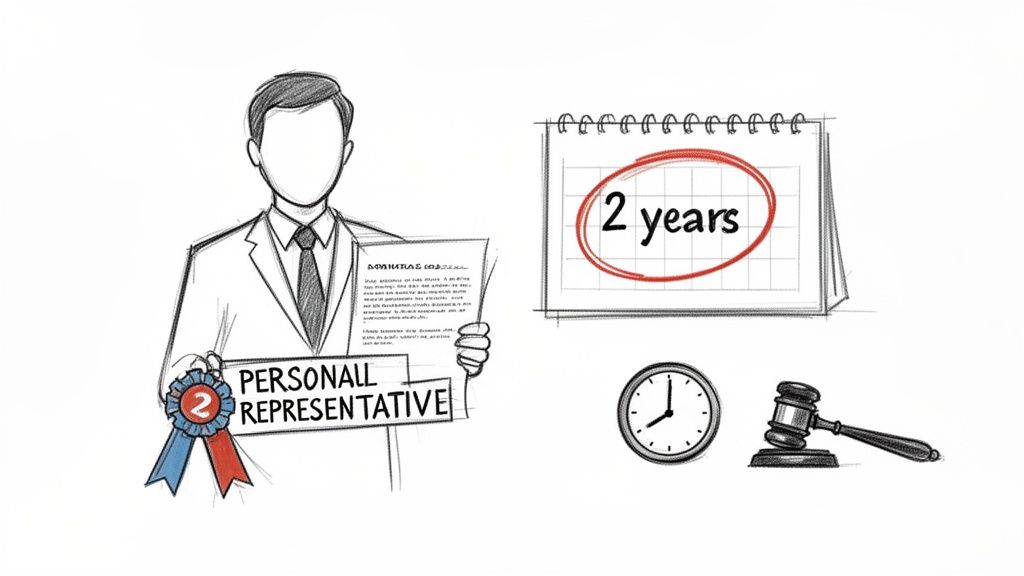
After a devastating loss, the last thing you want to do is navigate a complex legal system. But two of the most critical questions families face right away are: Who actually has the right to file the lawsuit, and how long do we have to take action?
In Florida, the law is very specific and unforgiving on both points. Getting this right from the very beginning is absolutely essential.
It’s a common misconception that a grieving spouse or child can just walk into court and file a wrongful death lawsuit in Florida. The law actually sets up a specific process. The claim must be started by the personal representative of the deceased person’s estate.
This person is essentially the legal manager of your loved one’s affairs. They might be named in the will, but if there isn't a will, the court will appoint someone for the role. While the personal representative is the one who officially files, they are acting on behalf of all the survivors—the spouse, children, and other dependents who have been impacted by the loss.
The Role of the Personal Representative
Think of the personal representative as the captain of the ship. They are the one steering the case through the legal system, while the surviving family members are the passengers.
This person has the formal authority and responsibility to:
File the wrongful death lawsuit with the court.
Work with the attorney to gather evidence and build the case.
Handle all negotiations with insurance companies and the at-fault parties.
Make key legal decisions (always in consultation with the family and their lawyer).
Distribute any settlement or award to the beneficiaries according to Florida law.
This structure keeps the process organized and ensures everyone’s interests are represented in a single, unified legal action.
Florida’s Unforgiving Statute of Limitations
Just as important as who can file is when they must file. Florida has a strict deadline called the statute of limitations. If you miss this window, the courthouse doors are permanently shut on your case, no matter how clear the fault or how strong the evidence is.
For the vast majority of wrongful death cases in Florida, the lawsuit must be filed within two years of the date of death. This isn't a guideline—it's a hard deadline with very few exceptions.
The clock starts ticking the moment your loved one passes away, not from the date of the accident that caused the fatal injuries. That two-year window can fly by while a family is focused on grieving. All the while, critical work needs to be done to investigate, collect evidence, and prepare the claim before it can be officially filed.
Critical Exceptions to the Two-Year Rule
While two years is the general rule, some situations can change the timeline—and often make it even shorter. You have to be aware of these exceptions, as they can completely derail your ability to seek justice.
Medical Malpractice: If a doctor's or hospital's negligence caused the death, the timeline gets more complicated. A "discovery rule" might come into play, but the two-year clock usually still starts ticking once the malpractice is known (or should have been known). These cases have their own set of very complex rules.
Government Entities: Filing a claim against a government body in Florida—like a city, county, or state agency—is a whole different ballgame. You must provide a formal notice of claim long before the two-year deadline, sometimes within just a few months of the incident. If you miss that initial notice period, you can be barred from ever filing the lawsuit.
Because these deadlines are so strict and complex, there is simply no time to waste. The single most important step you can take is to speak with an experienced wrongful death attorney immediately. They can pinpoint the exact deadline for your specific situation and take swift action to protect your family's rights.
If your family is suffering, don't let a procedural deadline stand in the way of accountability. In pain? Call Caine.
Understanding the Damages Your Family Can Recover
After a loved one’s life is tragically cut short, the emotional toll is immeasurable. The financial consequences, however, are very real and can quickly become overwhelming for a grieving family. In a wrongful death lawsuit in Florida, the compensation—legally known as "damages"—is structured to address these profound losses in a comprehensive way.
It’s easiest to think of the damages in two separate categories. One bucket holds the financial losses suffered by the deceased person’s estate, while the other is for the deeply personal losses endured by the surviving family members. The law recognizes that both types of harm deserve acknowledgment and compensation.
Damages Awarded to the Estate
First, the lawsuit aims to recover the tangible, economic losses that belong to the estate itself. These are the direct financial hits caused by the fatal incident and the resulting death.
The main goal here is to make the estate "whole" for the costs it incurred and the financial value that was lost.
Lost Earnings and Benefits: This covers the wages, salary, and benefits the deceased would have earned from the moment of their injury until their death. It also calculates their "net accumulations"—the value of earnings they would have reasonably saved and left to their estate if they had lived a full life.
Medical and Funeral Expenses: Any final medical bills for treatment related to the fatal injury that were paid directly by the estate can be recovered. The costs of funeral and burial services paid by the estate can also be included in the claim.
Damages Awarded to the Survivors
The second category of damages gets to the heart of the personal and emotional impact on the surviving family members. While no amount of money can ever replace a person, these damages are the legal system’s way of recognizing the depth of the survivors' suffering.
For a spouse, this includes the loss of companionship and protection, along with the profound mental pain and suffering they’ve experienced. For a minor child, it covers the loss of parental companionship, instruction, and guidance, as well as their own mental pain and suffering. The loss of a child can similarly result in damages for the parents' pain and suffering. This is where the true human cost of the tragedy is acknowledged.
Florida law is very specific about which family members can recover these personal damages. Generally, a surviving spouse, minor children, and in some cases, adult children or parents of the deceased are recognized as statutory survivors who can receive this type of compensation.
These intangible losses are often the most significant part of a wrongful death claim. The loss of a parent's guidance for a young child, for instance, is a lifelong deficit. The legal process assigns a monetary value to this loss to provide for the child's future wellbeing in the parent's absence. This can be particularly crucial after a fatal crash; you can learn more about how fault is determined in our guide on Florida auto and motorcycle accidents.
Punitive Damages: A Special Circumstance
In some rare and extreme cases, a third type of damages may be available: punitive damages. These aren't meant to compensate the family for their loss. Instead, they are intended to punish the wrongdoer for gross negligence or intentional misconduct.
Think of punitive damages as a financial penalty designed to send a powerful message and deter similar reckless behavior in the future. They are only awarded when the defendant’s actions were so outrageous that they showed a conscious disregard for human life. Obtaining them requires meeting a very high legal standard.
The potential value of these combined damages can be substantial, reflecting the gravity of the loss. For example, high-profile Florida cases have resulted in significant awards, such as a $100 million verdict against a condominium association for a fatal shooting and a $4.5 million verdict in a Jacksonville medical malpractice case. These outcomes show how juries quantify the immense value of a life and the depth of a family's loss.
Understanding these different types of damages is the first step toward securing your family’s future. An experienced attorney knows how to build a case that accounts for every single loss, both tangible and intangible. If you're facing this unimaginable situation, we are here to help you understand your rights. In pain? Call Caine.
Navigating the Legal Journey Step by Step
When you're grieving, the thought of a lawsuit can feel overwhelming—like trying to read a map in the dark. The legal system, however, has a very defined process. Knowing what to expect at each turn can bring a sense of stability during an incredibly uncertain time.
Think of it as a series of building blocks, with each step laying the foundation for the next. While every family's story is unique, the core stages of a wrongful death lawsuit in Florida remain consistent. It's also important to know that while the final stage could be a courtroom trial, the vast majority of cases—over 90%—are resolved through settlement negotiations long before that happens.
Stage 1: The Initial Investigation and Evidence Gathering
This is where it all begins. Before a single legal document is filed, my team and I become investigators. Our first job is to uncover the facts: what happened, how it happened, and who is legally responsible. This phase is all about building the bedrock of your case.
Evidence is the only language the legal system truly understands. In this first stage, we will be:
Collecting official reports, from police accident records to medical examiner findings.
Tracking down and interviewing any eyewitnesses who saw what happened.
Preserving critical physical evidence, whether it’s a wrecked vehicle, a defective product, or a hazardous condition at a property.
Identifying every single party who could be held liable—it's often more than just one person or company.
Documenting everything correctly from the very start is absolutely essential. Many of the same principles apply as in other injury cases, and you can learn more by reading our guide on how to document evidence needed for a personal injury claim in Florida.
Stage 2: Opening an Estate and Filing the Lawsuit
Once we've gathered enough evidence to build a strong, clear claim, we take two formal legal steps. First, we must petition the court to officially appoint a personal representative who can act on behalf of your loved one's estate. This is a procedural requirement here in Florida, and we handle it for you.
Next, we draft and file the official lawsuit, known as a "complaint," with the court. This document formally lays out our allegations against the at-fault party, explains the legal basis for holding them responsible, and states the damages your family is seeking. Filing the complaint officially kicks off the legal process and puts the defendant on formal notice.
Stage 3: The Discovery Phase
After the lawsuit is filed, we enter what’s called the "discovery" phase. This is often the longest part of the journey. You can think of it as a formal, mandatory "show your cards" period where both sides are required to share all the evidence they have with each other.
Discovery isn’t about courtroom surprises or "gotcha" moments. It's a transparent process where each side learns the strengths and weaknesses of the other's case through depositions (sworn testimony under oath), interrogatories (written questions), and requests for documents.
This structured exchange of information is what allows your legal team and the insurance company to get a true, accurate valuation of the claim. A case built on solid, well-documented evidence during discovery is what ultimately forces the other side to the negotiating table with a fair offer.
Stage 4: Settlement Negotiations and Mediation
With all the evidence out in the open, serious settlement negotiations can finally begin. We will assemble a comprehensive demand package that we present to the insurance company, detailing the full scope of your family's losses—economic and emotional. They will respond, and a period of intense back-and-forth negotiation will follow.
If those direct negotiations hit a wall, the next step is usually mediation. This is a structured meeting where a neutral, third-party mediator joins the conversation to help both sides find common ground and work toward a resolution everyone can agree on. Mediation is actually a mandatory step in many Florida lawsuits and is incredibly effective at helping families resolve their cases without ever stepping inside a courtroom.
Stage 5: The Trial
If a fair settlement simply cannot be reached, the final step is to take your case to trial. This is where we present all the evidence, expert analysis, and witness testimony to a jury. The jury will then be tasked with deciding whether the defendant is liable and, if so, exactly how much in damages they should award to your family.
Our strategy is to prepare every single case from day one as if it is going to trial. Insurance companies and their lawyers know which firms are ready and willing to fight in court and which ones will fold. That readiness is what gives us the leverage we need to secure the best possible settlement for your family.
If your family is facing this difficult journey, you do not have to walk it alone. We can guide you through every step. In pain? Call Caine.
How an Attorney Builds a Powerful Wrongful Death Case
Hiring a lawyer for a wrongful death lawsuit in Florida is about so much more than just filing paperwork. A skilled attorney becomes your family's strategic advocate, meticulously building a case strong enough to withstand the intense pressure from massive insurance companies. Their real value is in their ability to construct a powerful, evidence-based narrative that shows not only who was at fault but also the full, devastating scope of your family's loss.
This process kicks off with an exhaustive investigation that goes far deeper than the initial police or incident reports. Your legal team will immediately start gathering evidence, interviewing witnesses, and preserving crucial information before it can be lost or destroyed. Think of it as building the unshakeable foundation of a house; without it, the entire case can crumble.
Assembling a Team of Experts
A strong wrongful death claim often hinges on the testimony of highly qualified experts. An experienced attorney knows exactly who to hire and when to bring them in to analyze the evidence and offer credible, professional opinions. This team is essential for translating complex facts into a clear story that an insurance adjuster—or a jury—can understand.
This specialized team might include:
Accident Reconstructionists: These experts revisit the scene of a crash, using physics and engineering to determine precisely how the incident happened, establishing clear fault.
Medical Experts: We bring in physicians and specialists to review medical records and explain exactly how the defendant's negligence led directly to the fatal injuries.
Vocational Experts: These professionals analyze the deceased's career path, education, and skills to project their future earning potential.
Economists: An economist takes all the financial data—from lost wages to the value of household services—and calculates the total economic impact of the loss over a lifetime.
Each expert adds a critical layer of proof, turning abstract losses into concrete, quantifiable damages that insurance companies can't just brush aside. Their work is a non-negotiable part of building the case's total value. You can find more details about our approach to fighting for clients in our overview of Florida personal injury cases.
Countering Insurance Company Tactics
Let's be clear: insurance companies are not in the business of voluntarily paying fair compensation. Their goal is to protect their bottom line by minimizing every single payout. A seasoned attorney anticipates and systematically shuts down the tactics they use to devalue your family's claim.
Insurance adjusters are trained negotiators whose primary objective is to settle claims for the lowest amount possible. They may try to shift blame, dispute the severity of the financial loss, or make a quick, lowball offer before your family fully understands the long-term consequences.
An experienced lawyer knows these strategies inside and out. We build a case so thoroughly documented and backed by expert testimony that it leaves the insurer with little room to argue. By preparing every case as if it’s headed for trial, we create the leverage needed to force a fair settlement offer during negotiations. It’s this readiness to fight in court that maximizes your family's recovery.
The financial stakes in these cases are significant, reflecting the profound value of a life lost. For instance, a study of 100 Florida jury verdicts revealed an average case value of $1,924,028. There are regional differences, with the Orlando area averaging $2,210,342 and the Tallahassee area averaging $1,588,920. This data highlights why having an attorney who can build a powerful case is absolutely essential to securing the justice your family deserves.
Your family needs a fighter in your corner—someone who can build a case brick by brick, stand up to powerful insurance corporations, and make sure your story is heard.
In pain? Call Caine.
Common Questions About Wrongful Death Claims
When your family is reeling from the shock and grief of a sudden loss, legal questions can feel both urgent and overwhelming. You just need clear, direct answers to help you figure out what to do next.
Here, we'll tackle some of the most common and pressing questions we hear from families considering a wrongful death lawsuit in Florida.
How Much Does It Cost to Hire a Wrongful Death Attorney?
This is usually the first and most practical question on everyone’s mind. The good news is that you don’t need any money upfront to hire a highly qualified wrongful death lawyer.
Almost all personal injury and wrongful death attorneys in Florida work on a contingency fee basis.
This arrangement simply means our fee is contingent on successfully recovering money for your family. You pay absolutely nothing out of pocket. Instead, the firm receives a pre-agreed percentage of the final settlement or jury award. If we don’t win your case, you owe us nothing in attorney fees.
This model allows families to get top-tier legal help and pursue justice without taking on any financial risk. It also means your attorney is 100% invested in getting the best possible result for your case.
What Is the Difference Between a Wrongful Death Action and a Survival Action?
While they sound similar and are often filed together, these are two completely separate claims under Florida law. Each one is designed to compensate for different types of harm that come from the same tragic event.
Wrongful Death Action: This claim is filed by the surviving family members (like a spouse, child, or parent) for their personal losses. It’s meant to recover damages for things like the loss of companionship, mental pain and suffering, lost parental guidance, and the loss of the financial support the person would have provided.
Survival Action: This claim is brought by the estate itself to recover the losses the deceased person experienced. It covers the damages from the moment of injury until their death—things like their medical bills, lost wages during that time, and sometimes, the pain and suffering they endured before they passed away.
A simple way to think about it: the wrongful death claim addresses the family's future without their loved one, while the survival action settles the final debts and losses of the person who died.
The goal is to hold the negligent party accountable for the full scope of harm they caused—both to the person whose life was cut short and to the family left to pick up the pieces.
What Happens If My Loved One Was Partially at Fault?
This is a common worry, but it doesn't automatically stop your family from recovering compensation. Florida uses a legal rule called modified comparative negligence.
This principle means that if the deceased person was found to be partially responsible for the accident, the family’s total damages are simply reduced by that percentage of fault.
For instance, if a jury decides the total damages are $1 million but finds your loved one was 20% at fault, your family's award would be cut by that 20% (or $200,000), resulting in a recovery of $800,000. However, there's a critical cutoff: if the deceased is found to be more than 50% at fault, the family is blocked from recovering any damages at all.
An experienced attorney knows how to fight back against the insurance company's inevitable attempts to shift blame. We work to minimize any fault assigned to your loved one to protect your family's rightful compensation.
How Are Medical Malpractice Wrongful Death Claims Different?
When a death is caused by medical malpractice, the legal path gets even more complicated. Florida has a unique set of procedural rules and much shorter deadlines (statutes of limitations) for these specific cases. It’s crucial for families to understand that our state is a major center for this kind of litigation.
In fact, Florida ranks third in the nation for medical malpractice payouts, totaling over $3 billion across more than 11,000 claims. The average settlement for these cases is around $420,000, but outcomes can vary wildly based on the details. For example, one analysis of medical malpractice statistics shows that while 74 claims settled for under $100,000, another 26 resulted in payouts over $1 million.
This data makes one thing crystal clear: you need an attorney who specializes in these incredibly intricate cases.
The aftermath of a wrongful death is a painful and confusing time. You don't have to find the answers alone. The legal team at CAINE LAW is here to provide the compassionate guidance and aggressive advocacy your family deserves. We will stand with you, answer your questions, and fight to secure the justice and financial stability you need to move forward.
In pain? Call Caine. Schedule your free, no-obligation consultation today by visiting us at https://cainelegal.com.
