In Pain? Call Caine
What Is Lane Splitting? A 2026 Florida Rider's Guide

5 Min read
By: Caine Law
Share

You're sitting in traffic on I-95 or the Palmetto, inching forward in the Florida heat, and a motorcycle slips between the lines of cars. Maybe that rider was you. Maybe a driver drifted over without looking, and now you're hurt, your bike is down, and the insurance company is already treating it as your fault.
That's where most online explanations fail. They tell you lane splitting is controversial, or they stop at a simple yes-or-no legal answer. That doesn't help much after a crash in Florida, where the main problem is how insurers, police reports, and defense lawyers use the gray area against injured riders.
If you're asking what lane splitting is, you probably don't need a dictionary definition alone. You need to know what the maneuver is, how it differs from other riding behavior, why it creates unique crash patterns, and what it can do to a Florida injury claim.
What Lane Splitting Really Means for Motorcyclists
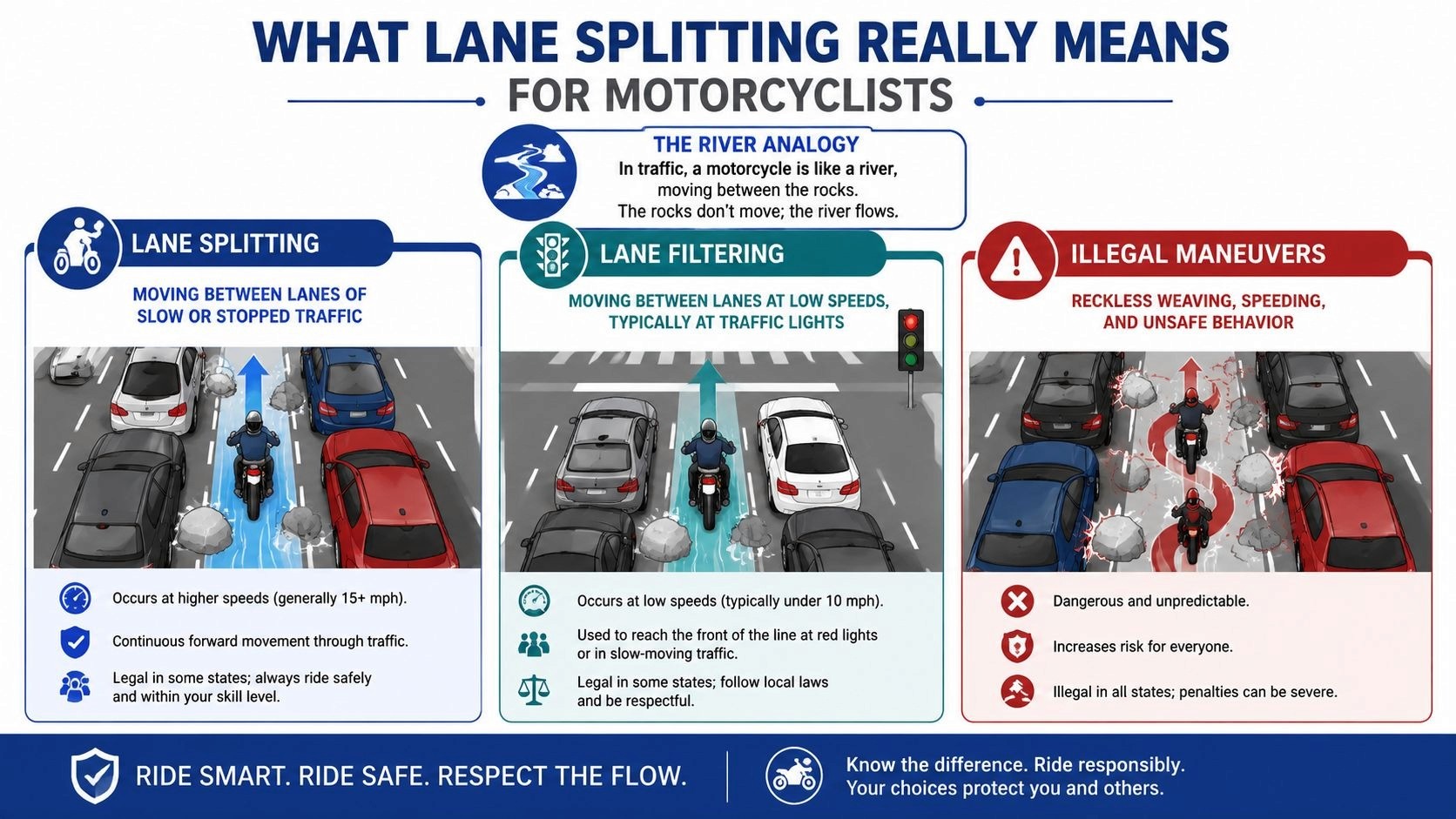
Lane splitting is when a motorcycle rides between two lanes of vehicles traveling in the same direction, usually to move through stopped or slow traffic. This movement involves the motorcycle maneuvering through existing gaps. The motorcycle isn't taking a full lane. It's moving through the narrow channel between vehicles.
That basic definition matters because people use the wrong words all the time. Riders, drivers, police officers, and adjusters may describe very different conduct with the same label. If the terms get sloppy, fault analysis gets sloppy too.
Lane splitting versus lane filtering
The clearest way to understand what lane splitting is is to compare it with similar conduct.
Term | What it means | Why it matters legally |
Lane splitting | Riding between lanes of moving or stopped vehicles traveling in the same direction | This draws the most scrutiny after a crash |
Lane filtering | A narrower practice, usually moving between stopped vehicles at very low speed | Some states allow this in limited situations |
Shoulder surfing | Riding on the shoulder to bypass traffic | This is different from lawful lane splitting and is often treated much more harshly |
Lane filtering is not just a casual synonym. It usually describes a slower, tighter maneuver in stopped traffic, often near an intersection or light. By contrast, lane splitting can happen while surrounding vehicles are still moving.
What lane splitting is not
A lot of post-crash blame starts with exaggeration. A rider moved between lanes in congestion, and the driver later describes it as weaving, racing, or passing on the shoulder. Those are not the same thing.
In any crash report or insurance statement, use the most accurate term possible. “Between lanes in slow traffic” means something different from “weaving through traffic.”
Three distinctions matter:
It isn't random weaving. Weaving means repeated lane changes, abrupt movement, and unpredictable path changes. Lane splitting is a straight or mostly straight path between lanes.
It isn't shoulder riding. The California Highway Patrol says riding on the shoulder is illegal and not considered lawful lane splitting under California's motorcycle safety guidance.
It isn't automatically reckless. Sometimes it is unsafe. Sometimes it's done carefully in congestion. The legal fight usually turns on how it was done, what surrounding traffic was doing, and whether another driver changed lanes without checking.
Why this definition matters after a Florida crash
In a Florida claim, words become evidence fast. If an adjuster can reframe lane splitting as reckless passing, improper lane usage, or aggressive weaving, they gain an advantage before the investigation even starts.
That's why precision matters. The first question isn't just “Was the rider between lanes?” The better questions are these:
Was traffic stopped or crawling?
Was the rider traveling in a straight line or darting side to side?
Did a nearby driver merge or change lanes?
Did the crash happen between lanes, at a lane line, or on the shoulder?
Those details often decide whether the event looks like a bad riding choice, a preventable driver lane change, or some mix of both.
The Data on Lane Splitting Safety and Risks
A rider in stopped traffic often sees the same risk I see in crash files afterward. Stay in line, and you may get hit from behind. When you move between lanes, you may be blamed if a driver drifts or changes lanes into you.
That is why broad claims about lane splitting being "safe" or "unsafe" are not very useful. The critical factor is how the risk changes. In slow or stopped traffic, riding between lanes can reduce exposure to a rear-end impact. It can also increase the chance of a side-swipe, a mirror strike, or a crash with a vehicle that shifts laterally without warning.
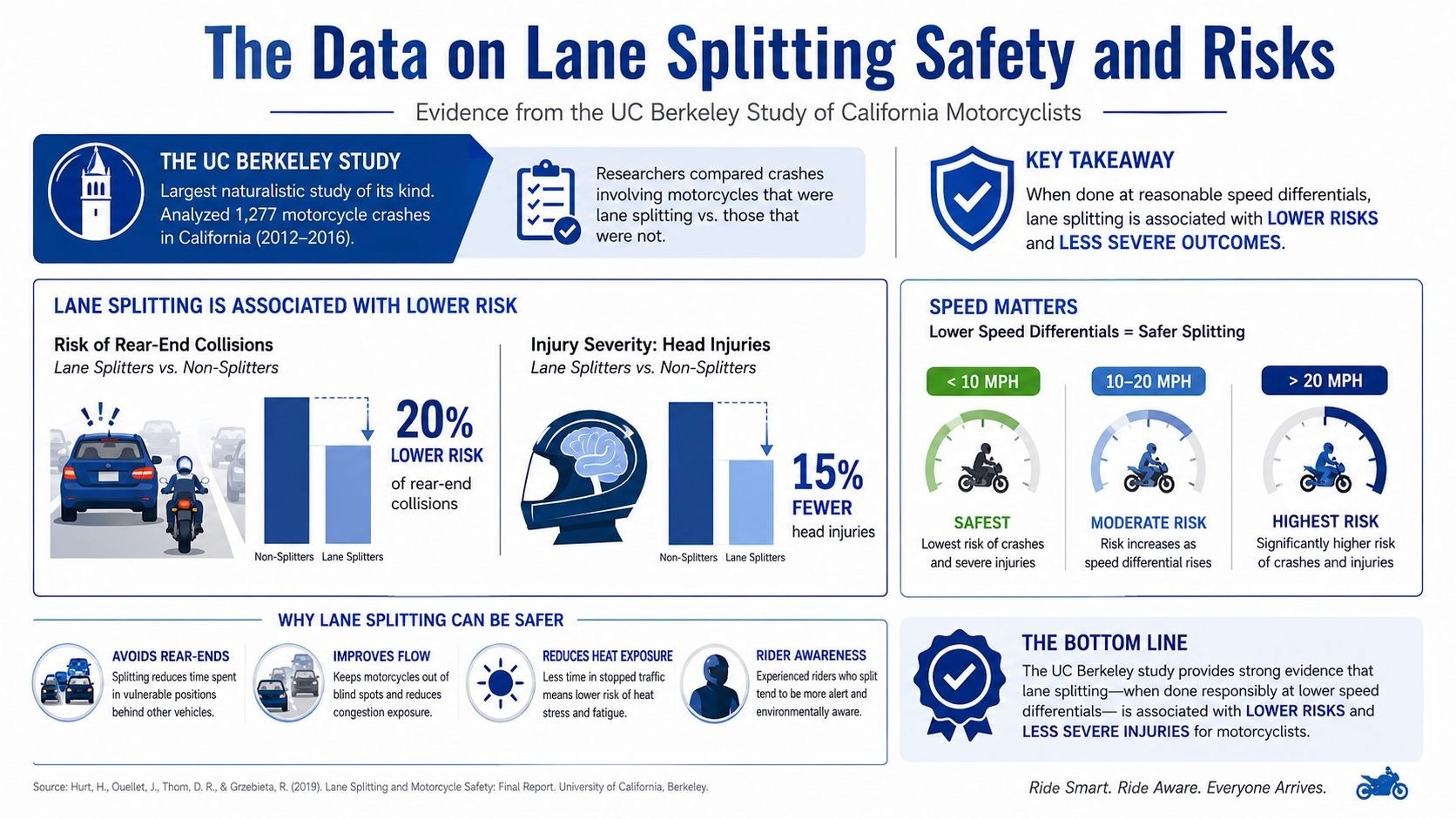
California crash research is often cited because it is one of the better-known datasets on this subject. Analysts found lane-splitting riders were less likely to be rear-ended than riders who stayed in line with traffic. The same research also found they were more likely to rear-end another vehicle. The trade-off matters. One danger goes down, another goes up.
Speed difference is the core issue
The strongest safety theme in the research is speed differential. That means the gap between the motorcycle's speed and the speed of surrounding traffic.
When that gap stays small, everyone has more time to react. When the motorcycle is coming through much faster than traffic, the margin for error disappears fast. Drivers check mirrors, start a lane change, or open space in a stop-and-go pattern. A bike that closes that distance too quickly is harder to see and harder to avoid.
That point matters in a Florida injury claim because insurers look for facts that make the rider sound unreasonable. If the evidence shows traffic was crawling and the motorcycle was only slightly faster, the defense argument is weaker. If the evidence shows a large speed difference, the adjuster will use it to argue comparative fault and cut the value of the case.
The crash pattern that shows up most often
Many lane-splitting collisions start with a lane change, not with a motorcycle losing control. Adjacent drivers drift, merge, or move over without ever registering that a motorcycle is beside them.
A review from the Washington Traffic Safety Commission summarizes that pattern and notes research indicating a higher crash risk for motorcycles traveling between lanes, largely because nearby drivers fail to detect them.
I see that same argument play out after Florida crashes. The driver says, "I never saw the bike." The insurer turns that into, "The rider should not have been there." In a gray-area state, that framing can hurt a claim unless the physical evidence shows the driver moved without checking, crossed the lane line, or made an unsafe merge.
What helps and what creates problems
Safer conditions usually include:
Slow or stopped traffic
A small speed difference
Open sight lines
Predictable traffic flow
Higher-risk conditions usually include:
Fast traffic
A large speed difference
Limited space next to trucks, buses, or large SUVs
Frequent merging and lane changes
For a Florida rider, those facts are not just safety details. They become liability facts. They determine whether the insurer treats the crash as a preventable, unsafe lane change by the driver, a risky maneuver by the rider, or a mixed-fault case in which the carrier tries to discount every part of the claim.
Lane Splitting Laws Across the US and in Florida
A rider from California filters through backed-up traffic in Miami, gets hit by a driver changing lanes, and assumes the claim will turn on who moved first. In Florida, the fight often starts earlier. The insurer uses the rider's position between lanes to argue that the whole event began with unsafe conduct.
State law across the country is inconsistent. California expressly recognizes lane splitting, while several other states allow only limited lane filtering under narrow conditions. Arizona, Utah, and Montana are common examples. Their rules generally tie filtering to stopped or very slow traffic and lower-speed roads, which gives riders, police, and insurers a clearer framework for judging what happened.
California versus limited filtering states
California treats lane splitting as a recognized riding practice. Filtering states take a narrower approach. That distinction matters in a claim.
Where a state sets clear limits, everyone involved has a reference point. An officer can compare the rider's speed and the traffic conditions to the rule. An adjuster can still argue fault, but the analysis starts with an actual standard instead of a guess. Florida does not offer that benefit to riders.
Why Florida creates claim problems
Florida riders often hear a simple answer that lane splitting is illegal here. In real cases, that might miss the practical problem. The harder issue is how the gray area gets used after a crash.
Without a clear lane-splitting framework, insurers have room to frame nearly any between-lane movement as careless, even where the other driver drifted, merged without checking, or crossed into the motorcycle's path. I see that strategy regularly. The adjuster is not just evaluating traffic law. The adjuster is building comparative-fault arguments that reduce what the carrier pays.
What the gray area means for a Florida rider
In a clear-law state, the legal question is narrower. In Florida, the argument spreads. The carrier may challenge the rider's judgment, visibility, lane position, speed, and right to expect a driver to notice the bike at all.
That is why the facts have to be developed early. Skid marks, lane markings, vehicle damage, helmet-cam footage, witness statements, and the exact point of impact can matter more than broad debates about whether lane splitting is allowed somewhere else. In serious injury cases, the defense often uses every available liability argument at once, which is one reason broader policy fights over civil claims, including Florida tort reform for trucking, matter to injured riders too.
For a Florida motorcyclist, the takeaway is straightforward. The fact that lane splitting is prohibited gives insurers room to argue comparative fault.
Fault and Liability in a Florida Lane Splitting Crash
The most important thing to understand after a Florida lane-splitting crash is this: the rider isn't automatically 100% at fault. But that's exactly how many insurance companies want the case to feel from day one.
When lane splitting is part of the story, adjusters often treat it like a shortcut to comparative fault. They argue that the rider created the danger by being between lanes, even when the other driver changed lanes abruptly, merged without checking, or drifted into the bike's path.
How insurers use the gray area
Here, the Florida gray area becomes a weapon. The defense doesn't need a perfect statutory match to make trouble. It only needs enough ambiguity to argue that the rider failed to operate safely.
Adjusters usually focus on questions like these:
Why were you between lanes at all
Were you passing vehicles outside a normal lane
Could a reasonable driver have expected you there
Did your position reduce the other driver's ability to see you
That framing can be effective even when the larger vehicle moves without a proper check. In serious crash litigation, the fight often turns on whether the rider's position was the main cause, a contributing cause, or the setting in which the driver made a negligent move.
The better liability analysis
A stronger legal analysis starts with conduct, not assumptions. If a driver changed lanes without checking their mirrors and blind spots, that driver may still bear substantial fault. The fact that the motorcycle was in the lane-dividing space doesn't erase the driver's duty to move safely.
That point matters even more in cases involving larger vehicles. If the crash involved a commercial vehicle, broader changes in liability rules and damages strategy can affect the strategic advantage in ways riders often don't see early on.
What actually moves a case
Evidence issue | Why it matters |
Vehicle position | Shows whether the driver encroached or merged |
Point of impact | Can support a lane-change failure rather than reckless rider movement |
Witness observations | Independent witnesses often notice sudden driver movement |
Scene photos | Preserve lane layout, traffic congestion, and sight lines |
In Florida, lane splitting can hurt a claim. It doesn't end it. The difference usually comes down to whether the case gets framed as “motorcyclist doing something unusual” or “driver made an unsafe lateral move and then blamed the rider.”
Steps to Take Immediately After an Accident
You are on I-95 in slow traffic. A driver shifts left without warning, clips your bike, and then tells the officer you were “cutting between cars.” In a Florida lane-splitting case, that statement can shape the insurance claim within minutes if you do not lock down the facts.

Get medical help and create a record
Call 911. Move out of traffic only if you can do it safely. Let EMS examine you, even if you think you can shake it off.
I have seen riders hurt their own cases by refusing treatment at the scene and then learning later that they had a serious shoulder, neck, or leg injury. The insurance company uses that gap to argue the crash was minor or that the injury came from something else.
Capture the scene before the story hardens
In these cases, photos of the bike alone are not enough. The claim often turns on movement, lane position, and whether the driver merged, drifted, or opened a gap and then closed it.
Try to document:
Where each vehicle ended up
The side of the other vehicle that made contact
Turn signals, mirrors, and side damage
Traffic flow, including whether vehicles were stopped or creeping
Debris, scrape marks, and gouges on the pavement
The full lane layout, including shoulders and merge space
As noted earlier, crash analysts often focus on mirror checks, lateral movement, and contact points in these motorcycle cases. Those details can support your version of events if the driver later claims you appeared “out of nowhere.”
Speak carefully to the police and insurers
Give the officer the facts. Do not guess about speed, distance, or fault if you are not sure. Do not use loaded phrases like “I was weaving” or “I was squeezing through” unless those words are exactly accurate, because insurers repeat them for months.
A better approach is simple and specific:
State where you were in relation to the lane lines and nearby vehicles.
Describe what the driver did. Merged, drifted, changed lanes, or turned without seeing you.
Point out witnesses before they leave.
Do not apologize for the crash. Politeness gets misread as admitting fault.
Preserve evidence that the insurance company will ask for later
Keep your helmet, jacket, gloves, and damaged parts. Do not repair the motorcycle until it has been photographed and, if needed, inspected. Save helmet-cam footage, phone photos, GPS or ride-app data, and every text, voicemail, or email tied to the wreck.
If you want a fuller rider-specific checklist, review this guide to motorcycle accidents in Florida and what to do after a crash.
One more practical point. Do not give a recorded statement to the other driver's insurer right away. In Florida's gray area around lane splitting, adjusters often ask questions designed to turn unusual riding into an automatic fault. The earlier you preserve the physical evidence, the harder it is for them to sell that version of the crash.
Why You Need an Attorney for a Lane Splitting Claim
A rider gets hit in slow traffic on I-95. The driver says the bike “came out of nowhere.” The adjuster hears “lane splitting” and starts building the file around one idea: the rider caused the problem. In Florida, that gray area gives the insurance company room to argue fault hard and early.
That is why legal help matters in these cases.
Lane-splitting claims are tougher than an ordinary rear-end crash or a clear left-turn collision. The movement happens fast, witness accounts are often incomplete, and the insurer knows many riders are worried that lane splitting will sink the case from the start. I have seen adjusters use that fear to push quick settlements before the rider understands how much the claim is really worth.
The practical issue is not just whether lane splitting was involved. The primary fight is over causation and comparative fault. Did the driver drift over the line without checking mirrors? Change lanes without signaling? Crowd the space between lanes? Those facts decide cases, but they are easy to blur if no one secures the evidence early.
An attorney should do more than send paperwork. In a Florida lane-splitting claim, counsel needs to:
preserve scene photos, bike damage, helmet-cam footage, and vehicle data before it disappears
get witness statements while memories are still fresh
compare the vehicle damage to each party's story about lane position and movement
push back when the insurer treats lane splitting as automatic negligence
frame the driver's duties clearly, especially the duty to keep a proper lookout before merging or changing lanes
value the case fully, including medical treatment, lost income, future care, and pain and suffering
Sometimes that also means bringing in an accident reconstruction expert. Sometimes it means pressing the insurer with its own insured's statement, repair records, or phone data. The point is simple. A good case can lose value fast when the other side defines the story first.
If you are trying to understand what legal representation in these cases usually involves, this overview of auto and motorcycle accident cases gives a useful starting point.
Lane splitting can complicate a Florida injury claim. It does not cancel your rights. A lawyer helps keep the focus where it belongs: what the driver did, what the evidence shows, and what it will take to cover your losses.
If a lane-splitting crash left you injured, boxed in by insurance adjusters, or worried that the gray area in Florida law will be used against you, talk to CAINE LAW. The right legal strategy can preserve evidence, challenge unfair fault arguments, and protect the value of your case before the record hardens against you. In pain? Call Caine.