
In Pain? Call Caine
Ringing in ears after car accident: ringing in ears after car accident relief

5 Min read
By: Caine Law
Share
That ringing sound in your ears after a car accident? It's not just a minor annoyance. It's a very real medical symptom called tinnitus, and it can be a sign of a much more serious underlying injury, like whiplash or even a traumatic brain injury (TBI).
This isn't something you can just "shake off." It's an invisible injury that deserves immediate medical and legal attention.
That Ringing in Your Ears Is a Serious Post-Accident Signal
The aftermath of a car wreck is pure chaos. With adrenaline pumping and obvious injuries demanding attention, it's all too easy to ignore something like a persistent ringing in your ears. But that phantom noise is your body's alarm system—it's signaling that something is wrong, and you need to listen.
This condition isn't "all in your head." It's a legitimate medical issue often triggered by the violent, jarring forces of a collision. The road ahead means understanding what's causing it, getting a proper diagnosis, and knowing how to protect your legal rights here in Florida.
Why You Cannot Ignore Tinnitus
Dismissing tinnitus as something that will just fade away is a serious mistake. Many accident victims do this, but that ringing can be the very first clue that you've suffered damage to your hearing, your neck, or your brain.
Tinnitus is more than just a nuisance; it's a critical diagnostic clue. Its presence after trauma demands immediate medical evaluation to rule out or identify underlying injuries that require prompt treatment.
Think of it like the check engine light in your car. The light itself isn't the problem, but it’s warning you about a deeper issue that needs a mechanic. In the same way, tinnitus is alerting you to physical trauma that needs a doctor's diagnosis. For more on what to do right after a crash, check out our guide on what to do when accidents happen.
When you first notice ringing in your ears after an accident, every step you take matters—both for your health and for any potential legal claim you may have in Florida. The table below outlines the critical first moves.
Immediate Steps for Ringing Ears After a Florida Accident
Action Step | Why It's Critical in Florida |
|---|---|
Seek Medical Evaluation Immediately | Florida's PIP "14-Day Rule" requires you to seek initial medical treatment within 14 days of the accident to be eligible for your full insurance benefits. This visit creates a crucial medical record linking the tinnitus to the crash. |
Document Every Symptom | Be specific with your doctor. Describe the ringing, its frequency, and any other symptoms like dizziness, headaches, or neck pain. This detailed documentation is vital evidence for your injury claim. |
Follow All Medical Advice | Consistently follow your doctor's treatment plan. Gaps in treatment can be used by insurance companies to argue that your injuries aren't serious. |
Consult a Personal Injury Attorney | An attorney can protect you from insurance adjuster tactics and ensure all evidence is preserved. They will handle the legal complexities so you can focus on healing. |
Taking these steps helps build a strong foundation for both your physical recovery and your financial one.
Just How Common Is Post-Accident Tinnitus?
If you're hearing that ringing, you are far from alone. Tinnitus is a surprisingly frequent outcome of car crashes. In fact, studies show that approximately 66% of accident victims report experiencing tinnitus symptoms. For some, it's an occasional annoyance, but for many others, it becomes a constant disruption to their daily life. You can read the full research on post-MVA tinnitus for a deeper dive.
Protecting your health and your legal rights starts the moment you notice that sound. Recognizing that this ringing is a valid medical condition directly linked to your accident is the first step toward getting the help you deserve. If you're dealing with the fallout from a crash, you don't have to go it alone. In pain? Call Caine.
The Direct Link Between a Car Crash and Tinnitus
It's easy to think of a car crash and the persistent ringing in your ears as two separate problems. One is a violent, external event; the other is a maddening, internal noise. But there's a direct physical line connecting the trauma of the accident to the ringing, and understanding that link is crucial to getting the compensation you need to recover.
Think about the delicate, complex network of nerves, bones, and soft tissues in your head and neck. A collision subjects this entire system to sudden, unnatural forces. That trauma can easily disrupt the sophisticated process of hearing, tricking your brain into perceiving a sound that isn't really there.
This flowchart helps map out the journey from the moment of impact to taking legal action for your tinnitus.
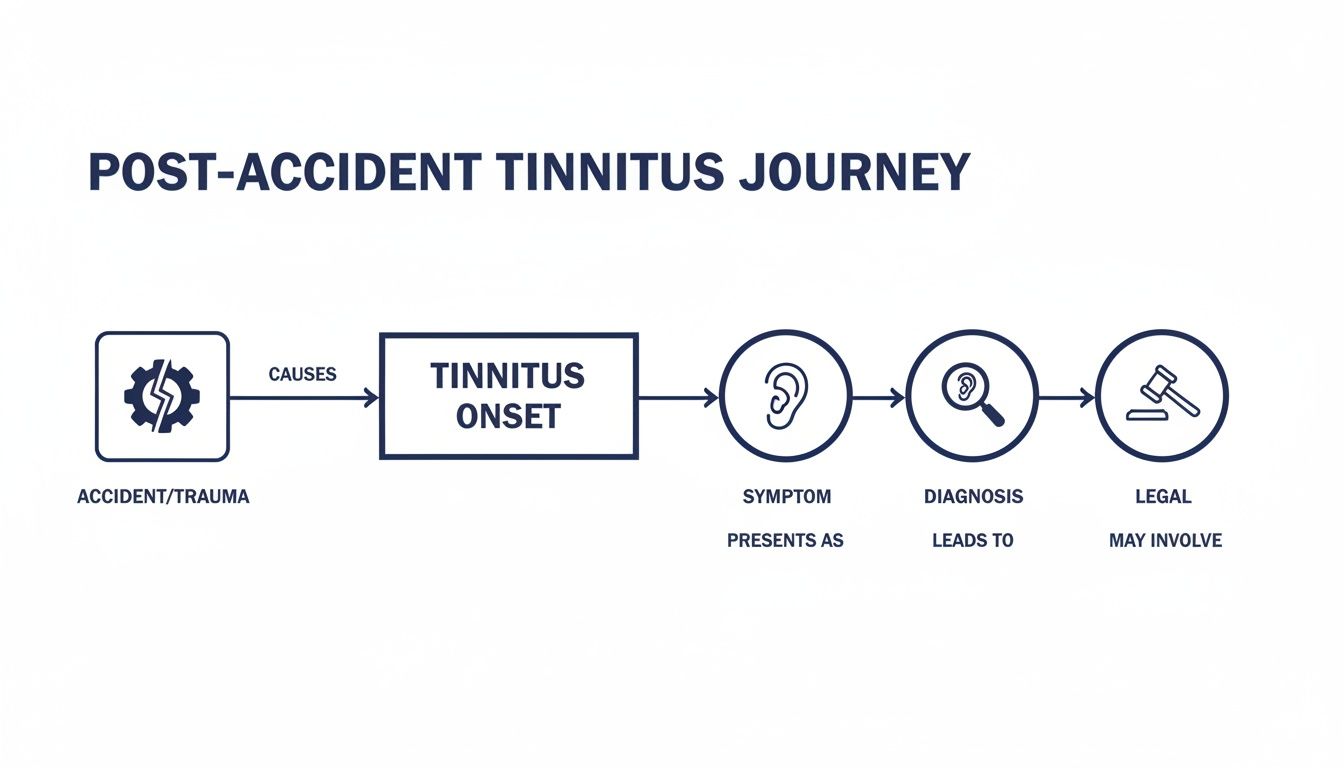
As you can see, the physical event sets off a chain reaction—triggering a medical condition that requires both a proper diagnosis and a strong legal strategy to fully address.
The Primary Culprits Behind Post-Accident Tinnitus
Several specific injuries are notorious for causing that incessant ringing noise. While each one impacts the auditory system in a slightly different way, they all trace back directly to the forces you experienced in the wreck. These aren't just possibilities; they are well-documented medical realities.
Let's break down the three most common causes.
Whiplash-Associated Disorders: That violent, back-and-forth snapping of your head and neck doesn't just strain muscles. It can stretch, pinch, or damage the delicate auditory nerve pathways that carry sound signals from your inner ear to your brain, leading to tinnitus.
Traumatic Brain Injury (TBI): Even a "mild" concussion involves your brain striking the inside of your skull. This impact can damage the brain's auditory processing centers, scrambling how it interprets sound signals and essentially creating phantom noise.
Direct Ear Trauma: The sudden, explosive sounds of a crash—crunching metal, shattering glass, or a deploying airbag—can cause acoustic trauma. This can permanently damage the tiny, fragile hair cells in the inner ear that are critical for hearing, resulting in both tinnitus and potential hearing loss.
The medical evidence linking these injuries to tinnitus is overwhelming. Whiplash, for example, has a particularly strong association. One study looking into whiplash-related tinnitus found that a staggering 55.8% of patients developed the condition. Similarly, research focusing on TBI revealed that 53% of young adult patients reported tinnitus during their recovery. You can read more about the link between whiplash and tinnitus in the full study.
How Physical Force Translates to Phantom Noise
So, how does a physical jolt create a sound? It helps to think of your auditory system as a high-end stereo. Your inner ear is the microphone, picking up sound waves. The auditory nerves are the cables carrying the signal, and your brain is the amplifier, decoding those signals into the sounds you recognize.
A car accident violently shakes that entire setup.
The force can damage the "microphone" (inner ear), fray the "cables" (auditory nerves), or mess with the "amplifier's" internal circuitry (the brain's processing centers). When any part of that system gets damaged, the result is often static—the constant ringing, buzzing, or hissing of tinnitus.
This is a real, physiological injury, not just a psychological reaction to a stressful event. The sound you're hearing is a direct byproduct of physical damage. Insurance adjusters will almost certainly try to downplay it, but the science is clear. Proving this connection is the key to your personal injury claim.
When your life is turned upside down by a constant, maddening noise caused by someone else's mistake, you need a team that gets both the science and the law. We know how to build a case that shows the undeniable link between the crash and your suffering. In pain? Call Caine.
The Hidden Danger of Airbag Deployment
Airbags are a modern miracle of car safety. They’re designed to be a soft landing in a crash, preventing far worse injuries, and they save thousands of lives every single year. But this life-saving explosion comes with a serious, and often permanent, side effect: hearing damage and tinnitus.
The whole point of an airbag is to deploy with lightning speed. It's not a gentle puff of air; it's a controlled chemical explosion happening just a few feet from your head. That explosive force creates an incredibly powerful sound wave.
An Acoustic Assault on Your Ears
To really get a sense of how loud this is, let's put it in perspective. A normal conversation hovers around 60 decibels (dB). A loud rock concert can blast your ears at 120 dB. The point where you can get immediate, permanent hearing damage is about 140 dB.
An airbag goes off with a sound pressure level that can spike above 160-170 dB. That isn't just loud—it's a level of acoustic trauma the human ear was never designed to handle. This intense pressure wave can physically demolish the delicate, microscopic structures deep inside your ear.
This sudden, violent noise can destroy the tiny hair cells in your inner ear. These cells are responsible for converting sound vibrations into electrical signals your brain understands as sound. Once they're gone, they're gone for good, leading to permanent hearing loss and the phantom ringing of tinnitus.
Think of those hair cells like the strings on a guitar. The sound of an airbag is like taking a sledgehammer to the instrument. Even if only a few strings are broken, the guitar will never play music the same way again. Similarly, when those inner ear cells are damaged, your hearing is permanently altered, often leaving you with that persistent ringing in ears after car accident.
More Than Just a Loud Pop
It’s not just the initial "boom" that causes the problem. The rapid, violent change in air pressure inside the car's cabin can also trigger something called barotrauma—the same kind of injury divers get from surfacing too quickly. This intense pressure can rupture your eardrum or knock the tiny bones in your middle ear out of place, making the hearing problems and tinnitus even worse.
This isn't just a theory; it's a harsh reality for countless accident survivors. Study after study has shown that airbag deployment is a major, and often overlooked, cause of hearing damage. In fact, research suggests that around 17% of people exposed to an airbag deployment will suffer some degree of permanent hearing loss or tinnitus. The risk is even higher with side airbags, which can hit a peak sound pressure of 178 dB. You can learn more about these hearing loss findings to understand just how significant this risk is.
Delayed Symptoms and Why You Need to See a Doctor
One of the trickiest things about airbag-induced tinnitus is that you might not notice it right away. In the chaos and confusion after a crash, your body is flooded with adrenaline. You might not register a faint ringing in your ears. It can take hours, or even a few days, for the sound to become constant and impossible to ignore.
This delay makes it easy for insurance companies to argue that your tinnitus isn't related to the accident. That's why getting a full medical evaluation after any crash where an airbag deploys is absolutely critical, even if you think you’re okay.
Here’s why a hearing evaluation is not something you can afford to skip:
Uncovering Hidden Damage: A specialist, like an audiologist or an ENT doctor, has the tools to detect hearing loss you might not even be aware of yet.
Establishing a Timeline: Seeing a doctor right away creates an official medical record. This document is a powerful piece of evidence that directly links your hearing problems to the car accident.
Preventing Further Complications: The sooner you get a diagnosis, the sooner you can learn strategies to manage the tinnitus and keep it from taking over your life.
The facts are clear: while airbags save lives, they pose a serious threat to your hearing. You have to take any new ringing in your ears after an accident seriously, both for your health and for your legal rights. If the blast from an airbag has left you with a constant, maddening noise, you deserve to be compensated for that harm. In pain? Call Caine.
How to Document Your Tinnitus for a Florida Injury Claim
That ringing in your ears after a car accident isn't just a medical issue—it's a legal one. To get the compensation you deserve here in Florida, you have to be able to draw a straight, undeniable line from the crash to your tinnitus. That means building a rock-solid case with clear evidence.
Your actions in the days and weeks after the wreck are absolutely critical. Insurance companies are notorious for trying to downplay or dismiss "invisible" injuries like tinnitus. They'll often argue it’s unrelated to the crash or not as serious as you say. Meticulous documentation is your single best defense against these tactics.
Create a Clear Timeline with Immediate Medical Care
First things first: get to a doctor. Right away. In Florida, this is more than just good health advice; it's a legal requirement. Under the state’s “14-day rule” for Personal Injury Protection (PIP) benefits, you must get initial medical treatment within 14 days of the accident, or you risk losing access to your full coverage.
This first visit does something incredibly important—it creates the starting point for your official medical record. It establishes a clear timeline, showing your symptoms popped up right after the collision. When you see the doctor, be as specific as possible. Describe the ringing, its volume, and any other symptoms you're having, like dizziness or headaches.
From there, it's vital to get a referral to a specialist, like an audiologist or an Otolaryngologist (ENT). A specialist’s diagnosis isn't just another opinion; it's expert validation that confirms your condition is real and links it directly to the trauma of the crash.
The Power of a Detailed Symptom Journal
While doctor’s notes are official, they don't always capture the full story. Your personal account of how tinnitus impacts your day-to-day life is what makes a claim truly compelling. This is where a symptom journal becomes your most powerful tool. Think of it as your daily logbook of evidence.
Your journal should track things like:
When the ringing is worst: Note the time of day or specific activities that make the tinnitus louder or more distracting.
The impact on your life: How is it affecting your sleep? Your concentration at work? Can you still enjoy a simple conversation with your family?
Emotional and psychological effects: Don't forget to document the anxiety, frustration, or depression that comes with having a constant noise in your head.
Any related expenses: Keep every single receipt for medications, white noise machines, or any other therapies you're trying.
A well-kept journal transforms your injury from a simple medical diagnosis into a detailed narrative of daily suffering. It provides concrete examples of pain and suffering that an insurance adjuster or jury can understand.
This kind of detailed record-keeping is a cornerstone of any successful injury case. For a deeper dive into what to save, check out our guide on how to document evidence needed for a personal injury claim in FL.
Adhering to Florida's Legal Deadlines
Finally, you absolutely have to keep an eye on the clock. Florida has a strict statute of limitations. For most personal injury cases rooted in negligence, you generally have just two years from the date of the accident to file a lawsuit. If you miss that deadline, you could lose your right to seek compensation forever.
This is why moving quickly is so important. Building a strong case takes time, from gathering all the medical records to negotiating with insurance companies. Waiting too long can put your entire claim in jeopardy.
Properly documenting the ringing in ears after car accident isn’t just about paperwork; it's about building a fortress of proof around your claim. Every doctor's visit, journal entry, and receipt adds another brick to that wall. If you're struggling to manage your symptoms while trying to navigate this complex process, you don't have to do it alone. In pain? Call Caine.
Getting Your Tinnitus Diagnosed and Treated
When that ringing in your ears just won’t quit, it's more than just annoying—it’s deeply unsettling. The path to getting control starts with a clear, methodical medical process. This journey isn't just about your health; it's about building the solid foundation you'll need for your personal injury claim.
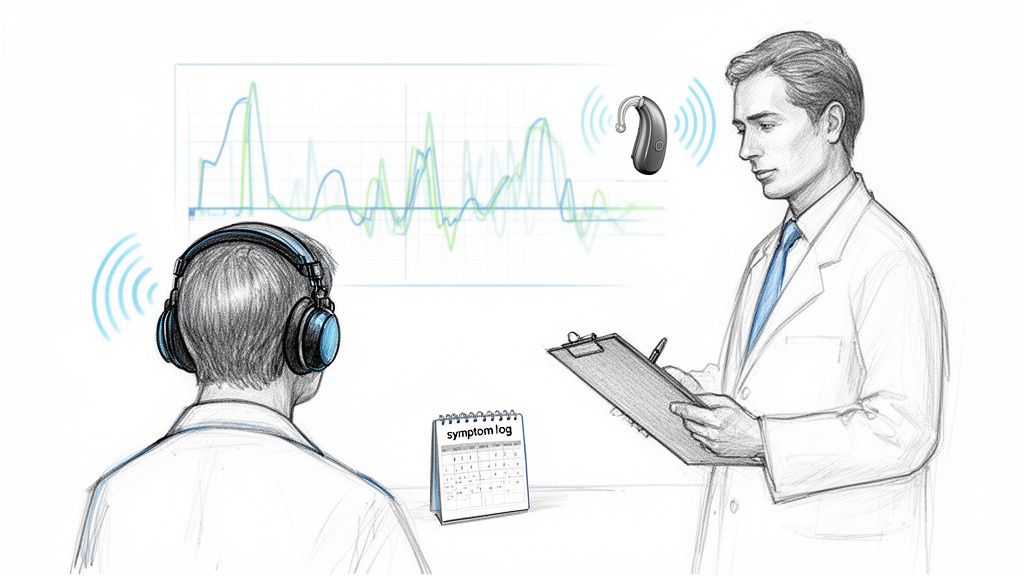
It usually all starts with your primary care doctor, who will do an initial check of your ears, head, and neck. From there, you’ll almost certainly be sent to specialists with the right tools and expertise to really dig into the ringing in ears after car accident. These experts are typically an audiologist (a hearing specialist) or an Otolaryngologist—you probably know them as an Ear, Nose, and Throat (ENT) doctor.
Pinpointing the Cause with Diagnostic Tools
To figure out what’s really going on, specialists use a series of objective tests. This isn’t a guessing game. It’s a scientific process to rule out different causes and nail down the extent of the damage to your auditory system.
The diagnostic process typically involves a few key steps:
Comprehensive Hearing Test (Audiogram): This is the gold standard. You'll sit in a soundproof room and listen for a series of tones at different volumes. It helps the audiologist map out any hearing loss, which often goes hand-in-hand with tinnitus.
Physical Examination: An ENT will give your head, neck, and ears a thorough once-over, looking for any structural problems or blockages that could be contributing to those phantom sounds.
Imaging Scans: If your doctor suspects a traumatic brain injury or a serious neck injury from the crash, they might order an MRI or CT scan. These images can reveal hidden damage to the brain's hearing pathways or nerve issues caused by whiplash.
These tests are absolutely critical. They provide the concrete, medical proof that your injury is real. This is the kind of objective data you need to shut down an insurance company's attempt to claim your condition is minor or wasn't caused by the accident.
Modern Treatments to Manage Tinnitus
While there's often no magic "cure" for permanent tinnitus, that doesn't mean you have to just live with it. Modern medicine offers several effective strategies to manage the condition, significantly improving your quality of life by making that constant ringing far less intrusive.
Tinnitus treatment is focused on management, not elimination. The goal is to retrain the brain to tune out the phantom noise, reducing its impact on your daily life and restoring a sense of quiet.
Your specialist will likely recommend a mix of therapies designed specifically for you.
Common Treatment Approaches
Sound Therapy: This uses external noises to mask the internal ringing. It can be as simple as a white noise machine or a fan at night, or it can involve sophisticated wearable sound generators or specialized hearing aids that play a gentle, soothing sound.
Cognitive Behavioral Therapy (CBT): This is a powerful psychological approach that helps you change how you react—emotionally and mentally—to the tinnitus. It doesn't silence the noise, but it gives you coping tools to stop it from causing anxiety, stress, or depression.
Medications: While no pill can cure tinnitus, certain medications can help you deal with the related symptoms. Doctors might prescribe anti-anxiety drugs or sleep aids to help you manage the emotional toll the condition takes.
The long-term costs for these treatments—from specialist visits to hearing aids and ongoing therapy—are a crucial part of your injury claim. These are necessary medical expenses you have because of someone else's mistake. You shouldn't have to carry that financial burden alone. We can help you fight for the compensation you need to cover this lifelong care. In pain? Call Caine.
How a Florida Attorney Can Win Your Tinnitus Claim
Let’s be honest: insurance companies aren’t your friends. When you file a tinnitus claim, the adjuster on the other end of the line is trained to see it as a minor complaint, not the debilitating, life-altering condition it is. Their job is to protect their company's bottom line by paying you as little as possible. This is exactly why having an experienced Florida personal injury attorney in your corner is so critical.
Proving an "invisible injury" like tinnitus isn't easy. You can't just show them a picture. It requires a specific legal strategy built around showing them the undeniable, daily impact it has on your life through irrefutable evidence.
Building a Case for Your Suffering
At Caine Law, we know precisely how to build a case that an insurance company can't just brush aside. We start by meticulously gathering the crucial evidence: medical records from your audiologist and ENT, expert testimony that directly links the tinnitus to the trauma of the crash, and the detailed notes from your own symptom journal.
An attorney’s role is to translate your personal suffering into a legal argument for damages. We demonstrate how tinnitus affects your ability to work, sleep, and enjoy life, ensuring your pain and suffering are given a real monetary value.
We fight for full compensation that covers every single aspect of your injury. This means going beyond just the medical bills. We pursue damages for lost income if the condition hurts your job performance and, just as importantly, for the significant non-economic toll it takes on your daily life. You can see more about our strategy by exploring our approach to personal injury claims in Florida.
Securing the Compensation You Deserve
We treat every case as if it's headed straight for trial. This aggressive preparation sends a clear message to the insurance company: we’re serious, and we’re ready. More often than not, this approach leads to much higher settlement offers before a courtroom is ever necessary.
To understand the compensation available, it helps to break down the different types of damages you can pursue in a Florida claim.
Damages You Can Claim for Tinnitus in Florida
Type of Damage | What It Covers |
|---|---|
Economic Damages | These are the tangible, out-of-pocket costs. Think past and future medical bills, hearing aids, sound therapy machines, counseling, and any income you've lost because you couldn't work. |
Non-Economic Damages | This covers the "invisible" suffering. It includes compensation for your pain, emotional distress, anxiety, loss of enjoyment of life, and the daily frustration of living with a constant ringing in your ears. |
We calculate the complete, long-term cost of your condition, accounting for everything from ongoing therapy to future medical needs.
Don’t let an insurance adjuster tell you what your pain is worth. That constant noise in your head is a serious injury, and you have every right to demand fair compensation for it. We have the experience to make them listen. In pain? Call Caine.
Common Questions About Tinnitus After a Car Crash
Trying to get your bearings after a car accident is hard enough. When you add a persistent ringing in your ears, it can be overwhelming. You're probably wondering what this noise is, what it means for your health, and how it will affect your future. Let’s tackle some of the most common questions we hear from accident victims across Florida.
How Long Will This Ringing Last?
Honestly, it's different for everyone. For some, the ringing is a short-term problem that fades away within a few weeks or months. But if that sound sticks around for more than six months, doctors usually classify it as chronic tinnitus.
Chronic cases often point to permanent damage—maybe to the delicate structures in the inner ear, the auditory nerves, or even the parts of your brain that process sound. The good news is that even if the noise is permanent, there are effective treatments that can turn down the volume, so to speak, making it far less intrusive and helping you get your life back.
Can the Stress of the Wreck Make My Tinnitus Worse?
Without a doubt. While the crash itself caused the physical injury, the psychological trauma and ongoing stress that follow can absolutely crank up the volume on your tinnitus. It's a well-known fact that high levels of stress and anxiety make the symptoms feel louder and more disruptive.
This can trap you in a vicious cycle: the tinnitus causes stress, and that stress makes the ringing seem even worse. It’s exactly why a good treatment plan often includes things like Cognitive Behavioral Therapy (CBT) to help you break that cycle and manage the emotional side of the condition.
Is Tinnitus a Red Flag for a More Serious Injury?
Yes, and this is critical to understand. Tinnitus isn't just an annoyance; it can be one of the first and most obvious symptoms of a much bigger problem caused by the accident, such as:
Traumatic Brain Injury (TBI): That ringing is a classic symptom of a concussion or a more severe TBI.
Whiplash-Associated Disorders: When the nerves and soft tissues in your neck get damaged, it can directly mess with the signals your brain uses to hear.
Vestibular Damage: If you’re also feeling dizzy or unsteady on your feet, it could be a sign of damage to the balance system in your inner ear.
Think of tinnitus as an alarm bell. It’s not just a noise; it’s a clear signal from your body that you have sustained an injury that requires immediate and thorough medical investigation. Ignoring it could mean leaving a more severe condition undiagnosed.
What Is a Tinnitus Claim Worth in Florida?
There’s no magic number here, because the value of a tinnitus claim is completely unique to your situation. The compensation you can go after really depends on a few key factors: how severe your symptoms are, the total cost of your medical care, and the overall impact this has had on your quality of life.
A solid personal injury claim will demand compensation for both your economic and non-economic damages. That means covering tangible costs like doctor’s visits and hearing aids, but also fighting for compensation for intangible losses like chronic pain, emotional distress, and simply not being able to enjoy life the way you used to. An experienced attorney knows how to calculate the full, long-term cost of your injury to ensure you demand fair compensation for the ringing in ears after car accident that you're now forced to live with.
If you're struggling with the constant noise of tinnitus after a car accident, you don’t have to face the fight for compensation alone. The team at CAINE LAW has the experience to build a powerful case that proves the true extent of your suffering. We understand how to fight back against insurance companies that try to downplay your injury. Let us handle the legal battle so you can focus on finding relief. Contact us today for a free, no-obligation consultation to discuss your case. In pain? Call Caine.
