
In Pain? Call Caine
Navigating the Wrongful Death Statute in Florida

5 Min read
By: Caine Law
Share
When a family loses someone because of another person’s carelessness, the emotional devastation is overwhelming. During this incredibly difficult time, Florida law provides a way to seek justice and find a measure of financial stability. It's called the Florida Wrongful Death Act, and it creates a path for families to hold the responsible party accountable.
This is a civil action, totally separate from any criminal charges, that allows surviving family members to claim compensation for their losses.
What Is Florida's Wrongful Death Act?

Under Florida law, when someone’s death is caused by the "wrongful act, negligence, default, or breach of contract or warranty" of another person or entity, a specific legal remedy kicks in. This framework, laid out in Florida Statutes § 768.16–§ 768.26, allows the deceased person’s estate to bring one single lawsuit on behalf of all the surviving family members.
It's not about replacing a loved one—nothing ever could. Think of it more as a crucial support system. It’s designed to cover the profound losses, both financial and emotional, that families are forced to endure when a life is cut short.
We'll walk through exactly how the wrongful death statute in Florida works. We’ll break down the critical two-year filing deadline, clarify who can legally file a claim, and detail the types of damages you can recover.
The Purpose Behind the Law
At its heart, the Florida Wrongful Death Act is designed to shift the financial burdens of a preventable death away from the grieving family and onto the party who caused it. Without this law, families could be left facing devastating financial ruin on top of their emotional suffering.
This legal action addresses several key areas:
Accountability: It forces negligent parties to answer for their actions, both legally and financially.
Financial Support: It provides compensation for the lost income, services, and support the deceased would have provided for their family.
Emotional Damages: The law also acknowledges the immense pain and suffering of survivors, allowing for compensation for this intangible loss.
A wrongful death claim is a civil action, which means it’s all about financial compensation for the family's losses. It is entirely separate from any criminal charges the at-fault party might face, such as manslaughter or vehicular homicide.
How It Differs from Other Injury Claims
Wrongful death claims are unique. Unlike a standard personal injury case where the injured person sues for their own damages, here the lawsuit is brought by a representative for the benefit of the survivors.
The focus shifts from the injuries the person suffered before they passed to the losses experienced by the family members left behind. Understanding that distinction is absolutely vital to navigating the legal process correctly.
If your family is facing this tragic situation, knowing your rights is the first step toward finding your footing again. In pain? Call Caine.
The Two-Year Clock: Florida's Critical Filing Deadline and Its Exceptions
When a family is reeling from the loss of a loved one, thinking about legal deadlines feels impossible. But in the world of Florida's wrongful death law, the calendar is an unforgiving reality. There's a strict time limit, known as the statute of limitations, that acts as a countdown clock on your family’s right to seek justice.
In Florida, that clock is almost always set to two years.
This means the personal representative of the estate has just two years from the date of the person's death to file a wrongful death lawsuit. If you miss this window, the court will almost certainly dismiss the case, permanently closing the door on any chance of financial recovery, no matter how clear the fault was.
When Does the Two-Year Clock Actually Start?
This is where many families make a devastating mistake. They assume the two-year period starts from the date of the accident that caused the fatal injuries. That’s not how it works.
The clock for a wrongful death claim officially starts ticking on the exact day the person passed away.
Let's look at a real-world example:
A construction worker falls from a faulty scaffold on March 1st.
He is rushed to the hospital but tragically dies from his injuries on April 15th.
The two-year deadline to file a lawsuit begins on April 15th—the date of his death, not the date of the fall.
That distinction is everything. A simple miscalculation of a few weeks could doom an otherwise valid case from the start. Florida Statute §95.11(5)(e) is crystal clear: the two-year countdown begins on the date of death. Whether the tragedy was caused by a car crash or medical malpractice, that single date is what matters. You can discover more insights about Florida’s strict filing deadlines and how they are applied.
Are There Any Exceptions to This Two-Year Rule?
While the two-year deadline is firm, the law does carve out a few narrow exceptions for unique and complex situations. These aren't loopholes; they're specific remedies for circumstances where the standard rule would be unjust.
One of the most common is the delayed discovery rule, which often comes into play in medical malpractice cases. Sometimes, the connection between a doctor's mistake and a patient’s death isn't obvious right away. The discovery rule can pause the clock, starting it only when the family knew—or reasonably should have known—that medical negligence was the true cause of death.
Another critical area involves claims against the government. If the death was caused by a city bus driver, a county employee, or any state agency, the rules change dramatically. There are much shorter, stricter notice requirements that you have to meet long before a lawsuit can even be considered.
Important Takeaway: The exceptions to the statute of limitations are incredibly complex and are interpreted very narrowly by the courts. You should never assume an exception applies to your situation without speaking to an experienced wrongful death attorney who can give you a clear-eyed assessment.
Finally, the most powerful exception was created to address the most heinous of acts: murder. This change ensures a killer can’t simply hide and wait for the clock to run out on their civil liability.
How the Jeffrey Klee Memorial Act Changed Everything for Homicide Cases
A landmark change to Florida's law came in the form of the Jeffrey Klee Memorial Act. This act was a direct response to a profound injustice. Imagine finding out, 30 years later, who was responsible for your loved one’s murder, only to be told that the two-year filing deadline expired decades ago.
That was the reality for many families before this law.
The Jeffrey Klee Memorial Act completely eliminates the statute of limitations for wrongful death claims that arise from murder or manslaughter. This means that no matter how much time has passed—ten, twenty, or fifty years—a civil claim for damages can be filed against the responsible party once they've been identified.
It's a powerful tool for holding killers accountable, guaranteeing that the families of homicide victims can pursue justice in civil court without ever having to worry about a deadline.
Navigating these timelines is often the first and most critical step in protecting your family’s rights after a preventable tragedy. Here's a quick summary of the key deadlines.
Florida Wrongful Death Statute of Limitations
The table below provides a snapshot of the standard filing deadline and the most significant exceptions under Florida law. It's a helpful starting point, but always remember that every case has unique facts that can affect these time limits.
Scenario | Statute of Limitations | Governing Statute / Rule |
|---|---|---|
Standard Wrongful Death Claim | 2 years from the date of death | Florida Statute § 95.11(4)(d) |
Medical Malpractice | 2 years from the date of death or from when the negligence was discovered (or should have been discovered), but no more than 4 years from the incident. | Florida Statute § 95.11(4)(b) |
Claim Against a Government Entity | 3 years for the state (or 2 years for federal), but requires a formal notice of claim to be filed much sooner. | Florida Statute § 768.28 |
Murder or Manslaughter | No time limit. The lawsuit can be filed at any time after the responsible party is identified. | Florida Statute § 95.11(10) |
This summary highlights the complexity involved. The interplay between different statutes and the specific facts of a death means you should never try to calculate these deadlines on your own.
If your family is grappling with the aftermath of a preventable tragedy, understanding these deadlines is the first step toward protecting your rights. In pain? Call Caine.
Who Is Legally Allowed to File a Claim in Florida?
When your family is reeling from a loss, the last thing you want to do is navigate a maze of complex legal rules. One of the biggest points of confusion in Florida’s wrongful death law is figuring out who, exactly, is allowed to file the claim. The answer isn't as simple as you might think.
Individual family members, no matter how profoundly they're affected, don't file the lawsuit themselves. Instead, Florida law requires that a single, unified claim be brought forward by the decedent's personal representative. This system is designed to prevent a flood of different lawsuits and keep the legal process organized and moving forward.
The Role of the Personal Representative
Think of the personal representative as the captain of the ship. This is the person appointed to steer the estate through the legal waters, acting on behalf of all the survivors and the estate itself.
A personal representative is chosen in one of two main ways:
Named in the Will: If the person who passed away had a valid will, they most likely named a personal representative (sometimes called an executor) in that document.
Appointed by the Court: If there's no will, or if the person named in the will can't serve, the court will appoint someone. This is usually a close family member, like a surviving spouse or an adult child.
Once appointed, this individual is the only one with the legal authority to file the wrongful death lawsuit. They are responsible for gathering evidence, working with the attorney, and ultimately bringing the case against the negligent party.
Who Are the "Survivors" Who Receive Compensation
While the personal representative is the one filing the suit, they're doing it for the benefit of the estate and the legally recognized "survivors." These are the specific family members who have suffered losses and are entitled to recover damages.
Florida's Wrongful Death Act creates a clear pecking order for who qualifies as a survivor. The law's purpose is to make sure compensation gets to the people most directly impacted by the loss.
This hierarchy generally includes:
The surviving spouse.
The deceased's minor children (meaning anyone under the age of 25).
The deceased's parents, especially if their child was a minor.
Adult children can also be considered survivors and may be able to recover damages for lost parental companionship and mental anguish, but typically only if there is no surviving spouse. It’s a framework built to centralize the legal claim while still recognizing the unique and personal losses of each family member.
This infographic breaks down the critical filing deadlines a personal representative must follow.
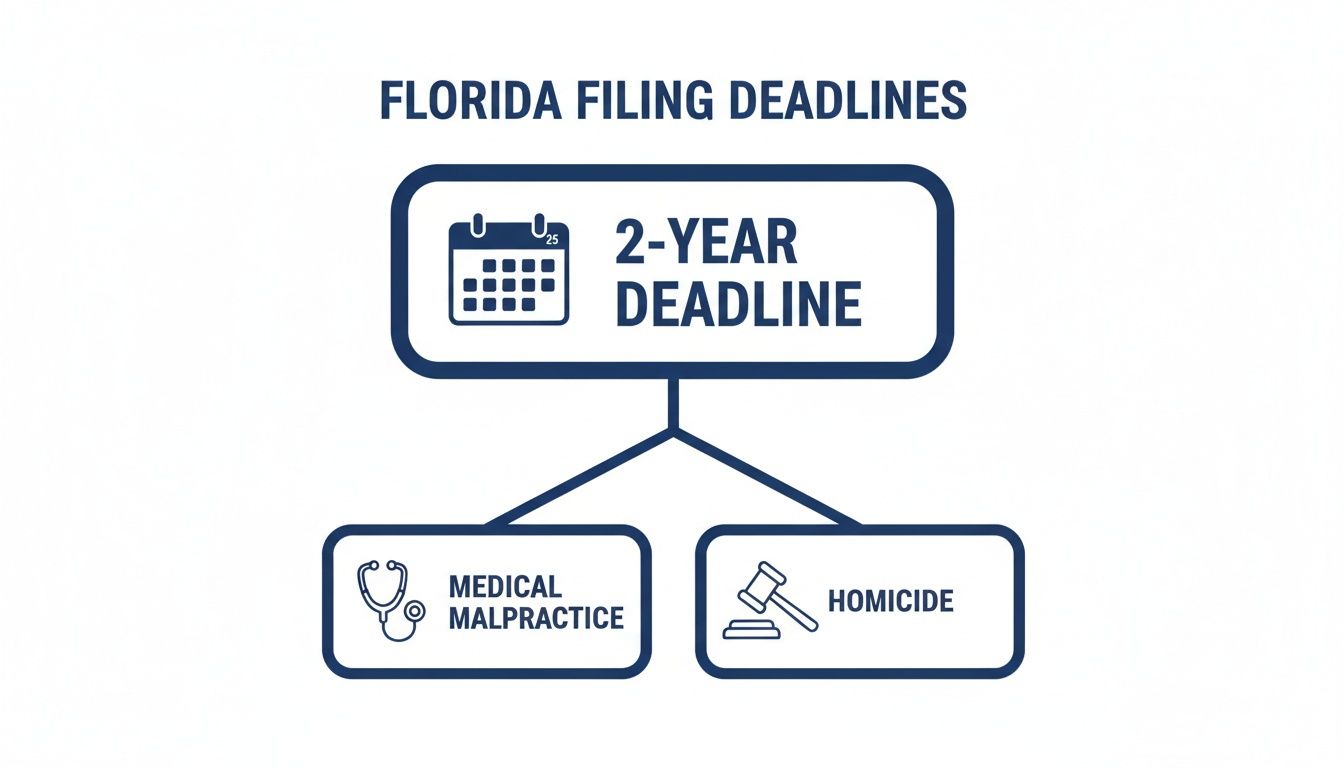
As you can see, while a two-year deadline is standard, there are crucial exceptions for cases that involve medical malpractice or homicide.
Legal Authority Under the Wrongful Death Act
So, where does the personal representative get this power? It comes directly from state law. Florida's Wrongful Death Act, found in §768.16–§768.26, gives this individual the authority to seek damages for survivors when a death is caused by someone else's negligence. The law defines a wrongful death as one resulting from a wrongful act, negligence, or a breach of contract, which effectively transfers the legal rights from the deceased to their survivors. You can learn more about the specifics of the Wrongful Death Act and its detailed definitions.
This legal structure is absolutely vital. It ensures that the interests of all eligible family members are represented in a single, comprehensive claim, preventing chaotic and conflicting legal battles. If you're unsure about your family's rights or who should act as the personal representative, getting sound legal advice is the most important first step you can take. In pain? Call Caine.
Understanding the Damages You Can Recover

When a family files a claim under the wrongful death statute in Florida, the compensation—what the law calls "damages"—is meant to address the full, devastating scope of their loss. It’s not just about paying bills. It’s about recognizing the profound emotional suffering and the very real financial fallout that follows a preventable death.
To make sure every aspect of the loss is accounted for, Florida law neatly separates these damages into two buckets. One is for the surviving family members to compensate for their personal grief and hardship. The other is for the decedent’s estate to settle final debts and expenses.
Damages Awarded Directly to Survivors
This first category of damages goes straight to the living family members—the survivors—for their own unique and deeply personal losses. The goal here is to acknowledge the immense emotional and relational void left by their loved one's absence. These damages are intensely personal and will naturally vary based on the relationship each survivor had with the person they lost.
Some of the key damages for survivors include:
Mental Pain and Suffering: This is compensation for the grief, sorrow, and mental anguish each family member has had to endure.
Loss of Companionship and Protection: For a surviving spouse, this addresses the loss of their partner’s love, comfort, and companionship.
Loss of Parental Companionship, Instruction, and Guidance: For minor children, this recognizes the irreplaceable loss of a parent’s guidance, nurturing, and support during their most formative years.
Lost Support and Services: This covers the real-world financial value of everything the decedent would have provided, from their income to household chores and childcare.
The law recognizes that these contributions are significant. Losing them creates a genuine financial burden, and this part of the claim ensures survivors are compensated for both the emotional and practical support they’ve lost.
Damages Paid to the Decedent's Estate
The second category of damages is designed to compensate the deceased person's estate for the financial losses it took on because of the wrongful act. It's helpful to think of the estate as its own legal entity with its own set of bills to pay. These funds are used to settle the deceased's final expenses before any remaining assets are passed on to the heirs.
In a Florida wrongful death case, the personal representative is the only one who can file the lawsuit. They do so on behalf of both the survivors and the estate, seeking both types of damages in a single, unified claim.
These estate-specific damages typically cover:
Lost Wages and Benefits: The income the person would have earned from the time of their injury until their death.
Medical Expenses: The cost of any medical care the deceased received for their final injury before they passed away.
Funeral and Burial Expenses: The full cost of the funeral and burial, whether it was paid for by a survivor or directly from the estate.
Below is a simple breakdown of how these damages are structured.
Types of Recoverable Damages in a Florida Wrongful Death Case
Type of Damage | Who It Compensates | Description & Examples |
|---|---|---|
Mental Pain & Suffering | Survivors | Compensation for grief, sorrow, and anguish felt by each eligible family member. |
Loss of Companionship | Survivors | Acknowledges the loss of love, comfort, and guidance. Especially vital for spouses and minor children. |
Lost Support & Services | Survivors | The value of income, benefits, and household contributions the decedent would have provided. |
Lost Earnings | Estate | The wages, benefits, and net accumulations the decedent would have earned if they had lived. |
Medical Expenses | Estate | Costs for all medical treatment related to the final injury, from the accident until death. |
Funeral & Burial Costs | Estate | The reasonable expenses associated with the funeral and burial services. |
Separating damages this way allows the legal system to address the complete financial picture. It covers the costs shouldered by the estate while also providing direct compensation to family members for their grief and personal losses.
Of course, securing this compensation can get complicated, especially when you're up against uncooperative insurance companies. Knowing how to navigate potential insurance disputes is a crucial part of protecting your family’s financial future. An experienced attorney can ensure every potential damage is accurately calculated and fought for. In pain? Call Caine.
How the Jeffrey Klee Act Changed Homicide Cases
For most legal battles, the clock is always ticking. A statute of limitations sets a firm deadline, giving families a specific window to pursue justice before their right to file a lawsuit is lost forever. In Florida, that deadline is usually two years for wrongful death claims.
But what happens when a killer disappears for decades? What if the truth doesn't surface until long after that legal stopwatch has run out?
This isn't just a hypothetical question. It's the heartbreaking reality the family of Jeffrey Klee faced. In 1977, just weeks after his high school graduation, Jeffrey vanished. For more than 30 years, his family was left with nothing but questions. When his remains were finally found and a killer confessed, the two-year statute of limitations from the 70s had long expired. Despite a criminal confession, the family was legally blocked from seeking civil justice. You can read the full story behind this landmark case to grasp the profound injustice they faced.
A Legislative Fix for an Unthinkable Problem
Lawmakers in Florida recognized that no family should be penalized because a murderer was good at hiding their crime. They took decisive action. In 2010, they passed the Jeffrey Klee Memorial Act, a powerful law that corrects this devastating flaw in Florida's wrongful death statute.
The law's impact is both simple and profound: it completely removes the statute of limitations for any wrongful death claim arising from murder or manslaughter.
The Jeffrey Klee Act ensures that for families of homicide victims, the clock on civil justice never runs out. No matter how many years or decades pass, the moment the person responsible is identified, the family’s right to file a wrongful death lawsuit is preserved.
The Act's Narrow but Powerful Focus
It's important to understand this exception is laser-focused. It only applies to deaths that are the result of a homicide. It doesn’t change the rules for other wrongful death cases, like those involving car crashes or medical mistakes.
This targeted approach was designed specifically for the unique horror of murder, where killers often go to extreme lengths to cover their tracks, sometimes for a lifetime. The Act effectively creates two parallel paths for accountability:
Criminal Court: The state prosecutes the offender for the crime, aiming for a conviction and prison time.
Civil Court: The victim's family, through their personal representative, can sue the offender to recover financial damages for their immense loss.
This dual-track system means that even if a criminal case hits a roadblock, the family still has an independent path to pursue a measure of justice in civil court.
The Lasting Impact on Wrongful Death Claims
The Jeffrey Klee Act is far more than a legal footnote. It’s a testament to one family's unwavering fight and a solemn promise from the state of Florida that time will not shield a killer from civil accountability.
It closed a loophole that once allowed murderers to escape financial responsibility for the lives they shattered. Now, there is a permanent pathway for families to seek justice, no matter how long it takes.
If your family is facing a loss under these incredibly difficult circumstances, the legal path is clear, but it demands expert guidance. In pain? Call Caine.
What To Do When Starting a Wrongful Death Claim
Trying to navigate life after losing a loved one is overwhelming. The last thing on your mind is legal action, but taking a few clear steps right away can protect your family’s rights and lay the groundwork for a successful claim under Florida's wrongful death statute.
The single most important move you can make is to consult with an experienced wrongful death attorney. They can immediately take over the complex legal requirements, giving your family the space to grieve without the added burden of legal deadlines and paperwork.
Before you meet with a lawyer, it helps to gather any documents you can easily find. This initial collection of paperwork gives your legal team a running start in understanding the facts of your case.
Key Documents to Collect
Having these records on hand can be incredibly helpful when you first speak with an attorney:
The official death certificate.
Any accident reports or police reports related to the incident.
Medical records and bills from any treatment your loved one received before they passed.
Contact information for any known witnesses.
One of the most critical pieces of advice I can offer is this: avoid speaking with insurance adjusters from the at-fault party’s side. Their entire job is to protect their company's bottom line, which usually means minimizing or outright denying your claim. Let your attorney handle every single one of those conversations.
An insurance adjuster may sound friendly and compassionate, but their ultimate goal is to get a recorded statement from you that can be twisted and used to weaken your case. Politely decline to speak and refer them directly to your lawyer.
The Attorney’s First Moves
Once you have legal representation, your attorney takes charge of the entire process. They'll move quickly to establish the decedent’s estate, which is a required first step before a lawsuit can even be filed. This involves petitioning the probate court to appoint a personal representative for the estate.
From there, a thorough investigation kicks off. Your legal team will start gathering evidence, interviewing witnesses, bringing in experts if needed, and building a strong, fact-based case. They will handle every procedural detail, from filing court documents to negotiating with the other side. For a clearer picture of what to do after any type of accident, you can read our guide on essential steps and legal guidance.
Taking these initial steps with professional guidance ensures your family's pursuit of justice is on the right track from day one.
In pain? Call Caine.
Frequently Asked Questions About Florida's Wrongful Death Law
Losing a loved one is devastating, and the legal process that follows can feel like a heavy burden on top of your grief. We've found that families often have similar questions when they first start to navigate Florida's wrongful death statute. Below, we've provided clear, straightforward answers to the most common ones.
Wrongful Death vs. Survival Action
It's easy to get these two terms confused. People often use "wrongful death claim" and "survival action" interchangeably, but in Florida, they are two completely separate legal actions. Knowing the difference is critical because it determines what compensation your family can actually recover.
A wrongful death claim is brought by the surviving family members for their own losses. Think of it as compensation for the personal impact of the death—the mental pain, the loss of companionship, and the future financial support that is now gone.
A survival action is different. It’s filed by the decedent's estate to recover damages the deceased person could have claimed if they had lived. This covers the period between the injury and their passing and includes things like their medical bills and lost income.
Can Adult Children File a Claim?
This is a tricky question, and the answer really depends on the family's unique situation—specifically, whether there's a surviving spouse.
Under Florida law, adult children (those 25 or older) can typically only recover damages for their pain and suffering if there is no surviving spouse. It's a harsh reality of the statute.
However, that doesn't mean adult children are always left out. Even if there is a surviving spouse, an adult child might still have a claim for lost financial support and services, but they have to prove they were actually receiving that support from their parent. This is a complex area of the law, and getting experienced legal guidance here is absolutely essential.
A wrongful death claim is designed to compensate for two types of losses: the emotional and relational losses of the survivors, and the economic losses of the estate. The law carefully defines who can recover for each type of loss.
What if the Deceased Was Partially At Fault?
Many families worry that they can't seek justice if their loved one was even a little bit to blame for the accident. Fortunately, that’s not how it works in Florida. Our state follows a rule called "pure comparative negligence."
What this means is that your family can still recover damages even if your loved one was partially responsible. The court simply reduces the total compensation award by their percentage of fault.
For example, let's say the total damages in a wrongful death case are calculated to be $1 million. If a jury determines the deceased was 10% at fault for the accident, the family’s final award is reduced by that 10%. They would still be able to recover $900,000. This rule ensures that a family isn't completely barred from compensation just because of a minor degree of fault.
Navigating the specifics of the wrongful death statute in Florida requires a deep understanding of the law and a commitment to fighting for your family's rights. At CAINE LAW, we bring that experience to every case. We understand what you're going through and are here to help you seek the justice and compensation you deserve. In pain? Call Caine.
