In Pain? Call Caine
Wrongful Death Lawsuit: A Clear Guide to the Process and Compensation

5 Min read
By: Caine Law
Share
When you lose a family member, your world stops. But when that loss is caused by someone else's carelessness, a distracted driver, a negligent doctor, or a company that cut corners, the grief is compounded by a deep sense of injustice. A wrongful death lawsuit is the legal path for families in Florida to find answers, demand accountability, and secure their future after such a devastating event.
Understanding a Wrongful Death Lawsuit in Florida
Put simply, a wrongful death lawsuit is a civil action that arises when a person's death is caused by the wrongful act or negligence of another. If your loved one would have had a valid personal injury claim had they survived their injuries, their family can now bring a wrongful death claim in their place.
Think of it as the personal injury case your loved one can no longer file for themselves. The lawsuit has two primary goals: holding the responsible party accountable for their actions and providing the financial support your family now desperately needs to navigate a future without your loved one.
The Goal Is Justice and Stability
It’s a common misconception that these lawsuits are only about money. While compensation is a critical component, the pursuit of justice is often what drives families. This legal process forces the at-fault party to answer for the tragic consequences of their negligence, which can also be a powerful force for change, preventing other families from suffering the same fate.
Of course, the financial reality of an unexpected death is immediate and immense. A wrongful death claim is designed to cover these overwhelming burdens, including:
Loss of the deceased’s income and future earnings
Final medical bills from the injury or illness
Funeral, burial, or cremation expenses
Loss of companionship, guidance, and support for surviving family members
Florida’s Specific Rules for Filing
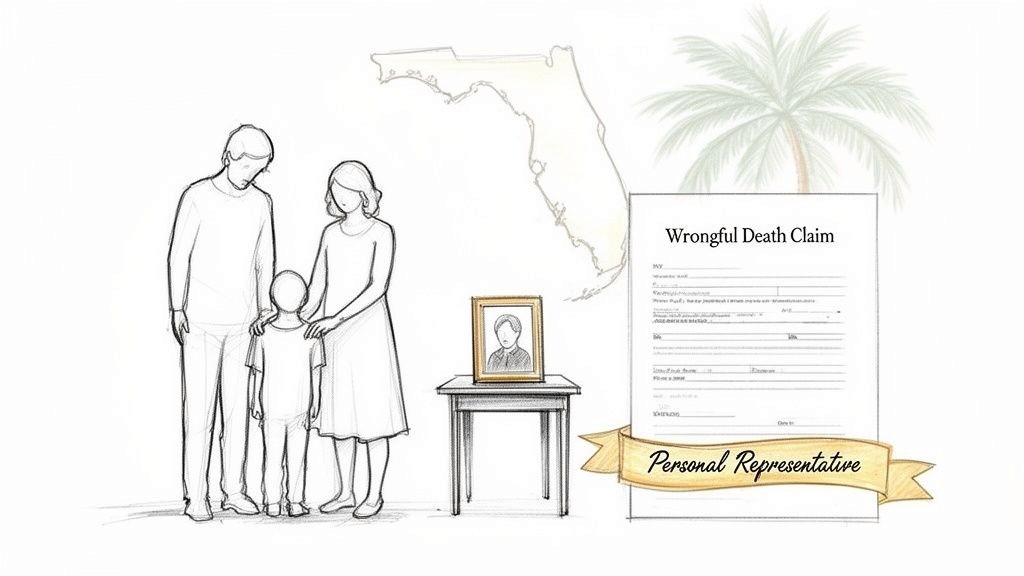
Florida has very particular laws governing who can file a wrongful death lawsuit. Unlike in some other states, individual family members, like a spouse or child, cannot file the claim directly. The lawsuit must be brought on behalf of the decedent's estate.
In Florida, a designated "personal representative" must file the lawsuit on behalf of the estate and all survivors. This person is usually named in the deceased’s will. If there's no will, the court will appoint someone to fill this crucial role.
This structure streamlines the legal process, ensuring that any compensation recovered is distributed fairly among the eligible family members according to state law. The personal representative is the central figure who manages the legal claim for everyone who has suffered a loss.
Trying to navigate this complex legal system while grieving is an unimaginable burden. You don't have to carry it alone. Having a compassionate and experienced legal team by your side is essential. If you're facing the pain of losing someone you love because of another's actions, let us handle the legal fight. In pain? Call Caine.
When your family is reeling from the shock of a sudden loss, trying to understand the legal process can feel impossible. The rules for a wrongful death lawsuit in Florida are very specific, particularly about who can file a claim and who can actually receive compensation. It’s not as straightforward as every grieving family member filing a lawsuit; Florida has a structured system to manage the process for everyone involved.
The entire wrongful death lawsuit flows through a single, central figure: the personal representative of the deceased person's estate. Think of this person as the captain of the ship, legally empowered to steer the case forward on behalf of all the survivors who have suffered a loss.
This individual is the only one who can legally file the wrongful death lawsuit. They’re usually named in the deceased’s will. If there wasn't a will, or if the named person can't serve, the court will appoint someone, often a close family member like a spouse or an adult child.
The Role of the Personal Representative
The personal representative has a critical job. They act as the legal point person for the estate and all the survivors, handling every aspect of the lawsuit.
Their duties include:
Formally filing the wrongful death claim in court.
Gathering all the necessary evidence and working with the legal team.
Negotiating with insurance companies and the at-fault parties.
Distributing any settlement or court award to the eligible survivors, strictly following Florida law.
This structure is intentional. It prevents a chaotic situation where multiple family members might file separate, competing lawsuits and ensures one unified case is presented to seek justice.
Who Actually Qualifies as a “Survivor”?
While the personal representative files the lawsuit, the compensation is ultimately for the deceased's "survivors." Florida law has a clear definition of who fits this description, and their eligibility for certain types of damages depends on their relationship to the person who passed away.
A "survivor" isn't just any grieving relative. The law primarily recognizes the spouse, children, and parents of the deceased. In some specific cases, other blood relatives or adoptive siblings who were financially dependent on the deceased might also qualify.
The most clearly recognized survivors are the surviving spouse and minor children (meaning children under the age of 25). Adult children and the parents of the deceased can also be survivors, but their ability to recover compensation for non-economic damages, like their own pain and suffering, can be more limited—especially in cases involving medical malpractice.
This system might seem complex, but it’s designed to direct financial support to those who were most directly and profoundly impacted by the loss. An experienced attorney can help you understand exactly where you and your family fit within this legal framework. Your case deserves serious representation. Call 786-206-8726 today.
Matching Survivors to Potential Damages
Florida law recognizes that each survivor’s loss is unique. A spouse loses a partner, while a child loses a parent, and the types of compensation available reflect these different realities.
The table below gives a general breakdown of who can claim what in a Florida wrongful death case.
Who Can Recover Damages in a Florida Wrongful Death Case
Eligible Survivor | Types of Damages They Can Recover |
Spouse | Loss of companionship and protection, plus their own mental pain and suffering. They can also recover for lost support and services from the date of the fatal injury. |
Minor Children (under 25) | Loss of parental companionship, instruction, and guidance, as well as their own mental pain and suffering. They can also recover for lost support and services. |
Adult Children | If there is no surviving spouse, adult children can recover for lost parental companionship, instruction, guidance, and their own mental pain and suffering. |
Parents of a Minor Child | Can recover for their mental pain and suffering. |
Parents of an Adult Child | If there is no surviving spouse or children, the parents can recover for their mental pain and suffering. |
The Estate | The estate itself can recover economic losses like the wages the deceased would have earned, medical bills from the final injury, and funeral expenses. |
Trying to navigate these rules while you’re grieving is an immense burden. You don't have to figure this out on your own. At Caine Law, we handle these legal complexities so you can focus on your family. We'll make sure every eligible survivor's claim is properly valued and aggressively pursued.
Proving a Successful Wrongful Death Case
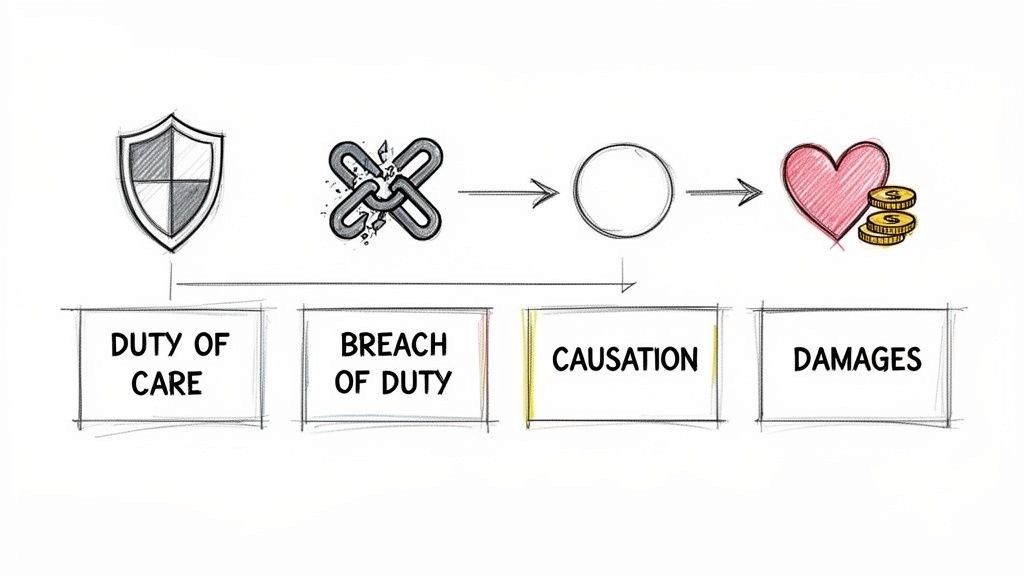
Winning a wrongful death lawsuit involves far more than just proving a tragic loss happened. Here in Florida, your legal team has to build a case that solidly proves four specific elements of negligence.
Think of these as the four legs of a table; if even one is weak or missing, the entire claim can fall apart. A successful case must clearly show that someone else's wrongful act directly led to your loved one’s death and, as a result, your family has suffered real damages.
Let’s walk through each of these four pillars so you can see how an experienced attorney constructs a powerful and undeniable claim.
Element 1: Duty of Care
First, we have to establish that the person or entity at fault (the defendant) owed your loved one a duty of care. This is just a legal term for a basic responsibility we all have to act with reasonable caution to avoid hurting others. This duty is all around us, in countless everyday situations.
Here are a few common examples you’d recognize immediately:
Drivers on the road have a duty to operate their cars safely and obey traffic laws to protect everyone else out there—other drivers, pedestrians, and cyclists.
Doctors and hospitals have a professional duty to provide medical care that meets the accepted standard in their field.
Property owners, from a corner store to a large apartment complex, have a duty to keep their premises reasonably safe for visitors and customers.
Proving this duty is usually the most straightforward part of a wrongful death claim. It’s the foundation that the rest of the case is built upon.
Element 2: Breach of Duty
Once we've shown a duty of care existed, we then have to prove the defendant breached that duty. This simply means showing they failed to act as a reasonably careful person or professional would have in the same situation. The breach is the specific careless act—or failure to act—that set the tragedy in motion.
A classic example of a breach is a truck driver who was texting instead of watching the road, causing a fatal crash. It could also be a surgeon who failed to spot obvious signs of internal bleeding after a routine operation. These aren't just mistakes; they're clear violations of their duty of care.
Sadly, medical errors are a devastatingly common form of breach. It’s staggering, but medical mistakes claim between 250,000 and 400,000 American lives every single year, making them the third leading cause of death. Yet only about 1.2% of these cases result in malpractice payouts. In 2023, just 3,046 such payments were made nationwide, which shows just how often these tragedies go unaddressed.
Florida ranks third among states for total malpractice payouts, a somber reflection of the problem we face right here at home.
Element 3: Causation
The third pillar is causation. This is where we connect the dots between the defendant's breach and the death itself. It isn’t enough to show they were careless; we have to prove their specific carelessness is what caused the fatal injury.
This element requires drawing a clear and direct line from the defendant's action (the breach) to the ultimate outcome (the death). An attorney must show that "but for" the defendant's negligence, your loved one would still be alive.
For instance, we’d use evidence like the truck driver's phone records and an accident reconstruction report to prove that their texting directly led to the crash that caused the fatal injuries. In a medical case, we would bring in medical experts to testify and link a doctor’s failure to diagnose a condition to the patient’s subsequent death from that illness.
Element 4: Damages
Finally, we must prove that the death resulted in damages, these are the tangible and intangible losses your family and the estate have suffered. These losses are the basis for the financial compensation you need and deserve to start putting the pieces back together.
Damages in a wrongful death lawsuit in Florida typically include things like:
Medical bills that piled up before the death.
The costs of the funeral and burial.
Lost future income and benefits your loved one would have earned.
The profound loss of companionship, guidance, and support for the family.
The family’s own mental pain and suffering.
An experienced attorney meticulously documents every single loss to ensure the full scope of your family’s suffering is presented clearly and powerfully. Proving these four elements is the key to securing justice for your loved one.
If your family is going through this, let us build your case. When it matters most, call Caine Law at 786-206-8726.
Understanding the Compensation Your Family Can Recover
Let's be clear: no amount of money can ever fill the void left by the person you lost. It’s an impossible task. But the compensation from a wrongful death lawsuit serves two real-world purposes. First, it provides the financial stability your family needs to pick up the pieces and move forward. Second, it holds the negligent person or company accountable for the profound harm they’ve caused.
In Florida, the law understands that a single death creates two different kinds of loss—the financial loss to the person who passed, and the personal, emotional loss to the family left behind. To address this, compensation, which lawyers call damages, is split into two distinct categories. Getting a handle on these is the first step in understanding how the legal system tries to account for the full weight of what your family is going through.
Damages Awarded to the Estate
The first type of compensation is paid directly to your loved one's estate. Think of it as repaying the direct financial and economic holes the death created. These are the measurable, tangible costs that can be calculated using things like pay stubs, invoices, and expert financial projections.
These damages almost always include:
Lost Earnings and Benefits: This covers the salary, wages, and other benefits (like health insurance or retirement contributions) your loved one would have earned from the time they were hurt until their expected retirement age. We often bring in financial experts to project these future earnings with precision.
Lost Net Accumulations: This is a bit more complex. It’s the amount of money your loved one would have likely saved and added to their estate if they had lived a full life. It’s meant to replace the growth of their assets that was tragically cut short.
Final Medical Expenses: Any hospital bills or medical costs for treating the final injury or illness—from the moment of the incident until their passing—are recoverable by the estate.
Funeral and Burial Costs: The reasonable expenses for a funeral service and burial or cremation are also included in the estate's claim.
These economic damages create the financial foundation of the lawsuit, making sure the at-fault party is held responsible for the concrete monetary losses their negligence caused.
Damages Awarded to the Survivors
The second category of damages is often the larger of the two, and it tackles the profound personal losses suffered by the surviving family members. These are the intangible, emotional, and relational losses that are much harder to put a number on, but are every bit as real and devastating. Florida law makes a point to acknowledge this deep human cost.
These damages are meant to compensate for the loss of the relationship itself, the love, companionship, guidance, and support that has been stolen from the family. They are deeply personal to each survivor's unique relationship with the deceased.
Survivor damages are designed to compensate for things like:
A spouse’s loss of companionship and protection.
A minor child’s loss of parental guidance, instruction, and companionship.
The mental pain and suffering endured by each eligible survivor.
Calculating these non-economic damages isn't about spreadsheets; it's about understanding a family's story and the true emotional impact of the loss. An experienced attorney knows how to build a powerful case that communicates the depth of your family’s suffering, ensuring this immense personal toll is fully and fairly recognized.
Especially in cases against large corporate defendants, we're seeing juries hold them accountable with substantial verdicts. The recent spike in "nuclear verdicts" awards that top $10 million is a powerful reflection of this. A recent report documented a record 135 such verdicts against corporations, a staggering 52% increase from the year before, totaling an incredible $31.3 billion. Wrongful death cases are a major driver of these massive awards, showing a clear public demand for corporate responsibility when negligence leads to preventable deaths. You can read more about these verdicts against corporate negligence on Marathon Strategies.
Securing the compensation your family deserves requires meticulous work from a legal team that knows how to value every single aspect of your loss. We handle the complex calculations and the aggressive negotiations, so you can focus on healing.
Navigating the Lawsuit Timeline and Florida’s Deadline
The path forward after a devastating loss can feel long and completely overwhelming. Understanding the legal process, from the very beginning to the end, gives you a much-needed map for the journey ahead. But the most critical landmark on this map is Florida's strict deadline for filing a wrongful death lawsuit, a non-negotiable window that impacts everything else.
As you can see, the process is methodical. Each stage builds on the one before it, all designed to construct a powerful and persuasive case on your family's behalf.
The Most Important Deadline: Florida’s Statute of Limitations
When it comes to a wrongful death case, time is not on your side. Florida law has a strict deadline known as the statute of limitations. Think of it as a ticking clock on your family’s right to seek justice through a lawsuit.
In almost all cases, you have only two years from the date of your loved one’s death to formally file that lawsuit.
Waiting too long has heartbreaking consequences. If you miss this deadline, the court will almost certainly throw your case out forever, no matter how strong your evidence is. This is exactly why it's so critical to speak with an attorney as soon as you possibly can. We can help you preserve your family's rights. You can learn more about the specifics in our guide to the Florida statute of limitations.
The Stages of a Wrongful Death Lawsuit
While every family's story is different, most wrongful death claims follow a similar path. Having a dedicated legal team to manage these complex steps allows you and your family to focus on what truly matters: grieving and beginning to heal.
1. Investigation and Evidence Gathering
This is the foundation of everything. Our team will launch a deep investigation into the circumstances of the death, hunting down every single piece of available evidence. This typically includes:
Accident reports, medical records, and the official death certificate
Tracking down and interviewing eyewitnesses
Bringing in experts to reconstruct what happened
Securing photos, videos, and any physical evidence from the scene
2. Filing the Official Complaint
Once we have a solid base of evidence, we draft and file a formal "complaint" with the court. This is the legal document that officially kicks off the lawsuit. It lays out the facts, identifies the at-fault party (the defendant), and specifies the damages your family is seeking.
3. The Discovery Phase
After the complaint is filed, the case moves into a long but crucial phase called discovery. This is where both sides are legally required to exchange information and evidence under oath. It’s where the real work of building a case happens.
Common discovery activities include:
Interrogatories: Written questions sent to the other side, which they must answer in writing and under oath.
Requests for Production: Formal demands for documents and other tangible evidence.
Depositions: In-person, sworn testimony from witnesses, experts, and anyone involved in the case.
This phase is intense and can take many months to complete. It’s where the true strengths and weaknesses of each side's case are exposed.
The Path to Resolution: Settlement or Trial
4. Mediation and Settlement Negotiations
The vast majority of wrongful death lawsuits are resolved before ever setting foot in a courtroom. Once discovery is mostly complete, both sides usually get serious about negotiating a settlement.
This often involves mediation, where a neutral, third-party professional helps guide the conversation and find common ground.
While settlements can vary widely, successful cases often result in significant compensation to provide for a family's future. For instance, while California historically leads with an average wrongful death award of about $973,054, recent verdicts have soared, including a $30.5 million payout to a family after a police shooting. These awards stem from heartbreaking stories of preventable deaths due to corporate shortcuts or severe negligence, underscoring the immense financial void families face.
5. Trial
If a fair settlement just isn't on the table, the case will proceed to trial. Here, your attorney will present all the evidence to a judge or jury, who will then decide the outcome. While trials are not the most common path, having an attorney who is fully prepared to win in court is absolutely essential for gaining leverage during negotiations.
This entire process is demanding. You need an advocate in your corner who can manage every deadline, detail, and fight.
Why You Need an Experienced Wrongful Death Attorney
When you're dealing with unimaginable grief, the last thing you should have to face is a complex legal battle. It's an overwhelming burden no family should carry alone. This is where an experienced wrongful death attorney steps in, not just as a lawyer, but as your family's strongest advocate, handling every single detail so you can focus on healing.
Think of them as the quarterback of your case. They launch an independent investigation to uncover the facts, gathering crucial evidence that insurance companies might otherwise overlook or ignore. They also bring in top-tier experts, from accident reconstructionists who can piece together exactly what happened to forensic economists who can calculate the full, devastating financial impact on your family.
An Advocate in Your Corner
Let's be clear: insurance companies are not on your side. Their goal is to protect their bottom line by paying out as little as possible. An attorney completely levels that playing field. They take over all communications and negotiate aggressively on your behalf, because they know the tactics insurers use and, more importantly, how to shut them down.
This kind of legal support is absolutely critical. A seasoned attorney understands the true scope of a wrongful death claim and knows how to navigate specialized areas, ensuring every piece of documentation is flawless. For example, if a case involves evidence in multiple languages, understanding how accurate document translation can strengthen your lawsuit can be a key part of building a solid claim.
Having a skilled professional in your corner means you don't have to worry about deadlines, paperwork, or legal strategy. It’s about securing the justice and compensation your family deserves without adding more stress to your life.
Your attorney is your guide, your strategist, and your fighter, dedicated to protecting your rights from the first call to the final resolution.
When you're ready to see what your options are, we're here to answer your questions in a free, no-pressure consultation.
Frequently Asked Questions About Florida Wrongful Death Claims
When your family is grappling with a sudden, devastating loss, it’s only natural to have urgent questions about what comes next. We've put together some clear, direct answers to the questions we hear most often from families trying to find their footing after a tragedy.
How Much Does It Cost to Hire a Wrongful Death Lawyer?
This is one of the first things people ask, and the answer should offer some peace of mind. Reputable wrongful death attorneys in Florida, including us here at CAINE LAW, work on a contingency fee basis.
In simple terms, this means you pay absolutely nothing upfront. Not a single dollar for attorney’s fees or the costs of building your case. We cover all the expenses, from hiring investigators to paying for expert witnesses. Our fee is a percentage of the financial recovery we secure for you, whether that's a settlement or a trial verdict. If we don’t win, you don't owe us anything.
This approach levels the playing field, making sure every family has access to justice, regardless of their financial situation. It also means our goals are perfectly aligned with yours, and we only succeed when you do.
How Long Will My Wrongful Death Case Take?
There's no one-size-fits-all answer here, as the timeline for a wrongful death lawsuit really depends on how complex the situation is. A straightforward case where liability is crystal clear might be resolved in a matter of months. However, a more complicated case with disputed facts or multiple at-fault parties could easily take two years or more to reach a conclusion.
A few key things that influence the timeline are:
How deep the initial investigation needs to go.
The length of the discovery phase (when both sides exchange evidence).
Whether the insurance company is willing to negotiate in good faith.
If the case ultimately has to go to trial.
Can I File a Claim If the At-Fault Person Is Also Facing Criminal Charges?
Yes, absolutely. It’s critical to understand that the criminal justice system and the civil justice system are two completely separate tracks. A criminal case is brought by the state to punish the defendant for breaking a law. A wrongful death lawsuit, on the other hand, is a civil case brought by your family to seek financial compensation for your personal losses.
The outcome of one doesn't dictate the outcome of the other. In fact, you can win your civil lawsuit even if the defendant is acquitted in criminal court. This is because the standard of proof is much lower in a civil case—we have to prove it's "more likely than not" they were responsible, not "beyond a reasonable doubt."
Of course, beyond the legal process, we know families are also navigating immense grief. Resources like hospice bereavement services can offer vital support for the emotional healing that must happen alongside any legal action.
At CAINE LAW, we understand the immense weight your family is shouldering right now. Our job is to lift that legal burden, answer every single question you have, and fight relentlessly for the accountability and stability you deserve.
In pain? Call Caine.