
In Pain? Call Caine
Navigating the Florida wrongful death act florida: A Survivor's Guide

5 Min read
By: Caine Law
Share
When a loved one is suddenly taken away due to someone else's negligence, the world stops. The emotional pain is profound, but the practical consequences—lost income, mounting bills, and the sheer emptiness left behind—can be just as devastating. Florida law provides a path for families to seek justice in these darkest moments.
This path is defined by the Wrongful Death Act in Florida (found in Florida Statutes §§ 768.16–768.26). It's a specific legal framework designed to help surviving family members hold the responsible party accountable and recover compensation for their immense loss.
Understanding the Florida Wrongful Death Act

At its heart, the Act answers a critical question: If the person who passed away could have filed a personal injury case had they survived, who can now step in and fight for justice on their behalf? The answer is the estate, acting for the benefit of the family left behind.
This isn't about trying to put a price on a human life—no amount of money could ever do that. Instead, it’s about providing a legal remedy to shift the staggering financial and emotional burdens from the shoulders of the grieving family back to the person or company whose actions caused the tragedy. It's a mechanism for accountability.
What is the Core Purpose of the Act?
The Wrongful Death Act recognizes that a death creates tangible losses, like the sudden stop of a paycheck, and intangible ones, like the loss of a spouse's companionship or a parent's guidance. Its primary purpose is to provide financial relief for those specific damages.
It's important to understand that these claims are civil actions, completely separate from any criminal charges. This means a family can pursue a wrongful death lawsuit even if the at-fault party is never criminally charged, or if they are found "not guilty" in a criminal trial. Civil cases have a different standard of proof, focusing on negligence rather than proving criminal intent "beyond a reasonable doubt."
Who Are the Key People in a Wrongful Death Claim?
Florida's law is very specific about who can bring a claim to ensure the process is orderly and fair. You'll often hear two key terms: the personal representative and the survivors.
The Personal Representative: This is the only person legally allowed to file the wrongful death lawsuit. They are appointed by the court—often named in the deceased’s will or chosen from close family—to act as the administrator of the estate. They file the claim on behalf of all the survivors.
The Survivors: These are the specific family members who have suffered harm and are eligible to receive compensation. Florida law defines who qualifies, but it typically includes the spouse, children, and parents of the person who died. In some cases, other blood relatives who were dependent on the deceased may also be considered survivors.
This structure consolidates everything into a single, unified case, preventing a chaotic situation where multiple family members file separate lawsuits.
To give you a clearer picture, here is a quick breakdown of what goes into a wrongful death claim in Florida.
Key Elements of a Florida Wrongful Death Claim
Component | Brief Explanation |
|---|---|
Negligent or Wrongful Act | The death must have been caused by another party's wrongful act, negligence, default, or breach of contract. |
Personal Representative | A court-appointed individual must file the lawsuit on behalf of the deceased person's estate and survivors. |
Identifiable Survivors | The claim is brought for the benefit of specific family members (like a spouse, children, parents) as defined by Florida law. |
Provable Damages | The survivors must have suffered measurable damages, such as lost financial support, emotional pain, and loss of companionship. |
This table provides a simple overview, but every case has its own unique and painful story. The law exists to provide a structured way to seek justice when a life is cut short by a preventable act.
When your family is grappling with such an unimaginable loss, navigating the legal system is the last thing you should have to worry about. We are here to help you understand your rights and carry that burden for you.
In pain? Call Caine.
Who Can File a Claim and Who Benefits?
When a family is reeling from the shock of a sudden loss, the last thing they want to deal with is a confusing legal process. Florida’s Wrongful Death Act actually brings a clear, structured method to what could otherwise be a chaotic situation, spelling out exactly who can take legal action and who can receive compensation.
There's a common and understandable misconception that any grieving family member can file a lawsuit. Florida law, however, is very specific on this point. Only one person, known as the personal representative of the deceased's estate, holds the legal authority to bring a wrongful death claim to court.
This person is essentially the legal administrator for the person who has passed away. Often, they are named in the deceased's will. If there's no will, the court will appoint someone, which is usually a close relative like a spouse or an adult child. The personal representative then files a single lawsuit on behalf of both the estate and every eligible family member, or "survivor."
The Role of the Personal Representative
You can think of the personal representative as the captain of the ship. They are responsible for steering the legal process forward for everyone involved, consolidating all the different claims into one unified action.
Their responsibilities include:
Formally opening the deceased's estate in probate court.
Identifying every potential survivor who might be entitled to compensation.
Filing the wrongful death lawsuit against the party at fault.
Handling settlement negotiations or taking the case to trial for the estate and survivors.
Distributing any money recovered to the survivors as directed by Florida law.
This system is designed to prevent the nightmare of multiple family members filing separate lawsuits, which would create confusion and likely delay justice for everyone. It ensures a more orderly and fair process.
Who Are Considered Survivors?
While the personal representative is the one who files the suit, they do it for the benefit of the survivors. These are the family members who have been directly harmed by the loss and are entitled by law to receive damages. Florida Statutes § 768.18 is very strict about who qualifies.
The law recognizes that the impact of a death extends far beyond a single person. Survivors are those whom the law has identified as having a right to be compensated for their specific, personal losses, both financial and emotional.
In most cases, the primary survivors are:
The Spouse: The surviving husband or wife is almost always a key beneficiary.
Minor Children: For the purpose of the Act, children under the age of 25 are considered "minors." They are entitled to compensation for the loss of parental guidance, instruction, and support.
Parents: The parents of a deceased minor child can recover damages. If the deceased was an adult, parents might still qualify as survivors if there is no spouse or child.
Complex Scenarios and Eligibility
The rules can definitely get a bit more complicated depending on the family structure. For instance, adult children (those 25 or older) may have very limited rights to recover damages for their own pain and suffering, especially in medical malpractice cases, unless there is no surviving spouse.
Unfortunately, unmarried partners are not recognized as survivors under the Act, no matter how long or committed the relationship was. This is a stark reminder of how strictly the law defines these roles.
Let’s look at a real-world scenario: a 40-year-old father is tragically killed in a car accident. He leaves behind his wife and two children, ages 12 and 16. In this situation, his wife would likely be appointed as the personal representative. She would then file one lawsuit on behalf of herself and her two minor children, seeking damages for the immense losses they have all suffered.
Understanding these roles is the first critical step toward seeking justice. An experienced attorney can help you figure out who is eligible in your specific circumstances and make sure the claim is filed correctly from the very beginning.
In pain? Call Caine.
Understanding Florida's Two-Year Filing Deadline
When you're grieving the sudden loss of a family member, the last thing on your mind is a legal calendar. It's completely understandable. But under Florida's Wrongful Death Act, time is one of the most critical factors in your case. The state has a strict time limit, known as a statute of limitations, that governs your family's right to file a lawsuit.
In Florida, the personal representative of the estate usually has just two years to file a wrongful death claim. Missing this deadline isn't a simple mistake—it's catastrophic for your case. If you're even one day late, the court will almost certainly throw out your claim, forever closing the door on your family's chance to seek justice and compensation. This makes knowing when that clock starts ticking absolutely essential.
When Does the Two-Year Clock Start Ticking?
One of the most common points of confusion is figuring out when this two-year countdown actually begins. It's a crucial detail. The clock doesn't start on the date of the accident or the act of negligence. Instead, the deadline is calculated from the date of your loved one's death.
Let’s look at a quick example. Imagine someone is hurt in a car crash on March 1, 2024, but they tragically pass away from their injuries a month later, on April 15, 2024. The two-year deadline to file a wrongful death lawsuit would be April 15, 2026—not March 1, 2026. That distinction can make all the difference in protecting your family’s legal rights. For more on what to do right after an incident, check out our guide on what to do when accidents happen.
Are There Exceptions to the Deadline?
While the two-year rule is incredibly strict, Florida law does recognize that some situations just aren't black and white. There are a few rare exceptions that can "toll," or pause, the statute of limitations, which could extend the time you have to file.
These exceptions are tough to prove and aren't granted lightly, but they typically involve situations like:
Fraudulent Concealment: If the person at fault actively hid what they did, preventing you from discovering the real cause of death, the clock might not start until the truth comes to light.
Minor Survivors: When a surviving child is under the age of 18, the deadline may be paused until they become a legal adult, giving them their own opportunity to pursue a claim.
The Discovery Rule: Sometimes, especially in complex medical malpractice cases, the true cause of death isn't immediately obvious. The "discovery rule" might apply if the cause was hidden and couldn't have been reasonably found within those first two years.
Navigating these deadlines and their potential exceptions is a minefield without experienced legal help. The law is filled with nuances, and a simple miscalculation can jeopardize everything. This is why it's so important to speak with an attorney as soon as you can to make sure your family's rights are preserved.
In pain? Call Caine.
Calculating the Full Value of a Wrongful Death Claim
When a family is forced to face the future without a loved one, the emotional void is immeasurable. The financial devastation, however, can and must be calculated to ensure the family’s stability isn’t another casualty. The Florida Wrongful Death Act gives us a structured way to determine the full value of a claim by breaking compensation down into two distinct categories.
One stream of damages goes directly to the survivors for their personal losses, while the other is paid to the deceased’s estate to cover costs and replace lost earnings. Understanding this divide is the first step in building a comprehensive case for justice.
Valuing the Survivors’ Losses
Survivors are entitled to compensation for both the tangible and intangible ways their lives have been turned upside down. The law rightfully recognizes that some of the deepest wounds aren't financial at all.
These non-economic damages include:
Mental Pain and Suffering: This acknowledges the profound emotional anguish and grief shouldered by each eligible survivor.
Loss of Companionship and Protection: For a surviving spouse, this addresses the irreplaceable loss of their life partner's love, comfort, and society.
Loss of Parental Guidance and Instruction: For minor children, this compensates for losing a parent's nurturing, advice, and presence as they grow up.
Beyond these devastating emotional losses, survivors can also recover for the tangible contributions the deceased would have provided. This includes the value of lost financial support from their income and the cost of replacing the services they performed for the household, from childcare to home maintenance.
Valuing the Estate’s Losses
The second category of damages is meant to compensate the deceased's estate for the financial harm it suffered. Think of this as addressing the economic impact from the perspective of the person who passed away.
The primary damages paid to the estate include:
Lost Earnings: This is the total value of wages, benefits, and other income the deceased would have reasonably been expected to earn over their lifetime had they lived.
Medical and Funeral Expenses: The estate can recover any medical bills tied to the final injury, along with all funeral and burial costs. If a family member paid these bills directly, they can be reimbursed from the settlement.
Calculating these future earnings isn't simple guesswork. It often requires bringing in financial experts who can analyze a career trajectory, potential promotions, and inflation to paint an accurate picture of the family's total financial loss.
A wrongful death claim isn't about putting a price tag on a human life. It's about quantifying the full scope of the financial and emotional wreckage to hold the at-fault party accountable for the future they stole from a family.
This timeline shows the critical two-year window families have to file a claim after a loved one's passing.
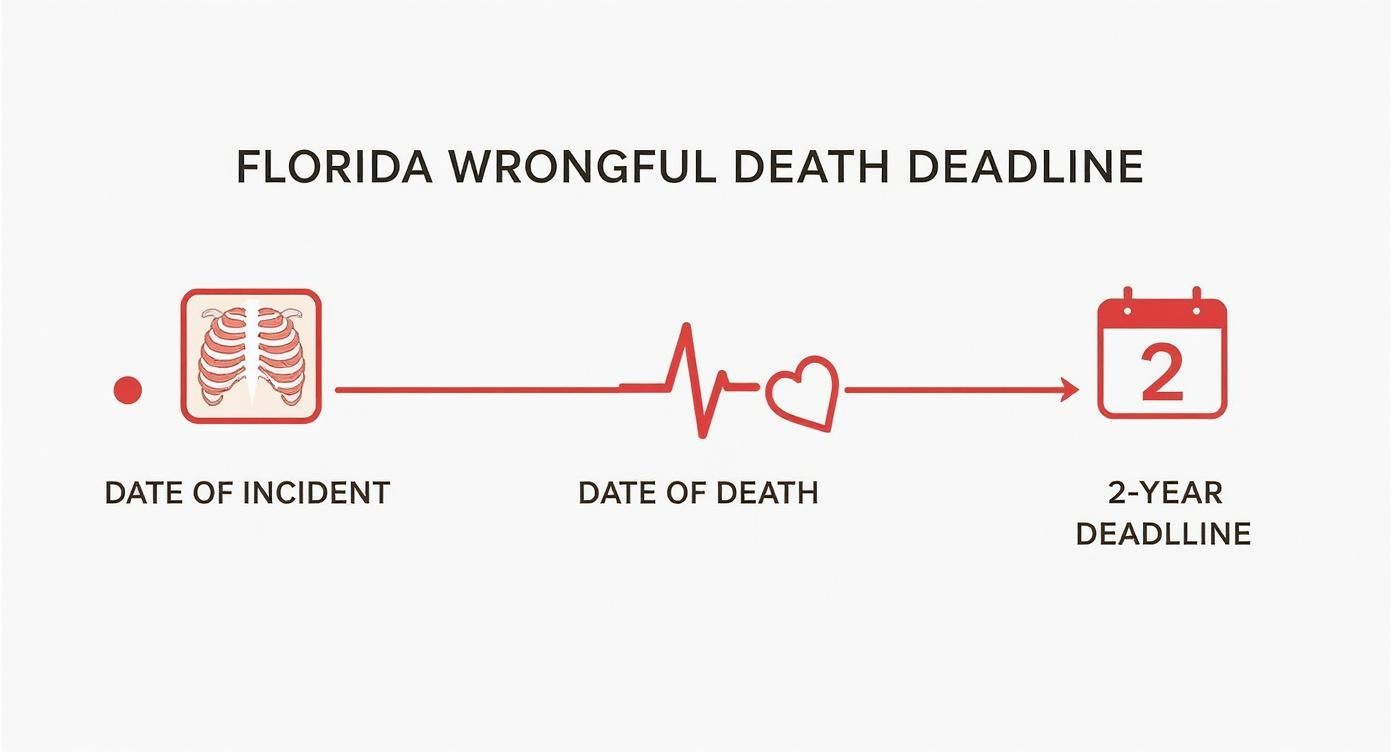
The key takeaway here is that the clock starts ticking on the date of death, not the date of the incident that caused it. This is a crucial detail for protecting your family’s legal rights.
To make the distinction clearer, here’s a breakdown of how damages are typically allocated between the survivors and the estate.
Damages in a Wrongful Death Case: Survivor vs. Estate
Type of Damage | Paid to the Survivor | Paid to the Estate |
|---|---|---|
Mental Pain and Suffering | ✓ | |
Loss of Companionship (Spouse) | ✓ | |
Loss of Parental Guidance (Minor Child) | ✓ | |
Lost Financial Support | ✓ | |
Value of Lost Household Services | ✓ | |
Lost Future Earnings & Benefits | ✓ | |
Medical Bills from Final Injury | ✓ | |
Funeral and Burial Expenses | ✓ |
As you can see, the law separates the personal, human losses from the direct financial losses to ensure every aspect of the family's devastation is addressed.
A Case Study in Calculating Damages
Let's put this into a real-world context. Imagine a 45-year-old electrician is killed by a negligent driver. She was the family's primary earner, bringing in $85,000 a year, and left behind a husband and two teenage children.
An experienced attorney would calculate their claim by combining multiple elements:
For the Survivors: The husband would have a claim for his immense mental pain and the loss of his wife’s companionship. The two children would have a claim for their own suffering and the loss of their mother’s guidance as they navigate young adulthood. On top of that, the value of her lost contributions around the house would be assessed.
For the Estate: An economist would project her lost future earnings from age 45 until a planned retirement at 67, accounting for inflation and raises. This figure could easily top $1.8 million. Finally, her final medical bills and funeral costs would be added to the total.
By meticulously building each component of the claim, the family can demand the full value of their devastating loss. Of course, dealing with the at-fault party's insurance company is a battle in itself, which is why understanding the process for handling Florida insurance disputes is so critical for families in this position.
In pain? Call Caine.
How Negligence Is Proven in Florida Courts

Winning a claim under the wrongful death act florida isn't automatic—it has to be proven. The whole case hinges on showing that someone else's carelessness, or negligence, was the direct cause of your loved one's death. But what happens when the situation isn't so black and white?
Florida courts use a legal concept called "pure comparative fault." This rule is designed to fairly assign responsibility when more than one person played a part in the accident, which can sometimes include the person who passed away.
Understanding Pure Comparative Fault
Think of it like a pie. After all the facts are presented, the court will slice up the pie of responsibility, assigning a percentage of fault to everyone involved. That includes the defendant, any other drivers or parties, and yes, even the deceased.
How that pie gets sliced has a direct and serious impact on the compensation your family can receive. For instance, if a jury decides the total damages in a case are $1 million but finds your loved one was 10% at fault for the accident, the final award is reduced by that percentage.
In that scenario, the family's recovery would be cut by $100,000 (10% of $1 million), bringing the final award down to $900,000. This makes it absolutely critical to build the strongest case possible to minimize any fault assigned to your loved one.
This system ensures that while negligent parties are held accountable, the final compensation reflects the full reality of what happened.
Evidence Used to Establish Fault
To prove negligence and fight back against any attempts to shift blame, you need a powerful case built on a foundation of solid evidence. An experienced attorney will launch an immediate and thorough investigation to find and preserve every piece of the puzzle. This evidence is what tells the story.
Common, crucial pieces of evidence include:
Official Police and Accident Reports: These reports give an initial, objective account of what happened, often with diagrams, officer opinions, and any tickets issued at the scene.
Witness Interviews and Statements: Eyewitness testimony can be incredibly compelling, providing perspectives that physical evidence alone can't capture.
Photos and Videos: Nothing tells the story quite like images from the scene, security camera footage, or a dashcam recording. This evidence can be undeniable.
Expert Testimony: We often bring in specialists like accident reconstructionists or medical experts. They analyze the technical evidence and explain complex details in a way a jury can understand.
Medical Documentation: All medical records are carefully reviewed to draw a clear, direct line from the negligent act to the ultimate cause of death.
A Real-World Example: A Truck Accident
Let’s imagine a fatal crash where a commercial truck blows through a red light and hits a car. To prove the truck driver was negligent, we'd piece together the story, layer by layer. We’d start with the police report, which likely cited the driver for the violation.
Next, we’d pull traffic camera footage that clearly shows the truck illegally entering the intersection. Then, we’d track down and interview witnesses who saw it happen. Finally, we might hire an accident reconstruction expert to analyze the truck’s "black box" data, which could prove the driver was also speeding.
By weaving all this evidence together, we create a powerful, undeniable narrative that establishes the truck driver's complete fault. This is how we protect a family's right to receive the full compensation they deserve. Proving negligence is a meticulous process, but it's the key to securing justice.
In pain? Call Caine.
How Our Firm Fights for Your Family's Future
When you're reeling from an unimaginable loss, the last thing you should have to do is fight a legal battle alone. That’s our job. At CAINE LAW, we step in to carry that weight, giving you the space to grieve while we relentlessly pursue justice and protect your family’s future.
Our work together starts with a simple conversation. We offer a free, confidential consultation where you can tell us your story. It’s more than just a legal meeting—it’s our chance to listen, to understand what you’re going through, and to explain your rights under the wrongful death act florida in plain English, without any confusing jargon.
Launching an Aggressive Investigation
As soon as you give us the green light, our team springs into action. We immediately launch a deep-dive investigation into what happened. In these cases, time is everything. Evidence disappears, memories fade, and we work fast to make sure crucial details aren't lost or destroyed.
We track down and interview witnesses, obtain official reports, and gather every piece of documentation that can help build your case. Our goal is to assemble a clear, undeniable picture of the negligence that caused your loved one’s death.
Calculating the Full Scope of Your Losses
Figuring out what a wrongful death claim is worth goes far beyond adding up hospital bills. We bring in a network of trusted experts—economists, financial planners, and other specialists—to calculate the true, full value of your family's loss. This is a meticulous process.
We project a lifetime of lost income, benefits, and the countless contributions your loved one made to your household. More than that, we work to put a number to the profound emotional devastation your family is enduring.
We are committed to securing a fair settlement through strategic negotiation but are always prepared to fight for a just verdict in court. We handle the legal burden so you can focus on healing.
From there on, we take over all communications with the insurance companies. Their job is to pay out as little as possible. But because we've worked on the defense side, we know their playbook inside and out. We know how to counter their arguments and fight for the maximum compensation you deserve, shielding you from their tactics and pressure.
Our promise is simple: we will handle every legal detail with the skill and tenacity your family deserves.
In pain? Call Caine.
Common Questions About Florida Wrongful Death Claims
When you’re grieving, the last thing you want to deal with is a complex legal system. But families often have urgent questions about their rights under the wrongful death act florida. We've answered some of the most common ones here to give you some clarity during a difficult time.
What's the Difference Between a Wrongful Death Claim and a Survival Action?
This is a frequent point of confusion, but it’s helpful to think of them as two different ways the law addresses the total harm caused by a fatal accident. They compensate for different losses.
A wrongful death claim is for the survivors. It’s designed to compensate family members for their personal losses—the emotional pain, the loss of companionship, and the lost financial support they would have received from their loved one.
A survival action, on the other hand, is for the estate. It addresses the harm the person suffered before they died. This includes things like their medical bills from the final injury and any pain and suffering they experienced.
Interestingly, Florida law didn't even allow for wrongful death lawsuits before 1883. The thinking was that a personal injury claim died when the person did. The state later created both the Wrongful Death Act and the Survival Statute to make sure families had a way to seek justice. You can discover more about the evolution of these laws in Florida history.
Can We File a Lawsuit if Criminal Charges Are Also Involved?
Absolutely. A wrongful death lawsuit is completely separate from any criminal case. They happen in different courts, have different goals, and use different standards of proof.
The state brings a criminal case to punish the person who broke the law. Your family brings a civil wrongful death claim to get financial compensation for your immense losses. Because of this, a "not guilty" verdict in a criminal trial has no bearing on your civil case. It's very possible to lose a criminal case but win the civil one.
The standard of proof is the key. A civil claim only needs to be proven by a "preponderance of the evidence"—meaning it was more likely than not that the defendant was negligent. That’s a much lower bar than the "beyond a reasonable doubt" standard required to convict someone of a crime.
How Long Does a Wrongful Death Lawsuit Usually Take?
There’s no single answer here, as the timeline can vary dramatically. A straightforward case where liability is obvious might settle in just a few months.
However, more complex cases—especially those with multiple defendants or where the facts are in dispute—can take one to three years to resolve. If the case has to go all the way to a trial, it can take even longer. The complexity of the investigation, the other side's willingness to negotiate in good faith, and the court's own schedule all play a major role.
What if My Loved One Didn't Have a Will?
You can still file a wrongful death claim even if your loved one died without a will (this is legally known as dying "intestate").
In these situations, the court steps in to appoint a personal representative for the estate. Following state law, this is usually a close family member like a spouse or an adult child. Once appointed, that representative has the legal authority to file the lawsuit for all the eligible family members.
At CAINE LAW, we know you have questions, and we're here to give you the answers and support you deserve. Let us take on the legal burden so you can focus on healing. In pain? Call Caine. Learn more by visiting us at https://cainelegal.com.
