
In Pain? Call Caine
why do insurance companies deny claims: A Florida Guide

5 Min read
By: Caine Law
Share
That letter from your insurance company hits like a punch to the gut. The word "DENIED" in big, bold letters feels final, a devastating end to a long process. You’ve held up your end of the bargain, paying every premium on time. Now, when you actually need the coverage you paid for, the company you trusted has slammed the door in your face.
But here’s a truth I’ve learned from years of fighting these battles: a claim denial is almost never the end of the story. It’s the beginning of a negotiation.
Your Insurance Claim Was Denied What Happens Now

Let’s be direct about why insurance companies deny claims. At the end of the day, they are massive, for-profit corporations built to manage financial risk. Every single dollar they pay out on a claim is one less dollar on their bottom line. It’s a fundamental conflict of interest, and it means their business model is designed to minimize payouts whenever and wherever they can—even on perfectly valid claims.
This doesn't automatically mean every adjuster is acting in bad faith. What it does mean is that insurers have a very powerful financial incentive to find any reason, big or small, to say no. They operate inside a maze of complex policies, endless exclusions, and dense legal jargon that is intentionally designed to confuse the average person.
Understanding the Insurer’s Playbook
Think of your insurance policy as the rulebook for a very one-sided game. The insurance company wrote all the rules, and their adjusters have played this game thousands of times. They know every loophole, every technicality, and every shortcut. When you file a claim, they put your submission under a microscope, searching for any tiny deviation from their rulebook.
To help you get ahead, here’s a quick look at some of the most common reasons insurers give for denying a claim.
Common Reasons for Claim Denials at a Glance
This table breaks down some of the typical justifications you'll see in a denial letter and what your first move should be.
Denial Reason | What It Means for You | Your Potential Next Step |
|---|---|---|
Policy Exclusions | The insurer is claiming your specific loss isn't covered by a clause in your policy. | Review your policy documents carefully; exclusions can be misinterpreted or misapplied. |
Lapsed Coverage | They allege your policy wasn't active at the time of the incident due to a missed payment. | Check your payment records immediately to confirm your payment history and coverage dates. |
Insufficient Evidence | The company claims you didn't provide enough proof of your damages or medical injuries. | Gather all photos, receipts, medical records, and witness statements to build a stronger file. |
Filing Errors | A simple mistake on a form or a missed deadline is being used to reject the entire claim. | Identify the error and see if it can be corrected and the claim resubmitted. |
Disputed Liability | The insurer is arguing that you were at fault or that their policyholder was not responsible. | Collect police reports, witness contacts, and any evidence that proves the other party’s fault. |
Keep in mind, these are just the opening arguments from the insurance company. They are not the final word.
A denial letter isn’t a brick wall; it’s a roadmap. It tells you exactly which arguments the insurer is using against you, giving you the information needed to build a counter-strategy and fight back effectively.
Shifting Your Perspective From Helplessness to Empowerment
The single most important thing you can do right now is change how you see that denial letter. Stop seeing it as a final judgment and start seeing it for what it is: the insurance company’s opening move in a negotiation.
Your job now is to understand their reasoning and gather the evidence needed to systematically tear it apart. This is why documenting everything right after an incident happens is so critical. If you need a refresher on this, you can learn more about essential steps and legal guidance after an accident in our detailed guide.
This shift in mindset is everything. It transforms you from a victim of the system into an empowered advocate for your own rights. Once you understand why they deny claims, you can prepare for the fight ahead and put yourself in a position to win. And if that fight feels like too much to handle on your own, remember you don't have to face them alone. In pain? Call Caine.
The Top Reasons Insurance Companies Deny Claims

Insurance companies have a playbook for denying claims, and most of their reasons fall into a few predictable categories. Getting that denial letter can feel like a punch to the gut, but it's also the moment the insurer shows their hand. Once you know why they've said no, you can start building your strategy to turn it into a yes.
Let's pull back the curtain on the most common excuses insurers use to reject perfectly valid claims, cut through the jargon, and expose the weaknesses in their arguments.
Policy Exclusions and Loopholes
Every policy has a section detailing its exclusions—a list of specific situations, injuries, or events it simply won't cover. This is often an insurer's first line of defense. They might point to a clause and say your injury was from a "pre-existing condition" or that your specific type of accident isn't on their approved list.
The real problem here is that these exclusions are often written in frustratingly vague language, leaving them wide open to interpretation. An adjuster might stretch the meaning of an exclusion to fit your claim, counting on you to just give up. This is why you have to grab your policy and read that section word for word. Does their reason really hold up?
Insufficient Documentation or Evidence
This one is a classic. You get a letter stating your claim is denied because you failed to provide enough proof of your injuries, your financial losses, or the other person's fault. Suddenly, the burden is right back on your shoulders, making you feel like you did something wrong.
But "insufficient documentation" is often just a stall tactic. It could mean they genuinely need one more document, or it could be their way of grinding the process to a halt. This is precisely why we tell clients to gather everything from day one—photos, police reports, every single medical bill, and witness contacts. A mountain of evidence is your best defense against this excuse.
A denial based on 'insufficient documentation' is not a dead end. It's an invitation to overwhelm the insurer with so much organized, compelling evidence that they can no longer justify their position.
Misrepresentation or Application Errors
Remember when you first signed up for that policy? You had to fill out an application. If the insurance company digs up what they believe is an error or an omission on that form—even an honest mistake—they can use it to void your coverage entirely. They call this misrepresentation.
For example, maybe you forgot to mention a minor ankle sprain from ten years ago. If you get into a car accident and injure that same ankle, the insurer might accuse you of intentionally hiding a "pre-existing condition" to get out of paying. To fight this, you have to show the error was unintentional and has no real bearing on your current claim.
Failure to Provide Timely Notice
Insurance policies are packed with deadlines for reporting an accident and filing a claim. Miss one, and the insurer can deny your claim on a technicality, completely ignoring the fact that you have a valid case. Their argument is that your delay prevented them from investigating the incident properly.
While these deadlines are real, so are legitimate reasons for being late—like being hospitalized with serious injuries. In situations like that, you can argue that it wasn't "reasonably possible" for you to file on time. But you have to act fast to make that argument and protect your rights.
Uncovering the Real Numbers Behind Denials
It’s one thing to talk about these tactics, but it’s another to see how often they happen—and how often they can be beaten. The data shows a system where denials are common, but they are far from the final word.
Insurers often cite that benefits aren't covered, which accounts for about 11.4% of denials. More alarmingly, a staggering 62.4% are denied for vague, unspecified reasons, leaving people totally in the dark. Yet despite this, less than 1% of people appeal a denied claim. For those who do fight back, the odds are surprisingly good: 44% of internal appeals in healthcare are successful. This shows that many initial denials are just plain wrong or are an attempt to see if you'll go away quietly. You can dig into more of these claims industry statistics and trends to see the full picture.
This data proves that challenging a denial is anything but a lost cause. With the right evidence and a solid strategy, you have a real chance of getting the decision overturned.
Each of these denial tactics has cracks in its foundation. Whether it’s a stretched interpretation of an exclusion, a flimsy request for more paperwork, or an unfair accusation, you have the power to fight back. The key is to respond strategically and never take the first "no" as the final answer. If you're facing a denial and don't know where to turn, help is available. In pain? Call Caine.
Recognizing When Insurers Cross the Line
While plenty of claim denials are legitimate, based on the fine print in your policy, some cross a critical line. They move from a simple disagreement into unethical and illegal territory. You have to understand that not every "no" from an insurance company is a fair one. When an insurer acts unreasonably just to get out of paying what they rightfully owe you, that’s called bad faith.
Knowing the difference between a tough negotiation and genuine bad faith is the key to protecting your rights. In Florida, it’s not just about the insurer denying your claim. It’s all about how and why they denied it.
What Is Bad Faith Insurance in Florida?
Think of your insurance policy as a two-way promise. You promise to pay your premiums on time, and in return, your insurer promises to have your back when a covered disaster hits. Bad faith is what happens when the insurance company shatters that promise without an honest, fair, and reasonable reason.
Florida law is very clear on this: insurers have a legal duty to handle claims fairly. When they start putting their own profits ahead of their responsibility to you, the policyholder, they’re acting in bad faith. This isn't just about a simple mistake or a minor disagreement over the cost of a repair; it’s a pattern of dishonest or obstructive behavior designed to cheat you out of your benefits.
Spotting the Red Flags of Bad Faith
Bad faith isn't always a blatant, in-your-face refusal. Insurance companies have gotten very good at making their unreasonable tactics look like "standard procedure." But if you know what to look for, the warning signs are there.
Here are a few of the most common red flags that your insurer might be playing dirty:
Unreasonable Delays: The adjuster keeps giving you the runaround, dragging out the investigation for months without a good reason. They’re hoping you’ll get so frustrated you just give up.
A "So-Called" Investigation: They barely look into your claim, ignoring all the evidence you sent that proves your case. Instead, they only hunt for excuses to deny it.
Twisting the Policy's Words: The adjuster flat-out misrepresents or lies about what your policy covers, telling you that a clearly covered situation is somehow excluded.
Ignoring the Obvious: You give them everything they need—the police report, photos, medical records detailing your injuries—and they act like they never saw it.
These tactics are all about wearing you down and making you feel like you have no power. Recognizing them for what they are is the first step to fighting back.
From Lowball Offers to Outright Lies
One of the most common and insulting bad faith tactics is the "lowball" offer. This is when the insurer offers you a settlement that is so low it’s a slap in the face, not even coming close to covering your actual damages. They know your claim is worth far more, but they’re betting you’re desperate enough for cash to accept pennies on the dollar.
Let's say you suffered a serious injury in a wreck, racking up $150,000 in medical bills and lost income. Your policy limit is $250,000. If the insurance company offers you $20,000 and refuses to budge, despite all the evidence, that’s a classic lowball offer and a major red flag for bad faith.
When an insurer’s actions are not just incorrect but are actively unreasonable and dishonest, they have breached their duty of good faith. This is a serious legal violation that gives you the right to hold them accountable for more than just the original claim amount.
Other dirty tricks include making threats, like hinting your premiums will skyrocket or that they’ll cancel your policy if you push the issue. They might also bury you in paperwork, demanding endless, irrelevant documents to create so many hoops to jump through that you finally abandon the claim in exhaustion.
If you get the feeling your insurer is trying to bully you instead of fairly evaluating your claim, trust your gut. Document every phone call, save every email, and don't let them push you around. When an insurance company refuses to play by the rules, you need someone who knows how to make them. In pain? Call Caine.
Understanding Florida Insurance Laws and Deadlines
When you’re fighting a denied insurance claim, knowledge isn’t just power—it’s your most important weapon. Insurance companies operate within a strict legal framework, and here in the Sunshine State, specific laws and deadlines dictate exactly how they must handle your claim. Getting a handle on these rules is the first step to holding your insurer accountable and spotting when they’ve stepped out of bounds.
Think of it like this: the insurance company wrote the policy, but the state of Florida wrote the rulebook for the game. If you don’t know the rules, you can’t call a penalty when they break them.
The Insurer’s Clock Starts Ticking Immediately
From the moment you file a claim, a series of legal clocks start ticking for your insurance company. Florida law doesn't let them drag their feet forever. They have to act, and these deadlines are your first line of defense against unreasonable delays—a classic tactic used to frustrate policyholders into just giving up.
These timelines aren't friendly suggestions; they are legal obligations.
14 Days to Acknowledge: Your insurer has 14 days just to acknowledge they’ve received your communication about the claim.
90 Days to Decide: Within 90 days of getting your claim, they must either pay it in full, pay the undisputed portion, or send you a formal denial letter explaining their reasons. They can't just leave you hanging.
If your insurer blows past these deadlines without a very good, clearly communicated reason, they aren't just giving you bad customer service. They may be breaking Florida law.
Your Deadline: The One You Absolutely Cannot Miss
While the insurance company has its own set of deadlines, you have a critical one, too: the statute of limitations. This is the final, non-negotiable deadline for filing a lawsuit against an insurance company. If you miss this window, your right to take them to court evaporates, no matter how strong your case is.
In Florida, the statute of limitations for a personal injury claim is now generally two years from the date of the accident. For a breach of contract claim against your insurer (like for a denied property damage claim), it's typically five years. But these timelines can get tricky depending on the details of your situation, which is why moving quickly is so critical.
The statute of limitations is the legal point of no return. Once it passes, the courthouse doors are closed to you forever. It is the single most important deadline in your entire claim.
This is exactly why some insurance companies love to delay. Every day they stall is another day burned off your calendar, potentially letting them off the hook for good. Don't let their slow-walking run out your clock.
Knowing these timelines is crucial. It lets you hold the insurance company's feet to the fire. You can follow up with confidence, reference their legal duties, and document every single time they fail to meet them. This creates a powerful record that can expose patterns of delay or even outright bad faith.
To make this easier to track, here’s a quick rundown of the most important timelines you need to be aware of under Florida law.
Key Florida Insurance Claim Timelines You Must Know
This table simplifies the critical deadlines for both insurance companies and policyholders. Think of it as your cheat sheet for holding your insurer accountable.
Action | Insurer's Deadline | Policyholder's Deadline |
|---|---|---|
Acknowledge Claim | 14 days from receiving notice of the claim. | File your claim as soon as reasonably possible. |
Pay or Deny Claim | 90 days to make a decision after receiving the claim. | N/A |
File a Lawsuit (Personal Injury) | N/A | Generally 2 years from the date of the accident. |
File a Lawsuit (Breach of Contract) | N/A | Generally 5 years from the date of the breach. |
Keeping these dates in mind will help you stay in control of the process and protect your legal rights every step of the way.
Fighting an insurance denial is a battle of persistence and documentation, all guided by the calendar. If you feel like time is running out or your insurer is simply ignoring their legal duties, you don't have to face them alone. In pain? Call Caine.
Your Step-By-Step Plan to Appeal a Denied Claim
Getting that denial letter can feel like a punch to the gut. It’s easy to feel like the insurance company has slammed the door shut, and that's the end of it. But it's not. Think of their denial not as a final verdict, but as their opening move in a negotiation. Now, it's your turn to respond.
Challenging a denial isn't about shouting into the void; it's about building a strategic, organized, and persistent case. Let’s walk through the process, step by step, to turn that frustration into focused, effective action. The moment you open that letter, the journey to overturn their decision begins.
Stage One: The Internal Appeal
Your first and most immediate option is to file an internal appeal directly with the insurance company. This is your formal chance to get them to take a second look at their decision. To succeed here, you need to be prepared, professional, and armed with evidence.
Treat this like you're a detective building an airtight case. Your mission is to present so much compelling proof that the adjuster has no logical choice but to reverse the denial.
A strong appeal package should always include:
A Formal Appeal Letter: Don't just say you disagree. Clearly state that you are appealing the denial of your claim (make sure to include the claim number!). Go through their reasons for denial one by one and explain exactly why they are wrong, referencing the specific evidence you’re including.
All Your Medical Records: Gather every record, test result, and report from every doctor who has treated your injuries. It helps to highlight the specific sections that directly back up your claim.
Expert Opinions: Sometimes, you need another professional voice. Reports from medical or vocational experts can be incredibly powerful in confirming how severe your condition is and how it impacts your ability to work.
Every Piece of Documentation: Think of anything and everything related to your case—police reports, photos of the accident scene and your injuries, repair estimates, and receipts for every single out-of-pocket expense.
This can feel like a full-time job, which is why it's so important to know what your legal options are. You can explore the different types of personal injury and insurance dispute services we handle to see how a dedicated legal team can take this burden off your shoulders.
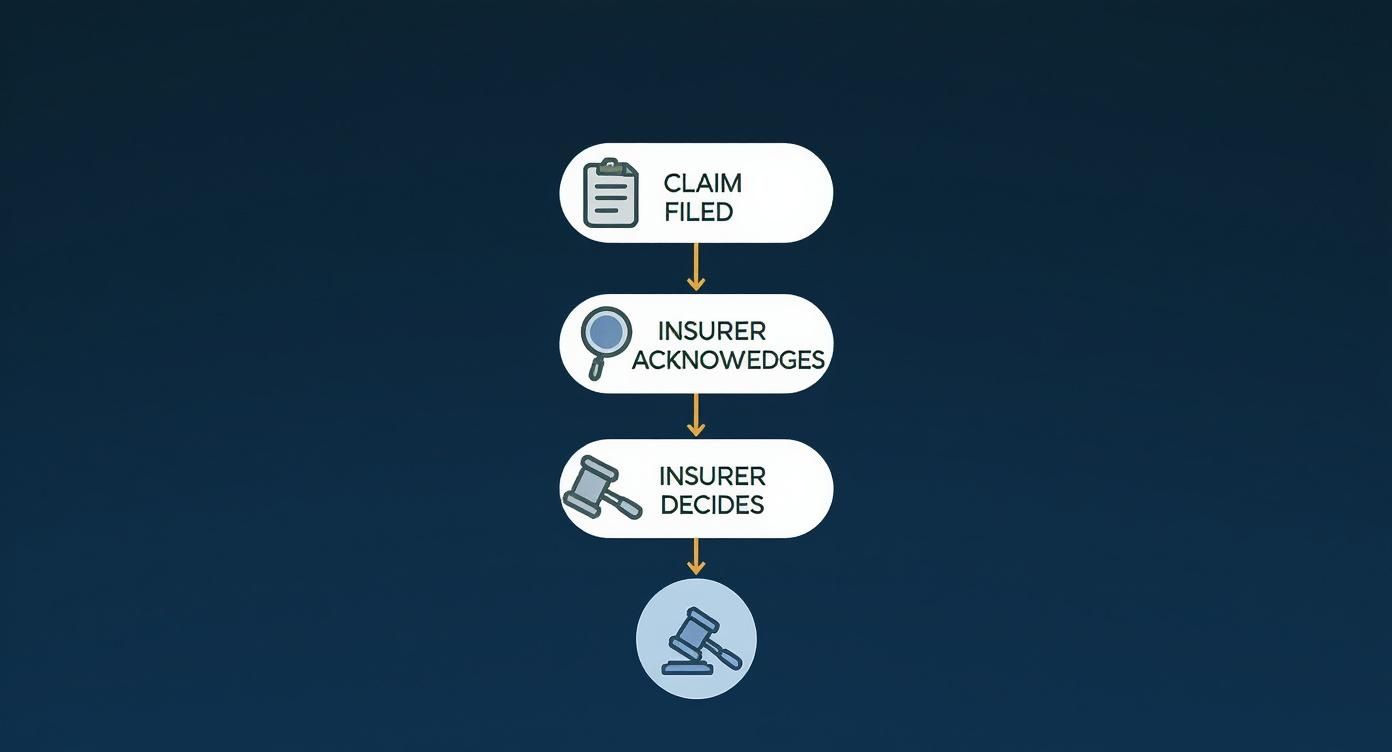
This chart shows the simplified path a claim takes. That "Insurer Decides" box is a critical fork in the road. A denial isn't the end; it's the official start of your proactive appeal.
Stage Two: Escalating with a Demand Letter
What if the insurance company digs in its heels and rejects your internal appeal? Or maybe they come back with a laughably low offer. It’s time to turn up the heat. The next move is usually sending a formal demand letter, which is almost always drafted by an attorney.
This isn’t just another letter. It’s a powerful legal document that signals you’re done playing their game and are prepared to go to court. A demand letter officially lays out the facts, details the full extent of your damages—medical bills, lost income, pain and suffering—and makes a specific demand for a settlement amount. It puts the insurer on formal notice that litigation is on the table.
A well-crafted demand letter completely shifts the power dynamic. It tells the insurance company that the informal back-and-forth is over. Now, they are facing a credible legal threat and must re-evaluate the financial risk of continuing to deny your valid claim.
Stage Three: Filing a Lawsuit
When an insurer stubbornly refuses to do the right thing, even after a strong appeal and a formal demand, filing a lawsuit may be the only path left to get the compensation you’re owed. This is a big step. It moves your fight out of the insurance company’s internal system and into a formal court of law.
Litigation can be a lengthy process, there's no sugarcoating it. But it's often the only way to truly hold an insurance company accountable for a wrongful denial or bad faith. It gives your attorney powerful tools, like taking sworn depositions and issuing subpoenas, to uncover evidence the insurer might have conveniently overlooked during their initial investigation.
And make no mistake, the fight is getting tougher. In the healthcare world, for example, the denial rate for private payers jumped from 8% in 2021 to 11% in 2023. Insurers are getting more aggressive with denials, often hiding behind paperwork technicalities or "medical necessity" arguments. This trend shows just how critical it is to be ready to fight back.
Moving from an internal appeal to a full-blown lawsuit is a major escalation, but you don't have to walk that road alone. Each stage requires a different strategy and a different level of pressure. If your claim was denied, don't just accept it. In pain? Call Caine.
Why You Need an Attorney to Fight Your Denial
Trying to take on a massive insurance corporation by yourself is more than just an uphill battle—it’s an intimidating, exhausting fight you shouldn't have to face. Insurers have entire departments staffed with adjusters, investigators, and teams of lawyers. Their one and only goal? To protect the company's bottom line.
This isn't a fair fight. It’s the classic David vs. Goliath story, except Goliath has nearly unlimited resources, and you're stuck trying to recover from an injury.
An experienced insurance claim attorney does far more than just help with paperwork. They level the entire playing field. They understand the dense, confusing language of insurance policies and know every tactic adjusters use to pressure you into accepting a lowball offer. That inside knowledge is your single most powerful asset.
Leveling the Legal Playing Field
Hiring a skilled lawyer immediately changes the entire dynamic of your claim. They know Florida’s insurance laws inside and out, including the critical deadlines and bad faith statutes designed to protect you. This expertise lets them instantly spot illegal tactics you might miss, like an insurer deliberately twisting the words of your own policy against you.
Your attorney also takes over all communication with the insurance company. This is a game-changer for two big reasons:
It stops the constant calls from adjusters trying to trick you into a recorded statement they can use to deny your claim.
It shields you from the stress and pressure of their delay tactics and endless follow-ups, letting you focus completely on your recovery.
A good attorney also understands how to build a case that an insurance company simply cannot ignore. They bring in the right experts—medical specialists, accident reconstructionists, and financial analysts—to build a mountain of evidence that proves the full and true extent of your damages. Successfully fighting a denial requires a deep understanding of Florida's insurance disputes process, and a legal professional brings that expertise to your side from day one.
Hiring an attorney sends a clear message to the insurance company: you will not be bullied, you know your rights, and you are fully prepared to take your case to court if necessary. Often, that credible threat of a lawsuit is the only thing that forces them to the table with a fair settlement offer.
Most personal injury attorneys, including our firm here at Caine Law, work on a contingency fee basis. What does that mean for you? You pay absolutely nothing upfront. The attorney's fee is just a percentage of the money they recover for you.
If we don't win your case, you owe us nothing. Period. This system makes expert legal help accessible to everyone, no matter their financial situation. You don't have to go through this alone. In pain? Call Caine.
Answering Your Questions About Claim Denials
Getting that denial letter from your insurance company can be infuriating and confusing. It often leaves you with more questions than answers. Let's clear up some of the most common concerns we hear from Florida policyholders who are in your exact situation.
How Long Do I Have to Fight a Denied Claim in Florida?
This is a critical question, and the answer depends on the type of claim. For most wrongfully denied claims, like property damage or a health insurance issue, Florida law views it as a breach of contract. You generally have up to five years to file a lawsuit.
But don't let that long timeline fool you into waiting. For personal injury cases, the clock is much, much shorter—typically just two years. The best move is always to act fast and start the internal appeal process right away. This protects your right to take legal action later if you need to.
What if the Insurance Company's Settlement Offer Is a Joke?
First, understand that a lowball offer isn't the final word. It's often just the opening move in a negotiation. They want to see if you'll just take the money and go away.
You do not have to accept it. Your first step should be to reject their offer—in writing—and hit back with a counteroffer. This isn't just a number you pull out of thin air; you need to back it up with a mountain of evidence showing your actual damages. Think repair estimates, all of your medical bills, proof of lost wages, and anything else that proves what your claim is really worth.
Can My Insurance Company Cancel My Policy Just for Filing a Claim?
Florida law gives you some real protection here. An insurer can't just cancel your policy for filing a single, legitimate claim, especially when the incident wasn't even your fault.
Now, if you file a whole series of claims in a short time, they might decide not to renew your policy when it expires. But outright canceling your policy as punishment for filing a claim is often illegal retaliation, and that's something you can absolutely fight.
The single most powerful weapon in any appeal is a perfectly organized file. This means every single medical record, police report, expert opinion, photo, receipt, and email you've exchanged with the insurer. When your documentation is rock-solid, it systematically dismantles their excuses for not paying.
Trying to navigate a denied claim on your own is an uphill battle, and it's incredibly stressful. You don't have to face it alone. The experienced attorneys at CAINE LAW are here to look at your case, lay out your options in plain English, and fight for every dollar you're owed. In pain? Call Caine.
