
In Pain? Call Caine
What To Do After a Car Accident in Florida

5 Min read
By: Caine Law
Share
The moments after a car crash are disorienting. Adrenaline is pumping, you might be in shock, and it's tough to think clearly. But what you do right then and there can have a huge impact on your health, safety, and your ability to get fair compensation later on.
Knowing the right moves gives you a clear roadmap when you need it most. The goal is simple: secure the scene, check for injuries, and handle your legal duties under Florida law.
Your First Moves at a Florida Accident Scene
Everything you do at the scene—from the information you gather to the police report that gets filed—lays the groundwork for your insurance claim. Getting it right from the start makes all the difference.
This visual guide breaks down those crucial first steps into a simple, easy-to-follow process.
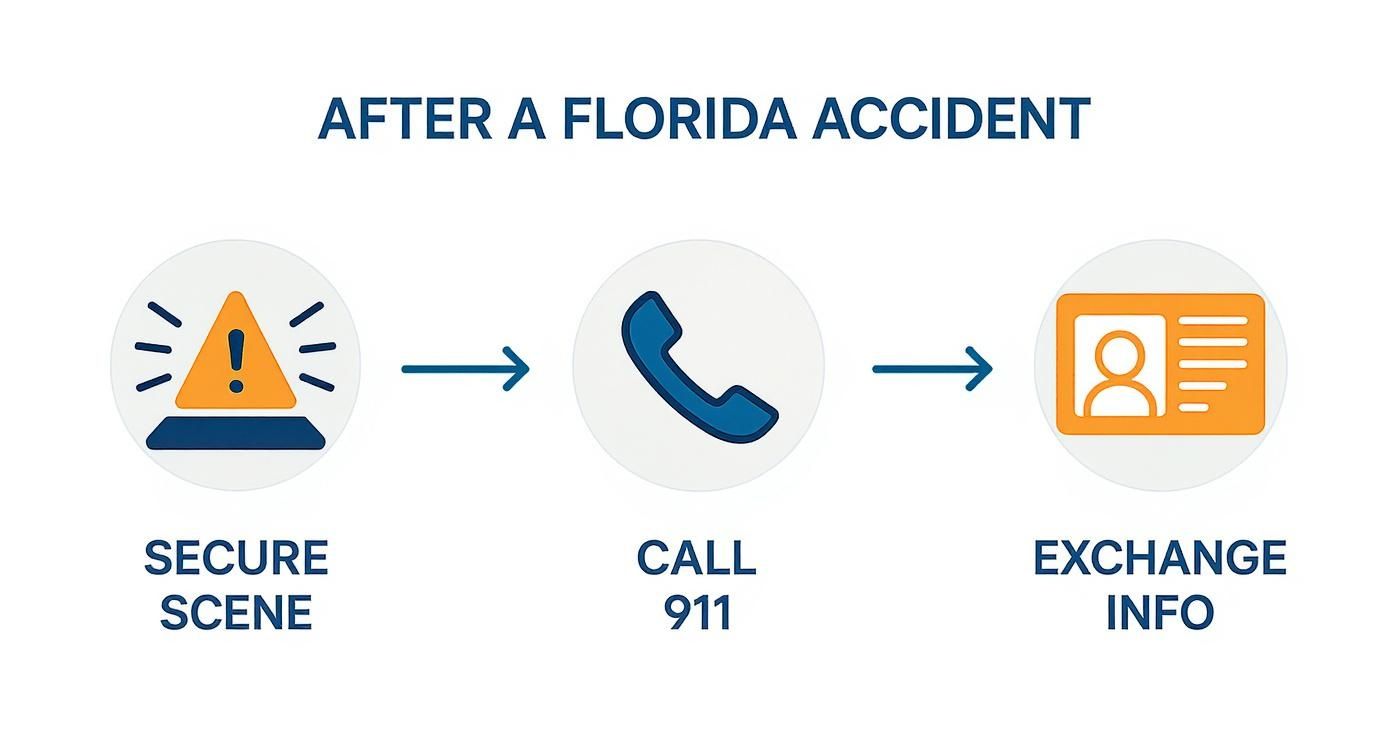
From making the scene safe to calling for help and gathering key details, this flow shows you how to prioritize safety while protecting your legal rights.
For a quick reference, here’s a breakdown of what to do immediately after a crash in Florida.
Florida Post-Accident Immediate Action Plan
Action | Why It's Critical in Florida | Pro Tip |
|---|---|---|
Secure the Scene | Prevents secondary collisions, a common danger on busy Florida roads like I-95 or the Turnpike. | If you can, move your car to the shoulder and turn on your hazard lights immediately. |
Call 911 | Required by law for accidents with injuries or over $500 in damage. Creates an official record. | Give a clear, precise location. Mention any obvious injuries so paramedics are dispatched. |
Exchange Info | You'll need the other driver’s insurance and contact details to file a claim. | Take a picture of their insurance card and driver's license. It’s faster and more accurate. |
Stay Quiet | Avoid saying "I'm sorry" or anything that sounds like admitting fault. It can be used against you. | Stick to the facts. Don't discuss who was at fault with the other driver. Let the police investigate. |
Document Everything | Photos and witness contacts are powerful evidence that can support your version of events. | Take wide shots of the scene, close-ups of damage, and photos of skid marks or road signs. |
This table covers the bare essentials, but let's dive a little deeper into why these steps are so important.
Prioritize Safety Above All Else
Your first job is to make sure nobody else gets hurt.
If it was a minor crash and your car is still drivable, pull it over to the shoulder or into a nearby parking lot, well away from traffic. This one small action can prevent a much more serious secondary collision, something we see all too often on Florida's crowded highways.
Once you’re in a safe spot, flick on your hazard lights. This makes your vehicle visible, especially at night or in bad weather, and warns other drivers to slow down.
If your car won't move or someone is seriously hurt, stay put. Keep your seatbelt on and wait for first responders. Never try to move someone with a potential neck or back injury—you could make things much, much worse. Your only job is to assess the situation and avoid creating new dangers.
Fulfill Your Legal Duty to Report the Crash
Calling 911 isn’t just a good idea; it’s often the law. In Florida, you must report any crash that results in injury, death, or has apparent property damage of $500 or more. With the cost of car repairs today, that covers just about any fender bender.
A formal police report is one of the most powerful pieces of evidence you can have. It provides an objective, third-party account of the incident, including diagrams, witness statements, and the officer’s initial assessment of what happened.
When you dial 911, be ready to give your exact location and report any injuries. This ensures the right help—police and paramedics—gets to you quickly. That official police report will become a cornerstone of your insurance claim.
It's also critical to know that leaving the scene of an accident is a serious crime. Florida law is clear: you have to stop and stay, no matter who was at fault. Fleeing can lead to severe criminal charges, including a felony hit-and-run if someone was injured. You can explore additional insights about Florida's traffic laws and accident statistics to understand just how serious these rules are.
Exchange Information, but Never Admit Fault
While you're waiting for the police, you’ll need to swap information with the other driver. How you handle this conversation is crucial. Keep it short, stick to the facts, and remain calm.
Here’s exactly what you need to get:
Full Name and Contact Information: Their phone number and address.
Insurance Details: Ask to see their insurance card and snap a picture of it. Get the company name and policy number.
Vehicle Information: Note the make, model, color, and license plate of their car.
Driver's License Number: This confirms their identity.
As you do this, bite your tongue. Fight the urge to apologize or say things like, "I'm so sorry" or "I didn't see you." Even a simple apology can be twisted by an insurance adjuster to mean you admitted fault. Just state the facts and let the police officer sort out what happened.
If anyone stopped to help, politely ask for their name and number. An independent witness can be incredibly valuable for your case. If you feel overwhelmed or the other driver is being difficult, just remember that expert help is available. In pain? Call Caine.
Documenting the Scene Like a Pro
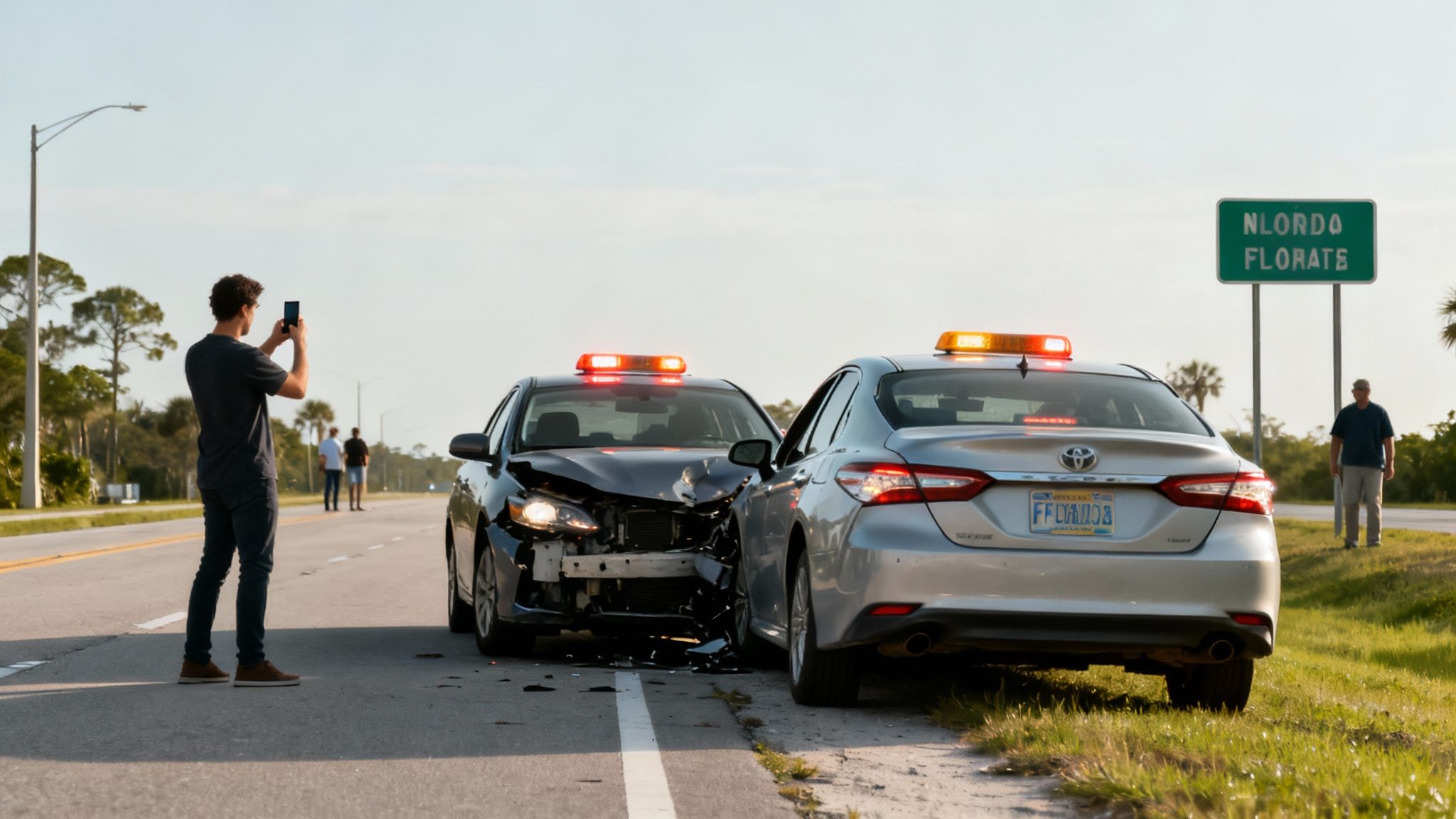
After you've checked on everyone and called 911, the next few minutes are absolutely critical. The evidence you gather right then and there can become the foundation of your entire claim. You need to switch gears and think like an investigator. Luckily, the most powerful tool for the job is already in your pocket: your smartphone.
Every detail you collect helps paint an accurate, unbiased picture of what happened. This isn't just for your own records; it’s the ammunition you'll need when dealing with insurance companies. A solid set of photos and notes prevents the other driver from changing their story and gives your attorney what they need to fight for you.
This is about more than just a few pictures of a dented bumper. It's about telling the complete story of the crash through undeniable proof.
Start With the Big Picture
Before you start zooming in on the damage, take a step back. Capture the entire scene from several different angles. These wide shots provide crucial context that can make or break a case.
Think about it: a photo showing a stop sign hidden by an overgrown tree branch is powerful evidence. Pictures of slick, rain-soaked roads from a classic Florida downpour can explain why someone couldn't stop in time. Even sun glare at a particular intersection can be a contributing factor.
Your goal with these first shots is to document:
The layout of the intersection or road.
Weather conditions like rain, fog, or intense sunlight.
The traffic flow and any relevant signs or signals.
The final resting positions of all vehicles involved.
This kind of evidence makes it much harder for an at-fault driver to argue about the conditions at the time of the crash.
Zoom In On the Critical Details
Once you have the overall scene documented, it's time to get up close. This is where you focus on the direct results of the impact. Don't just take one photo of the damage—take a dozen from different angles and distances.
Get detailed close-ups of every dent, scratch, and broken part on all the cars involved, not just yours. This is huge, as photos of the impact points can help accident reconstruction experts pinpoint speed and determine who was at fault.
Don’t forget the temporary evidence. Skid marks on the pavement, shattered glass on the road, and any scattered debris will be cleaned up and gone forever. Snap pictures of it all before it disappears.
Make sure you also get clear photos of the other driver's license plate, their vehicle registration, and their insurance card. It’s far more reliable than trying to scribble down information when you’re shaken up.
Gather the Human Element
Photos and physical evidence are essential, but what people saw can be just as important. If there were any witnesses to the crash, their testimony could be the key to your case, especially if the other driver starts pointing fingers.
Politely ask anyone who stopped if they'd be willing to share their name and phone number. Just let them know their independent account of what happened could be incredibly helpful. You'd be surprised how many people are willing to help when they see something that clearly wasn't your fault.
You don't need a full statement on the spot. Just getting their contact information is enough. Your legal team can follow up later to get a formal account of what they saw. This one simple step can shut down a "he said, she said" argument before it even starts.
Having a complete file of photos, documents, and witness contacts puts you in a position of strength. If you're hurting and not sure what to do with all the evidence you’ve collected, we know exactly how to handle it. In pain? Call Caine.
Navigating Florida's No-Fault & PIP Insurance
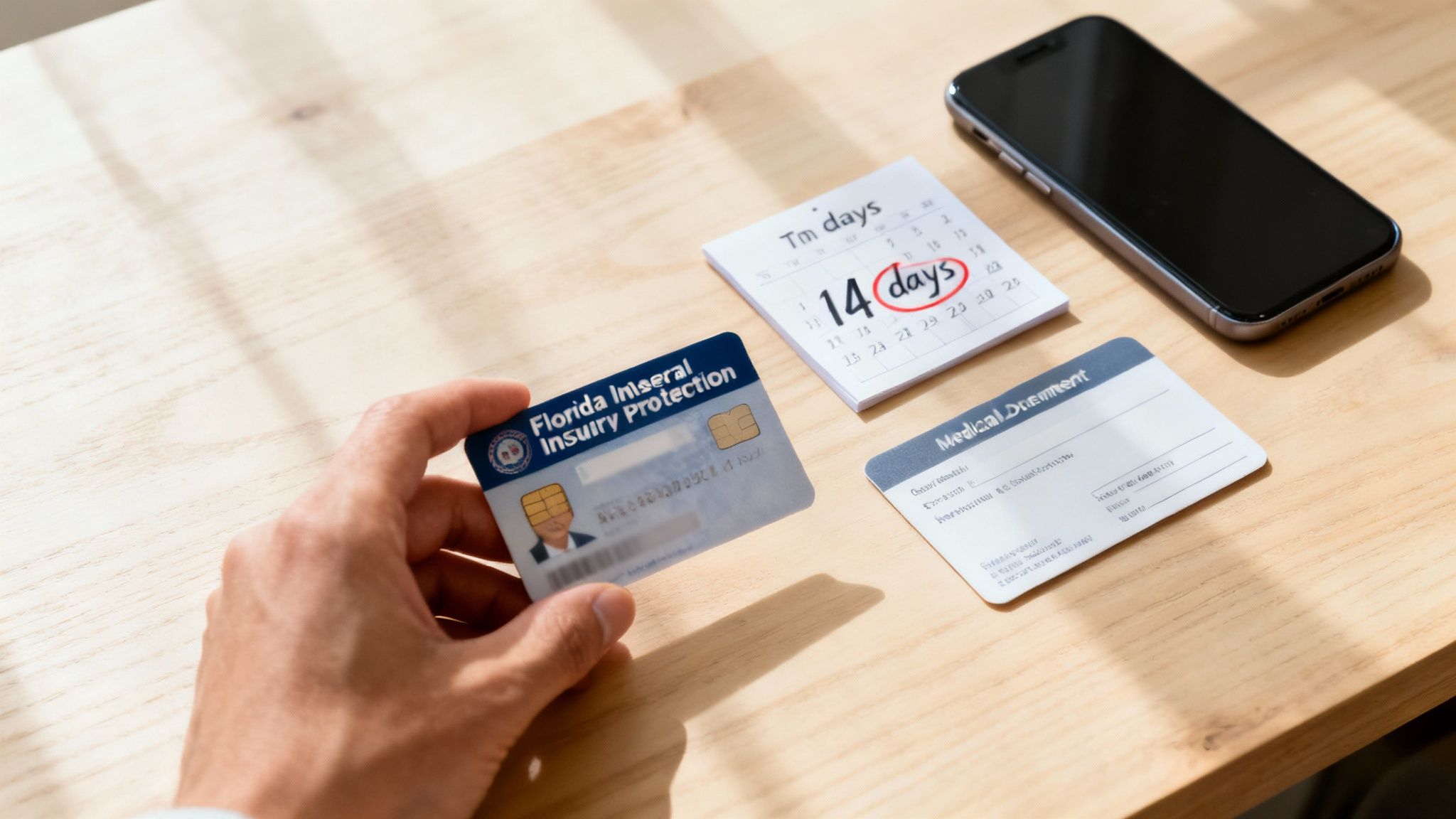
Once the immediate chaos of a Florida car accident settles, you’re thrown into a new and often frustrating world: insurance claims. The Sunshine State operates under a unique "no-fault" system that can be confusing, especially when you're already dealing with injuries and stress. Getting a handle on how it works is absolutely crucial to protecting yourself financially.
At its core, the no-fault law means your own insurance company is the first line of defense for your medical bills, no matter who actually caused the crash. This is done through your Personal Injury Protection (PIP) coverage, which is mandatory for every single driver in Florida.
This system was set up to get initial medical bills paid quickly, without having to wait for a lengthy fight over who was at fault. But it's also a system full of strict rules and tight deadlines that can easily trip you up if you're not careful.
How Your PIP Coverage Works
Every Florida driver is required by law to carry at least $10,000 in PIP coverage. This is the pot of money designated to cover a portion of your immediate medical costs and lost income after an accident.
Here’s the breakdown of what your PIP benefits typically cover:
80% of your reasonable and necessary medical bills.
60% of your lost wages if your injuries keep you from working.
The idea is to get you access to medical care right away, without having to prove the other driver was liable first. But this benefit comes with one of the biggest catches in all of Florida insurance law.
The Critical 14-Day Rule You Can't Ignore
This is non-negotiable. You have an extremely short window to get medical help if you want to use your PIP benefits. Under Florida law, you must seek initial medical treatment within 14 days of the car accident. If you wait until day 15, your insurance company has the legal right to deny your entire PIP claim, leaving you on the hook for every last cent of your medical bills.
The 14-day deadline is absolute. The adrenaline from a crash is powerful and can easily mask serious injuries like concussions, whiplash, or even internal damage. Getting checked out by a doctor right away not only protects your health—it preserves your right to the insurance coverage you’ve been paying for.
This rule is exactly why it's so vital to get seen by a medical professional—whether at an urgent care, the ER, or your family doctor—as soon as you possibly can. A documented medical visit officially connects your injuries to the accident and creates the paper trail you'll need for any claim. Don't let a delay cost you the $10,000 in benefits you're entitled to.
When PIP Just Isn't Enough
While PIP provides a decent initial safety net, that $10,000 can disappear in the blink of an eye, especially if you have serious injuries. When your medical needs go beyond what PIP covers, you may have the right to step outside the no-fault system and file a claim against the at-fault driver’s insurance for the rest of your damages.
This is where things get much more complicated. To pursue compensation for things like pain and suffering, your injuries must meet a legal threshold. This usually means you’ve suffered:
A significant and permanent loss of an important bodily function.
A permanent injury (within a reasonable degree of medical probability).
Significant and permanent scarring or disfigurement.
Death.
Figuring out if your injuries meet this standard and then taking on the other driver’s insurance company requires a specific kind of experience. It's far too easy to say the wrong thing to an adjuster or accept a lowball offer that won't cover your long-term medical care.
This is also when many people find their own insurer starts giving them the runaround, leading to unfair denials and delays. For a deeper look at what to do in these situations, you can check out our guide on handling insurance disputes in Florida.
If you’re drowning in medical bills while the insurance company is giving you the silent treatment, you don’t have to fight this battle on your own. We know their playbook and how to shut it down. In pain? Call Caine.
Communicating with Police and Insurance Adjusters
The chaos at the accident scene might be over, but a different kind of challenge is just beginning. You're about to have conversations with police officers and, inevitably, insurance adjusters.
How you handle these discussions is every bit as critical as the photos you snapped at the scene. Every word matters. Knowing the rules of engagement here can protect you from some very costly mistakes down the road.
Your first official piece of the puzzle is the Florida Traffic Crash Report. This document is the cornerstone of your claim. It contains the responding officer’s on-scene observations, diagrams, witness information, and a record of any tickets they issued. Insurance companies lean on this report heavily.
You can usually get your copy online through the Florida Highway Safety and Motor Vehicles (FLHSMV) portal a few days after the incident. Make it a priority to download it and read every single word.
What the Crash Report Tells You
That report is more than just a formality; it’s the official story of what happened, and it can either build up your case or create serious hurdles. As you read it, zero in on a few key areas that will have a major impact on your claim.
Here’s what you need to analyze:
The Narrative: This is the officer's written summary of what they believe happened, based on the physical evidence and statements they gathered. It often contains their initial take on who was at fault.
Citations Issued: Did the other driver get a ticket for a moving violation, like running a red light or speeding? That's powerful evidence of their negligence.
Diagram of the Scene: The officer’s sketch will show where the vehicles were, the points of impact, and other important road features.
Witness Information: The report should list names and contact info for any independent witnesses. Their third-party testimony can be invaluable.
If you spot a clear factual error—a misspelled name or the wrong street—you can request a correction. But trying to change an officer's opinion on who was at fault? That's a much tougher battle, and it's exactly why you want an attorney to review the report with you.
Handling the Call from the Insurance Adjuster
It won’t be long before your phone rings. It’ll be an insurance adjuster—maybe from your own company, but more likely from the at-fault driver's insurer. They will sound friendly, concerned, and helpful. But never forget their number one job: to save their company money by minimizing your claim.
Their entire goal is to get you to say something—anything—they can use against you. They are masters at asking leading questions designed to trip you up.
Never, ever give a recorded statement to the other driver's insurance company without talking to a lawyer first. These recordings are not for your benefit. Adjusters use them to lock you into a story, find tiny inconsistencies, and later use your own words to deny or slash the value of your claim.
Be polite, but be firm. Provide only the most basic, factual information: your name, your contact details, and the date and location of the crash. That's it. You are not obligated to discuss the details of your injuries, how you're feeling, or your opinion on who was at fault.
Phrases That Can Hurt Your Claim
Innocent, everyday things we say out of habit can be twisted and used to imply you were responsible for what happened. Adjusters are trained to listen for these specific words.
Here are a few examples of what not to say:
"I'm sorry." Even if you're just being polite, they will interpret this as an admission of fault.
"I'm fine" or "I feel okay." Adrenaline is a powerful pain-masker. If you say you're fine right after the crash but later discover a serious back injury, the adjuster will point to your initial statement to argue the injury isn't related.
"I think..." or "Maybe..." Don't guess or speculate. If you don't know the answer to a question, the best response is, "I don't recall at this moment."
Stick to the facts you know for certain. If the adjuster gets pushy or pressures you for a recorded statement, you have every right to end the conversation. Simply tell them you aren't prepared to discuss the details further and that your attorney will be in touch.
Dealing with adjusters is a strategic game. You need a professional player on your team. In pain? Call Caine.
When to Hire a Florida Car Accident Attorney

It’s one of the most common questions we hear after a crash: "Do I actually need a lawyer?" Honestly, for a minor fender-bender with no injuries, you might be able to handle it yourself. But for anything more serious, the answer is a firm yes.
Think of it this way: the other driver’s insurance company has an entire team of professionals working around the clock. Their only goal is to protect the company's bottom line by paying out as little as humanly possible. When you hire an attorney, you’re not just getting legal help; you’re leveling the playing field with an expert who is 100% in your corner.
Clear Signs You Need Legal Help
Not every bump and scratch warrants a lawsuit. However, if your accident involves any of the following, your next call should absolutely be to a Florida car accident attorney.
Serious Injuries: If you or a passenger suffered anything beyond a few minor scrapes, you need a lawyer. The real cost of medical care—future surgeries, ongoing physical therapy, lost income from being out of work—is almost always more than what an insurance company will initially offer.
Disputed Fault: Is the other driver pointing the finger at you? Is the police report vague or incorrect about who caused the crash? An attorney is essential here. We can launch our own investigation to find the evidence needed to prove the other party’s negligence.
Uninsured or Underinsured Drivers: Dealing with a driver who has no insurance is an absolute nightmare. A good lawyer knows how to explore every possible avenue for compensation, including your own Uninsured Motorist (UM) coverage.
Complex Accidents: Crashes involving commercial trucks, multiple vehicles, or government entities are a whole different ballgame. They have layers of complexity that demand specialized legal knowledge.
The reality is that insurance companies are businesses, not charities. They often use specific tactics, like offering a quick but low settlement, to close a case cheaply before you even realize the full extent of your injuries and long-term needs.
An experienced lawyer sees these strategies from a mile away and won't let you get taken advantage of while you’re trying to recover.
The Role of an Attorney in Your Claim
A personal injury attorney does so much more than just fill out paperwork. They become your advocate, investigator, and negotiator, taking on the entire stressful process so you can focus on one thing: getting better.
We start by digging into the crash, gathering police reports, interviewing witnesses, and even bringing in accident reconstruction experts if the case calls for it. We also meticulously calculate the true value of your claim, which goes far beyond just adding up your current medical bills. This includes future medical costs, lost wages, diminished earning capacity, and fair compensation for your pain and suffering.
This becomes even more critical in high-traffic areas. For instance, Miami-Dade County alone saw nearly 39,000 car accidents and over 18,500 injuries in a recent year. In busy urban centers, the risk of complex, multi-vehicle pile-ups is much higher, making skilled legal representation a necessity, not a luxury.
An attorney also handles all communication with the insurance companies, shielding you from their aggressive tactics and leading questions. We negotiate aggressively for a fair settlement that covers all your losses. And if the insurer refuses to be reasonable? A trial-ready attorney is prepared to take your case to court. You can learn more about our specific approach to auto and motorcycle accident claims in Florida.
Don't try to navigate this complex legal battle alone, especially when you are hurt and vulnerable.
In pain? Call Caine.
Florida Car Accident FAQs
Even after the initial chaos of a crash dies down, the questions start piling up. It’s completely normal to feel a bit lost while navigating the complex worlds of insurance and law here in Florida. We've put together some straightforward answers to the questions we hear most often, clearing up the confusion so you can understand your rights and the deadlines you absolutely can't miss.
Making smart, informed decisions right now is the key to protecting your recovery—both your physical health and your financial stability. Let’s tackle some of the most pressing concerns you might be facing.
How Long Do I Have to File a Car Accident Lawsuit in Florida?
This is one of the most important questions, and the answer has a hard, unforgiving deadline. In Florida, the window of time you have to file a lawsuit is called the statute of limitations. It’s strict. For most personal injury claims from a car crash, you now have just two years from the date of the accident to file.
This is a huge change from the old four-year deadline, so if your accident happened on or after March 24, 2023, this two-year rule applies to you. If you miss that window, the court will almost certainly throw your case out. You’ll lose your right to seek compensation forever. That’s why it’s so critical to talk to an attorney well before the clock runs out.
What if the Other Driver Was Uninsured or Fled the Scene?
Your stomach drops. It’s an incredibly stressful situation, and unfortunately, it happens all the time on Florida roads. Your first line of defense here is your own Uninsured/Underinsured Motorist (UM/UIM) coverage. This is optional coverage, but we recommend it to everyone. It’s designed to step in and cover your damages when the at-fault driver has no insurance, or not enough to cover your bills.
Think of UM coverage as your safety net. It can pay for your medical bills, lost income, and even your pain and suffering when the person who caused the wreck can't be held financially responsible. This coverage also kicks in if you're the victim of a hit-and-run.
If you don’t have UM coverage, don’t give up hope. A good attorney can dig deep to find other potential sources of recovery, like identifying other parties who might share the blame. It's a complex process, but you may still have options.
Should I Accept the First Settlement Offer from the Insurer?
Almost never. Insurance adjusters are trained professionals, and their job is to close your claim for as little money as possible. They often toss out a quick, lowball offer before you even have a clue about the full extent of your injuries or what kind of medical care you’ll need down the road.
The moment you accept that first offer, you’ll have to sign a release. That document legally signs away your right to seek any more money for that accident, period. If you discover months later that you need surgery, it’s too late. You can’t go back and ask for more. Always have an experienced attorney review any settlement offer to make sure it’s fair and actually covers everything you've lost and will lose in the future.
Do I Still Need a Doctor If I Just Feel a Little Sore?
Yes. One hundred percent, yes. After a crash, your body is flooded with adrenaline, a powerful natural painkiller that can easily hide serious injuries. What feels like minor soreness or a stiff neck could actually be whiplash, a herniated disc, or even a concussion.
More importantly, Florida's PIP law has a strict rule. You must get medical treatment within 14 days of the crash to even be eligible for your $10,000 in PIP benefits. A trip to the ER, an urgent care clinic, or your family doctor creates an official record linking your injuries to the accident. That documentation is pure gold for your claim. Don’t gamble with your health or your benefits—get checked out immediately. You can learn more by exploring our resources on Florida personal injury claims.
At CAINE LAW, we know the road to recovery is long and filled with obstacles. You don’t have to face the insurance companies and the legal system by yourself. We’re here to fight for the justice and full compensation you deserve. In pain? Call Caine. Contact us today at https://cainelegal.com for a free, no-obligation consultation.
