
In Pain? Call Caine
What to Do After a Car Accident

5 Min read
By: Caine Law
Share
The moments after a car crash are a blur of adrenaline, confusion, and stress. Before you even think about insurance or whose fault it was, your absolute first priority must be safety.
Can you get out of the car? Are your passengers okay? If you're able, the next move is to get your vehicle out of the flow of traffic to prevent a second, or even third, collision.
Your Immediate Steps at the Accident Scene
What you do in the first few minutes after a wreck can dramatically impact your physical and financial recovery for years to come. Your body is pumping with adrenaline, which is great for survival but terrible for self-diagnosing injuries. It’s notorious for masking the pain of whiplash, internal injuries, or even a concussion.
Making the right moves right away is about taking control of a chaotic situation. It's not just about your immediate health; it’s about protecting your rights. You might find the other driver is friendly and suggests just swapping numbers and "handling it privately." I can tell you from experience, this is almost always a mistake. Memories get fuzzy and stories change, but an official police report is an objective, third-party account of what happened.
Prioritizing Safety Above All Else
Before you do anything else—before you even look at the damage—take a deep breath and check on yourself and everyone in your car. Then, check on the occupants of the other vehicle(s), if it's safe to do so.
Road traffic accidents are a massive global problem. According to the World Health Organization, about 1.19 million people die in crashes every year, and tens of millions more are left with serious injuries. Taking careful, deliberate action at the scene can keep you from becoming one of those statistics.
This flowchart lays out the first three things you absolutely must do.
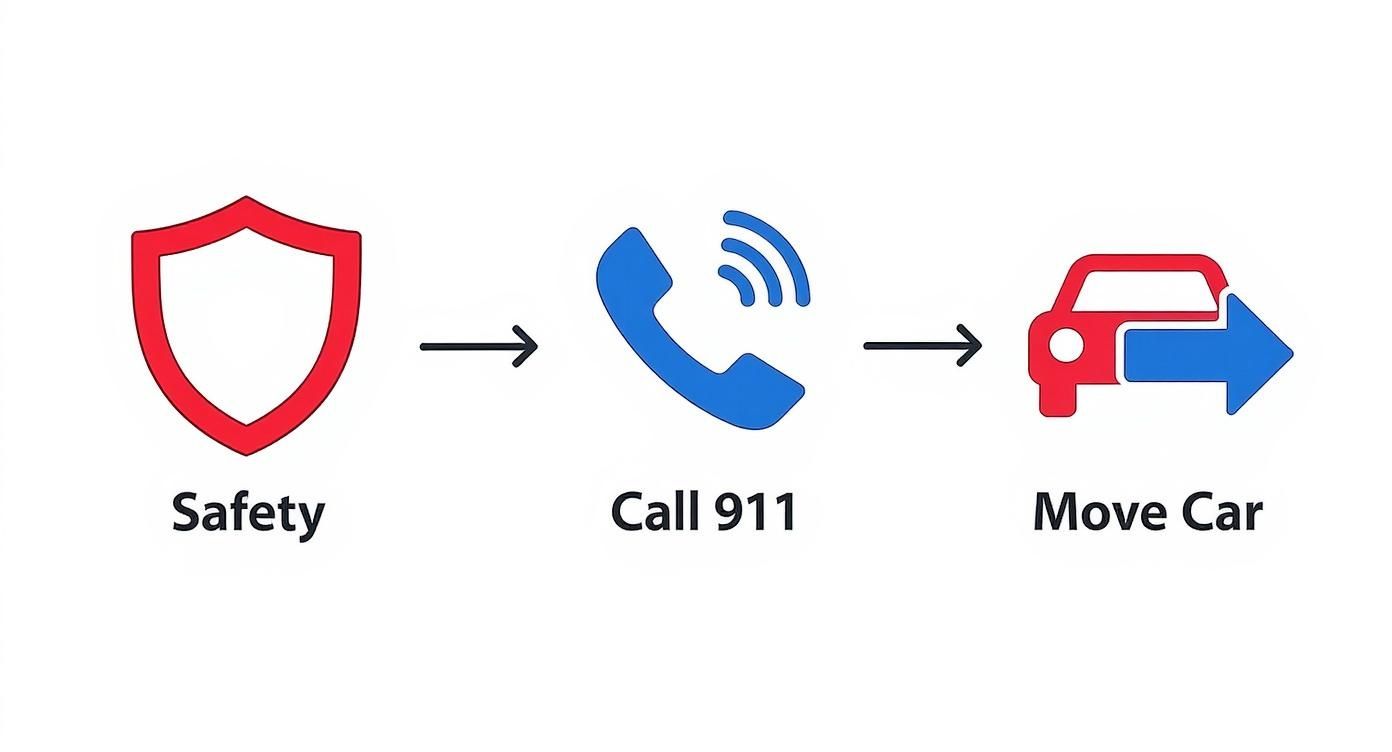
It really is that simple: safety, emergency services, and clearing the road. Everything else comes after.
To make it even clearer, here’s a quick-reference table outlining the most critical safety actions you should take within minutes of a crash.
Immediate Post-Accident Safety Actions | |
|---|---|
Action | Why It's Critical |
1. Stay at the Scene | Leaving the scene of an accident, especially one with injuries, is a crime in Florida. It's called a "hit and run" and carries severe penalties. |
2. Check for Injuries | Assess yourself, your passengers, and others involved. Don't move anyone who is unconscious or complains of severe neck or back pain unless they are in immediate danger (like a fire). |
3. Call 911 Immediately | This gets police and medical help on the way. A police report is crucial for any future insurance claim or personal injury case. |
4. Move to Safety | If your vehicle is drivable and there are no serious injuries, move it to the shoulder or a nearby safe location. This prevents secondary accidents and keeps traffic flowing. |
5. Turn on Hazard Lights | Make your vehicle as visible as possible to other drivers, especially at night or in bad weather. Use flares or warning triangles if you have them. |
These initial steps are non-negotiable. They protect your health, satisfy your legal obligations, and lay the groundwork for a successful recovery.
Making the Critical 911 Call
I don't care if it's a "minor" fender bender in a Publix parking lot—you need to call 911. It's not an overreaction; it's a necessity. When you make that call, be ready to give the dispatcher clear and simple information:
Your exact location. Use cross-streets, mile markers, or a major landmark. "I'm on I-95 near the exit for Atlantic Blvd" is a good start.
How many people are hurt? Be specific. "The driver in the other car is conscious but says his neck hurts." or "My passenger is bleeding from their forehead."
What's the scene like? Are cars blocking all lanes? Is there fluid leaking from a car? Are there any immediate dangers?
An expert tip: A huge mistake people make is saying "I'm fine" at the scene. You're not a doctor, and you're full of adrenaline. The best thing to say is, "I'm not sure if I'm injured." Let a paramedic or a doctor make that call. It protects both your health and your legal rights.
A Real-World Intersection Collision Scenario
Picture this: you’re stopped at a red light in Miami. It turns green, you start to go, and suddenly a car blows through their red light and plows into your driver's side door. It's a violent, jarring impact.
Your first instinct might be panic or rage. Fight it. Run through a mental checklist.
First, your passengers. Is everyone conscious and alert? Anyone complaining of pain? Next, yourself. Then, turn on your hazard lights. That simple click warns other drivers of the danger.
If your car can still move, and it’s safe, carefully pull it over to the shoulder or into the nearest parking lot. Getting out of live traffic is one of the most important things you can do to prevent the situation from getting worse.
Only after you are safe should you even think about exchanging information or taking pictures. How you handle these first few moments sets the stage for everything that follows. If you're hurt and feeling overwhelmed by it all, just remember you don't have to figure this out alone. In pain? Call Caine.
Gathering Evidence to Protect Your Claim

After you've checked on everyone and called 911, your focus needs to shift. The next few minutes are critical, and the evidence you gather now will form the bedrock of your insurance claim and any potential legal action.
It's tough, I know. You're shaken up. But right now, you need to become a detective for your own case. What you document at the scene can make or break your ability to get fair compensation down the road. Memories fade and stories change, but photos don't lie.
Your Smartphone Is Your Most Powerful Tool
That phone in your pocket is an incredible evidence-gathering machine. Start snapping pictures immediately. Don't worry about taking too many—you can always delete them later. The goal is to capture everything from every possible angle.
Here’s a practical checklist of what to photograph:
The Big Picture: Take wide shots of the entire accident scene from different spots. This shows the location, weather, and traffic flow.
Damage to All Vehicles: Document the damage on every car involved, not just yours. Get close-ups of dents and scrapes, then back up for shots showing the points of impact.
License Plates: Get clear, readable photos of every license plate.
Road Conditions: Look for anything relevant on the road itself—skid marks, debris from the crash, potholes, or nearby construction.
Signs and Signals: Capture photos of stop signs, traffic lights, speed limit signs, or anything else that controlled the intersection.
Visible Injuries: If you or your passengers have cuts, bruises, or any other visible injuries, photograph them right there at the scene.
These photos create a visual timeline. They provide objective proof that can shut down an insurance adjuster's attempts to dispute the facts weeks or months from now.
Exchange Information and Find Witnesses
While photos are vital, you also have to get the facts from the other driver and anyone who saw what happened. Try to stay calm and professional. From a legal standpoint, what to do after a car accident includes several universal steps to protect everyone involved. Even if nobody seems hurt, you need to exchange names, addresses, and insurance details.
Make sure you walk away with this information from the other driver:
Full Name and Address
Phone Number and Email
Insurance Company and Policy Number
Driver’s License Number
Vehicle Make, Model, and License Plate Number
Real-World Scenario: Picture a simple parking lot fender-bender. A driver backs into your car, but they insist you were moving. Suddenly, a shopper who saw the whole thing confirms you were parked. Getting that witness's name and number just turned a frustrating "he said, she said" situation into a clear-cut case.
Witnesses are your impartial allies. If someone stops to check on you, thank them and immediately ask for their contact information. A single, unbiased statement can be the one thing that proves who was really at fault.
Document More Than Just the Obvious
Once you have the photos and contact info, take a breath. Use the voice memo app on your phone or a notepad to record everything you remember. Adrenaline can make memories fuzzy later, so capturing fresh details is crucial.
Jot down things like:
The date and exact time of the crash.
Your precise location—cross-streets or mile markers.
What you were doing just before the impact.
Anything the other driver said. An apology like, "I'm so sorry, I didn't see you," is a powerful piece of information.
This simple act creates your own personal record that can back up the official police report. It ensures your side of the story is preserved accurately from the very beginning. If this all feels overwhelming or you’re just not sure you've done enough to protect yourself, get some guidance. In pain? Call Caine.
Handling Police Reports and Insurance Calls

After you've done everything to secure the scene and capture the immediate evidence, it's time to deal with the official reports. This means two conversations that can feel intimidating but are absolutely critical: talking with the police and calling your insurance company. The way you handle these interactions can set the stage for your entire recovery.
The goal is to stay calm, stick to what you know for sure, and understand what to say—and just as importantly, what not to say. This isn't about being evasive; it's about protecting your rights from the very beginning and making sure the facts are reported correctly.
Interacting with Law Enforcement
When the police arrive, their job is to secure the area, assist anyone who is injured, and create an official record of what happened. Your role is to give them clear, factual information so they can do their job properly.
This is not the time to guess or speculate. If you aren't sure about something they ask—like the exact speed you were traveling—it is perfectly okay to say, "I'm not sure." The shock and adrenaline from a crash can scramble details in your mind. It’s far better to be honest about what you don't remember than to state something inaccurate that could be used against you down the line.
One of the most common—and damaging—mistakes people make is apologizing or admitting fault. A simple, "I'm so sorry, I didn't see them," can be twisted into a full admission of guilt. Let the officer conduct their investigation and draw conclusions from the evidence.
Before the officer leaves the scene, make sure you walk away with two key pieces of information: their name and badge number, and the police report number. You'll need that report number to get a copy of the official crash report, which is a cornerstone document for your insurance claim.
Making the First Call to Your Insurer
Once you've spoken with the police, you need to report the accident to your own insurance company as soon as you can. Almost every policy has a clause that requires you to provide "prompt notification." This first call is purely informational.
Have this information ready before you dial:
Your policy number (keep your insurance card handy)
The exact date, time, and location of the crash
A simple, factual description of the events (no blame, no emotion)
The other driver's contact and insurance information
The police report number you just received
This call officially opens your claim. Your insurer will assign an adjuster to your case, and their investigation will begin.
Understanding Florida’s No-Fault System and Critical Deadlines
It's absolutely essential to understand that Florida is a "no-fault" state. This means that, regardless of who was at fault for the crash, you must first go through your own Personal Injury Protection (PIP) coverage for your initial medical bills.
The no-fault system is meant to get you quick access to medical care without waiting for a lengthy fault investigation. But there's a huge catch you cannot miss.
Under Florida law, you have just 14 days from the date of the accident to get initial medical treatment for your injuries. If you wait until day 15, your insurance company has the legal right to deny your PIP claim for medical coverage entirely. This is why getting checked out by a doctor right away is non-negotiable, even if you think you're okay.
The minutes and days after a crash are chaotic, but knowing these deadlines can make all the difference. To help you keep track, here’s a quick overview of the most important timeframes.
Key Deadlines After a Florida Car Accident
Action | Deadline | Consequence of Missing It |
|---|---|---|
Seek Initial Medical Care | Within 14 days of the accident | Loss of your PIP insurance benefits for medical treatment. |
Report the Accident to Your Insurer | As soon as reasonably possible | Your insurer could deny your claim for failure to provide prompt notice. |
File a Personal Injury Lawsuit | 2 years from the date of the accident (as of 3/24/2023) | You lose your legal right to sue the at-fault party for damages. |
File a Wrongful Death Lawsuit | 2 years from the date of death | Your family loses the right to seek compensation for their loss. |
Note: The statute of limitations was recently changed from four years to two years. If your accident occurred before March 24, 2023, the old four-year deadline may still apply. It's crucial to confirm the exact deadline for your specific case.
Trying to navigate these rules while you're in pain and under stress is a heavy burden. Remember, insurance companies have their own agenda, and it doesn't always line up with your best interests. If you feel that your insurer is giving you the runaround or unfairly questioning your claim, it might be time for professional help. You can learn more about how we handle these situations by reading our guide on resolving insurance disputes. In pain? Call Caine.
Your Health Comes First—Always.
After the dust settles and the initial shock of a crash wears off, your top priority isn't the car, the insurance, or the police report. It's you. I can't tell you how many times I've seen clients make the dangerous mistake of shrugging off medical care because they "feel fine." Adrenaline is a powerful chemical, and it does an incredible job of hiding serious injuries right after a traumatic event.
What feels like a little neck stiffness today could be the start of a debilitating whiplash injury that doesn't fully show up for days, or even weeks. That dull headache you're trying to ignore? It could be a concussion. Many of the most serious injuries—things like internal bleeding or soft tissue tears—don't scream for attention right away. Getting checked out immediately isn't just a good idea; it's the most critical step you can take to protect your future.
Get to a Doctor, No Excuses
Even if paramedics gave you a once-over at the scene, you still need a proper examination from a doctor or at an urgent care clinic. This visit is non-negotiable, and it accomplishes two vital things.
First, and most importantly, it gets you the care you need. Catching hidden injuries early is the key to a faster and more complete recovery. Second, it creates an official medical record that connects your injuries directly to the accident. Insurance companies are built on skepticism. If you wait a week or two to finally see a doctor, the adjuster will almost certainly argue your injuries weren't that bad or, worse, that something else must have caused them after the crash.
Here's the bottom line: Seeing a doctor right away creates an undeniable paper trail. It establishes a clear, immediate link between the crash and your injuries, shutting down one of the insurance company's favorite tactics before they can even try it.
This medical record is the cornerstone of your entire recovery, both for your health and for your financial compensation.
Become the Chief Witness to Your Own Story
While your doctor is documenting your medical condition, your job is to document how those injuries are impacting your day-to-day life. You need to become the primary storyteller of your own experience. To an insurance adjuster, you're just a claim number. It's up to you to show them the real human cost of the crash.
The most effective way to do this is to start a 'pain and recovery journal' the same day as the accident. It doesn't need to be fancy—a simple notebook or a notes app on your phone is perfect.
Every day, take a few minutes to jot down the answers to these questions:
On a scale of 1 to 10, what's my pain level today?
Where does it hurt? Is the pain sharp, dull, throbbing, or aching?
What couldn't I do today because of the pain? (Think about simple things: lifting a gallon of milk, sitting at my desk for more than an hour, getting a full night's sleep.)
How am I feeling emotionally? (Anxious about driving? Frustrated? Depressed?)
Did I have any doctor's appointments or treatments?
This journal becomes an incredibly powerful piece of evidence. It paints a vivid, day-by-day picture of your suffering in a way that a single medical report never could.
Track Every Penny
Beyond the physical pain, a car crash unleashes a flood of unexpected costs. You have to be meticulous about tracking every single expense that pops up because of this accident. Get a dedicated folder or start a digital file and save everything.
This includes, but is not limited to:
Medical Bills: Keep every single receipt and statement from doctors, chiropractors, physical therapists, specialists, and hospitals.
Prescription Costs: Save the receipts for any medications, pain relievers, or medical devices like a neck brace or crutches.
Lost Wages: Keep copies of your pay stubs and ask your employer for a letter documenting the time you had to miss from work for your injuries and appointments.
Out-of-Pocket Expenses: Keep a log of your mileage driving to and from the doctor. Did you have to take an Uber because you couldn't drive? Save that receipt.
This isn't just about getting reimbursed. This financial record helps paint the full picture of the economic damage you've suffered. If you've been seriously hurt, understanding the true scope of a Florida personal injury claim is the only way to make sure you get fair compensation for everything you've lost. It's your leverage against an insurance company that's looking to pay as little as possible. If trying to heal while juggling all this paperwork feels overwhelming, remember you don't have to do it alone. In pain? Call Caine.
When to Contact a Car Accident Lawyer

After a crash, your mind is racing. Between getting medical care and trying to document everything, one big question usually surfaces: "Do I actually need a lawyer for this?"
Honestly, for a simple fender-bender where no one got hurt, you probably don't. But I've seen far too many people assume their situation is "simple" when it's anything but. Knowing when to get professional legal advice is one of the most important calls you can make to protect yourself.
Clear Signs You Need Legal Help
While not every collision requires hiring an attorney, there are definite red flags that should have you picking up the phone immediately. If any of these sound like your situation, a consultation isn't just a good idea—it's essential.
You should reach out to an attorney if:
Anyone was injured. This is the big one. If you, a passenger, or someone in the other car has any injury at all—from whiplash to something much worse—you need legal guidance.
Fault is being disputed. The other driver is blaming you, or their story keeps changing. This isn't a straightforward claim anymore. An attorney can step in to protect you from false accusations.
The insurance company is giving you the runaround. Are they pressuring you for a recorded statement? Delaying your claim? Offering a quick, insultingly low settlement? That adjuster is not on your side.
Your injuries are serious or long-term. A crash that leads to surgery, significant medical treatment, or permanent disability involves complex calculations for future costs. You should not try to figure that out on your own.
Ignoring these signs is a gamble. It can leave you buried in unpaid medical bills and with a settlement that doesn't come close to what you truly deserve.
Busting Myths About Personal Injury Lawyers
Let's be real—a lot of people hesitate to call a lawyer because of things they've heard. It's time to clear up a couple of the most common myths.
Myth #1: "I can't afford a lawyer."
This is the biggest misconception out there. Reputable personal injury firms, including Caine Law, work on a contingency fee basis. What does that mean for you? You pay absolutely nothing upfront. Our fee is just a percentage of the money we recover for you. If we don't win your case, you owe us nothing. Period.
This model levels the playing field. It gives you immediate access to expert legal representation without any financial risk, so you can take on a massive insurance company with a powerful advocate in your corner.
Myth #2: "Hiring a lawyer means I'm going to court."
Not at all. The truth is, the vast majority of car accident cases—well over 90%—are settled out of court. An experienced attorney is first and foremost a skilled negotiator. We know how to build a rock-solid case that pressures the insurance company to make a fair offer, because the last thing they want is to face us in a courtroom.
What Happens During a Free Consultation
Think of your first meeting with a car accident lawyer as a no-strings-attached conversation. It’s your opportunity to tell your story, get honest feedback, and understand your rights without any pressure.
To make the most of it, be ready to talk about:
The specifics of how the crash happened.
The injuries you've suffered and the medical care you've gotten so far.
Any conversations you’ve already had with insurance adjusters.
Any documents you have, like the police report, photos, or medical bills.
The attorney will listen, ask questions to get the full picture, and then give you a straightforward assessment of your case. They can give you immediate advice on what to do (and what not to do) to protect your claim. For those navigating Florida auto & motorcycle accidents, this is the perfect time to get clarity on the state-specific laws that affect you.
Talking to a lawyer early on prevents you from making critical mistakes, like giving a recorded statement to the other side’s insurer or accepting a settlement that won't cover your future medical needs. It’s the first proactive step toward taking back control.
If you are hurt and unsure what to do next, we can help. In pain? Call Caine.
When the initial shock of a crash wears off, it’s almost always replaced by a flood of questions. You’re not alone in feeling overwhelmed by insurance paperwork, legal deadlines, and calls from adjusters. Let’s cut through the confusion and get you some clear, straightforward answers to the questions we hear most often from our clients here in Florida.
Trying to navigate this maze while you're also trying to heal from your injuries is incredibly tough. Getting the right information early on can save you from making costly mistakes and protect your right to get the compensation you deserve.
What if the Other Driver Does Not Have Insurance?
This is a scenario that causes a lot of stress, but it happens more often than you’d think. If an uninsured driver hits you, your own policy is your first line of defense. This is exactly why Uninsured/Underinsured Motorist (UM/UIM) coverage is something we believe every Florida driver should have.
Think of it as a safety net. This part of your policy is designed to cover your:
Medical bills and any future treatments you might need
Wages you lost from being unable to work
Pain and suffering
Without UM coverage, your only real option is to sue the at-fault driver personally. The hard truth is, if someone can't afford car insurance, they probably don't have the assets to pay for your damages, making it nearly impossible to recover what you're owed. A good attorney will dig into your policy to find every possible source of coverage, even ones you didn’t know you had.
Should I Give a Recorded Statement to the Other Driver's Insurance Company?
Let me be direct: do not give a recorded statement to the other driver’s insurance adjuster before you’ve spoken with a lawyer. You are under no legal obligation to give one, and frankly, it almost never helps your case.
Insurance adjusters are skilled negotiators. Their job is to protect their company’s bottom line by paying out as little as possible. They are trained to ask tricky, leading questions designed to get you to say something—anything—that can be used against you later to devalue your claim or even pin some of the blame on you.
A simple, "I'm so sorry, I didn't see them coming," can be twisted into an admission of fault. Saying you "feel fine" right after the crash can be used to argue your injuries aren't serious, even if the pain sets in days later. It's always best to politely decline and tell them your attorney will be in contact. That one simple sentence protects you.
How Long Do I Have to File a Car Accident Lawsuit in Florida?
This is a critical deadline you can't afford to miss. In Florida, the statute of limitations for filing a personal injury lawsuit from a car accident is now generally two years from the date of the crash. It's important to note this was recently changed from four years for any accidents that happened on or after March 24, 2023.
Two years might seem like a long time, but in the legal world, it flies by. Building a strong case takes time—it involves a thorough investigation, gathering all the right evidence, consulting with medical and accident reconstruction experts, and negotiating with the insurance company. If you miss that two-year window, the court will almost certainly throw out your case, and you will lose your right to seek any compensation for your injuries, forever. It is absolutely vital to contact an attorney well before that deadline gets close to make sure your rights are fully protected.
At CAINE LAW, we know the aftermath of an accident is filled with uncertainty. Our entire focus is on giving you the clear answers and aggressive representation you need to start moving forward. We’ll handle the legal headaches so you can focus on what’s most important—getting better. If you're in pain and not sure what to do next, let our experience work for you. In pain? Call Caine. Contact us today for a free, no-obligation consultation.
