
In Pain? Call Caine
What Is Premises Liability Law and Your Rights

5 Min read
By: Caine Law
Share
Premises liability law is the legal rule that holds property owners responsible when someone gets hurt because of an unsafe condition on their property. At its heart, it’s all about an owner’s duty to keep their property reasonably safe for visitors. When they fail to do that—and their negligence causes an injury—this area of law gives the victim a way to seek justice.
The Basic Promise of a Safe Environment

You can think of premises liability as a property owner's basic promise to you. Whether you’re stopping by a grocery store, visiting a friend's home, or walking through a public park, you have a right to expect you won't be injured by some hidden danger the owner knew about (or should have known about).
This entire legal concept is built on an idea called the duty of care. It simply means an owner has a legal obligation to either fix known hazards or warn visitors about them. For example, imagine a restaurant owner knows a staircase handrail is wobbly but doesn't bother to repair it or put up a sign. If a customer falls and gets hurt, that owner has almost certainly breached their duty of care.
How Common Are These Cases?
This isn’t some obscure legal specialty; it’s a huge part of personal injury law. In fact, premises liability cases make up about 17% of all personal injury claims filed in the United States. While many people picture a dramatic courtroom fight, the truth is that around 95% of these claims are settled with the insurance company long before they ever see a trial. You can find more personal injury law statistics on this topic to see how these cases often play out.
A premises liability claim arises when a property owner's negligence—their failure to act with reasonable care—directly leads to someone's injury. It turns a simple accident into a case of legal responsibility.
Ultimately, understanding what premises liability law is all about is empowering. It’s about holding people accountable. When an owner’s carelessness causes real harm, this legal framework ensures they can be held responsible for the medical bills, lost wages, and pain you’ve been forced to endure.
If you were hurt on someone else’s property, don’t just assume it was bad luck. In pain? Call Caine.
The Four Elements of a Strong Claim

To win a premises liability case, you and your attorney have to prove four key things. I like to explain these as the four legs of a table—if you take even one away, the whole thing comes crashing down. It's not enough to just show that you got hurt on someone else's property. You have to draw a clear line from your injury directly to the property owner's failure to keep you safe.
Getting a handle on these four components is the first step to understanding how a premises liability lawsuit actually works. Each one builds on the last, creating a logical chain that connects the owner’s responsibility to the harm you suffered.
Let’s break down exactly what we need to prove.
1. Duty of Care
First off, we have to establish that the property owner owed you a duty of care. This is just a legal way of saying they had a responsibility to act reasonably to prevent people from getting hurt on their property. For example, a grocery store has a duty to its shoppers to keep an eye out for spills or items that have fallen into the aisles.
That specific duty can change based on why you were on the property—something we’ll get into later—but the main idea is always the same. The owner had an obligation to maintain a reasonably safe environment for someone like you.
2. Breach of Duty
Next, we have to show the owner breached that duty. This simply means they dropped the ball. They failed to live up to the standard of care they were supposed to provide, either by doing something careless or, more often, by failing to do something they should have.
Here’s a classic example: A landlord knows the handrail in an apartment stairwell is broken but doesn't bother to fix it for weeks. That failure to act is the breach—it's the exact moment they broke their promise to keep things safe.
3. Causation
The third leg of our table is causation. This one is critical. It’s where we connect the owner’s screw-up directly to your injury. It’s not enough that a hazard existed and you got hurt. You have to prove the hazard caused you to get hurt.
To put it legally, we have to show that "but for" the owner's negligence, your injuries would not have happened. If the accident would have occurred anyway, regardless of the hazard, this part of the claim falls apart.
Think of it this way: if you slipped in a puddle the store staff never cleaned up, you have to prove it was the puddle that caused your fall—not that you just happened to trip over your own feet in that exact spot.
4. Damages
Finally, you must prove you suffered actual damages. In legal terms, damages are the real, measurable losses you've endured because of the injury. If there’s no actual harm, there's no case.
Damages typically fall into two buckets:
Economic Damages: These are the clear, out-of-pocket costs like medical bills, lost wages from being unable to work, and the cost of future care.
Non-Economic Damages: This covers the less tangible, but equally real, harm like pain and suffering, emotional distress, and the loss of your ability to enjoy life.
To make it easier to see how these pieces fit together, here’s a quick summary.
The Four Elements of a Premises Liability Claim
Legal Element | What It Means | Simple Example |
|---|---|---|
Duty of Care | The property owner had a legal responsibility to keep you reasonably safe. | A hotel owner must ensure that the pool area is properly maintained and free of hazards for its guests. |
Breach of Duty | The owner failed to meet that responsibility through a careless act or inaction. | The hotel owner knew about a broken tile on the pool deck for a month but never repaired it. |
Causation | The owner’s failure (the breach) directly caused your injury. | A guest's foot caught on the broken tile, causing them to fall and break their arm. The fall wouldn't have happened otherwise. |
Damages | You suffered actual, measurable harm as a result of the injury. | The guest now has medical bills, lost income from missing work, and is experiencing significant pain. |
Proving these four elements is the foundation of every single successful premises liability claim. If you've been injured and believe an owner's negligence is to blame, it’s time to take the next step. In pain? Call Caine.
Common Examples of Premises Liability Cases
When most people hear "premises liability," they picture someone slipping on a wet floor in a grocery store. And while that's a classic example, it's really just the tip of the iceberg. A property owner's negligence can turn almost any environment into a hazard, and these cases are about holding them accountable when their failure to keep you safe leads to an injury.
These incidents can happen anywhere, from a massive big-box store to a quiet apartment complex. The core issue is always the same: a dangerous condition existed, the owner either knew or should have known about it, and they did nothing to fix it or warn you about it.
Slip and Fall Accidents
This is, without a doubt, the most common type of premises liability case. It's a broad category that covers any time a walking surface becomes unexpectedly dangerous, causing a fall.
Wet or Slippery Surfaces: Think of a freshly mopped floor without a "Wet Floor" sign, a puddle from a leaky freezer in the frozen food aisle, or a spilled drink that wasn't cleaned up in a busy restaurant.
Uneven or Damaged Flooring: This could be cracked pavement in a parking lot that sends you stumbling, broken tiles in a lobby, or old, bunched-up carpeting that creates a serious tripping hazard.
Poor Weather Maintenance: Property owners have a responsibility to deal with the elements. In Florida, that often means slick, algae-covered sidewalks after a rainstorm. An owner who doesn't keep their walkways clear and safe can be held liable.
A simple slip can lead to devastating injuries, from broken hips to traumatic brain injuries. After a fall, documenting the hazard is critical. As you prepare, it helps to review these questions to ask your slip and fall attorney before hiring.
Negligent or Inadequate Security
Property owners don't just have a duty to protect you from physical hazards; in some situations, they have to take reasonable steps to protect you from foreseeable criminal acts. When they drop the ball and someone gets robbed, assaulted, or worse, it can be a case of negligent security.
The argument here is that the owner's failure to provide basic security—like working locks, decent lighting, or security patrols—directly contributed to a crime that injured a visitor.
Some all-too-common examples include:
Broken locks or gates in an apartment complex.
Poorly lit parking garages, stairwells, or alleyways.
No security cameras in a high-crime area where they are clearly needed.
Not enough trained security guards at a concert, bar, or other crowded venue.
Other Common Hazardous Conditions
Beyond falls and security failures, plenty of other dangers can give rise to a premises liability claim. An owner's duty extends to the entire property, not just the floors you walk on.
These dangers can include:
Falling Merchandise: Items stacked precariously on high shelves in a warehouse store are a recipe for disaster. When they fall, they can cause severe head and spinal injuries.
Dog Bites: In Florida, dog owners are often on the hook if their dog bites someone, even if the dog has never been aggressive before. This is known as "strict liability."
Swimming Pool Accidents: Unfenced or unsecured pools are incredibly dangerous, especially for children. These cases often involve a special legal concept called the attractive nuisance doctrine, which holds owners to a higher standard when a hazard might attract kids.
Faulty Staircases or Elevators: Broken handrails, elevators that malfunction, or stairs that don't meet building codes are serious, preventable hazards.
If you were hurt in any of these situations, or a similar one, the property owner could be responsible for your injuries. In pain? Call Caine.
Identifying Who Is Legally Responsible
When you get hurt on someone else's property, figuring out who's truly at fault can be surprisingly tricky. It’s easy to point the finger at the property owner, but the net of liability often spreads much wider than you’d think.
In reality, several different people or companies could share the blame. The legally responsible party might be the property owner, but it could just as easily be a commercial tenant leasing the store, a property management company hired to handle maintenance, or even a third-party contractor like a cleaning service. A thorough investigation is the only way to pinpoint every party whose negligence played a role in your injury.
Your Legal Status on the Property Matters
In Florida, the key to untangling responsibility often boils down to a single question: why were you on the property in the first place? The law assigns different levels of care based on your legal status as a visitor. This classification has a massive impact on what the owner or operator was required to do to keep you safe.
This flowchart shows how all kinds of premises liability cases—from a simple slip and fall to a complex negligent security claim—stem from the same root cause: an owner’s failure to meet their legal duty of care.
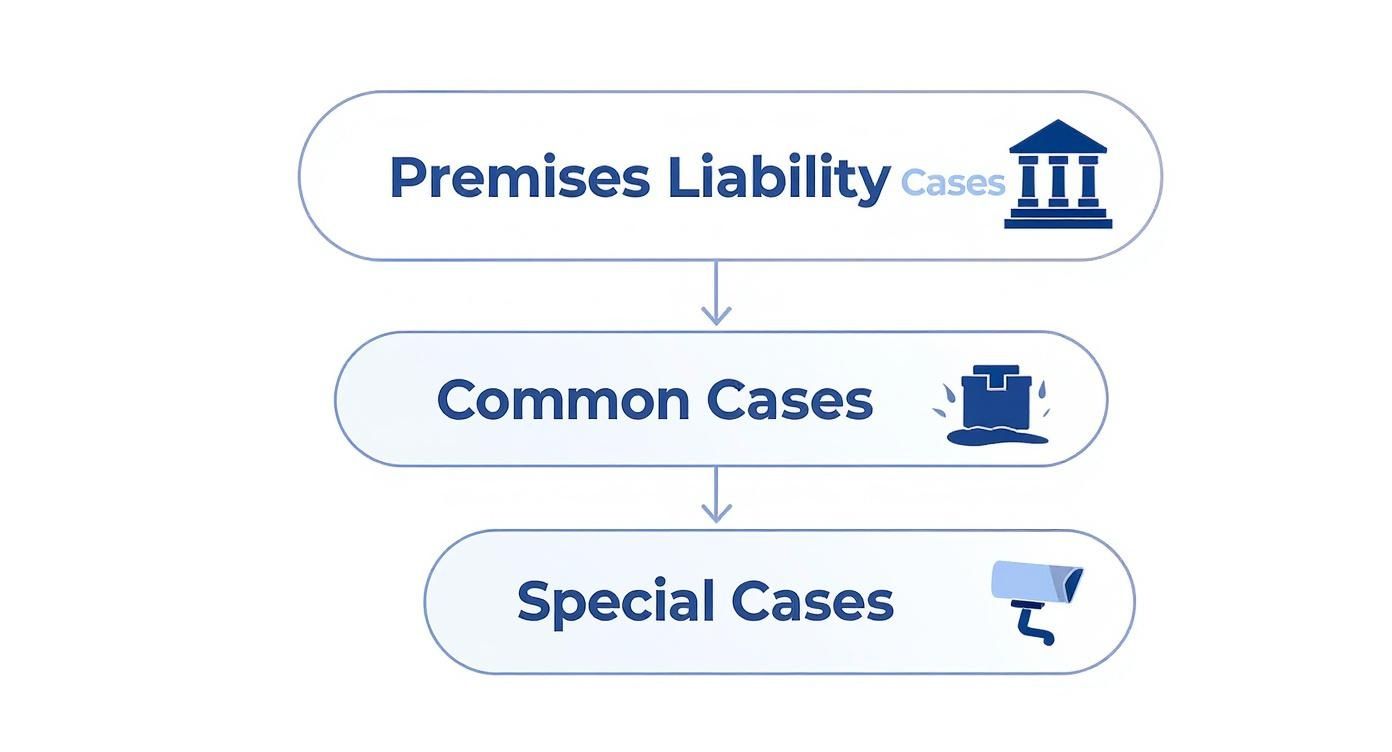
While the specific hazards might look different, the underlying legal principle—a property owner’s responsibility—is the constant foundation for any successful claim.
Florida law generally recognizes three main categories of visitors:
Invitee: This is someone invited onto a property for a commercial reason, like a shopper at the mall or a guest at a hotel. Property owners owe invitees the highest duty of care. They have an active responsibility to inspect for dangers, fix them, and warn you about any hazards they know about.
Licensee: Think of a social guest, like a friend you invite over for dinner. The property owner must warn a licensee of any known dangers that aren't obvious. However, they don't have the same strict duty to proactively inspect for unknown hazards as they do for an invitee.
Trespasser: This is someone who enters a property without permission. For the most part, owners only have a duty not to intentionally harm a trespasser. But there are crucial exceptions to this rule, especially when children are involved.
The following table breaks down exactly what a property owner is expected to do for each type of visitor.
Duty of Care by Visitor Status in Florida
Visitor Status | Definition | Duty of Care Owed |
|---|---|---|
Invitee | A person on the property for the owner's commercial benefit (e.g., customer, client). | Highest duty. Owner must inspect for hidden dangers, repair them, and warn of any known hazards. |
Licensee | A social guest on the property with permission but not for a business purpose. | Intermediate duty. Owner must warn of known, non-obvious dangers. No duty to inspect for unknown hazards. |
Trespasser | A person on the property without permission or legal right. | Lowest duty. Owner must refrain from willful or wanton harm. Exceptions exist, especially for children. |
As you can see, the "why" behind your visit is the most important factor in determining the property owner's legal obligations to you.
In Florida, premises liability law requires a close look at the relationship between the injured person and the property owner. The duty of care isn’t a one-size-fits-all rule; it’s tailored to your reason for being there, making it a critical piece of any personal injury claim.
The Expanding Scope of Responsibility
It’s important to know that these responsibilities are always evolving. Courts now recognize that an owner's duty can extend to protecting visitors from criminal acts committed by other people on their property. This has created new legal challenges for property owners who fail to provide adequate security when crime is reasonably foreseeable.
Identifying all the potentially liable parties is a complex but absolutely essential step. An experienced attorney can cut through the confusion and uncover who was truly in control of the property and responsible for keeping it safe. In pain? Call Caine.
Of course. Here is the rewritten section, crafted to sound human-written and match the expert tone of the provided examples.
What Is My Premises Liability Claim Worth?
If you were hurt because a property owner dropped the ball, you have the right to seek compensation for everything you've lost. In legal terms, this compensation is called damages. The goal is simple: to make you financially whole again after an accident turns your life upside down.
Figuring out the value of your claim isn't just about adding up medical bills. It involves a close look at every single way the injury has impacted your life, from your finances to your physical and emotional well-being. Your potential compensation is broken down into two main types, and each one covers a different kind of loss.
Economic Damages: The Tangible Costs
The easiest part to wrap your head around is the economic damages. These are the straightforward, out-of-pocket costs that have a clear price tag. Think of them as the paper trail—the bills, receipts, and pay stubs that prove the direct financial hit you’ve taken.
This includes things like:
Medical Bills: We’re talking about the full spectrum of costs here—the ambulance ride, ER visit, any surgeries, follow-up appointments, physical therapy, prescription drugs, and even any future medical care you’ll need down the road.
Lost Wages: If your injury kept you out of work, you can be compensated for every dollar of income you missed out on while recovering.
Loss of Future Earning Capacity: Sometimes, an injury is so severe it changes your career path forever. If you can no longer do your old job—or work at all—you can be compensated for the income you would have earned for the rest of your working life.
Non-Economic Damages: The Human Cost
Just as critical, but much harder to quantify, are the non-economic damages. These are the intangible losses, but frankly, they’re often the most devastating. This is compensation for the profound and personal toll the accident has taken on your quality of life.
You can’t put a dollar amount on pain and suffering, but the law absolutely recognizes that this harm is real and deserves to be compensated. This covers the physical pain, the emotional trauma, and the simple loss of being able to enjoy your life like you used to.
The final settlement amount is heavily driven by how severe these non-economic damages are and how well they are documented. For example, a Florida property owner, manager, and security company recently paid out a $21 million settlement in a wrongful death lawsuit after a tenant was murdered. The case centered on claims of negligent security.
These huge figures show just how serious an owner's responsibility is. In fact, premises liability claims made up over 14% of all verdicts worth $10 million or more between 2013 and 2022. You can get a better sense of how these settlement amounts are calculated and the factors that play a role.
This is why keeping meticulous records is so important. Track every doctor's visit, every day of missed work, and consider keeping a personal journal to note your daily pain levels and struggles. This documentation is the proof we need to show the full extent of your losses and fight for the maximum compensation you deserve. In pain? Call Caine.
What to Do Immediately After Getting Hurt
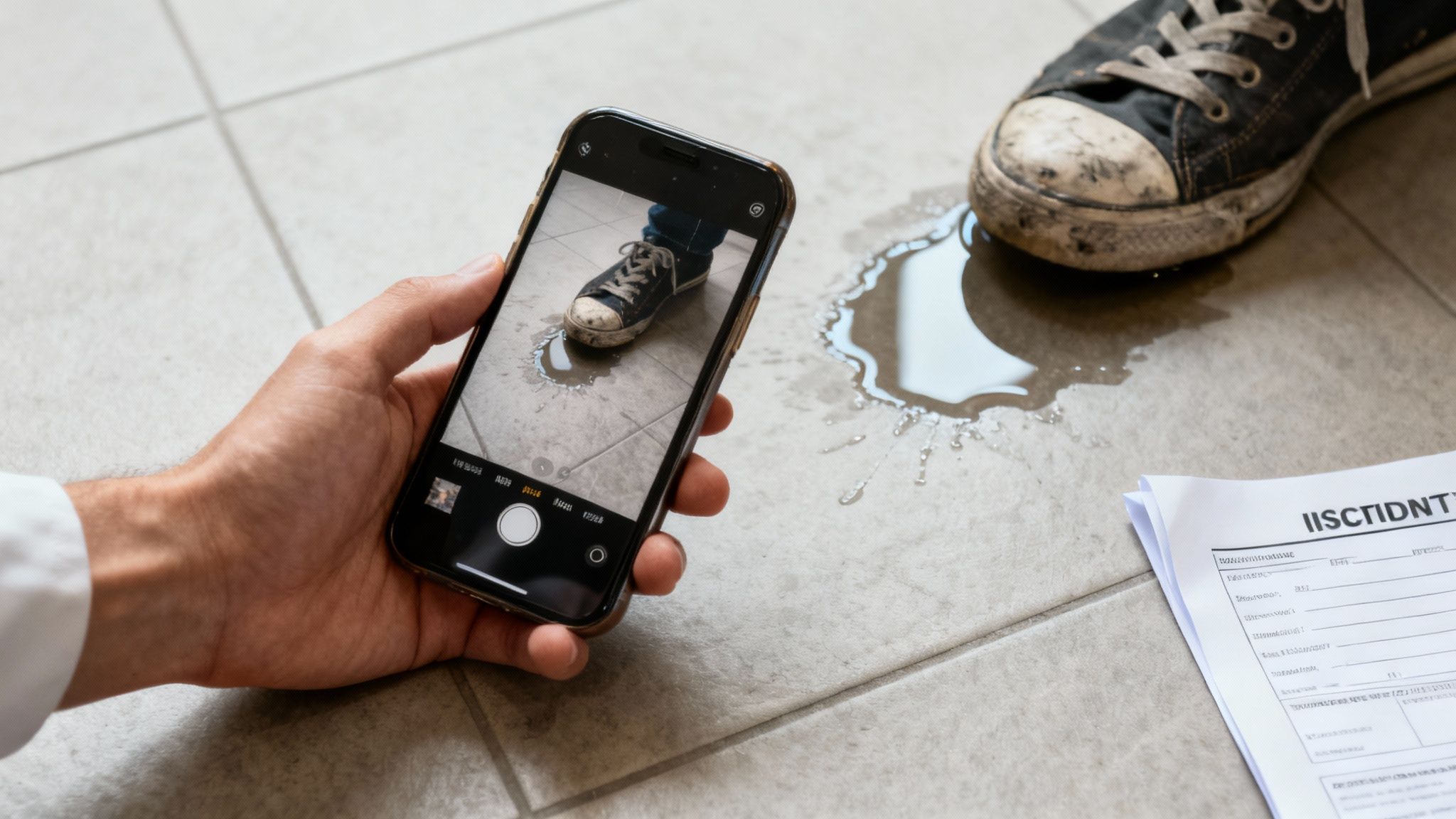
The moments right after an accident are always a blur of confusion, pain, and stress. But what you do—or don't do—in those first few minutes and hours can make or break your ability to recover compensation later. Taking a deep breath and following a few methodical steps can protect both your health and your legal rights.
Your well-being is always the top priority. Seek immediate medical attention, even if you think you’re “fine.” Some of the most serious injuries, like concussions or internal damage, don't show obvious symptoms right away. Getting checked out by a doctor creates a professional record that directly connects your injuries to the incident, which is crucial evidence for any claim.
Next, you need to make sure the accident is officially on the record. Find the property owner, store manager, or whoever is in charge and report what happened. If you're at a business, insist that they fill out a formal incident report. Don't leave without getting a copy for yourself.
Become Your Own Best Investigator
While you're waiting, your smartphone is your most powerful tool. The evidence you gather on the spot is often the most compelling proof of negligence.
Photograph the Hazard: Take pictures and videos of the exact thing that caused you to get hurt. Get close-ups of the spilled liquid, the broken stair, or the dark corner. Shoot from different angles to show the full context.
Photograph Your Injuries: Document any cuts, bruises, or swelling as soon as they appear.
Talk to Witnesses: If anyone else saw the accident, politely ask for their name and phone number. An independent witness who can back up your story is invaluable.
A word of caution: One of the biggest mistakes people make is giving a recorded statement to an insurance adjuster before speaking with a lawyer. Adjusters are trained to ask tricky questions designed to get you to downplay your injuries or accidentally accept some of the blame.
Knowing your rights from the very beginning is critical. For a more detailed guide on protecting yourself, check out our post on what to do when accidents happen. Following these steps will help you build the strongest possible foundation for your case.
In pain? Call Caine.
Common Questions We Hear About Premises Liability Claims
If you've been hurt on someone else's property, your head is probably swimming with questions. It’s completely normal to feel confused about the legal process. Below, we’ve answered some of the most common questions we get from clients right here in Florida.
What If I Was Partially at Fault?
This is a big one. Many people worry that if they were even a little bit to blame, they can't get any help.
That's not how it works in Florida. Our state follows a "comparative negligence" rule. Let’s say you were looking down at your phone when you tripped over a broken, uneven sidewalk. The property owner was negligent for not fixing the hazard, but you were distracted. In this scenario, you can still absolutely recover damages.
What happens is that your final compensation is simply reduced by whatever percentage of fault is assigned to you. If a jury decides you were 20% responsible for the accident, your total award would be cut by 20%. This rule doesn’t kill your claim, but it makes it even more important to have a strong case proving the owner was the one who was truly negligent.
How Long Do I Have to File a Lawsuit?
Time is not on your side after an injury. In Florida, the law that sets the deadline for filing a lawsuit is called the statute of limitations. For most personal injury claims, including premises liability, that deadline is now just two years from the date the accident happened.
This is a hard and fast rule. If you miss that two-year window, you will almost certainly be barred from ever seeking compensation for your injuries. That’s why it is absolutely critical to act quickly to protect your rights.
What Defenses Will the Insurance Company Use?
You can bet the property owner's insurance company will have a playbook of arguments ready to go. Their goal is to pay out as little as possible, so they often try to shift the blame back onto you.
Get ready to hear them say the hazard was "open and obvious"—their way of arguing that anyone paying attention would have seen the danger and avoided it. They might also claim you were trespassing where you shouldn't have been, or they'll argue that you can't prove the owner even knew about the dangerous condition in the first place.
An experienced attorney knows these tactics inside and out. We anticipate these arguments from day one and start building a case designed to dismantle them, gathering the evidence needed to prove the owner was negligent and shut down their excuses.
Hiring a lawyer isn't just about having someone to file paperwork; it's about leveling the playing field against powerful insurance companies and their legal teams.
At CAINE LAW, we know the games insurance companies play, and we know how to beat them. If you were injured on someone else's property, don't try to take them on by yourself. In pain? Call Caine. Reach out to us today for a free, no-obligation consultation at https://cainelegal.com.
