
In Pain? Call Caine
Statute of limitations florida negligence: Key Facts About Your Claim

5 Min read
By: Caine Law
Share
In Florida, the clock is ticking a lot faster than it used to. For most negligence claims, your window to seek justice is now just two years. This critical deadline closes twice as fast as it did before, making quick, decisive action more important than ever.
The Two-Year Deadline for Florida Negligence Claims
Think of your right to file a lawsuit as a train ticket. For years, that ticket was good for a four-year journey, giving you plenty of time to get on board. But the rules suddenly changed. Now, that same ticket expires in just two years. If you don't use it in time, the train leaves without you, and you lose your chance to reach your destination—financial recovery.
That’s a perfect analogy for what happened with Florida's statute of limitations for negligence.
A Major Shift in Florida Law
This wasn't some minor tweak to the law; it was a fundamental overhaul of how personal injury claims work in the Sunshine State. In March 2023, the legislature passed House Bill 837, slashing the time limit to file a negligence lawsuit from four years down to two. This much shorter deadline applies to any incident of negligence that happened on or after March 24, 2023.
The change impacts everyone, from victims of car wrecks on I-95 to people hurt in slip-and-fall accidents in stores across Miami-Dade, Orange County, and beyond.
The countdown on your claim starts the moment the negligent act occurs. If you wait too long, the courthouse doors will be permanently closed to you—no matter how clear the other party’s fault is or how severe your injuries are.
What Does Negligence Cover?
When we talk about "negligence," we're not using some fancy legal term. We're talking about a huge range of everyday situations where someone's carelessness causes real harm to someone else.
Understanding what falls under this umbrella is the first step to protecting your rights. Common examples include:
Auto Accidents: A distracted driver runs a red light and T-bones another car.
Slip and Fall Incidents: A grocery store manager knows about a leaky freezer but fails to clean up the puddle, causing a shopper to fall and break their hip.
Negligent Security: An apartment complex with a history of break-ins doesn't fix a broken security gate, leading to a tenant being assaulted.
Premises Liability: A homeowner knows a step on their front porch is rotten but doesn't warn a guest, who then falls through and gets hurt.
In every one of these scenarios, the injured person now has just two years to file a lawsuit. Missing that deadline isn't a simple procedural mistake; it means giving up your legal rights completely.
Let’s take a quick look at how the new two-year deadline applies to common personal injury claims.
Florida Negligence Deadlines at a Glance
This table provides a simple summary of the statute of limitations for general negligence cases under the new law.
Type of Negligence Claim | Statute of Limitations |
|---|---|
Car Accidents | 2 Years |
Truck Accidents | 2 Years |
Motorcycle Accidents | 2 Years |
Slip and Fall | 2 Years |
General Personal Injury | 2 Years |
Premises Liability | 2 Years |
Remember, this is a major change from the old four-year rule. The bottom line is that you have far less time to act.
If you've been hurt, don't let the calendar dictate your future. In pain? Call Caine.
Pinpointing When Your Legal Clock Starts Ticking
Knowing you have a two-year deadline for a Florida negligence claim is just the first piece of the puzzle. The real head-scratcher is often figuring out when that two-year clock actually starts ticking. The answer is a legal concept called accrual, and it marks the exact moment your legal right to sue officially comes alive.
For most personal injury cases, it's pretty straightforward. The clock usually starts on the very same day the incident happened. If you got hurt in a car crash on May 15th, that's Day One.
But life and injuries are rarely that simple. Sometimes, the damage doesn't show up right away, and that’s where a critical exception comes into play.
The Discovery Rule Explained
Florida law gets it—some injuries are sneaky and take time to reveal themselves. You might feel fine after a minor fender-bender, only to develop debilitating back pain months down the road that a doctor traces right back to that crash. For situations like this, we have the Discovery Rule.
This rule says the statute of limitations clock might not start until the date you discovered your injury, or the date you reasonably should have discovered it.
This is all about fairness. It stops a victim from losing their right to sue before they even realize they've been seriously harmed. But that phrase "reasonably should have been discovered" is key. You can't just ignore obvious symptoms and hope for more time. The law looks at what a reasonable person would have done in your shoes—when would they have gone to a doctor and found out what was wrong?
This decision tree shows just how much things changed on March 24, 2023, and whether the two-year or the old four-year deadline applies to your case.
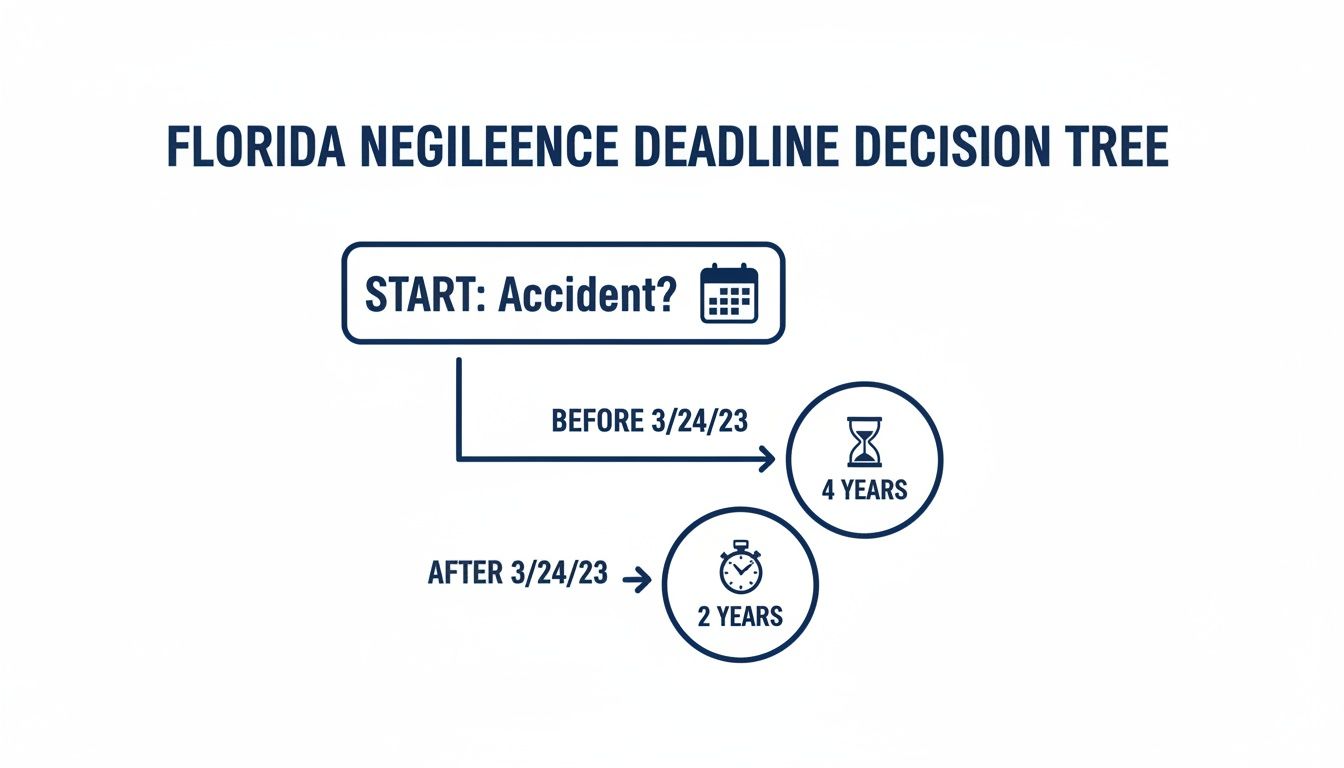
As you can see, the new law created a sharp dividing line, slashing the time you have to file a lawsuit in half for any negligence that happened after that date.
A Real-World Example of the Discovery Rule
Let's walk through an example. Say you slip on a wet floor in a grocery store in April 2024. You're a little bruised and embarrassed, but you shake it off and go home. Over the next few months, though, a nagging pain in your wrist gets worse and worse until you can’t even grip a coffee mug.
Finally, in August 2024, you go to a doctor who orders an MRI. The scan reveals a hairline fracture and ligament damage, and the doctor confirms it's from the fall.
So, when did your clock start?
Date of Incident: April 2024
Date of Discovery: August 2024
A good personal injury attorney would argue that your two-year clock started ticking in August 2024. That was the moment you actually discovered—and couldn't have reasonably known about—the true extent of your injury. This small but vital detail could push your filing deadline from April 2026 all the way to August 2026, potentially saving your entire case.
Getting this date right is absolutely critical. A simple miscalculation can have devastating results, permanently slamming the door on your chance to get the compensation you deserve. If there's even a shadow of a doubt about when your injury happened or when you discovered it, getting an expert legal opinion is non-negotiable.
Don't let a technicality end your case before it even has a chance to start. In pain? Call Caine.
Exceptions That Can Pause or Extend Your Filing Deadline
While Florida's new two-year deadline is strict, it isn't completely rigid. The legal system gets that life happens, and sometimes circumstances make it nearly impossible to file a lawsuit on time. For these specific situations, the law allows the statute of limitations clock to be "paused." This legal pause is called tolling.
Think of it like hitting the pause button on a stopwatch. The time that's already ticked by is locked in, but the clock stops running until the situation gets resolved. Once it is, someone hits "resume," and the clock starts counting down again right where it left off. This whole process is about fairness, ensuring victims who can't legally pursue a claim through no fault of their own don't lose their chance for justice.

But don't mistake these exceptions for loopholes. They are very narrow, well-defined circumstances that only apply in specific cases. Knowing if one fits your situation could be the difference between getting compensation and walking away with nothing.
When the Injured Party Is a Minor
One of the most common reasons to toll the statute of limitations for Florida negligence is when the injured person is a child. The law recognizes that a minor simply doesn't have the legal capacity to file a lawsuit on their own.
Let's say a 10-year-old gets hurt on a badly maintained playground slide. Their two-year deadline doesn't just run out when they turn 12. Instead, the clock is usually paused until the child legally becomes an adult at age 18. This gives them the opportunity to make their own decision about pursuing the case once they're old enough.
There's a catch, though. Florida law puts a cap on this, stating that the tolling period for a minor can't extend the deadline more than seven years from the date of the injury. This means a parent or guardian needs to take action long before the child turns 18 to make sure their rights are protected.
Concealment or Absence of the Defendant
What if the person who hurt you disappears? If the at-fault party actively tries to dodge responsibility, the law won't penalize you for the delay. The clock can be paused if the defendant does things like:
Leaves the State of Florida: If the person you need to sue skips town just to avoid being served with a lawsuit, the time they're gone usually won't count against you.
Goes into Hiding: The same idea applies if the defendant hides somewhere inside Florida to avoid being found.
Uses a False Name: Should the person at fault use an alias to make it impossible to track them down, that kind of fraudulent concealment can also pause the clock.
The principle here is simple fairness. A wrongdoer shouldn't get to run out the clock on their victim simply by trying to escape justice.
Incapacity or Mental Incompetence
Just like children, adults who have been declared legally incompetent can't file a lawsuit. If an injury victim is mentally incapacitated and can't manage their own affairs or even understand their legal rights, the statute of limitations can be tolled.
This often comes into play in cases where the negligence itself caused a catastrophic brain injury, leaving the victim in a coma or with severe cognitive problems. The clock stays paused until their competency is restored. And just like with minors, this tolling is also subject to that seven-year maximum extension.
These exceptions to the statute of limitations for Florida negligence are incredibly complex and depend entirely on the specific facts of your case. Never just assume an exception applies to you without getting a real legal analysis. Getting it wrong could mean you miss your deadline and permanently lose your right to compensation.
Don't let a legal technicality decide your future. In pain? Call Caine.
Navigating Special Rules for Malpractice and Wrongful Death
While the general two-year rule for negligence covers a lot of ground, some of the most devastating cases—medical malpractice and wrongful death—don't follow that clock. They operate under their own distinct and much stricter timelines.
These aren't just minor tweaks to the law; they're entirely different sets of rules that demand immediate attention. Understanding them is absolutely critical if you're going to protect your family’s rights in these life-altering situations. A small misstep in timing can permanently bar you from seeking justice.
The Two Clocks of Medical Malpractice
When you’re harmed by a healthcare provider in Florida, the law starts not one, but two separate clocks.
The first is a two-year statute of limitations. This seems straightforward enough, but there’s a crucial twist. The clock starts ticking the moment you either discover the injury or reasonably should have discovered it.
But there’s a second, more unforgiving clock running in the background: the four-year statute of repose.
Think of the statute of repose as a final, absolute deadline. It's a hard stop. Regardless of when you discovered your injury, if more than four years have passed since the actual medical error occurred, your right to file a claim is almost always extinguished.
There are very few, incredibly narrow exceptions to this four-year cutoff. This dual-timeline system means you could discover a surgical error three years after the procedure but have only one year left to act before the door slams shut for good.
How the Statute of Repose Really Works
Let's break that down with a real-world example.
Statute of Limitations (2 Years): A surgeon leaves a small sponge inside a patient in January 2024. The patient has some vague abdominal pain but doesn't connect it to the surgery until a scan in June 2025 reveals the foreign object. The two-year clock would likely start ticking in June 2025—the date of discovery.
Statute of Repose (4 Years): In that same scenario, the absolute final deadline to file a lawsuit is January 2028—exactly four years from the date of the negligent act. If the sponge isn't found until February 2028, it’s too late. The statute of repose has already expired, and the patient has no legal recourse.
This system was designed to prevent doctors from facing liability forever, but it can create a terribly unjust outcome for patients who suffer from injuries that don't show up for years.
The Timeline for Wrongful Death Claims
For grieving families, the timeline for filing a wrongful death claim is both emotionally challenging and legally rigid. In Florida, the statute of limitations for wrongful death is just two years, and the starting point is what matters most.
The clock begins on the date of the person's death, not on the date of the negligent act that caused it.
This is a critical distinction. If someone is injured in a car accident and fights for their life for six months before passing away, the family's two-year window to file a wrongful death lawsuit begins on the day they died, not the day of the crash.
The recent 2023 change to Florida's general negligence deadline has had a huge impact here. Wrongful death claims, now also under a strict two-year deadline from the date of death, reflect this new urgency. With thousands of fatal crashes happening across the state each year, the stakes couldn't be higher: families who wait more than 730 days to act can lose their legal rights forever. You can explore more insights about Florida's updated car accident timelines and their impact on victims' rights.
These specialized cases demand immediate and knowledgeable legal guidance. If you've lost a loved one or suffered from medical negligence, time is not on your side.
In pain? Call Caine.
Why Acting Fast Protects and Strengthens Your Claim
That two-year statute of limitations for Florida negligence isn't just some arbitrary deadline on a calendar. It's a ticking clock, and with every day that passes, the strength of your case can quietly erode. Acting fast isn't just a good idea; it's a powerful strategic advantage that gives you the best shot at building an undeniable claim.
Think of it this way: when investigators arrive at a crime scene moments after an incident, the evidence is fresh, witnesses are right there, and the scene is intact. But if they show up days or weeks later? Crucial details are gone for good. The exact same principle applies to your negligence claim.
Preserving Evidence Before It Disappears
The most powerful evidence is often the most fragile. It has a surprisingly short shelf life and can vanish without a trace if you don't move quickly to lock it down. The sooner your legal team can get to work, the better their chances are of securing these make-or-break pieces of proof.
Immediate action allows your attorney to send out spoliation letters—formal legal demands that force at-fault parties to preserve specific evidence. This simple step can stop a company from "accidentally" erasing the very information you need to win.
Here are a few examples of time-sensitive evidence that can make or break your case:
Surveillance Footage: Most businesses, from grocery stores to apartment complexes, overwrite their security camera footage every 7 to 30 days. That video could be the only unbiased witness to your slip and fall, but it will be erased forever if you wait.
Witness Memories: Someone who saw your accident might have a crystal-clear memory of it the next day. A few months later, that same memory can become fuzzy, unreliable, or completely gone.
Vehicle Data: Modern cars have an "event data recorder" (EDR), or black box, that logs critical data like speed, braking, and steering moments before a crash. This information can be overwritten or lost if the vehicle is quickly repaired or sent to a salvage yard.
Physical Conditions: That broken handrail, puddle on the floor, or gaping pothole that caused your injury will likely be fixed fast by the property owner. Photos taken right after the incident are invaluable, but the opportunity is fleeting.
Gaining Leverage Against Insurance Companies
Let’s be clear: insurance companies are not on your side. Their primary goal is to minimize their payout, and they often use your delay as a weapon against you. They know that as time passes, evidence gets weaker and injured people can become more desperate to accept a lowball offer.
When you hire an attorney right away, you flip the script. Your lawyer takes control of all communications, preventing adjusters from tricking you into a recorded statement that could be used to damage your claim later. Acting quickly signals to the insurance company that you are serious and are building a powerful case from day one. This puts you in a position of strength, not desperation. You can also review our guide on the essential steps to take after an accident to further protect your rights.
Procrastination is the insurance company's best friend. Swift legal action is their worst enemy. It signals that you will not be intimidated and are prepared to prove every aspect of your claim.
The Impact of Recent Legal Changes
The need for speed has been cranked up to a whole new level by recent legal reforms in Florida. The 2023 shift via HB 837 didn't just slash the negligence statute of limitations down to two years; it also brought in massive changes to comparative fault rules. Now, if you are found to be more than 50% responsible for your own injuries, you get nothing. Zero.
This makes an early and thorough investigation more critical than ever. Your attorney needs time not just to prove the other party’s negligence but also to aggressively defend you against any unfair blame they try to shift onto you. Waiting until the last minute hands the defense a massive, often insurmountable, advantage.
Don't let a preventable mistake cost you everything. Getting legal help immediately protects your rights, preserves the evidence you need, and puts you in the strongest possible position to get the justice you deserve.
In pain? Call Caine.
How a Skilled Attorney Manages Florida's Strict Deadlines
Knowing the statute of limitations for Florida negligence is one thing. Actually using that knowledge to build a winning case is something else entirely. It’s the difference between reciting a rule and turning that rule into a powerful strategic advantage. This is where the experience of a dedicated personal injury firm becomes your greatest asset.
Navigating Florida’s tight two-year deadline isn't just about getting paperwork filed on time. It’s about kicking off a methodical, aggressive process designed to get results. With a track record of recovering over $100 million for our clients, the team at Caine Law has proven time and again that a deep understanding of the law is the key to maximizing compensation within this high-pressure timeframe.
The Caine Law Advantage From Day One
It all starts with a free, no-obligation consultation. This isn't just a quick chat. It's an in-depth analysis of your case where we pinpoint the exact date your legal clock started ticking, identify any potential exceptions, and immediately map out a strategy to protect your rights.
Once we take on your case, we move fast:
Immediate Investigation: We dispatch investigators and send out legal notices to preserve critical evidence—like security footage and witness statements—before it can be lost or destroyed.
Expert Collaboration: We bring in medical experts, accident reconstructionists, and other specialists early on. This builds a powerful, evidence-based foundation for your claim from the very beginning.
Aggressive Representation: We take over all communications with the insurance companies. This shields you from their pressure tactics while we build a case designed to prove the full extent of your damages.
An experienced attorney doesn't just meet deadlines—they master them. They use that time constraint as a catalyst for decisive action, gathering irrefutable proof and positioning your case for the strongest possible outcome, whether that's a high-value settlement or a courtroom verdict.
Our goal is simple: manage every legal complexity so you can focus on your recovery. We know the insurance companies’ playbook because we’ve spent years beating them at their own game. We prepare every single case as if it's headed for trial, which ensures we negotiate from a position of undeniable strength. This proactive approach is essential when the clock is always working against you. Before you commit, it's wise to be prepared; you can learn about the 9 questions to ask your slip and fall attorney before hiring in our detailed guide.
Don't let a deadline dictate your future. The right legal team can turn that ticking clock into a roadmap for justice.
In pain? Call Caine.
Frequently Asked Questions
When you're dealing with an injury, the last thing you need is a maze of confusing legal rules. To help cut through the noise, here are some straightforward answers to the questions we hear most often about Florida's statute of limitations.
What Happens If I Miss the Two-Year Deadline?
This is the big one, and the answer is unfortunately brutal. If you miss Florida's strict two-year deadline, the court will almost certainly throw out your case. It’s a permanent bar.
That means you lose your right to sue the person who hurt you—forever. You can’t recover a dime for your medical bills, lost income, or the pain you've been forced to endure. It doesn't matter how obvious their fault was or how strong your evidence is. The deadline is absolute, which is why you can't afford to wait.
Does This Deadline Matter If I'm Just Dealing with an Insurance Company?
Yes, it matters more than anything. That deadline to file a lawsuit is the only real leverage you have when you're negotiating with an insurance adjuster.
Think about it: insurance companies know the law inside and out. They have the date circled on their calendar. The moment that deadline passes, they know you can no longer drag them into court. Your power vanishes. At that point, they have zero legal or financial reason to offer you a fair settlement, and they’ll likely just walk away from the table. You must file a lawsuit before the clock runs out to protect your claim, even if you’re in the middle of settlement talks.
Your ability to file a lawsuit is what turns an insurance claim from a polite request into a legal demand. Without it, you’re asking, not telling.
I Was Injured Before March 24, 2023. Am I Stuck with the New Two-Year Rule?
No, you're likely not. The new two-year statute of limitations generally only applies to injuries that happened on or after March 24, 2023.
If your injury occurred before that date, the old four-year deadline probably still applies to your case. But—and this is a big but—the laws around these transition dates can get tricky. You should never assume. The only way to be certain about your specific filing deadline is to have an experienced attorney review the facts of your situation. Getting this wrong is simply not a risk worth taking.
Don't let a simple calendar date take away your chance at justice. The team at CAINE LAW is here to make sure your rights are protected so you can focus on getting better.
In pain? Call Caine. Reach out today for a free, no-pressure consultation at https://cainelegal.com.
