
In Pain? Call Caine
Slip and Fall Injury Settlement Amounts: What Florida Claimants Should Know

5 Min read
By: Caine Law
Share
When you’ve been hurt in a fall, the first question that pops into your head is almost always, “What’s my case actually worth?” There’s no magic number for slip and fall injury settlement amounts, but they can range from a few thousand dollars for a minor sprain to well over a million for injuries that change your life forever.
The final value isn't pulled out of thin air; it’s directly tied to the specific, provable losses you suffered because someone else was negligent.
Understanding the Wide Range of Settlement Values
It’s tempting to look for a simple average, but that can be really misleading. A settlement isn’t a lottery prize. It’s a carefully calculated amount meant to make you whole again.
Think of it like repairing a classic car after a wreck. The repair cost isn’t based on an "average" bill; it’s based on the exact parts, labor, and specialized work needed to restore that specific car to its former glory. Your slip and fall claim is built the same way, piece by piece, based on what you lost.
The Two Pillars of a Slip and Fall Settlement
Every settlement is built on two distinct types of losses, which lawyers call damages.
Economic Damages: These are the straightforward, black-and-white financial hits you’ve taken. They’re the foundation of your claim because you can prove them with receipts, pay stubs, and doctor’s bills. Think medical expenses, lost paychecks from being out of work, and the cost of any future care you’ll need.
Non-Economic Damages: This is where the human cost comes in. This category covers the invisible, personal impact of the injury—the physical pain, the emotional trauma, and the way it’s robbed you of enjoying life. While it’s harder to put a price tag on suffering, these damages are often the most significant part of a settlement, especially when the injury is serious.
This two-part structure is exactly why slip and fall injury settlement amounts can be so different. A fall that leaves you with a bruised knee might only rack up a few thousand in medical bills with minimal pain and suffering. But a fall that causes a traumatic brain injury? That could mean millions in lifelong medical costs and a profound, devastating personal loss.
These accidents have a massive economic footprint. In the U.S., compensation and medical costs soar to around $90 billion every year. Legally, 95% of these cases settle out of court, with typical payouts landing somewhere between $10,000 and $150,000. Of course, the most severe cases can lead to multi-million dollar verdicts. You can learn more about these slip and fall figures on GoldLaw.com.
Before we get into the nitty-gritty of how these damages are calculated, it's crucial to understand what an insurance adjuster or jury will look at when deciding what your claim is worth. The table below breaks down the key factors that can dramatically move the needle on your final settlement amount.
Key Factors That Influence Your Settlement Value
Factor | Impact on Settlement Value (Higher vs. Lower) | Brief Explanation |
|---|---|---|
Severity of Injury | Higher | The more severe and permanent your injury, the higher the value. A spinal cord injury is worth exponentially more than a sprained ankle. |
Clear Liability | Higher | If it’s obvious the property owner was 100% at fault (e.g., they ignored a known hazard), your claim is much stronger and more valuable. |
Total Medical Bills | Higher | Higher medical costs—past, present, and future—directly increase the "economic damages" portion of your settlement. |
Lost Wages | Higher | The more work you miss and the higher your income, the more you can claim in lost wages, pushing the settlement value up. |
Comparative Fault | Lower | If you are found partially at fault for your own fall (e.g., you were texting while walking), Florida law can reduce your settlement by your percentage of fault. |
Pre-Existing Conditions | Lower | If the fall aggravated a pre-existing injury, the defense may argue they are only responsible for the new damage, potentially lowering the value. |
Lack of Evidence | Lower | Without strong proof—like photos, witness statements, and incident reports—it’s much harder to prove negligence, which weakens your case. |
Getting the compensation you deserve starts with proving your losses, and our team is here to help you do just that.
In pain? Call Caine.
How Attorneys and Insurers Calculate Your Claim's Value
Figuring out what a slip-and-fall settlement is worth isn't guesswork; it's a careful process of adding up your losses, piece by piece. Both your lawyer and the insurance company will start by building a foundation based on your tangible, provable expenses.
Think of it like building a house. You have to lay a solid financial groundwork before you can account for the less visible, human impact of the injury. This process separates your claim into two main categories of damages. Understanding how they fit together is the first step in seeing how a final settlement number takes shape.
This visual shows how the two types of damages—economic and non-economic—come together to form the basis of your total settlement value.
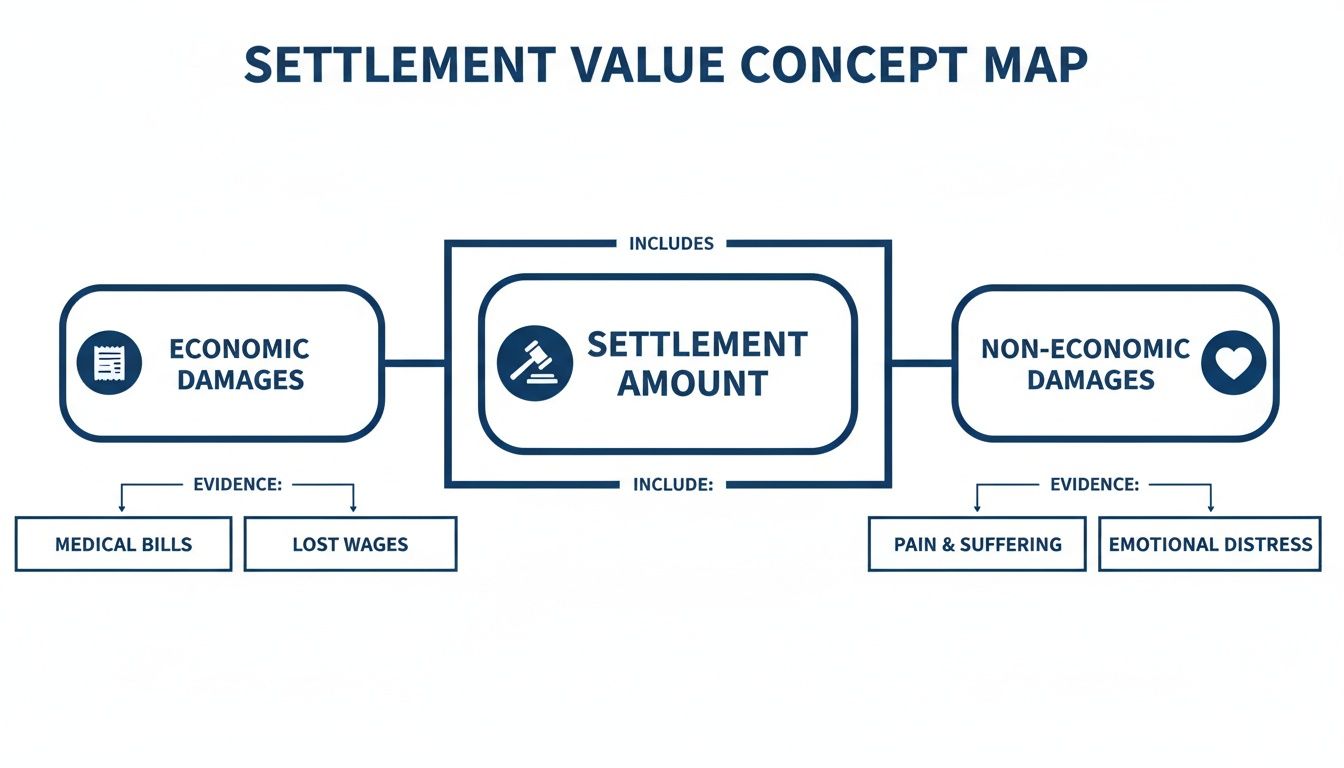
As the graphic shows, your total compensation is a mix of concrete financial losses and the more personal, human costs that come with an injury.
Calculating Economic Damages: The Foundation of Your Claim
First, we tally up what are known as economic damages. These are the most straightforward losses because they all come with a paper trail. They represent every single dollar you lost or had to spend because the accident happened.
These are the hard costs an insurer can't easily argue against, as long as you have the documentation to back them up. Your attorney will meticulously gather every bill, receipt, and pay stub to establish this base number.
Here are the main components of economic damages:
Medical Expenses: This covers everything from the initial ambulance ride and ER visit to surgeries, hospital stays, prescriptions, and physical therapy. It also includes an expert projection of any future medical care you’ll need.
Lost Wages: This is the income you couldn't earn while you were out of work recovering. If your injuries permanently impact your ability to do your job, we also calculate your diminished future earning capacity.
Out-of-Pocket Costs: Think of these as all the other related expenses. It could be gas money for driving to doctor’s appointments, the cost of installing a ramp at home, or hiring help for daily chores you can no longer manage on your own.
Valuing Non-Economic Damages: The Human Cost
Next comes the trickier part of the equation: non-economic damages. This is compensation for the intangible, personal ways the injury has turned your life upside down. It's often called "pain and suffering," and it's meant to address the physical pain, emotional distress, and loss of enjoyment of life you've had to endure.
Since there's no receipt for suffering, attorneys and insurance companies use a formula to put a dollar value on it.
The most common way to calculate these damages is the "multiplier method." Here, your total economic damages are multiplied by a number, typically between 1.5 and 5, to get a value for your pain and suffering.
That multiplier isn't just picked out of a hat. A higher number is used for more severe, permanent, and life-altering injuries. A minor sprain that heals quickly might get a 1.5 multiplier, while a traumatic brain injury could easily justify a 4 or 5. This method provides a logical framework for turning the abstract concept of suffering into a concrete number for settlement talks.
Dealing with an insurer who tries to downplay this part of your claim is frustrating, and understanding the complexities of navigating insurance disputes is crucial for a fair outcome.
By combining the hard numbers from your economic damages with a carefully justified value for your non-economic damages, a complete picture of your claim's worth starts to emerge. This total is what forms the basis of the demand letter your attorney sends to the insurance company, officially kicking off negotiations.
Having a skilled legal team build this calculation is your best tool for securing the full compensation you deserve. If you're dealing with the aftermath of a fall, let us handle the numbers so you can focus on healing.
In pain? Call Caine.
Critical Factors That Shape Your Settlement Amount
While the "multiplier method" gives us a rough starting point, it's far from the whole story. The final value of a slip and fall settlement is really shaped by a handful of key factors. These factors can either add serious value to your claim or give the insurance company the ammunition they need to slash their payout offer.
Think of these as levers. When the evidence is strong and the facts are on your side, a good attorney can pull these levers to significantly increase your case's value. Understanding them is crucial because it explains why two accidents that seem almost identical on the surface can end up with wildly different settlement amounts.
The Severity of Your Injury
This is, without a doubt, the biggest driver of your settlement's value. A fall that results in a traumatic brain injury or a spinal cord issue requiring lifelong care is going to be in a completely different ballpark than a sprained ankle that heals in six weeks.
It’s the long-term impact that truly matters. Insurers, and juries if it comes to that, look closely at:
Permanence: Are you going to make a full recovery, or will you be left with permanent pain, a disability, or disfiguring scars?
Future Medical Needs: Will you need more surgeries down the road? What about ongoing physical therapy or even in-home care?
Impact on Daily Life: Has this injury stolen your ability to work, enjoy your hobbies, or simply care for your family and yourself?
The more your life has been fundamentally changed by the injury, the higher the multiplier we can argue for, which ultimately leads to a more substantial settlement.
Proving Clear Negligence
The severity of your injury means nothing if you can't prove the property owner was negligent. To have a valid claim, you have to show that the owner knew (or should have known) about a dangerous condition and simply failed to fix it or at least warn you about it.
This is a game-changer. A case where a store manager ignored a leaky freezer for days is much, much stronger than one where a customer spilled a drink seconds before you walked by. Proving the property owner acted unreasonably—that they were careless—is essential to getting the compensation you deserve.
A strong case demonstrates that the property owner had ample opportunity to address a hazard but chose not to. This shifts the focus from a simple accident to a preventable incident caused by carelessness, which often leads to a higher settlement.
Florida’s Comparative Fault Rule
It's important to know that Florida law operates under what's called a "modified comparative negligence" standard. This is a legal way of asking: did your own actions contribute to the fall? For instance, were you completely distracted by your phone while walking through an area with an obvious hazard sign?
If a jury finds you were partially at fault, your settlement gets reduced by your percentage of blame. So, if you're awarded $100,000 but are found to be 20% responsible, your final award is cut by $20,000, leaving you with $80,000. And be warned: if you are found to be more than 50% at fault for the incident, you are barred from recovering any damages in Florida.
The Impact of Pre-existing Conditions
Insurance adjusters love to seize on pre-existing conditions to try and devalue or deny a claim. They'll argue that your pain isn't from the fall, but from an old back injury you had years ago.
Don't let this scare you. A pre-existing condition doesn't automatically kill your claim. The key is to prove that the fall aggravated or made that old condition worse. A skilled attorney can use your medical records and expert testimony to draw a clear line, showing exactly how the new injury made your old problem more painful or debilitating. This forces the property owner to be held responsible for the additional harm they caused.
The Strength of Your Evidence
Finally, the evidence you gather is the glue that holds your entire claim together. Without solid proof, even the most legitimate case can fall apart. Compelling evidence removes doubt and puts serious pressure on the insurance company to offer a fair settlement rather than take their chances in court.
Having a checklist can help you stay organized in the chaotic moments after a fall.
Evidence Checklist for a Strong Slip and Fall Claim
Type of Evidence | Why It's Important | How to Collect It |
|---|---|---|
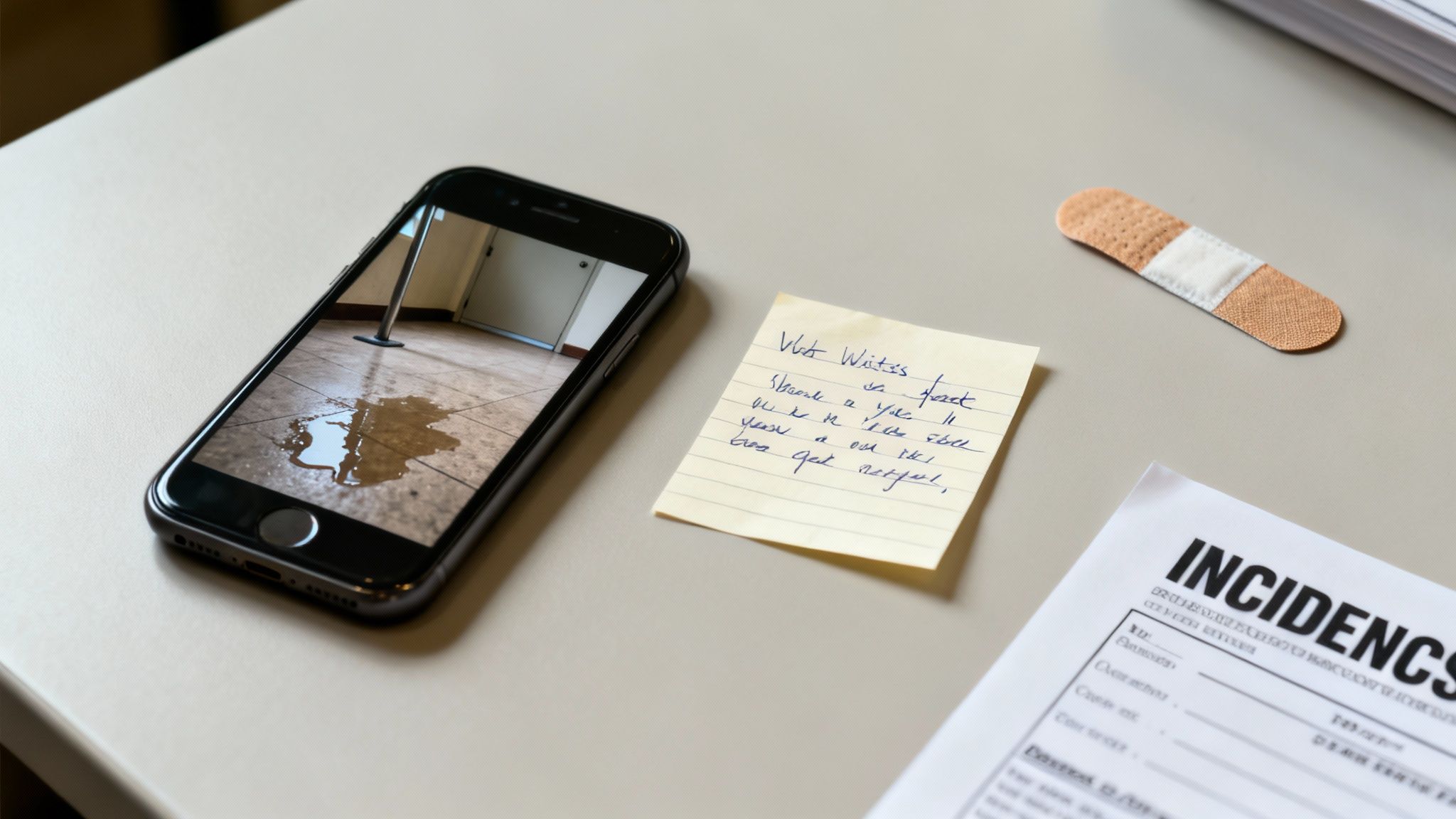
Photos & Videos | A picture is worth a thousand words. It captures the hazard exactly as it was. | Use your smartphone immediately. Take photos of the spill, obstacle, poor lighting, your injuries, and the surrounding area from multiple angles. |
Witness Information | Independent witnesses add credibility and can confirm your version of events. | Get names and phone numbers of anyone who saw you fall or saw the hazard before you fell. Don't rely on the business to do this for you. |
Incident Report | Creates an official, time-stamped record that the event happened. | Insist on filing a report with the manager or property owner before you leave. Ask for a copy for your records. |
Medical Records | This is the official link between the fall and your injuries. | See a doctor right away. Keep all bills, visit summaries, and follow all medical advice to show you're taking recovery seriously. |
The Shoes & Clothes You Wore | Your footwear can be used to counter claims that you were wearing inappropriate shoes. | Preserve the shoes and clothing you were wearing in a safe place. Do not wear or wash them. |
The stronger your collection of evidence, the more leverage you have in negotiations.
Navigating these factors takes real-world experience. If you're trying to get a fair settlement, you need an advocate on your side who knows how to build a powerful case from the ground up. In pain? Call Caine.
Navigating the Florida Slip and Fall Settlement Process
Figuring out what a slip and fall case is worth is one piece of the puzzle. Understanding the actual journey to get that compensation is another thing entirely. The settlement process isn't a one-time event; it’s a series of strategic moves, with each step building on the one before it.
Think of it like building a house. You need a solid foundation, a sturdy frame, and a strong roof to protect you. A legal case is no different. This roadmap will give you a clear idea of what to expect, from the moment you fall to the day your case is resolved.

The First Steps Are the Most Important
What you do in the minutes and hours right after a fall can seriously impact your case down the road. The priorities are simple: take care of yourself and document what happened.
Seek Immediate Medical Care: Your health is everything. Getting checked out by a doctor creates an official medical record connecting your injuries to the accident. This is non-negotiable evidence.
Report the Incident: Don't leave without notifying the property owner or manager. Insist they file an incident report, and make sure you get a copy before you go.
Once you’ve addressed your immediate health needs, the next move is to protect your legal rights. This is where you should consult with an attorney who knows personal injury law inside and out. They can start guiding you and building a powerful case right from the start.
Building Your Case and Kicking Off the Claim
After you bring an attorney on board, the real investigation begins. Your legal team will start gathering all the crucial evidence: photos of the hazardous area, statements from anyone who saw what happened, all of your medical records, and sometimes even opinions from safety experts. This is the material that forms the backbone of your claim.
Once the evidence is solid, your attorney will draft and send a formal demand letter to the insurance company for the at-fault property owner. This isn't just a simple ask for money. It's a comprehensive legal document that lays out the facts, proves why the owner was negligent, and details the settlement amount you are seeking based on all your damages.
This letter officially starts the negotiation process. The insurance company will almost always come back with a lowball counteroffer, and the back-and-forth begins.
While most settlements have a typical range, some cases with extreme negligence can lead to massive verdicts. A Los Angeles jury recently awarded a staggering $58,358,431 to a technician whose career was ended after a slip on ice. It just goes to show how high the stakes can get. You can read about this record-setting slip and fall verdict on Parris.com.
The Florida Statute of Limitations: A Critical Deadline
There’s a ticking clock on your right to file a claim, and it's one of the most important parts of this process. In Florida, there is a strict deadline called the statute of limitations. As of 2023, you now generally have only two years from the date of the fall to file a lawsuit.
If you miss that two-year window, you will almost certainly lose your right to seek compensation forever. It doesn't matter how strong your case is. This is exactly why it's so critical to contact a lawyer as soon as you can after an injury.
Most slip and fall cases are settled out of court during negotiations. But if the insurance company digs in its heels and refuses to offer a fair amount, your attorney will likely advise filing a lawsuit. This isn't a failure—it's a strategic move to force the other side to take your claim seriously and secure the full compensation you deserve.
If you've been hurt and are staring down this complicated process, you don't have to do it alone. Let our team handle the legal fight so you can focus on getting better. In pain? Call Caine.
Of course. Here is the rewritten section, crafted to sound human-written, natural, and expert-led, following the provided style guide.
What a High-Value Slip and Fall Case Actually Looks Like
It's one thing to talk about legal theories and calculations. It's another to see what they look like in the real world. Looking at actual slip and fall injury settlement amounts can show you just how powerful a case can be when clear negligence causes devastating, life-changing harm.
These stories aren't just about big numbers—they're about accountability. They’re a stark reminder of what happens when a property owner’s simple duty to keep people safe gets ignored, leading to catastrophic results for an innocent person.
From a Bright Future to a Life of Pain
Some of the biggest settlements come from incidents where the carelessness is just shocking. Take the case of a promising medical student at the University of Pennsylvania whose entire life was upended when she fell into an uncovered manhole on campus.
The fall left her with a broken back and severe spinal injuries, effectively erasing the medical career she had worked so hard for. A jury initially awarded her a jaw-dropping $85 million, which was later settled for $18 million.
In another case, a woman was just visiting a Virginia convenience store when she slipped, fell, and suffered a traumatic brain injury that left her with permanent seizures. That fall resulted in a $12.2 million settlement, a number that reflects the immense, lifelong impact on her health. You can read more about these notable slip and fall settlements on AskAdamsKutner.com. These cases show how a single moment of negligence can easily justify a multi-million dollar valuation.
The Anatomy of a Multi-Million Dollar Settlement
So, what’s the common thread in these high-value cases? It’s not a lottery. There are specific, powerful factors that consistently drive these outcomes.
If you look closely, you’ll see three key elements show up again and again:
Obvious, Extreme Negligence: We’re not talking about a small puddle. We’re talking about a glaring, dangerous hazard that was completely ignored. An open manhole isn't just a mistake; it's gross negligence that’s nearly impossible to defend.
Catastrophic, Permanent Injuries: The harm wasn't something the victim could just "walk off." These cases involve life-altering injuries—spinal cord damage, brain trauma, permanent disabilities—that demand a lifetime of medical care and destroy a person's ability to work and enjoy life.
Massive Future Damages: The settlement isn't just for the hospital bills already paid. It’s a careful calculation of all future medical needs, lost earning potential over a lifetime, and the profound, ongoing pain and suffering.
These cases all highlight a fundamental legal truth: the more preventable the accident was, and the more devastating the consequences are, the bigger the property owner's financial responsibility. The final number has to reflect the full story of the victim's loss—past, present, and future.
Looking at these real-world examples makes it crystal clear. Building a strong case is all about meticulously documenting both the property owner's failure and the true extent of the victim's suffering. The details matter. The evidence you gather is what turns a simple incident into a compelling case for maximum compensation.
If you’ve been seriously hurt because of someone else's carelessness, understanding what your claim could be worth is the first step toward getting justice. Our team knows how to analyze the unique facts of your case and fight for the settlement you truly deserve.
In pain? Call Caine.
How to Get the Compensation You Deserve
As we've covered, figuring out slip and fall injury settlement amounts is a complex business. Evidence is king, and having professional guidance in your corner is absolutely essential. Now, it's time to put that knowledge into action and protect your rights.
The single most important step you can take right now is to avoid speaking with insurance adjusters on your own. Their job is to protect their company's bottom line, which means minimizing your payout. They are highly trained to use your own words against you to devalue your claim.
Secure an Advocate for Your Case
While understanding the settlement process is a powerful first step, actually navigating it requires an experienced advocate who will fight for your best interests. A good attorney does more than just level the playing field—they make sure your story is heard and your losses are fully and professionally documented.
They will handle the back-and-forth negotiations, keep track of all the legal deadlines, and manage the mountain of complex paperwork. This frees you up to focus on the one thing that truly matters: your recovery.
Hiring the right legal partner is one of the most critical decisions you'll make. To help you feel confident in your choice, we put together a list of the 9 questions to ask your slip and fall attorney before hiring. It's a great resource to ensure you find the best possible fit for your specific case.
A fair settlement isn't just about covering today's medical bills; it's about securing your financial stability for the future. An experienced attorney builds a case that accounts for all potential long-term costs, from future surgeries to diminished earning capacity, ensuring you are made whole.
We invite you to schedule a free, no-obligation consultation to talk through the details of your case with our dedicated team. Let us review the facts, explain your legal options in plain English, and show you how we can fight for the maximum compensation you are entitled to.
In pain? Call Caine.
Frequently Asked Questions About Slip and Fall Claims
After a bad fall, it’s completely normal to have a million questions running through your head. The path forward can feel confusing. We’ve put together some clear, straightforward answers to the questions we hear most often from people in your exact situation.
How Long Do I Have to File a Slip and Fall Claim in Florida?
Florida has a strict deadline, legally known as the statute of limitations, for filing a personal injury lawsuit. This is one of the most critical parts of your case—if you miss this deadline, you could lose your right to recover any compensation at all.
That’s why you have to act quickly. Getting in touch with an attorney as soon as you can after an injury isn't just about getting a head start; it's about making sure crucial deadlines are met and that we can preserve important evidence before it vanishes.
Will I Have to Pay Taxes on My Settlement Money?
This is a great question, and an important one. The good news is that, for the most part, the portion of your settlement that covers your physical injuries and medical bills is not considered taxable income by the IRS.
Where it gets a little tricky is with other types of damages. If a specific part of your settlement is for lost wages, that portion is typically taxed as income. The same often applies to punitive damages, though those are pretty rare in slip and fall cases. An experienced attorney knows how to structure a settlement to help minimize your tax obligations down the road.
What if I Was Partially at Fault for the Fall?
Even if you think you might have been a little bit to blame, don't write off your case. Florida operates under a rule called “pure comparative negligence,” which is actually more forgiving than the laws in many other states. It simply means you can still get compensation even if you were partially responsible for the accident.
Here’s how it works: your final settlement is just reduced by whatever percentage of fault is assigned to you. For example, if a jury decides you were 20% at fault for a fall that led to a $100,000 award, your recovery would be reduced by $20,000, and you would receive $80,000. It doesn't stop you from having a valid claim.
The key takeaway here is to never assume you don't have a case just because you might share some of the blame. A good lawyer knows how to build a strong argument to minimize your percentage of fault and fight for the maximum compensation possible.
Does My Case Have to Go to Court?
It’s highly unlikely. The reality is that the overwhelming majority of personal injury cases—somewhere around 95%—are settled out of court through negotiation. Going to trial is an expensive, time-consuming, and unpredictable process for everyone involved, including the insurance company.
However, the secret to getting a great settlement offer is preparing the case as if it is going to trial. When the insurance company sees that your attorney is a skilled litigator who isn't afraid to fight for you in front of a jury, they suddenly become much more motivated to offer a full and fair settlement. It's all about leverage.
If you're trying to manage the pain and stress of a slip and fall injury, you don't have to figure it all out on your own. The team at CAINE LAW is here to guide you, answer your questions, and fight for the compensation you deserve. Find out how we can help at https://cainelegal.com.
In pain? Call Caine.
