
In Pain? Call Caine
What To Do After a Sideswiped Car Accident

5 Min read
By: Caine Law
Share
The moments after a sideswiped car accident are a blur. It's confusing, chaotic, and your adrenaline is pumping. But what you do in these critical first few minutes can make a world of difference. Your top priority is always safety, but right after that comes a methodical approach to gathering the facts. Having a clear plan helps you protect yourself and build a strong foundation for your insurance claim.
What to Do Immediately After a Sideswipe Collision
When you've just been hit, it's easy to feel overwhelmed. The key is to stay as calm as possible and follow a process. The steps you take on the scene have a direct impact on how your case will unfold later.
First things first: check for injuries. Then, if your car is drivable, carefully move it to the shoulder or a safe spot off the road. You don't want to risk another collision. Flip on your hazard lights right away to warn other drivers.
Prioritize Safety and Legal Duties
Once you’re out of harm's way, do a quick check on yourself and anyone else in the car. If there are any injuries—even if they seem minor—call 911 immediately. You need to get medical help on the way and have the police come to the scene. It's crucial to get checked out by a professional, as the shock of a crash can mask pain, and some injuries only show up hours or days later.
In Florida, the law is clear. You are required to report any accident involving injuries, a death, or property damage that looks like it's over $500. A police report provides an official, unbiased account of what happened, and it’s one of the most important documents you'll need for your insurance claim.
This infographic breaks down the essential post-accident process into three simple steps.
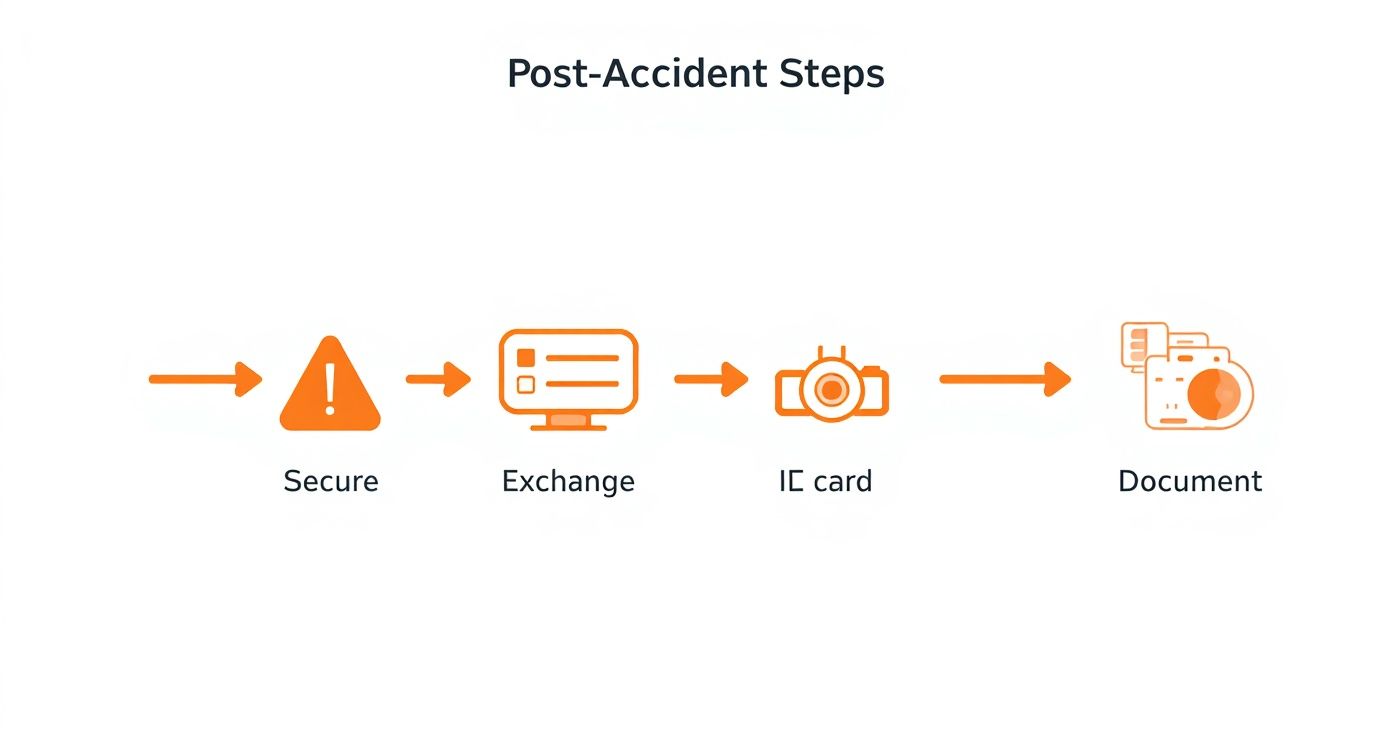
Think of it as your roadmap for the first few moments: secure the scene, swap information, and document everything.
Gather Critical Information and Evidence
While you're waiting for the police, it's time to become a detective. Use your smartphone to take as many pictures and videos as you can. Get shots of the damage to both cars from different angles. Then, zoom out and capture the whole scene. You'll want photos of:
Skid marks on the road
Nearby traffic lights and signs
The weather and road conditions at the time
Any visible injuries
Next, you'll need to exchange information with the other driver. It’s important to stick to the facts here. Don't get into a debate about who's at fault, and never apologize. Just calmly collect the essentials:
Their full name and contact information (phone number and address)
Their insurance company and policy number
Their driver’s license and license plate numbers
If anyone saw the accident happen, ask them if they'd be willing to be a witness. Get their name and phone number. An independent account of the sideswipe can be incredibly powerful evidence. If you want a deeper dive, you can learn more about essential steps and legal guidance after an accident in our full guide.
Remember: The evidence you collect at the scene is the raw material for building your insurance claim. Thorough documentation—from photos of paint transfer to the other driver's insurance card—paints a clear picture of what happened and who is responsible.
Taking these steps helps you navigate the initial shock with a clear head, protecting your rights right from the start.
In the immediate aftermath of a crash, it's crucial to know what to document. This quick checklist can help you stay focused when you're feeling stressed and unsure what to do next.
At-the-Scene Sideswipe Accident Checklist
Action Item | Why It's Important | Details to Note |
|---|---|---|
Call 911 | Creates an official police report and requests medical aid. | Operator's name, responding officer's name and badge number, report number. |
Take Photos/Videos | Visual evidence is hard to dispute. | Damage to both cars, license plates, skid marks, road signs, weather conditions. |
Exchange Information | Needed to file an insurance claim. | Driver's name, contact info, insurance company, policy number, driver's license number. |
Talk to Witnesses | Provides an unbiased third-party perspective. | Witness names and phone numbers. Note down what they say they saw. |
Do Not Admit Fault | Statements can be used against you later. | Stick to the facts. Avoid saying "I'm sorry" or "It was my fault." |
Seek Medical Attention | Documents injuries and protects your health. | Note the date, doctor's name, and keep all medical records and receipts. |
Following this checklist ensures you don't miss a critical piece of information that could be vital for your case down the road.
If you're hurt and unsure what to do next, expert help is available. In pain? Call Caine.
How Do Sideswipe Accidents Actually Happen?
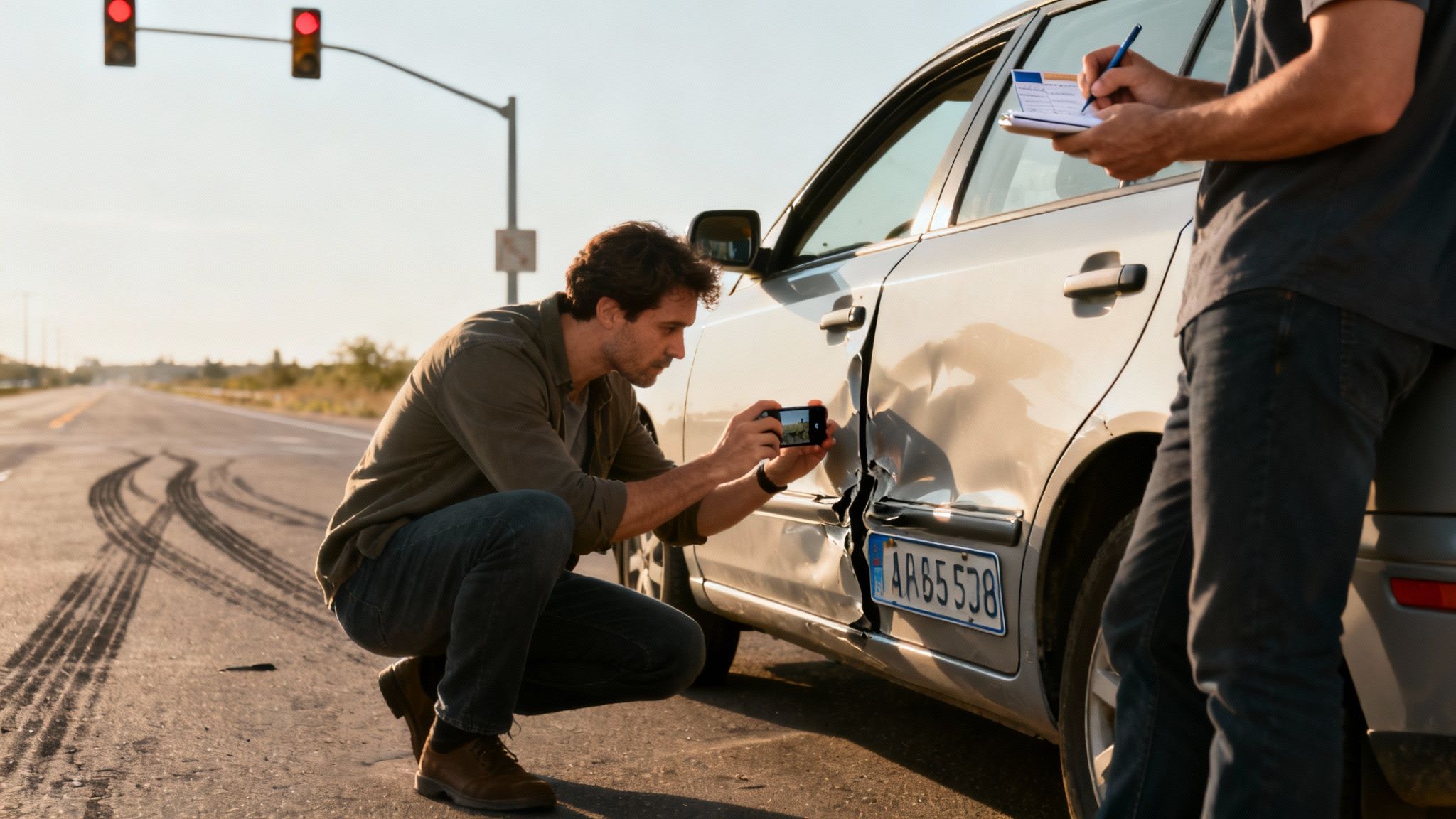
A sideswipe car accident is what happens when two vehicles moving alongside each other make contact. Unlike a head-on or rear-end collision, the impact happens along the parallel sides of the cars. It’s a glancing blow, but that doesn't mean it isn't dangerous—the consequences can be devastating.
Think of it like two boats passing too close in a narrow channel. Even a small miscalculation can cause them to scrape against one another, damaging both hulls and potentially throwing everyone off balance. The same idea applies on the road, where a single moment of inattention can lead to a violent and totally unexpected collision.
Figuring out the dynamics of your accident is the first step toward determining who is legally responsible. The angle of the impact, where the damage is on each car, and the flow of traffic all tell a story about what went wrong.
The Two Main Flavors of Sideswipe Collisions
Not all sideswipes are created equal. They generally fall into one of two categories, and each one comes with its own common causes and unique risks.
Same-Direction Sideswipe: This is the one we see most often. It happens when two cars are driving in the same direction, and one vehicle drifts, merges, or changes lanes right into the other. You see this constantly on multi-lane highways or busy city streets where drivers are always jockeying for position.
Opposite-Direction Sideswipe: These are less common, but they're often far more severe. This type of crash happens on two-lane roads when a driver crosses the center line and scrapes against a vehicle traveling in the opposite direction. The combined speed of both cars can create a truly catastrophic impact.
Recognizing which type of collision occurred is fundamental for accident reconstruction and proving who was at fault.
A sideswipe is more than just a fender bender. The initial impact can easily cause a driver to overcorrect or lose control, turning a scraping collision into a multi-car pileup or a rollover accident in a split second.
The Everyday Mistakes That Cause Sideswipe Crashes
Most sideswipe incidents aren't just random acts of bad luck. They’re almost always the direct result of a driver's preventable mistake. Negligence is usually at the heart of it, often stemming from a handful of all-too-common dangerous driving habits.
Failure to Check Blind Spots: This is the number one culprit, without a doubt. A driver glances in their mirrors but doesn't turn their head to check that "no-zone" where another car can easily hide. The result? A collision during a routine lane change.
Distracted Driving: Texting, messing with the radio, or getting deep into a conversation with a passenger pulls a driver's focus from the road. In just a few seconds, a car can easily drift out of its lane and into another vehicle's path.
Aggressive Maneuvering: Weaving through traffic, speeding, or making sudden lane changes dramatically increases the risk. Impatient drivers often don't leave enough space, completely misjudging the speed and position of the cars around them.
Driving Under the Influence: Alcohol or drugs wreck a driver's judgment, coordination, and ability to stay in a single lane. A sideswipe becomes almost inevitable.
Driver Fatigue: A tired driver can be just as dangerous as an impaired one. Drowsiness can lead to "microsleeps," causing a vehicle to drift into oncoming traffic or an adjacent lane without any warning.
When another driver's mistake leaves you injured and your car in the shop, you need someone ready to fight for you. In pain? Call Caine.
How Fault Is Determined Under Florida Law
After a sideswiped car accident, one of the first questions that pops into everyone's head is: who’s at fault? While it might seem obvious in the heat of the moment, Florida law sees things a bit differently. It’s rarely a simple case of one driver being 100% right and the other being 100% wrong.
The state uses a legal framework that can seriously affect your ability to get compensation. It’s built on the idea that sometimes, more than one person’s actions lead to a crash. Getting a handle on how this works is a must for anyone involved in a sideswipe collision here in Florida.
Florida’s Comparative Negligence Rule Explained
Florida operates under a modified comparative negligence system to assign fault. The easiest way to think about it is like a pie chart of responsibility. The total blame for the crash is 100%, and investigators—from the police on the scene to the insurance adjusters—will slice up that pie, assigning a percentage to each driver based on what they did or didn't do.
This rule means you can still get paid for your damages even if you were partly to blame. But there's a huge catch: you cannot be found more than 50% at fault. If your share of the blame hits 51% or higher, you're completely barred from recovering a dime from the other driver.
Let’s play this out. Imagine another car makes a reckless lane change and sideswipes you. But, at the time, you were going 15 mph over the speed limit. An adjuster might look at that and say the other driver is 80% at fault for the bad merge, but you’re 20% at fault because speeding made it harder for you to react.
That 20% directly cuts into your settlement. If your total damages—medical bills, lost pay, car repairs—add up to $50,000, your share of the fault will reduce your payout by $10,000. You’d walk away with $40,000.
How Investigators Piece Together the Puzzle
Figuring out those percentages isn't a random guess. It's a detailed investigation, like putting together a puzzle to see exactly what happened in the moments before the impact. Several key pieces of evidence are used to build that picture.
Here's what they look at:
The Police Report: While it might not be admissible in court, the officer's report is the first official take. It provides a neutral assessment of the scene, diagrams of the crash, and often a preliminary opinion on who did what.
Witness Statements: Independent witnesses are gold. Someone who saw the whole thing unfold can give a powerful, unbiased account of which driver drifted or forgot to signal. Their story can be incredibly convincing.
Vehicle Damage: The cars themselves tell a story. The location and severity of scrapes, paint transfer, and dents help accident reconstruction experts figure out the angle of impact and the forces involved.
Traffic Camera and Dashcam Footage: Video is the ultimate truth-teller. A clear recording of the sideswiped car accident can end the "he said, she said" debate instantly.
In a sideswipe case, it almost always boils down to one question: which driver left their lane? Evidence that proves one car drifted, merged without looking, or failed to check a blind spot is what you need to pin a higher percentage of fault on them.
The insurance company will use all this evidence to make its first call on who’s to blame. But their decision is not the final word. An experienced attorney can launch their own investigation to push back against an unfair fault assessment and fight to protect your right to full and fair compensation.
If you’re in a dispute over who caused your accident, don't just accept what the insurance company says. In pain? Call Caine.
Common Injuries and Damages from Sideswipes
The word "sideswipe" can be misleading. It sounds almost minor, like a glancing blow. But the reality for anyone who’s been in a sideswiped car accident is anything but minor. Even at lower speeds, the violent, sideways shove from another vehicle can inflict serious physical harm and lead to staggering repair bills. The true cost isn't just on the mechanic's invoice; it's measured in the long, painful road to recovery.
What makes these crashes so dangerous is the element of surprise. You’re driving along, and suddenly, your world is thrown sideways. There’s no time to brace for impact. For the person sitting closest to the point of collision, the results can be devastating as their body is slammed against the door, window, or car frame.
The Physical Toll of a Sideswipe Impact
Unlike a simple fender bender, a sideswipe transfers a shocking amount of force directly into the passenger cabin. This abrupt, lateral jolt triggers a cascade of injuries, and because of the adrenaline pumping through your system, you might not even feel some of them right away.
Common physical injuries include:
Whiplash and Soft Tissue Damage: Your head and neck snap violently to the side, straining muscles and tearing ligaments. This is classic whiplash, and it can leave you with chronic neck pain, stiffness, and headaches that just won't go away.
Head and Brain Injuries: It’s all too easy for an occupant's head to hit the side window or the B-pillar of the car. This can cause anything from a concussion to a more severe traumatic brain injury (TBI), with consequences ranging from temporary brain fog to long-term cognitive problems.
Shoulder, Arm, and Leg Injuries: The person on the side of the impact takes a direct hit. We see fractures, deep bruises, and serious joint damage to the shoulder, elbow, hip, or knee all the time.
Spinal Cord Injuries: In higher-speed sideswipes, the twisting motion of the crash can damage the vertebrae or the spinal cord itself, which can tragically lead to partial or even full paralysis.
These accidents are more dangerous than many people think. The data shows that sideswipe accidents are responsible for about 2.7% of all fatal crashes each year. That translates to roughly 2,500 deaths and 27,000 injuries annually in the U.S. alone. You can find more information about these statistics and injury types from recent studies.
Understanding the Full Scope of Your Damages
After getting hurt in a sideswipe, the financial stress can pile up fast. Under Florida law, you have the right to seek compensation for every single loss you've suffered. We call these "damages," and they are generally broken down into two crucial categories.
It's essential to track every single expense and document every way the accident has affected your life from day one. What seems like a small cost today can become part of a much larger financial burden over time.
This meticulous record-keeping is the bedrock of a strong claim for fair compensation.
Economic and Non-Economic Damages
Think of damages as covering two things: the bills you can stack up and the losses you can't put a price on. Both are equally important in calculating what your claim is truly worth.
Economic Damages: These are the tangible, out-of-pocket financial losses. You'll have receipts and invoices for these, and they are designed to make you financially "whole" again.
Medical Expenses: This covers it all—from the ambulance ride and ER visit to ongoing physical therapy, prescriptions, and any future surgeries you might need.
Lost Wages: Compensation for the paychecks you missed while you were out of work and recovering.
Loss of Earning Capacity: If your injuries mean you can't go back to your old job or earn what you used to, you can be compensated for that future loss of income.
Property Damage: This is the cost to either repair your vehicle or replace it, plus reimbursement for any personal items destroyed in the crash.
Non-Economic Damages: These are the intangible losses. There’s no bill for them, but they have a massive impact on your quality of life.
Pain and Suffering: This is compensation for the physical pain, ongoing discomfort, and emotional distress your injuries have caused.
Mental Anguish: This addresses the very real trauma that follows a crash, including anxiety, depression, fear of driving, or post-traumatic stress disorder (PTSD).
Loss of Enjoyment of Life: If your injuries prevent you from coaching your kid's soccer team, going for your morning run, or enjoying hobbies you once loved, you deserve to be compensated for that loss.
Figuring out the true value of all these damages is incredibly complex. An experienced attorney can help you identify and calculate the full extent of your personal injury claim to make sure nothing gets overlooked. If you've been hurt, don't try to face the insurance companies by yourself. In pain? Call Caine.
Navigating the Insurance Claim Investigation

Once you've filed a claim for your sideswiped car accident, you've entered a whole new phase of the process. The insurance company now kicks off its own investigation, and it’s critical to understand that this process isn't designed to help you.
Think of their adjuster less as an advocate and more as a gatekeeper. Their primary role is to protect the company's financial interests by scrutinizing your claim and finding ways to minimize the final payout.
The adjuster’s work is methodical. They’ll take all the evidence you gathered at the scene, pull the official police report, and start building their own narrative of what happened. This internal investigation becomes the foundation for every decision they make about fault and how much your claim is worth.
How Adjusters Build Their Case
The insurance adjuster essentially plays detective, but they're a detective on the other side's payroll. Their job is to sift through every document and statement, hunting for any inconsistencies or bits of information that can be used to drive down the value of your claim. Ultimately, their goal is to close your file as quickly and cheaply as possible.
To get there, they rely on a few key sources:
The Police Report: This is almost always their first stop. The officer's summary, diagrams, and any tickets issued give them an initial framework for assigning blame.
Driver and Witness Statements: They will meticulously compare your story with the other driver's account and what any witnesses had to say, looking for contradictions or admissions of fault.
Vehicle Damage Photos: The location and severity of the damage on both cars help them piece together the impact. Things like paint transfer, scrapes, and dents can either confirm or poke holes in your version of events.
Medical Records: The adjuster will ask you to sign a release for your medical records to "verify" your injuries. What they're really doing is digging for pre-existing conditions or anything else they can use to argue your injuries weren't caused by the crash.
This collection of evidence forms their internal case file, which dictates every negotiation tactic and settlement offer that comes next.
Common Tactics Used to Minimize Your Payout
Insurance companies are for-profit businesses, and their adjusters are highly trained negotiators. They have a playbook of tactics designed to convince you to accept less money than you rightfully deserve.
One of the most common is the quick, lowball offer. Don't be surprised if an adjuster calls you soon after the accident, sounding incredibly concerned and sympathetic, before offering a check to "help you put this all behind you." This is a calculated move. The offer is almost always a fraction of your claim's true value, made before you even know the full extent of your injuries or future medical needs.
A fast settlement offer is rarely a fair one. It's a calculated move to close your claim before you understand its true worth, effectively trading a small, immediate payment for your right to full and just compensation down the road.
Another go-to tactic is questioning the seriousness of your injuries. The adjuster might subtly suggest that your pain is from an old issue or that you're exaggerating your symptoms. This is precisely why they push so hard to get a recorded statement from you.
During a recorded statement, they ask carefully worded, leading questions designed to trap you. A simple, polite answer like "I'm doing okay" can be twisted later to imply you aren't really hurt. It's vital to be extremely careful with your words. You can learn more about handling these tactics and what to do when facing insurance disputes in our detailed guide.
Protecting Yourself During the Claims Process
Getting through this process successfully requires a smart, strategic approach. Everything you say and do can—and will—be used to affect the outcome. Your best defense is to be prepared and deliberate in every interaction.
Here are a few essential tips for dealing with the other driver's insurance adjuster:
Stick to the Facts: When you speak with them, provide only the basic, factual details: date, time, location, and the vehicles involved. Never offer opinions, apologize, or guess about who was at fault.
Decline a Recorded Statement: You are under no legal obligation to give a recorded statement to the other driver’s insurance company. You can politely refuse until you've spoken with an attorney.
Keep Records of Everything: Document every phone call—note the date, time, adjuster's name, and a summary of the conversation. Keep copies of every email and letter.
Never Sign Anything Without Review: Don’t sign medical releases or settlement agreements without having a lawyer look them over first. These documents often contain fine print that can sign away your rights.
Trying to take on a trained insurance adjuster by yourself is an uphill battle. They handle cases like yours all day, every day. If you feel like you're being pressured, dismissed, or lowballed, that's a clear sign it's time to get a professional in your corner.
In pain? Call Caine.
The Value of an Experienced Car accident Attorney
Trying to handle the aftermath of a sideswiped car accident is overwhelming, and you shouldn't have to go it alone. While you're focused on healing, the other driver's insurance company is already working hard to protect its own bottom line. Hiring an experienced personal injury attorney isn't just about getting a lawyer; it's about leveling the playing field.
From day one, your attorney becomes your dedicated advocate. They immediately take over all communication with the insurance companies. This simple step is huge—it keeps you from falling into common traps, like giving a recorded statement that can be twisted against you or accepting a quick, lowball settlement offer before you even know the full extent of your injuries.
Beyond the Basics: An Attorney’s Strategic Contributions
A skilled lawyer does a lot more than just file paperwork. They launch their own comprehensive, independent investigation into your accident, completely separate from what the police or insurers have done. This proactive approach is all about building the strongest possible case for you.
This investigation often involves:
Consulting with Experts: Your attorney might bring in accident reconstruction specialists who can analyze the vehicle damage, road debris, and impact points to prove exactly how the sideswipe happened and who was really at fault.
Calculating Full Damages: An attorney works with medical and financial experts to get an accurate picture of what your claim is truly worth. This isn't just about current medical bills and lost paychecks. It includes future medical needs, a diminished capacity to earn a living, and the very real impact of your pain and suffering.
By meticulously building your case with solid evidence and expert testimony, an attorney shifts the negotiating power back to you. They transform your claim from a simple request into a well-supported demand for full and fair compensation.
They know the tactics insurers use to undervalue claims and are ready to shut them down at every turn, making sure your rights are fiercely protected.
If you are facing a difficult recovery, you need a professional to handle the legal fight. In pain? Call Caine.
Frequently Asked Questions About Florida Sideswipe Accidents
After a sideswiped car accident, it’s completely normal to have a ton of questions. The maze of insurance claims and legal rules can feel overwhelming, but getting clear, straight answers is the first step toward making smart decisions for your future. This section tackles some of the most common worries we hear from Florida drivers just like you.
Our goal here is to give you immediate, practical information so you can understand your rights and the hurdles you might face while moving forward.
What If the Other Driver Was Uninsured or Fled the Scene?
This is a nightmare scenario for any driver. If a hit-and-run driver caused your crash or you find out the at-fault driver has no insurance, your main path to recovery is your own Uninsured/Underinsured Motorist (UM/UIM) coverage. This is an optional, but absolutely essential, part of your car insurance policy.
It's critical to file a police report right away after a hit-and-run. Give the officers every single detail you can recall about the other vehicle. You also need to notify your own insurance company quickly, but it's a very good idea to talk to an attorney before giving them a recorded statement. This ensures your own rights under your policy are fully protected.
How Long Do I Have to File a Claim in Florida?
Florida has a very strict deadline, known as the statute of limitations, for taking legal action. For most personal injury lawsuits from a car accident, you now have two years from the date of the crash to file. This updated deadline applies to any crash that happened on or after March 24, 2023.
Two years might sound like a long time, but it disappears in a flash. Evidence gets lost, witnesses move away, and memories fade. Getting in touch with an attorney long before this deadline is crucial for preserving the proof needed to build the strongest possible case for your recovery.
Waiting too long is one of the worst mistakes you can make. Once the statute of limitations expires, your right to seek compensation through the courts is gone for good, no matter how severe your injuries are.
Can I Still Get Compensation If I Was Partially at Fault?
Yes, in many situations, you can. As we talked about earlier, Florida’s comparative negligence rule lets you recover damages as long as you are not found to be more than 50% at fault for the collision.
However, your final compensation will be reduced by whatever percentage of fault is assigned to you. For instance, if you're found 20% responsible for the sideswipe, a $100,000 award would be cut down to $80,000. An experienced attorney will fight to make sure fault is assigned fairly and that the insurance company doesn't unfairly inflate your role in the accident.
What Should I Do When the Other Driver’s Insurance Calls Me?
You need to be extremely careful. The other driver’s insurance adjuster is not on your team. Their job is to protect their company's bottom line by minimizing your claim or denying it altogether. You should politely refuse to give a recorded statement or sign any papers until you've spoken with a lawyer.
All you need to do is get their name and contact info and let them know that your attorney will be in touch. This simple step protects you from accidentally saying something that could be twisted and used against you later on.
At CAINE LAW, we know the tactics insurers use and we're ready to fight for the full compensation you deserve. If you're struggling with the painful aftermath of a sideswipe accident, you don't have to go through it alone. In pain? Call Caine. Contact us today for a free consultation at https://cainelegal.com.
