In Pain? Call Caine
Should I Hire an Auto Injury Lawyer for a Car Accident in Miami?

5 Min read
By: Caine Law
Share
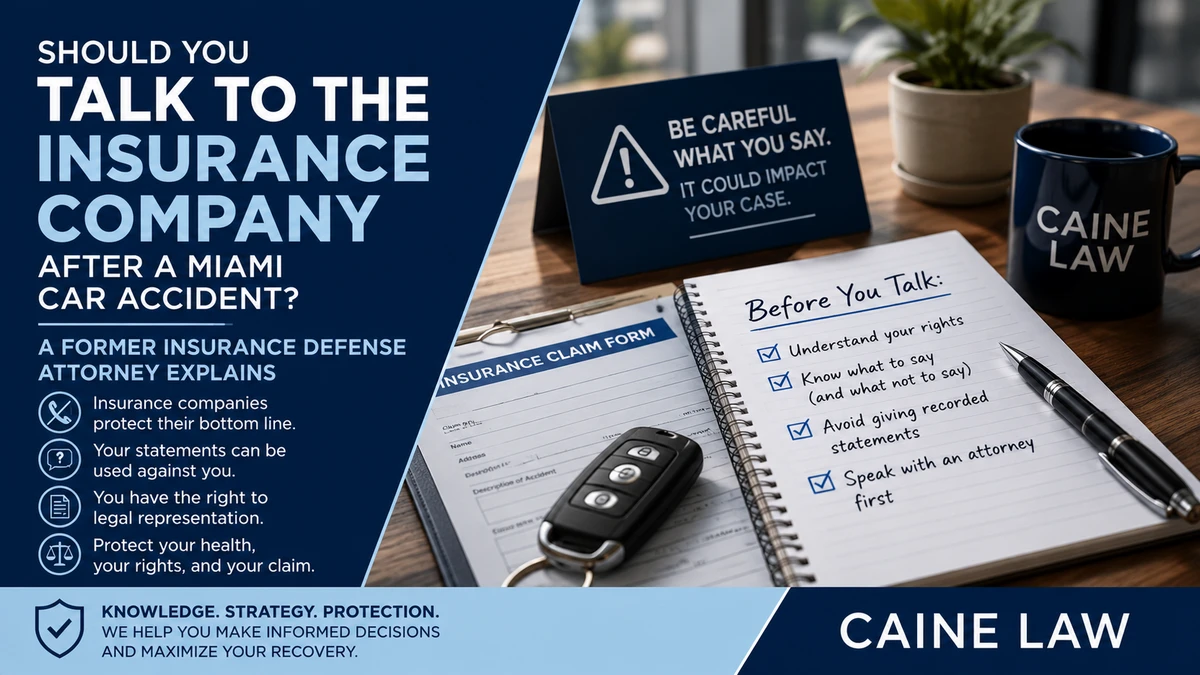
Quick Answer
If you were injured in a car accident in Miami, speaking with an auto injury lawyer as soon as possible can help protect your legal rights and prevent costly mistakes. While not every collision requires an attorney, accidents involving injuries, disputed fault, uninsured drivers, or insurance settlement offers often benefit from experienced legal guidance before important decisions are made.
Key Takeaways
Not every car accident needs a lawyer, but every injury claim deserves a professional evaluation.
Insurance companies often begin investigating your claim within hours of a crash.
Early legal guidance helps preserve evidence and protect your ability to recover compensation.
Daniel Caine’s experience representing insurance companies provides valuable insight into how claims are evaluated and negotiated.
A free consultation allows you to understand your options before accepting a settlement or providing a recorded statement.
Table of Contents
Do You Need a Lawyer After Every Car Accident?
When Should You Hire a Lawyer After a Car Accident?
What Does a Personal Injury Lawyer Actually Do?
How Insurance Companies Evaluate Car Accident Claims
Common Mistakes That Can Reduce Your Compensation
What Compensation May Be Available?
What Happens During a Free Consultation?
Frequently Asked Questions
Schedule Your Free Consultation
A serious car accident can change your life in an instant. One moment you are driving through Miami or commuting across Miami-Dade County. The next, you are dealing with injuries, medical appointments, insurance adjusters, vehicle repairs, and uncertainty about what comes next.
One of the first questions many people ask after getting in a car accident in Miami is whether they should hire an auto injury lawyer.
The answer depends on the circumstances of the collision. A minor crash with no injuries may be resolved through the insurance process without legal representation. An accident involving significant injuries, disputed liability, uninsured drivers, or long-term medical treatment presents a very different situation.
Many people underestimate how quickly a claim begins taking shape. Insurance companies often start investigating within hours of a motor vehicle accident. At the same time, injuries that initially seem minor may become more serious over the following days or weeks.
Understanding when legal representation provides value begins with understanding how the claims process works and what is at stake before you accept a settlement or make statements that could affect your case.
Do You Need a Lawyer After Every Car Accident?
No. You do not need a lawyer after every car accident. However, you should understand your legal rights before deciding to handle an injury claim on your own.
A low-speed collision with minor vehicle damage and no injuries is very different from a crash involving emergency medical treatment, ongoing pain, surgery, or time away from work. The challenge is that you often cannot accurately judge the seriousness of your injuries immediately after an accident.
Soft tissue injuries, neck injuries, back injuries, and traumatic brain injuries frequently become more apparent after the initial adrenaline has worn off. What feels like soreness today may require weeks or months of treatment.
At the same time, insurance companies are collecting evidence and evaluating liability. They review police reports, inspect vehicle damage, interview witnesses, and analyze medical records while determining how they intend to handle your claim.
Before deciding whether you need legal representation through an auto injury lawyer in Miami, ask yourself these questions.
Did I receive medical treatment after the accident?
Am I still experiencing pain or limited mobility?
Has the insurance company questioned who caused the collision?
Was an uninsured or underinsured driver involved?
Did the accident involve multiple vehicles?
Was a commercial truck, delivery vehicle, or rideshare driver involved?
Have I missed work because of my injuries?
Has an insurance adjuster asked me to provide a recorded statement?
Have I already received a settlement offer?
If you answered yes to any of these questions, speaking with an experienced personal injury lawyer can help you understand your options before making decisions that may affect your ability to recover compensation.
Most importantly, an initial consultation with an auto injury lawyer after a car accident in Miami allows you to receive legal guidance based on the specific facts of your case rather than relying on assumptions or general information found online.
When Should You Hire a Lawyer After a Car Accident?
You should contact a lawyer as soon as possible after any collision involving injuries, disputed fault, significant property damage, or questions about insurance coverage.
Early legal representation protects evidence, manages communication with insurance companies, and allows your attorney to begin building your case while you focus on your recovery.
The situations below often indicate that speaking with an auto injury lawyer after an accident in Miami should become a priority.
You Required Medical Treatment
Emergency room visits, surgery, diagnostic imaging, hospitalization, physical therapy, or ongoing medical care usually indicate a more complex injury claim.
Medical records not only document your injuries but also help establish the relationship between the collision and the treatment you received.
Fault Is Being Disputed
If the other driver disputes responsibility or the insurance company questions how the crash occurred, additional evidence may be needed to establish liability.
That evidence may include surveillance video, witness statements, vehicle damage analysis, photographs, electronic vehicle data, and expert accident reconstruction.
The Insurance Company Contacts You Immediately
Many people are surprised to receive a phone call from an insurance adjuster within a day or two of a collision.
While adjusters may appear helpful, their job is to evaluate the claim on behalf of the insurance company. Information gathered during these early conversations may later influence how your claim is valued.
Understanding your legal rights before providing detailed statements allows you to make informed decisions about your case.
You Receive a Quick Settlement Offer
An early settlement offer may seem attractive when medical bills are arriving and income has been interrupted.
However, accepting compensation before your medical condition is fully understood can create significant financial consequences. Future treatment, rehabilitation, reduced earning capacity, and long-term pain may not yet be reflected in the offer.
Before accepting any settlement, it is important to understand the full impact your injuries may have on your health, finances, and future.
What Does a Personal Injury Lawyer Actually Do?
Calling a lawyer after a car accident in Miami protects your legal interests while allowing you to focus on your recovery.
From the moment representation begins, your attorney manages communication with insurance companies, gathers evidence, documents damages, negotiates settlement offers, and prepares the case for litigation if a fair resolution cannot be reached.
At Caine Legal, every case begins with a thorough investigation of how the collision occurred, the injuries sustained, and the evidence needed to support your claim.
That process includes:
Reviewing the police crash report.
Obtaining medical records and billing records.
Interviewing witnesses.
Preserving photographs and video evidence.
Requesting available surveillance footage.
Evaluating current and future financial losses.
Managing communication with insurance companies.
Negotiating settlement offers.
Preparing every case for trial if necessary.
Many personal injury claims settle before trial. Successful settlements, however, often result from thorough preparation. Insurance companies recognize when an attorney is prepared to present a case before a jury, and that preparation frequently strengthens the firm’s negotiating position long before a courtroom becomes necessary.
How Insurance Companies Evaluate Car Accident Claims
Insurance companies begin evaluating your claim almost immediately after a collision. Understanding how that process works helps you make better decisions and avoid mistakes that could reduce the value of your case.
Many people believe the insurance company is simply trying to determine who caused the accident. In reality, adjusters are also evaluating the company’s financial exposure. They collect information, assess liability, review your injuries, and determine how much they believe the claim should cost to resolve.
That process often begins before you have completed medical treatment or understand the full extent of your injuries.
Insurance adjusters commonly review:
The police crash report.
Photographs and videos from the accident scene.
Vehicle damage.
Medical records.
Medical bills.
Witness statements.
Recorded statements.
Dash camera or surveillance footage.
Employment records documenting lost income.
Prior claims or injury history.
Every document, photograph, and conversation becomes part of the claim file.
One of Daniel Caine’s greatest strengths as a Miami-based auto injury lawyer is his experience on both sides of the legal system. Early in his career, he represented insurance companies, learning how claims are investigated, evaluated, negotiated, and defended. Today, he uses that knowledge to protect injured people instead of insurance carriers.
That perspective allows him to anticipate the strategies insurers may use, identify weaknesses in their position, and build stronger claims for his clients.
Understanding how the insurance company evaluates your case allows you to make informed decisions instead of reacting to the insurer’s timeline.
Common Mistakes That Can Reduce Your Compensation
The actions you take during the days and weeks after a collision can significantly affect your claim. Many people unintentionally make decisions that create unnecessary challenges later in the process.
The following mistakes are among the most common.
Waiting to Seek Medical Care
Prompt medical treatment protects both your health and your legal claim.
Some injuries, including whiplash, spinal injuries, and traumatic brain injuries, do not always produce immediate symptoms. Waiting several days before seeing a physician allows the insurance company to argue that your injuries were unrelated to the collision or were not serious enough to require immediate treatment.
Following your physician’s recommendations and attending scheduled appointments also creates a clear record of your recovery.
Giving a Recorded Statement Too Soon
Insurance adjusters often request a recorded statement within days of a collision.
While the conversation may seem routine, the questions are designed to gather information about the accident, your injuries, and your activities after the crash.
You may not yet know the full extent of your injuries or remember every detail accurately. Small inconsistencies between an early recorded statement and later medical records can become points of dispute.
Understanding your legal rights before providing a recorded statement can help you avoid unnecessary complications.
Accepting the First Settlement Offer
A quick settlement offer rarely reflects the full value of a serious injury claim.
Medical treatment often continues long after the initial offer is made. Future surgery, rehabilitation, ongoing pain, lost earning capacity, and other long-term consequences may not yet be known.
Once a settlement agreement is signed, you generally cannot reopen the claim if your condition worsens.
Before accepting any offer, make sure you understand both your current losses and the long-term impact of your injuries.
Posting About the Collision on Social Media
Insurance companies routinely review publicly available social media accounts during the claims process.
Photographs, videos, comments, and location check-ins can all become evidence. Even an innocent post taken out of context may be used to question the seriousness of your injuries.
Until your claim is resolved, it is generally best to avoid discussing the accident or your recovery on social media.
Waiting Too Long to Speak With a Lawyer
Evidence does not remain available forever.
Traffic camera footage may be deleted. Witnesses become harder to locate. Memories fade. Physical evidence disappears.
After a severe crash in Miami, speaking with an auto injury lawyer early gives your legal team the opportunity to preserve important evidence before it is lost and begin building the strongest possible case from the start.
What Compensation May Be Available?
If another person’s negligence caused your injuries, Florida law may allow you to recover compensation for both the financial losses you have experienced and the personal impact the collision has had on your life.
Every claim is unique. The amount of compensation depends on the severity of your injuries, the available evidence, insurance coverage, and the long-term effects of the accident.
Compensation may include the following.
Medical Expenses
Medical damages may include emergency transportation, emergency room treatment, hospitalization, surgery, physician visits, diagnostic imaging, prescription medications, physical therapy, rehabilitation, and anticipated future medical care related to your injuries.
Lost Income
If your injuries prevented you from working, you may be entitled to recover lost wages.
If your injuries permanently affect your ability to earn a living, compensation may also be available for diminished earning capacity.
Property Damage
You may be entitled to recover the reasonable cost to repair or replace your vehicle, along with towing charges, rental vehicle expenses, and other accident-related property losses.
Pain and Suffering
Some of the most significant losses cannot be measured by receipts or invoices.
Depending on the circumstances of your case, compensation may also be available for physical pain, emotional distress, mental anguish, loss of enjoyment of life, and the lasting effects your injuries have on your daily activities and relationships.
Wrongful Death Damages
When a family loses a loved one because of another person’s negligence, Florida law may allow eligible surviving family members to pursue compensation through a wrongful death claim.
These cases often involve complex legal and financial issues. Early legal guidance helps families understand their rights while allowing them to focus on their loved ones during an incredibly difficult time.
Determining the value of a personal injury claim requires much more than adding medical bills together. A thorough evaluation considers both your current losses and the ways your injuries may continue to affect your health, career, finances, and quality of life for years to come.
What Happens During a Free Consultation?
A free consultation, with an auto injury attorney in Miami after a car accident, gives you the opportunity to understand your legal rights before making decisions that could affect your claim.
During the meeting, Daniel Caine reviews how the collision occurred, the injuries you sustained, the medical treatment you have received, the available insurance coverage, and the legal issues that may influence your case.
You should expect to discuss:
How the collision occurred.
The injuries you sustained.
Medical treatment received to date.
Insurance companies involved in the claim.
Evidence currently available.
Questions about the claims process.
Whether legal representation is appropriate.
The consultation is also an opportunity for you to evaluate the attorney who may represent you. You can ask questions, discuss concerns, and gain a better understanding of what the legal process may involve.
There is no obligation to hire Caine Legal after your consultation with our Miami-based auto injury lawyers.
The goal is simple: provide the information you need to make an informed decision about protecting your rights and pursuing the compensation you deserve.
Frequently Asked Questions
How do I know if I have a personal injury case?
You may have a personal injury case if another person, business, or organization acted negligently and that negligence caused your injuries. Common examples include car accidents, motorcycle accidents, slip and fall incidents, negligent security, and defective products.
Every case is different. The strength of a claim depends on the available evidence, the extent of your injuries, and how Florida law applies to your specific circumstances. A free consultation allows Daniel Caine to evaluate your situation, answer your questions, and explain the legal options available to you.
How long do I have to file a personal injury lawsuit in Florida?
Florida law establishes deadlines for filing personal injury lawsuits, and those deadlines vary depending on the circumstances of the case. Missing an applicable deadline may prevent you from recovering compensation, regardless of how serious your injuries are.
In addition to legal deadlines, evidence becomes more difficult to obtain as time passes. Witnesses become harder to locate, surveillance footage may be erased, and important documentation can be lost. Speaking with an attorney soon after a collision gives you the best opportunity to preserve evidence and protect your rights.
What does it cost to hire Caine Legal?
Caine Legal offers free consultations for personal injury matters.
If the firm accepts your case, representation is generally provided on a contingency fee basis. This means you do not pay attorney’s fees unless compensation is recovered on your behalf.
During your consultation, Daniel Caine will explain how contingency fee representation works, answer your questions about costs, and ensure you understand the fee agreement before making any decisions.
What if I was partially responsible for the accident?
You may still be able to recover compensation even if you were partially responsible for the collision.
Florida follows a modified comparative negligence system. Depending on the facts of your case, your percentage of responsibility may affect the compensation available to you.
Insurance companies often attempt to assign more fault than the evidence supports. An experienced personal injury attorney can review police reports, witness statements, photographs, video evidence, and other documentation to ensure responsibility is evaluated fairly.
Will my case go to trial?
Most personal injury cases are resolved through negotiated settlements rather than a courtroom trial.
However, successful settlements often begin with thorough preparation. Insurance companies know which attorneys are prepared to take cases to trial when a fair settlement cannot be reached.
Daniel Caine has spent more than two decades as an auto injury lawyer in Miami taking depositions, preparing cases for litigation, and advocating for clients against insurance companies and large corporations. Preparing every case for trial from the beginning often creates a stronger position during settlement negotiations.
How much is my car accident case worth?
There is no standard settlement amount for a car accident claim.
The value of a case depends on many factors, including the severity of your injuries, medical expenses, future treatment needs, lost income, diminished earning capacity, pain and suffering, available insurance coverage, and the strength of the evidence.
Rather than relying on online settlement calculators or comparing your situation to someone else’s case, the most reliable way to understand the potential value of your claim is through a comprehensive legal evaluation with a personal injury lawyer after a car accident in Miami.
Schedule Your Free Consultation
After a serious car accident, it is normal to have questions about medical bills, lost wages, insurance companies, and what comes next. The decisions you make during the first days and weeks after a collision can affect your financial recovery for years to come.
Daniel Caine has dedicated more than 20 years to helping injured people after a car accident throughout Miami and Miami-Dade County navigate the legal system with confidence. His experience representing insurance companies early in his career provides valuable insight into how claims are evaluated, negotiated, and defended. Today, he uses that knowledge to advocate for people whose lives have been changed by another person’s negligence.
Whether you were injured in a car accident, motorcycle collision, or another serious incident, you deserve to understand your legal rights before accepting a settlement or making decisions that could affect your future.
Why Trust Caine Legal?
More than 20 years representing injury victims.
Over $100 million recovered through settlements and verdicts.
Former insurance defense attorney with firsthand knowledge of insurer strategies.
Direct access to attorney Daniel Caine throughout your case.
Free consultations.
Aggressive representation focused on maximizing compensation.
Schedule your Free Consultation with Caine Legal today and receive straightforward legal guidance focused on protecting your rights and pursuing the compensation you deserve.
About Daniel Caine
Daniel Caine has practiced law for more than 20 years, representing clients in personal injury, car accident, motorcycle accident, slip and fall, wrongful death, and insurance dispute cases.
Before representing injured individuals, Daniel worked for a prominent insurance defense firm, where he learned how insurers investigate claims, evaluate risk, negotiate settlements, and prepare cases for litigation. That experience now benefits the individuals and families he represents by providing insight into the strategies insurance companies often use during the claims process.
Daniel earned his Bachelor of Science from the Kelley School of Business at Indiana University before receiving his Juris Doctor from Nova Southeastern University Shepard Broad College of Law. Throughout his career, he has recovered more than $100 million through settlements and verdicts and is licensed to practice law in both Florida and Ohio.
Clients choose Caine Legal because they want experienced legal representation, direct communication with their attorney, and an advocate who is prepared to stand up to insurance companies when fair compensation is at stake.