
In Pain? Call Caine
Is Lane Filtering Legal in Florida

5 Min read
By: Caine Law
Share
Let's cut right to the chase: lane filtering is illegal in Florida. That means a motorcyclist can't ride between lanes of slow-moving or stopped traffic to get to the front of the line. Under current state law, any move that puts you in the space between two lanes of cars is prohibited.
Understanding Lane Filtering and Florida Law
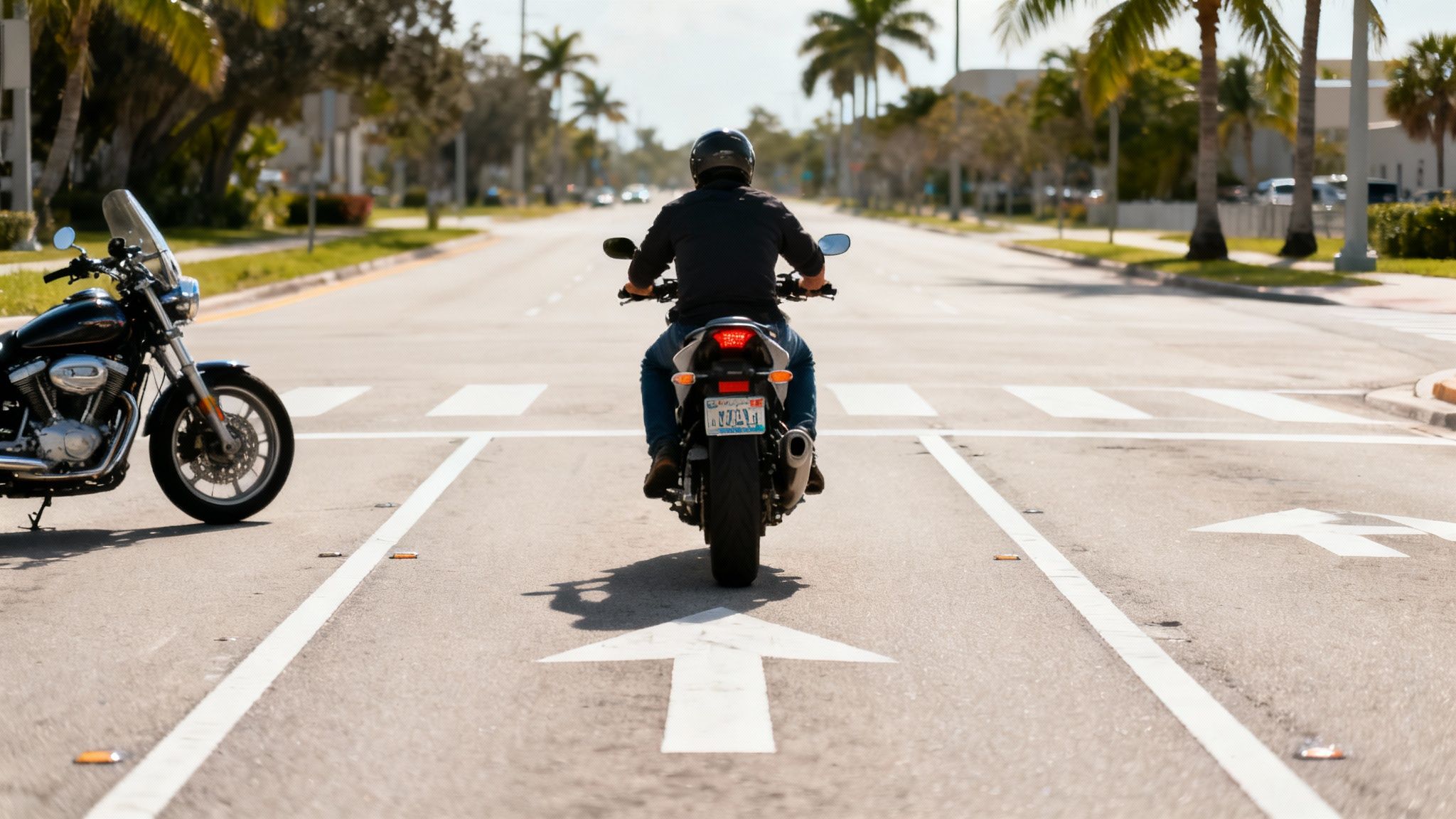
Navigating Florida's dense traffic on two wheels can be a real test of patience. You’ve probably seen videos of riders in other states zipping between cars and wondered if you could do the same here. It's critical to know that while people often use "lane filtering" and "lane splitting" interchangeably, they mean different things—and both are illegal in the Sunshine State.
This legal gray area creates a huge risk for riders. If an accident happens while you're between lanes, you can bet the insurance company will immediately point to that illegal maneuver to pin the blame on you. This can crush your chances of getting fair compensation for your injuries.
Filtering vs Splitting: What’s the Difference?
To really get why the state has this rule, it helps to understand the distinction safety experts and lawmakers make. Think of lane filtering as a low-speed move you’d make in a traffic jam, while lane splitting is its faster cousin out on the open highway.
The core issue in Florida isn't the speed of the maneuver, but the act itself. The law demands that a motorcycle occupies a full lane, just like a car, making any form of riding between lanes a traffic violation.
Knowing the difference helps clarify the risks involved and the reasoning behind the ban. Even though both are off-limits in Florida, here’s a simple breakdown to paint a clearer picture.
Lane Filtering vs Lane Splitting Key Differences
This table breaks down the two practices that are often confused. While some states permit one or both, it's important to remember that Florida law prohibits them entirely.
Practice | Definition | Traffic Condition | Legal Status in Florida |
|---|---|---|---|
Lane Filtering | Moving between lanes of stopped or slow-moving traffic, typically to reach the front at a red light. | Traffic is congested and moving at very low speeds, usually under 15 mph. | Illegal |
Lane Splitting | Riding between lanes of traffic that is moving at higher speeds on a highway or major road. | Traffic is flowing, but the rider moves faster than the surrounding vehicles. | Illegal |
Even if you were injured in a motorcycle accident where you think you might be partially at fault, you still have rights. An experienced attorney can protect you from getting stuck with unfair blame and will fight for the compensation you need to recover.
In pain? Call Caine.
So, Why Is Florida So Against Lane Filtering and Splitting?
It's one thing to know that lane filtering is illegal in Florida, but it's another to understand why the state takes such a hard line. This isn't just some random rule; it’s a deliberate choice based on how lawmakers interpret traffic laws and what they see as major public safety risks.
The whole issue hinges on one specific law: Florida Statute § 316.209. This statute says every motorcyclist is "entitled to full use of a lane." Now, that sounds like a good thing—and it is, since it stops cars from trying to squeeze you out. But it's a double-edged sword. The law essentially treats your bike like a car, meaning it has to stick to its own single lane and can't ride between other vehicles unless it's making a legal pass.
The Official Reasoning Behind the Ban
When you dig into the logic, it all comes down to one thing: predictability. Florida lawmakers and safety officials argue that keeping traffic patterns as predictable as possible is the best way to prevent certain kinds of nasty accidents. They've raised some key arguments against letting bikes ride between cars, even when traffic is barely moving.
The biggest fear is creating sudden, unexpected encounters in already tight spaces.
Sideswipes Are a Huge Concern: Most drivers simply aren't looking for a motorcycle to pop up between lanes. A car drifting just a little, a driver making a last-second lane change, or even someone opening their door in gridlock traffic can lead directly to a collision with a rider.
The "Startle" Factor: A motorcycle suddenly appearing right next to a car can easily startle a driver, causing them to jerk the wheel or slam on their brakes. That knee-jerk reaction doesn't just put the rider in danger; it can set off a chain reaction involving other cars.
Dangerous Speed Differences: Even at low speeds, there's a risk. A motorcycle moving at 15 mph next to a line of stopped cars creates a dangerous speed differential. If a car suddenly lunges forward or pulls into the gap without seeing the bike, there's no time to react.
At its core, Florida's law is built on the idea of order and predictability. By making every vehicle—motorcycles included—stay in a designated lane, the state believes it creates a traffic environment where everyone knows what to expect.
At the end of the day, Florida's stance is that keeping bikes inside a single lane is the safest bet for both the rider and everyone else on the road. While riders in other states will tell you that lane filtering cuts down on congestion and protects them from being rear-ended, Florida legislators have decided to prioritize the risks that come with maneuvering in such close quarters.
If you were hurt in a motorcycle accident, don't let worries about fault stop you from understanding your rights. A good attorney can break down the details of what happened and fight to make sure you aren't blamed unfairly.
In pain? Call Caine.
How Florida Motorcycle Laws Compare Nationally
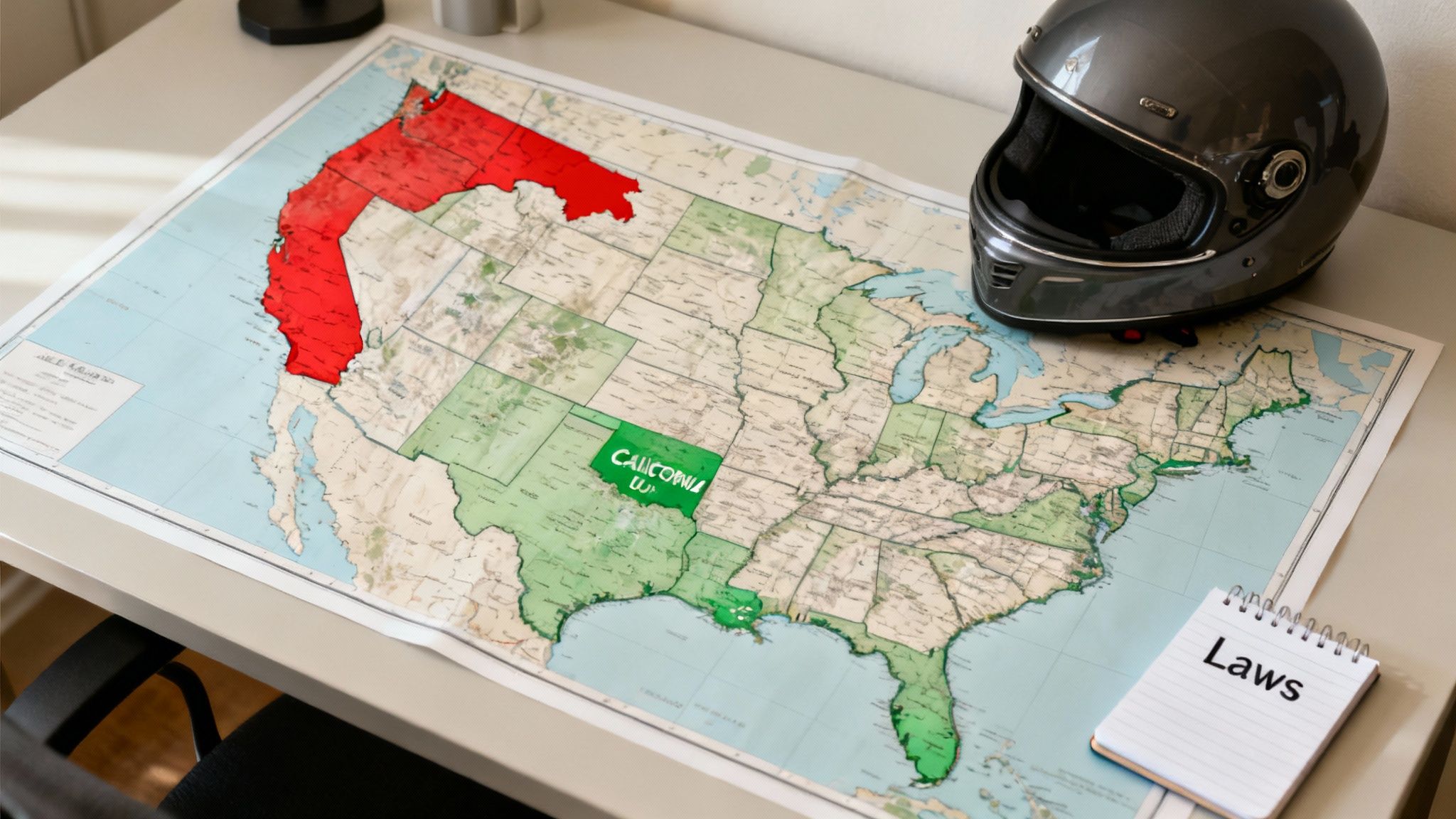
As a Florida rider, our state’s strict ban on lane filtering and splitting can feel a bit isolating. But the truth is, Florida’s position is the norm, not the exception. The vast majority of states either outright prohibit the practice or have laws that are interpreted to make it illegal—just like here at home.
This means if you're a Florida rider planning a cross-country trip, the rules of the road will feel pretty familiar in most places you go. However, the national landscape isn't totally uniform. A handful of states have broken from the pack, and they’re worth looking at to understand the full picture.
States That Allow Lane Filtering or Splitting
A small but growing number of states have decided the benefits of lane filtering outweigh the risks, as long as it's done within very specific guidelines. These pioneers have carved out a legal framework for a practice that remains a serious traffic violation in Florida.
A few states where some form of this maneuver is on the books include:
California: The original trailblazer. California has allowed lane splitting for years. While the rules were informal at first, the state has since created guidelines recommending that riders travel no more than 10 mph faster than surrounding traffic and avoid splitting when cars are moving at 30 mph or faster.
Utah: This state gave lane filtering the green light in 2019, but with some tight restrictions. Riders can only filter on roads with a speed limit of 45 mph or less, and only when traffic has come to a complete stop.
Montana: In 2021, Montana took its own approach. It legalized lane filtering, allowing motorcyclists to pass stationary or slow-moving vehicles at a speed that doesn’t exceed 20 mph.
Arizona: Joining the list in 2022, Arizona now permits filtering on multi-lane roads when traffic is stopped. Riders must keep their speed at 15 mph or below.
The Legal Gray Areas and Why They Matter
Beyond the states with clear-cut laws, you'll find others stuck in a legal gray area where lane splitting isn't explicitly mentioned as legal or illegal. This ambiguity can be even more dangerous for riders because it leaves enforcement up to the discretion of individual police officers and courtroom interpretations.
This patchwork of laws across the country really highlights why it’s so critical for motorcyclists to know the specific rules of any state they plan to ride in.
While Florida's law is clear-cut, the national debate continues. The different approaches from California to Utah show there's no single, easy answer to the question of whether lane filtering is safe or should be legal.
This national comparison drives home a vital point for every Florida motorcyclist: our state's laws are firm and aren't likely to change anytime soon. Getting into an accident while illegally filtering here will create serious problems for your injury claim. If you were hurt in a crash, you need a lawyer who understands these specific complexities inside and out.
In pain? Call Caine.
How Illegal Lane Filtering Can Tank Your Accident Claim
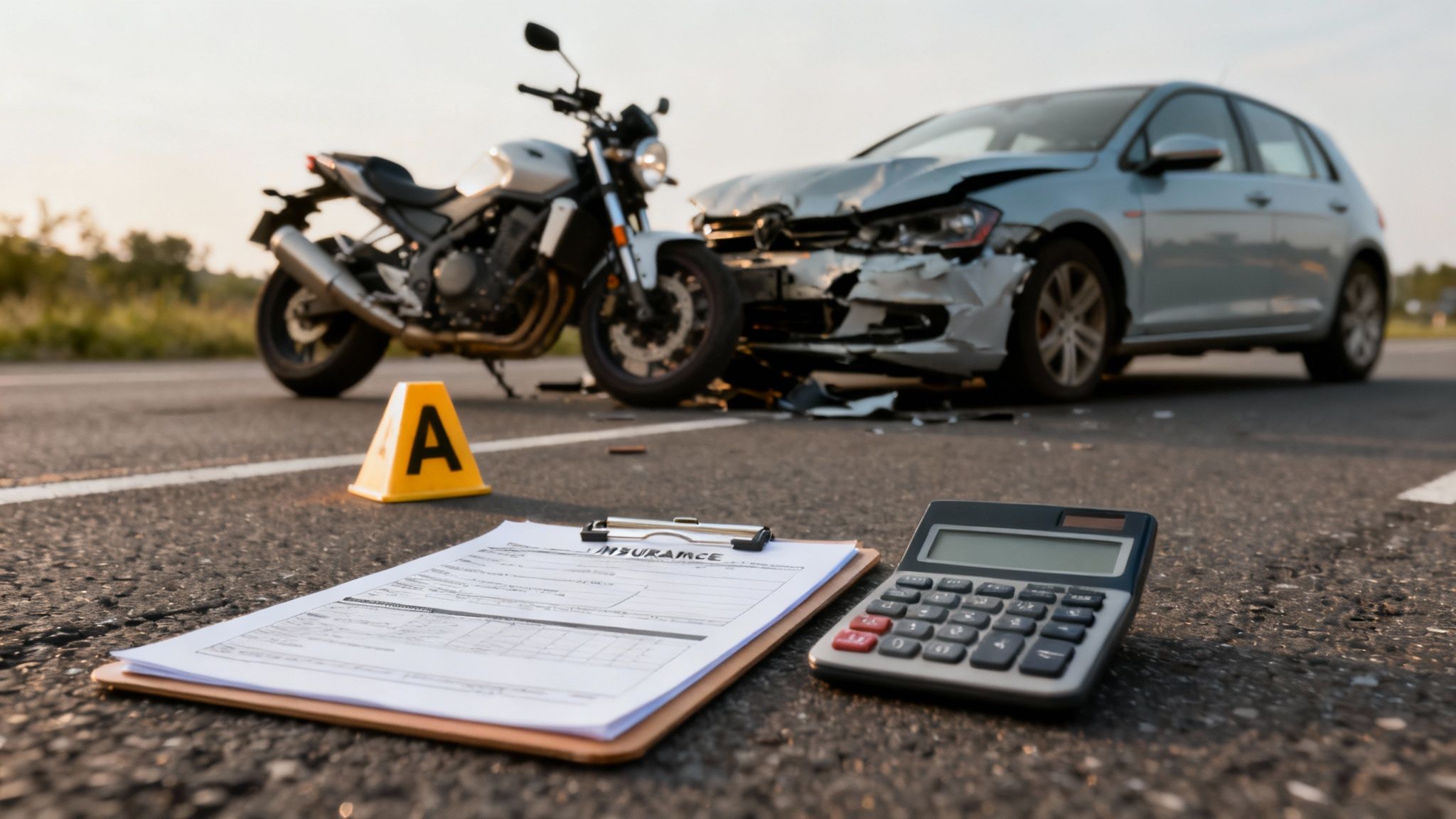
Getting into a wreck is a nightmare. But if that wreck happens while you’re lane filtering in Florida, the aftermath can get a whole lot worse for your financial recovery.
You can bet the other driver's insurance company and their lawyers will seize on that one detail—the illegal maneuver—to shift as much blame as possible onto your shoulders. It doesn't matter if their client was texting, speeding, or just not paying attention. Your actions will become their primary defense.
This strategy is incredibly effective in Florida because of a legal doctrine called comparative negligence. This rule is the single biggest weapon insurance companies have to reduce or even completely deny the money you need for your injuries.
What Is Comparative Negligence?
Think of it like this: a court assigns a percentage of fault to everyone involved in an accident. Under Florida's comparative negligence rule, any compensation you're awarded is then reduced by your percentage of fault.
Insurance adjusters are masters at using this. They’ll immediately argue that your decision to filter between lanes made you unpredictable and reckless, which in turn makes it easy to pin a hefty percentage of the blame on you. This isn't just some abstract legal concept; it has a direct, and often devastating, impact on the money you receive for medical bills, lost wages, and your pain and suffering.
The second an insurance adjuster hears you were filtering, their job is no longer about figuring out what the other driver did wrong. It’s about proving what you did wrong. This is how they can turn a clear-cut Florida personal injury claim into a financial disaster for you and your family.
How a Percentage of Fault Slashes Your Payout
Let’s play this out with a real-world example.
Imagine you're filtering through slow-moving traffic when a driver, distracted by a text message, abruptly changes lanes without signaling and hits you. The crash leaves you with serious injuries, and your total damages—for medical care, lost income, and pain—add up to $100,000.
It seems obvious the other driver was negligent. They were texting and made an unsafe lane change, after all. But because lane filtering is illegal here, their insurance company will dig in their heels, arguing you share the blame. After a fight, a court might decide the other driver was 70% at fault, but that your illegal filtering makes you 30% responsible.
Here’s what that looks like for your wallet:
Total Damages: $100,000
Your Assigned Fault: 30%
Reduction Amount: $30,000 (30% of $100,000)
Your Final Payout: $70,000
Just like that, you’ve lost $30,000 of the compensation you desperately need—all because of one illegal maneuver.
Ironically, even with filtering being illegal, studies often show that other motorists are more frequently to blame. A UK study, for example, found that in serious motorcycle accidents involving filtering, car drivers were twice as likely to be at fault, mostly because they just failed to see or anticipate the rider in congested traffic.
This is exactly why fighting to protect your rights after a crash is so critical. An experienced motorcycle accident attorney knows how to counter these blame-shifting tactics, build a powerful case to minimize your assigned fault, and fight to get you the maximum compensation possible.
In pain? Call Caine.
What to Do Immediately After a Motorcycle Accident

The moments after a motorcycle crash are a blur of adrenaline and confusion. It’s tough to think straight, but the actions you take right then and there can make or break your ability to protect your health and your legal rights. This is especially true if the other driver's insurance company decides to falsely accuse you of an illegal move like lane filtering to avoid paying what they owe.
Your number one priority is always your safety. If you're able, get yourself and your bike out of the flow of traffic to avoid a second collision. Then, call 911 right away. Report the crash and ask for medical help, even if you think you’re okay—some of the most serious injuries don't show symptoms for hours or even days.
Document Everything at the Scene
Once you're in a safe spot, your job shifts to gathering evidence. Think of yourself as a detective preserving the scene, because this documentation is your single best defense against getting blamed for something you didn't do.
Pull out your phone and start taking pictures and videos from every angle imaginable. Your mission is to capture the full story of exactly what happened.
Vehicle Positions: Snap photos showing where your bike and the other car ended up. Get wide shots that show their positions relative to each other and to lane markings, signs, and intersections.
Property Damage: Get up close and personal with the damage on all vehicles involved. These photos help accident reconstruction experts pinpoint how the impact occurred.
Road Conditions: Look for and photograph any skid marks, debris on the road, traffic signals, and even the weather conditions. Every detail adds crucial context.
Your Injuries: Take clear pictures of any cuts, bruises, or road rash you have.
Think of it this way: a thorough set of photos creates a powerful visual record. It can prove you were riding safely in your lane, making it much harder for an insurance company to pin the blame on you with false claims about illegal lane filtering.
Protect Your Legal Claim
Beyond photos, you need to collect contact and insurance information from the other driver. And if there were any witnesses, get their names and numbers. An independent witness who saw the whole thing can provide an unbiased account that is incredibly valuable for your case.
This next part is critical: do not admit fault. Don't apologize or say anything like "I should have seen you." When you talk to the police, stick to the facts. But when the other driver's insurance adjuster calls, avoid giving them a detailed statement until you’ve spoken with a lawyer. Those adjusters are trained to twist your words to devalue or deny your claim.
For a more detailed breakdown of what to do, check out our guide on essential steps and legal guidance after an accident happens.
Taking these immediate steps helps you build a strong foundation for your claim right from the very beginning.
In pain? Call Caine.
Why You Need a Motorcycle Accident Attorney
Trying to handle a motorcycle accident claim on your own is a tough road to travel. Insurance companies are rarely on your side; they’re actively looking for any reason to blame you for the crash.
After an accident, the insurance adjuster’s primary goal is to protect their company’s bottom line, not to make you whole again. This is where having a skilled attorney in your corner can make all the difference.
Insurance adjusters often start with an unfair bias against motorcyclists, assuming all riders are reckless. If they get even a whiff that you might have been filtering or making any other move they can twist, they’ll use it to slash your claim’s value or deny it outright—even if the other driver was clearly negligent.
Fighting Unfair Blame and Maximizing Your Compensation
The very first thing an experienced motorcycle accident lawyer does is shut down those blame-shifting tactics. We launch our own independent investigation, digging up critical evidence like traffic camera footage, witness statements, and accident reconstruction reports to show what really happened. This proactive approach is essential to fight back against false claims about whether your riding was lane filtering legal or not.
Your lawyer takes over all communication with the insurance company, shielding you from their pressure and intimidation. We know exactly how to calculate the full, true value of your claim, including everything you’re owed for:
All your medical bills, both now and in the future
Lost wages and any impact on your ability to earn a living
The physical pain, mental suffering, and emotional trauma you’ve endured
Repairing or replacing your motorcycle
An attorney’s job is to build a case so strong that the insurance company has no choice but to negotiate fairly. We understand the specific challenges riders face and can anticipate the opposition's every move, making sure your rights are protected every step of the way.
Going it alone means you risk accepting a lowball settlement that won’t come close to covering your long-term costs. The right lawyer levels the playing field, fighting to get you the maximum compensation you deserve. For a closer look at how we handle these specific situations, you can learn about our approach to auto & motorcycle accident claims.
Don't try to face the insurance companies by yourself.
In pain? Call Caine.
Lane Filtering FAQs: What Florida Riders Need to Know
The rules of the road can get confusing, especially when it comes to motorcycle-specific laws. Let's clear up some of the most common questions we hear from Florida riders about lane filtering.
Can I Filter Through Completely Stopped Traffic?
Absolutely not. Under current Florida law, it doesn't matter if traffic is at a dead stop or just crawling along—lane filtering is illegal in both scenarios. Riders are required to stay within a single, designated lane until they can make a legal and safe lane change into an open one.
If a Car Hits Me While I'm Filtering, Who's at Fault?
This is where things get complicated. The other driver could still be found mostly at fault, especially if they were driving negligently, but your final compensation will almost certainly be reduced.
Why? Because Florida operates under a comparative negligence rule. Since you were technically breaking the law by filtering, the other driver's insurance company will argue that you share responsibility for the crash.
Because lane filtering is illegal, any crash that happens while you're doing it automatically puts you on the defensive. This is exactly why having an experienced motorcycle accident attorney in your corner is so critical.
Are There Any Plans to Legalize Lane Filtering in Florida?
There's been a lot of talk over the years. Various bills have been introduced in the Florida legislature to either study the issue or outright legalize lane filtering, but so far, none have made it into law. As of today, the practice remains strictly prohibited, and all riders must follow the current statutes.
If another driver's negligence left you injured in a motorcycle accident, you need a legal team that understands the challenges riders face. The attorneys at CAINE LAW will fight to protect your rights and secure the compensation you deserve. In pain? Call Caine.
Learn more and get a free consultation at https://cainelegal.com.
