
In Pain? Call Caine
Is Lane Splitting Legal? A State-by-State Guide for Riders

5 Min read
By: Caine Law
Share
So, you're asking, "is lane splitting legal?" The honest answer is a frustrating maybe. It’s one of those practices that lives in a legal gray area in most of the country. Only a handful of states explicitly give it the green light, while the rest either ban it outright or simply have no laws on the books about it at all. That ambiguity can leave a rider twisting in the wind, unsure of their rights on the road.
Lane Splitting vs. Lane Filtering: What's the Difference?
To anyone in a car, a motorcycle zipping between lanes is just "lane splitting." But for riders, there's a crucial distinction—it's like the difference between a brisk walk and an all-out sprint. One is a calculated, low-speed move, while the other happens in the flow of traffic.
To make this crystal clear, let's break down the key differences between these two often-confused practices.
Lane Splitting vs Lane Filtering at a Glance
Practice | Definition | Common Scenario | General Legality in the US |
|---|---|---|---|
Lane Splitting | Riding between lanes of moving traffic, often at the same speed as surrounding vehicles. | A rider moving between two lanes of cars on a highway to get past a bottleneck. | Legal only in California (with specific guidelines). Illegal or not addressed in most other states. |
Lane Filtering | Moving at low speed between lanes of stopped or slow-moving traffic. | A rider "filtering" to the front of a line of cars stopped at a red light. | Explicitly legal in a growing number of states like Utah and Arizona, under strict conditions. |
As you can see, the major difference is the speed and movement of the surrounding traffic. Lane filtering is what happens in a gridlock or at a stoplight—a slow, careful maneuver to get to the front. In contrast, lane splitting is done while traffic is actually flowing, often at much higher speeds.
Knowing which is which—and more importantly, what your state allows—is the absolute first step to staying safe and keeping your record clean.
Why This Distinction Is So Critical for Riders
You have to know your local laws; it's non-negotiable. Getting it wrong can have some pretty serious consequences, both legally and financially, especially if there's an accident.
If you get into a crash while illegally lane splitting, you can bet the insurance company will try to pin 100% of the blame on you. That makes getting the compensation you deserve incredibly difficult. This is why knowing what to do after a crash is so vital for protecting yourself.
At the end of the day, whether you can legally ride between cars comes down entirely to where you are. A move that’s perfectly fine on a California freeway could land you a hefty fine and a world of legal trouble just one state over. And since these laws are always changing, it’s on every rider to stay informed.
If you’ve been hurt in an accident while riding between lanes, figuring out who was at fault can get complicated fast. In pain? Call Caine.
Lane Splitting Laws by State
Figuring out the web of lane splitting laws across the United States can feel like you're trying to read a map with constantly shifting borders. The real answer to "is lane splitting legal?" is a big "it depends"—specifically, on where your two wheels are planted.
What's an accepted, everyday practice in one state can be a ticketable offense just a few miles down the road. This patchwork of rules makes knowing the local law absolutely critical for every single rider. It's a mix of explicit permissions, outright bans, and a whole lot of frustratingly silent statutes. A handful of states are starting to see the benefits, but most are lagging behind, leaving riders in a confusing spot where they have to be their own legal experts.
The Trailblazers: Where Lane Splitting and Filtering Are Legal
California has always been the pioneer here. For years, riders did it and it was just... accepted. It existed in a legal gray area until 2016, when Assembly Bill 51 was signed, making California the first—and still only—state to officially legalize lane splitting.
This isn't a free-for-all, though. The California Highway Patrol gives riders guidelines, urging them to split in a "safe and prudent" manner. The general rule of thumb is to not go more than 10 mph faster than the surrounding traffic.
Following California’s lead, a few other states have opened the door to lane filtering, which you can think of as lane splitting's more cautious cousin. They recognize that letting bikes move to the front of stopped traffic is a win-win: it eases congestion and, more importantly, protects riders from getting rear-ended.
Here's who has joined the club:
Utah: Got the green light in 2019 for filtering on roads with a speed limit of 45 mph or less. The catch? Traffic must be stopped, and you can't go faster than 15 mph.
Arizona: Legalized lane filtering in 2022. Riders can move between stopped cars on roads with at least two lanes going in the same direction.
Montana: Hopped on board in 2021, letting motorcyclists filter between stopped or slow traffic at speeds no greater than 20 mph.
Colorado & Minnesota: These are the newest members, passing laws in 2024 and 2025 that allow for specific, controlled types of lane filtering.
This little diagram does a great job of breaking down the difference between the two maneuvers, which is really the key to understanding the laws.
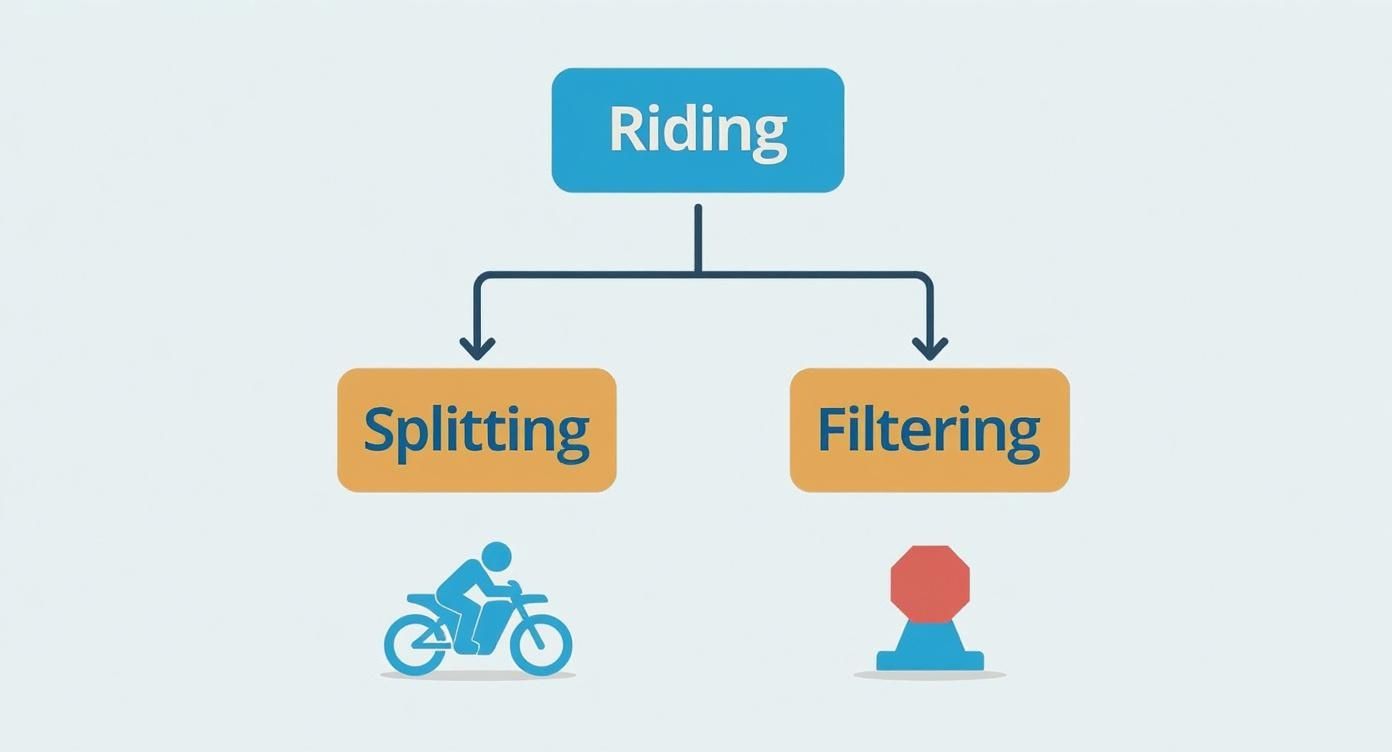
As you can see, splitting happens when traffic is moving. Filtering is a slow-speed move through stopped traffic. That difference is exactly why more states are getting comfortable with legalizing filtering first.
States Where It Is Expressly Illegal
While some states are embracing the idea, many others have put up firm legal roadblocks. In these places, riding between lanes is often treated the same as an improper lane change or even reckless driving. That means fines, points on your license, and a huge liability problem if you're in a crash. States like Texas, Oregon, and Washington have specific laws on the books that forbid it entirely.
For example, Oregon’s law (ORS 814.240) is crystal clear: motorcycles must stay within a single lane. That shuts down both splitting and filtering. Texas also put the issue to rest in 2023 with House Bill 4122, which officially banned the maneuver.
The Gray Zone: What About Florida?
And this is where things get really tricky, especially for us here in Florida. The state's traffic laws never actually use the words "lane splitting." Because the law is completely silent on the topic, the practice is stuck in a legal gray area.
Key Takeaway: When there’s no specific law, police and the courts usually lean on other traffic rules to interpret lane splitting. They might call it an unsafe lane change or failure to stay in your lane. That ambiguity creates a massive risk for riders.
Without a clear statute giving it the okay, a rider in Florida can be ticketed entirely at an officer's discretion. But the bigger problem comes if there's an accident. The other driver's insurance company will almost certainly pounce on the fact that you were splitting lanes, arguing you were performing an illegal and unsafe maneuver. They’ll use it to pin the blame on you, making it an uphill battle to get fair compensation for your injuries.
If you were hurt in a motorcycle wreck while navigating Florida's confusing traffic laws, don't let an insurance company bully you into taking the fall. These cases are legally complex and demand an attorney who knows the nuances and isn't afraid to fight back. In pain? Call Caine.
How Other Countries Handle Lane Splitting
The debate over whether lane splitting is legal isn't just happening on American highways—it's a global conversation, and the answers are all over the map. While many U.S. states are still on the fence, a lot of countries in Europe and Asia have long embraced it as a practical way to deal with clogged city streets. Looking at how they handle it helps put our own safety-versus-efficiency arguments into a much bigger picture.
In many parts of the world, especially in jam-packed urban areas, lane splitting isn't just legal; it's a normal, expected part of the daily commute. For riders there, it’s a common-sense move that cuts down on travel time and keeps traffic from grinding to a halt for everyone. This widespread acceptance usually comes with clear rules and, just as importantly, a driving public that's used to seeing motorcycles moving between cars.
A Patchwork of Rules in Europe
The European Union is a fascinating place to look for examples, with a real mix of regulations that are generally more permissive than what we see in the States. Some countries have made it fully legal and have rules to go with it. Others exist in a kind of gray area, while a few ban it completely. This variety shows there’s no single right answer, but a spectrum of approaches shaped by local culture and traffic realities.
For instance, places like the Netherlands and Belgium don't just tolerate lane splitting—they pretty much expect riders to do it in heavy traffic. But then you have France, which serves as a cautionary tale. After a trial run of quasi-legalization in 11 regions, a government study found a surprising 12% increase in motorcycle accidents where splitting was common. That unexpected result made officials hit the brakes, and they ended up reinforcing penalties instead of moving toward full legalization. You can learn more about the nuanced results of the French lane splitting study on revzilla.com.
Global Insight: The international experience shows that making lane splitting work safely really depends on having clear rules, public awareness, and proper rider training. When drivers expect to see bikes between lanes and riders stick to safe speeds, the practice can blend in smoothly.
This look around the globe highlights a key point: the law is only one piece of the puzzle. Cultural acceptance and driver education play a huge role in how safely lane splitting can actually be done. As more states in the U.S. think about legalizing the practice, they have a ton of international examples—both good and bad—to learn from.
If you’ve been hurt in a motorcycle accident, trying to make sense of the legal maze can feel impossible, especially when confusing traffic laws are part of the equation. You need an advocate who understands the fight ahead. In pain? Call Caine.
The Real Data on Lane Splitting Safety and Congestion

Is lane splitting a dangerous gamble or a smart traffic solution? The conversation often gets heated, with passionate arguments coming from both riders and drivers. To get a clear picture, we have to cut through the noise and look at what the actual data says about safety and traffic flow.
The global debate boils down to a core trade-off: rider safety versus traffic efficiency. On one hand, plenty of evidence suggests that when it’s done responsibly, lane splitting can actually protect motorcyclists from one of the most common dangers they face in traffic. On the other, drivers often have valid concerns about the risks involved when a motorcycle pops up unexpectedly between lanes.
The Safety Argument for Lane Splitting
One of the most compelling arguments for lane splitting is its potential to drastically reduce rear-end collisions. Think about it—when a motorcycle is stopped in traffic, it becomes a sitting duck for a distracted driver. Allowing a rider to filter between stopped or slow-moving cars gets them out of that vulnerable position.
This isn’t just a theory; the numbers back it up. Studies have shown that lane splitting can significantly cut down on these specific types of accidents. The rate of rear-end collisions for riders who split lanes drops dramatically compared to those who don’t, making a very strong case for its safety benefits. You can see more details about how lane splitting affects rider safety on inszoneinsurance.com.
A landmark study from the University of California Berkeley found that lane-splitting motorcyclists were notably less likely to be struck from behind by another vehicle. This suggests the practice can be a key defensive riding strategy in heavy, stop-and-go traffic.
Easing Congestion for Everyone
Beyond protecting the rider, lane splitting offers a clear benefit to every single driver on the road: it helps ease traffic congestion. Picture it this way: every motorcycle that moves between lanes effectively removes one vehicle from the line. While a single bike might not seem like a big deal, the cumulative effect can be huge.
Here’s how it helps:
Reduces Gridlock: By filtering forward, motorcycles take up less space, which can shorten traffic queues at lights and during slowdowns.
Improves Traffic Flow: Shorter lines mean traffic moves more smoothly and recovers from congestion much faster.
Of course, opponents raise fair points about the "startle effect," where a driver is surprised by a passing motorcycle and may swerve instinctively. This just highlights the need for clear laws, public awareness campaigns, and safe riding practices to make it work for everyone. Ultimately, the data shows a path forward where safety and efficiency can coexist.
If you were injured in a motorcycle accident while trying to navigate traffic, understanding your rights is crucial. In pain? Call Caine.
Navigating Insurance and Fault After an Accident
A motorcycle crash is stressful enough on its own. The aftermath, however, can quickly turn into a legal and financial minefield, especially if you were lane splitting. Insurance adjusters and, eventually, the courts have to untangle who was responsible, and your actions on the road play a huge part in that decision. Whether lane splitting was legal is just the starting point.
Even in a state like California where lane splitting is legal, you aren't automatically in the clear. If you were riding unsafely—say, going way faster than the cars around you or weaving erratically—you could still be found partially or even entirely at fault for the crash.
This is where a legal concept called comparative negligence comes into play. Think of it as a way to assign a percentage of the blame to everyone involved in an accident.
How Comparative Negligence Works
Imagine a pie chart of blame where each person involved gets a slice representing their share of fault. Florida follows what’s known as a "modified comparative negligence" rule. This means you can still get compensation for your injuries, but only as long as you are not found to be more than 50% responsible for the accident. Any award you receive is then reduced by your percentage of fault.
Example: Let's say a driver makes an unsafe lane change and hits you. You were lane splitting legally, but maybe you were going 15 mph faster than traffic, which is against safety guidelines. A court decides the driver was 80% at fault, but you were 20% at fault. If your total damages were $100,000, your final award would be reduced by your 20% share of the blame, leaving you with $80,000.
Navigating Fault Where Lane Splitting Is Illegal
In states like Florida, where the law doesn't say anything specific about lane splitting, things get even trickier. Because the practice isn't explicitly legal, you can bet the insurance company will use it against you. Their go-to move is to argue that you were operating your motorcycle in an unsafe or illegal way, hoping to shift 100% of the blame onto you.
Even if the other driver was obviously negligent—texting while driving, failing to signal, or swerving into your path—the simple fact that you were riding between lanes gives them powerful ammunition. This is a common tactic, and successfully fighting it requires a solid understanding of traffic laws and how to counter these kinds of arguments. It’s no surprise that these situations often lead to frustrating insurance disputes that require expert legal help to get a fair outcome.
Ultimately, what matters most are your actions at the moment of the crash. Were you riding carefully? Was your speed reasonable for the conditions? How you answer these questions is key to protecting your rights and getting the compensation you deserve.
If you've been hurt in a motorcycle accident that involved lane splitting, don't let an insurance company bully you into accepting blame. In pain? Call Caine.
Your Next Steps After a Motorcycle Accident

The moments after a motorcycle crash are a blur of adrenaline, confusion, and pain. It's tough to think straight, but what you do next is absolutely critical for your health and your legal rights—especially if lane splitting was involved. You can bet the other driver's insurance company is already looking for ways to pin the blame on you, making your actions at the scene incredibly important.
First thing's first: prioritize your safety. Get yourself and your bike out of traffic if you can to avoid a second collision. Check on others involved, but resist the urge to apologize or say you're sorry. Even a simple, well-intentioned apology can be twisted and used against you later. Call 911 right away to report the crash and get paramedics on the scene, even if you think you feel fine.
Gathering Critical Evidence
While you wait for help, your phone is your best friend. Start documenting everything. Take pictures and videos of the entire scene from as many angles as possible. Get shots of where the vehicles ended up, the damage to your bike and their car, any skid marks on the road, and any other details like potholes or debris.
Then, you'll need to swap information with the other driver. Make sure you get their:
Full name and phone number
Driver's license number
Insurance company and policy number
Vehicle make, model, and license plate
If anyone saw what happened, get their names and numbers, too. An independent witness can be a game-changer for your case.
The single most important thing you can do is get checked out by a doctor. Adrenaline is a powerful painkiller and can easily hide serious injuries like internal bleeding or a concussion. A medical report creates a clear, undeniable link between the crash and your injuries, which is vital for any insurance claim.
Why You Must Contact an Attorney
After a crash, especially one where the legality of lane splitting is a gray area, you need an advocate in your corner. Insurance adjusters will try to use your actions—legal or not—to deny your claim or lowball a settlement. They might paint you as a reckless rider even when their driver was the one who wasn't paying attention.
Don't let them control the story. Understanding your rights after auto and motorcycle accidents is the first step, but having an experienced attorney to protect you from these tactics is how you win. We know how to fight back and get you the recovery you deserve. In pain? Call Caine.
Your Top Questions About Lane Splitting, Answered
The rules of the road can get murky, especially when it comes to motorcycles. Let's clear up some of the most common questions riders have about lane splitting.
Is Lane Filtering the Same as Lane Splitting?
No, and it's a critical distinction to make. Think of lane filtering as what you do at a red light—inching your way at a low speed between rows of stopped or barely moving cars. It's a way to get to the front of the line.
Lane splitting, on the other hand, is riding between lanes of traffic that's moving, often at highway speeds. Because of the lower speeds involved, more states are open to legalizing filtering, seeing it as a way to ease congestion and prevent rear-end collisions.
What Are the Penalties for Illegal Lane Splitting?
If you're caught lane splitting where it's not allowed, you're looking at a standard moving violation. That usually means a traffic ticket, a fine (which can vary wildly from one state to another), and some points on your license. The exact penalty often comes down to the local laws and the officer who pulls you over.
Key Insight: In a state like Florida, where the law isn't crystal clear, you might not get a ticket for "lane splitting." Instead, it could be written up as "failure to maintain a single lane" or a similar general offense, which can create a real legal headache.
Who Is at Fault If a Car Hits Me While I'm Lane Splitting?
This is where things get complicated. Even in states where lane splitting is perfectly legal, fault isn't a given. If a driver carelessly changes lanes without signaling and hits you, they are likely to be found negligent.
However, if you were splitting in an unsafe manner—maybe going way too fast for the conditions or weaving erratically—you could be found partially at fault. Under "comparative negligence" rules, this would reduce the amount of compensation you could receive. An experienced motorcycle accident attorney is crucial for sorting out liability and making sure your rights are protected.
If you’ve been hurt in a motorcycle accident, the last thing you need is to battle an insurance company alone. The team at CAINE LAW knows their playbook inside and out and is ready to fight for the full compensation you're owed. Find out more at https://cainelegal.com. In pain? Call Caine.
