
In Pain? Call Caine
Injuries From Falling Down Stairs A Legal Guide

5 Min read
By: Caine Law
Share
A fall down the stairs might feel like a simple, clumsy moment, but the potential for serious, life-changing harm is huge. The truth is, injuries from falling down stairs can be anything from a moderate sprain to a traumatic brain injury or permanent spinal cord damage. Understanding just how bad these falls can be is the first step toward getting the help—and justice—you deserve.
The Hidden Dangers of a Stair Fall
That tumble down a flight of stairs isn't just an embarrassing slip-up. It's a violent event where physics and the human body collide with potentially devastating results. The momentum you build on the way down, the hard surfaces of the steps, and the awkward way you land can generate an incredible amount of force. That force is what turns a simple misstep into a serious medical emergency.
People often brush it off, thinking a few bruises are the worst of it. But that initial pain can easily mask deeper, more significant problems lurking beneath the surface.
More Than Just Bumps and Bruises
The injuries from a fall are incredibly varied and really depend on how you land and how far you fell. While minor scrapes are possible, the most common outcomes are far more severe.
Think of it like a car crash in slow motion. Every time you hit a step or a railing, it's a separate collision, transferring destructive energy to different parts of your body.
Here's a look at what we frequently see in our practice.
Injury Type | Common Examples | Key Symptoms to Watch For |
|---|---|---|
Soft Tissue Injuries | Sprained ankles, torn ligaments (ACL/MCL), strained back muscles | Swelling, bruising, instability, limited range of motion |
Fractures | Broken wrists/arms (from trying to break the fall), fractured hips, broken legs | Intense, localized pain, deformity, inability to bear weight |
Head & Brain Injuries | Concussions, traumatic brain injuries (TBIs), skull fractures | Headache, dizziness, confusion, memory loss, loss of consciousness |
Spinal Cord Damage | Herniated discs, fractured vertebrae, nerve compression, paralysis | Numbness, tingling, weakness in limbs, loss of bladder/bowel control |
These injuries aren't just about immediate pain. They can lead to chronic conditions, long-term disabilities, and a completely altered way of life.
The Alarming Statistics Behind Stair Accidents
The numbers don't lie—stair-related accidents are a massive problem. In the United States alone, they cause over 1 million injuries every single year. Research published in The American Journal of Emergency Medicine even identified stairway falls as the second leading cause of accidental injuries nationwide.
Tragically, these accidents result in about 12,000 deaths annually.
This data visualization drives home just how frequent and severe these injuries are.
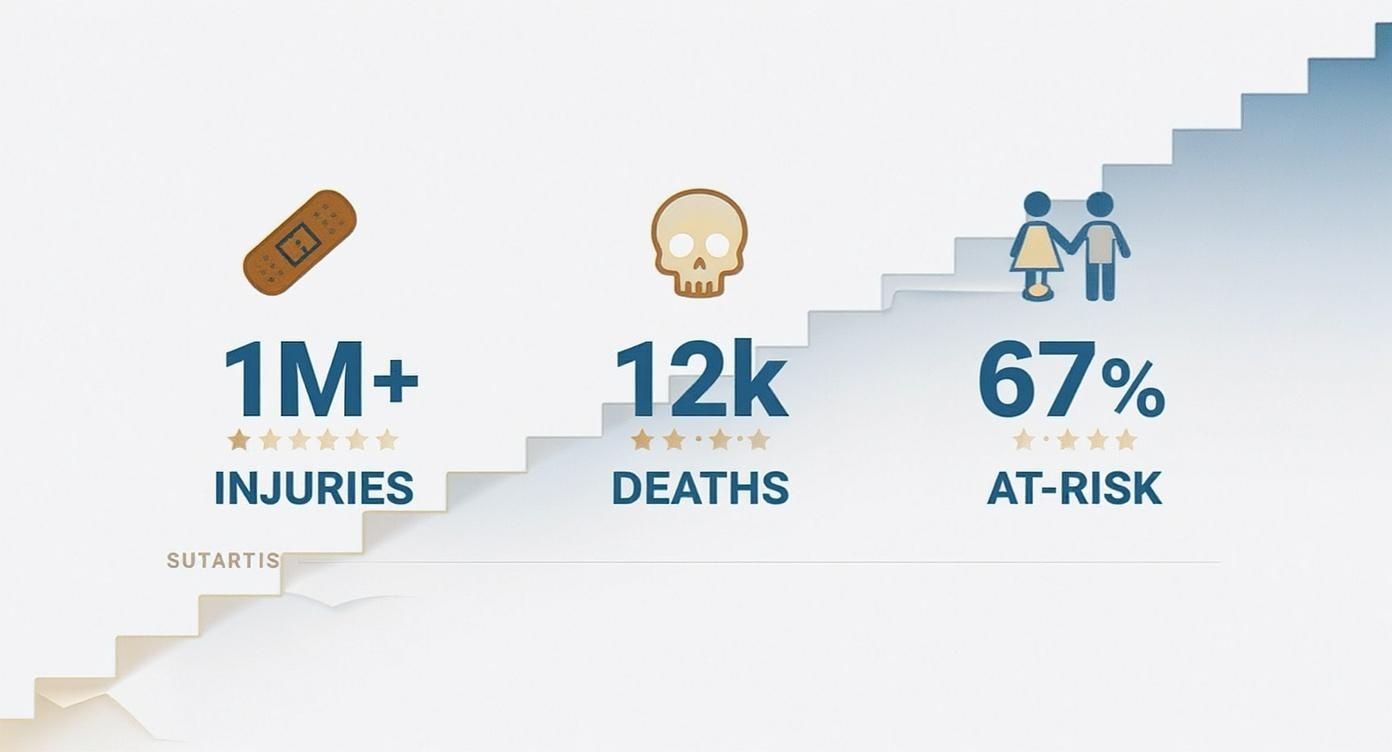
These figures prove that stair falls are a serious public health issue, not just rare freak accidents. And it’s a myth that only the elderly are at risk. In reality, 67.2% of those injured are a mix of older adults and young children. The harm ranges widely, with sprains and strains making up about 32.3% of injuries and fractures accounting for another 19.3%. You can read more about these alarming stair fall injury statistics and what causes them.
When a property owner's negligence—like a broken handrail, poor lighting, or a worn-out step—causes such a fall, they can be held responsible for the consequences. The law recognizes their duty to keep their premises reasonably safe.
If you or a loved one has been hurt because of unsafe stairs, you may be entitled to compensation for your medical bills, lost income, and pain and suffering. Protecting your rights starts with understanding the full scope of your injuries and getting expert legal advice. In pain? Call Caine.
Your First Steps After a Fall
The moments right after a fall down the stairs are a complete blur. There's the shock, the confusion, and the immediate, searing pain. It's almost impossible to think straight, but what you do in this critical window can make a huge difference—both for your physical recovery and for your right to pursue a claim for your injuries from falling down stairs.
Your health is, without question, the absolute first priority.
Even if you think you can just "walk it off," get a medical evaluation right away. Adrenaline is a powerful painkiller and can easily hide how badly you're hurt. What feels like a minor ache could actually be a concussion, a hairline fracture, or even dangerous internal bleeding. If you wait, you’re not only risking your health, but you're also handing insurance companies an excuse to argue the fall didn't cause your injuries.
Document Everything Immediately
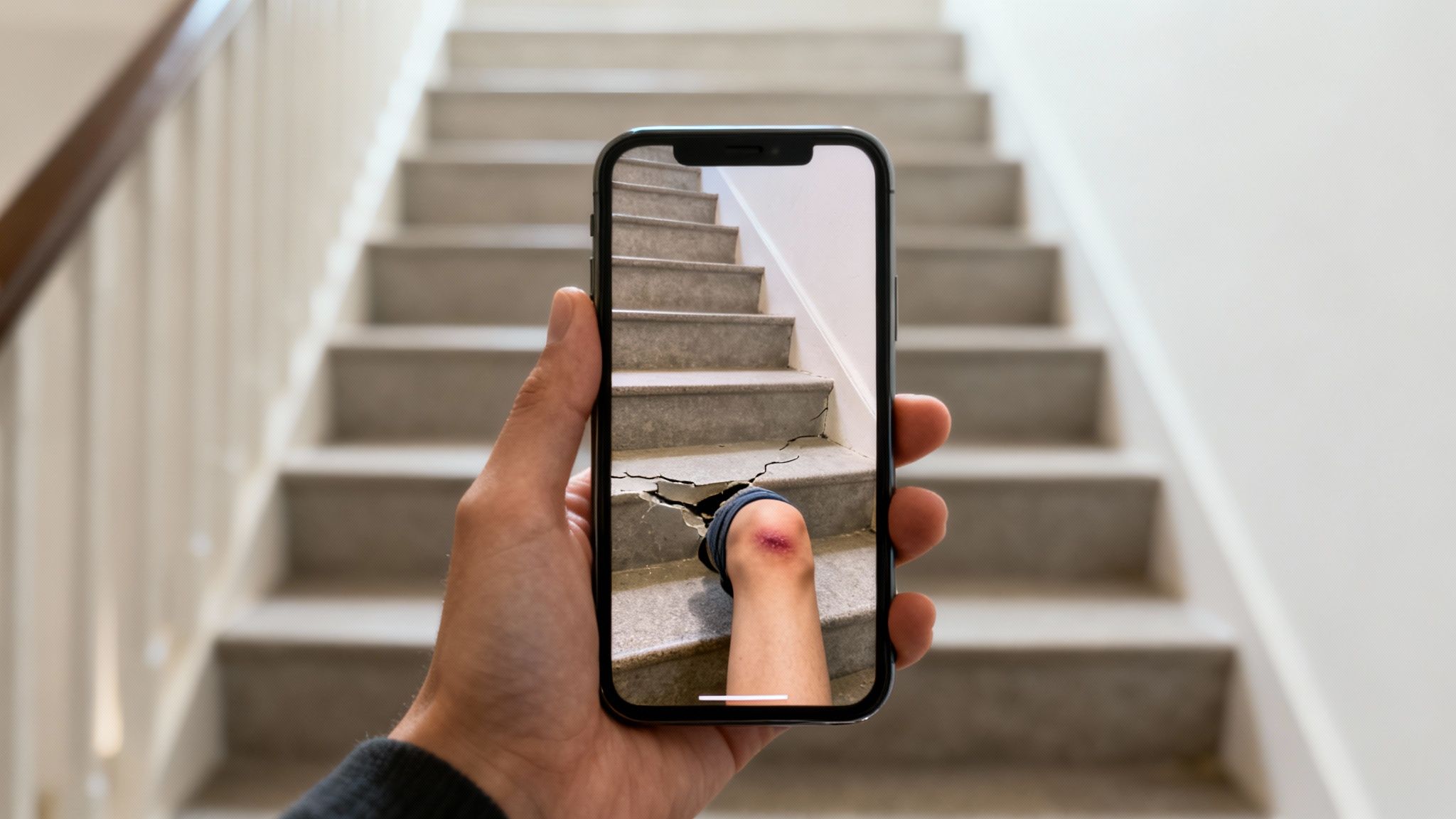
While you're waiting for help to arrive, or as soon as you're able, turn your smartphone into your most important tool. Think like a detective at a crime scene. Your job is to capture the conditions exactly as they were when you fell, because this evidence can become invaluable down the road.
Make sure your photos and videos cover these key things:
The Specific Hazard: Get close-up shots of whatever made you fall. Was it a busted step, a rip in the carpet, a puddle of liquid, or just a dangerously dark area? Snap a picture of it.
The Broader Scene: Pull back and take wider shots of the whole staircase and the area around it. This provides crucial context, showing things like a missing handrail or the property’s general state of disrepair.
Your Visible Injuries: Take photos of any cuts, bruises, swelling, or even torn clothing. These images create a time-stamped visual record of the immediate harm you suffered.
Witness Information: If anyone saw what happened, get their name and phone number. A witness who can back up your story is incredibly powerful.
This kind of visual evidence tells a story that words just can't. It freezes that moment in time, stopping a property owner from quickly fixing the hazard and then claiming it was never there. For more tips on this, check out our guide on the essential steps to take when accidents happen and how they connect to your legal options.
Create an Official Record
After you've documented the scene, the next step is to officially report the fall to whoever is in charge of the property—a landlord, a store manager, or a property management company.
Crucial Takeaway: Just telling someone isn't enough. You need to insist on filing a formal, written incident report and always ask for a copy for your records. This report creates an official paper trail, proving that you notified the owner about both the fall and the hazard that caused it.
If the manager or owner refuses to create a report or gives you a hard time, don't argue. Instead, make a detailed note of who you spoke to, the exact date, and the time. Then, follow up with an email describing the incident so you have your own written record. It’s a simple step, but it establishes a clear timeline and shows you acted responsibly. Taking these organized steps protects both your health and your legal rights. If you’re getting resistance or just feel overwhelmed, getting expert guidance can change everything. In pain? Call Caine.
Understanding Your Rights Under Florida Law
After a serious fall, it’s easy to feel powerless. You’re dealing with pain, the medical bills are starting to pile up, and everything feels out of your control. But in Florida, the law provides a clear path for holding a negligent property owner accountable for the injuries from falling down stairs that happen on their watch.
This area of law is called premises liability.
Think of a property owner as the captain of a ship. They have a legal responsibility, known as a duty of care, to make sure their property—whether it's an apartment building, a retail store, or an office—is reasonably safe for everyone who comes aboard. When they fail in that duty and someone gets hurt as a result, they can be held financially responsible for the harm that follows.
However, just getting injured on someone else's property isn't enough to automatically win a claim. To get the compensation you deserve, you and your attorney have to prove three specific things.
The Three Pillars of a Premises Liability Claim
Building a strong case is like constructing a sturdy three-legged stool. If any one of the legs is missing, the whole thing comes crashing down. To prove your right to compensation, we have to firmly establish each of these three pillars.
The Owner Was Negligent: We have to show that the property owner either knew about a dangerous condition on their property or reasonably should have known about it, but did nothing to fix it or warn people.
That Negligence Caused Your Fall: It's not enough to show a hazard existed. We must draw a direct line connecting the owner’s negligence—that specific hazard—to your fall and the injuries you suffered.
The Fall Caused Real Damages: Finally, we have to demonstrate that you suffered actual harm as a direct result of the fall. This includes things like medical bills, lost income from being out of work, and your pain and suffering.
This legal framework is designed to separate unavoidable accidents from incidents caused by clear, preventable carelessness.
What Does Negligence Look Like in the Real World?
"Negligence" can sound like a vague legal term, but when it comes to a staircase, it usually means very real, physical hazards. We’re not talking about minor scuffs or imperfections; we're talking about dangerous conditions that a responsible property owner should have fixed.
Some of the most common examples of property owner negligence include:
Building Code Violations: Stairs that are too steep, have uneven riser heights, or don't have enough tread depth are accidents waiting to happen.
Broken or Missing Handrails: A sturdy handrail is one of the most basic safety features. If it’s loose, broken, or missing entirely, that’s a clear sign of neglect.
Worn-Out or Damaged Steps: Loose floorboards, torn carpeting, or cracked concrete create obvious tripping hazards that an owner has a duty to address.
Inadequate Lighting: You can’t avoid a hazard you can’t see. A dimly lit stairwell can turn a simple flight of stairs into a dangerous trap.
These problems are far more common than you might think. The global impact of stair falls is staggering, especially for older adults. For example, detailed records from the United Kingdom show that stair falls cause around 230,000 injuries and 500 deaths there every single year. The top causes are almost identical to what we see in Florida cases: unsafe stair dimensions (17%), poor lighting (16%), and handrail problems (13%). You can discover more insights about these UK stair fall statistics and see just how widespread this issue is.
A property owner cannot simply claim ignorance. The law holds them responsible not just for dangers they know about, but also for those they should have found through regular maintenance and inspection.
If a property owner’s failure to keep their stairs safe led to your injuries, you have legal rights. Understanding the specifics of personal injury law in Florida is the crucial next step. Proving each element of your case takes experience and a deep understanding of the evidence required. An experienced attorney can launch an investigation, gather the proof, and build a powerful argument on your behalf. In pain? Call Caine.
Calculating the Full Cost of Your Injuries
Recovering from a serious fall is about much more than just healing a broken bone or getting over a concussion. The real cost of injuries from falling down stairs ripples outward, creating financial and personal hardships that can stick around for years. Understanding how to calculate these costs is the first step toward getting the full and fair compensation you deserve.
In the legal world, we call this compensation "damages." To keep things simple, we break damages down into two main categories that cover everything you’ve lost—from the tangible to the intangible.

Economic Damages: The Tangible Costs
Economic damages are the most straightforward part of a personal injury claim because they represent the actual, out-of-pocket expenses you've had to pay. Think of these as the items on a receipt—they all have a clear dollar value and can be proven with bills, pay stubs, and financial projections.
The whole point is to make you financially "whole" again, as if the accident never happened.
Common examples of economic damages include:
Current Medical Bills: This covers everything from the ambulance ride and ER visit to hospital stays, surgeries, and prescriptions.
Future Medical Expenses: A bad fall often means long-term care. This category accounts for future physical therapy, ongoing treatments, medical equipment (like a wheelchair), and even potential surgeries down the road.
Lost Wages: If your injuries forced you to miss work, you're entitled to the income you lost while you were recovering.
Loss of Earning Capacity: This comes into play if your injuries are so severe that you can't go back to your old job or have to take a lower-paying one. It calculates the income you’ll lose over the rest of your career.
Rehabilitation Costs: This includes specialized help like occupational therapy to relearn daily tasks or vocational rehab to find a new line of work.
The financial fallout from falls is a massive global problem. Health systems in countries like Finland and Australia report that the average cost per fall injury for older adults alone ranges from US$1,049 to US$3,611. And when you factor in the need for lifelong care, those numbers can skyrocket. You can learn more about the substantial global economic costs of falls directly from the World Health Organization.
Non-Economic Damages: The Human Impact
While economic damages cover your bank account, non-economic damages are meant to compensate for the deep, personal ways the injury has wrecked your quality of life. These losses don't come with a neat price tag, but their impact is just as real—and often, far more devastating.
Key Insight: Non-economic damages recognize that your life is more than just a paycheck. They compensate for the pain, emotional trauma, and loss of enjoyment that follow a serious injury.
Figuring out the value of these damages is more complex. It often takes a skilled attorney to truly articulate the full extent of what you're going through.
We often use a table to help clients see the difference between these two types of compensation.
Types of Compensation in a Stair Fall Claim
Type of Damage | Description | Examples |
|---|---|---|
Economic | Tangible, out-of-pocket financial losses that can be easily calculated. | Medical bills, lost income, cost of physical therapy, future surgical expenses. |
Non-Economic | Intangible losses related to the physical and emotional toll of the injury. | Chronic pain, emotional distress (anxiety, depression), loss of enjoyment of hobbies, disfigurement. |
These damages acknowledge that a fall can steal your ability to play with your kids, enjoy your favorite hobbies, or even just live without constant pain. Think about an avid runner who suffers a permanent leg injury. They haven't just lost mobility; they've lost a core piece of their identity. Putting a fair value on that kind of loss is a crucial part of any personal injury claim.
Accurately calculating the full spectrum of damages is essential to securing a settlement that truly covers all your needs—both now and for whatever comes next. In pain? Call Caine.
Why You Must Act Quickly in Florida
After a serious fall, the last thing on your mind is legal paperwork. Your world shrinks to doctor's appointments, managing pain, and just trying to get through the day. But while you’re focused on healing, another clock starts ticking—and this one has serious financial consequences.
This is the statute of limitations. Think of it as a legal deadline, an expiration date on your right to file a lawsuit for your injuries. In Florida, you only have a specific window of time after the incident to take formal legal action. Once that window slams shut, it’s closed for good.
If you miss this deadline, you lose your right to seek compensation forever. It doesn't matter how badly you were hurt or how obvious the property owner's negligence was.
Why Does This Deadline Even Exist?
The statute of limitations isn't there just to make things difficult. It exists for a very practical reason: to make sure legal claims are handled when the evidence is still fresh and reliable. The more time that passes, the more the critical details that could make or break your case start to fade away.
This "legal countdown" is designed to protect everyone involved by:
Preserving Evidence: That broken step or wobbly handrail that caused you to fall? It will get repaired. Security camera footage gets recorded over. The best evidence is immediate evidence.
Keeping Witness Memories Sharp: People who saw what happened are your best allies. But as months turn into a year, their memory of the event will naturally get fuzzy, making their testimony less powerful.
Connecting the Dots Medically: Seeking immediate medical care and legal advice creates a clear, undeniable line between the fall and your injuries. It makes it much harder for an insurance company to later claim something else was the real cause of your pain.
Every day you wait gives the other side an advantage and makes it harder to build the strong case you deserve.
Crucial Takeaway: Time is not on your side after an injury. The longer you wait, the harder it becomes to gather the clear, compelling evidence needed to hold a negligent property owner accountable.
It’s More Than Just a Final Deadline
Meeting the statute of limitations isn’t as simple as filing a form on the last possible day. Building a powerful personal injury claim is a detailed, time-consuming process. It requires a deep investigation, collecting all your medical records, bringing in experts to calculate the true cost of your injuries, and fighting with insurance adjusters.
All of that has to happen before the clock runs out. Waiting until you’re close to the deadline puts your entire claim in jeopardy. The single most important step you can take is to speak with an experienced attorney as soon as you can after your fall. It's the only way to protect your rights and give yourself the best shot at getting the compensation you need to truly recover.
In pain? Call Caine.
How an Attorney Strengthens Your Claim
Trying to handle an injury claim from a stair fall by yourself is a bit like stepping into the ring against a heavyweight boxer with no training. Insurance companies have entire teams of adjusters and lawyers whose one and only job is to protect their company's bottom line—which usually means paying you as little as possible or denying your claim outright.
When you hire an experienced personal injury attorney, you level that playing field. The whole dynamic of the fight changes.

Think of us as both your shield and your sword. We take on every complex detail and frustrating phone call, freeing you up to focus completely on your physical recovery. This is so much more than just filling out paperwork; it’s about strategically building a powerful, evidence-backed case from the ground up—one that’s designed to force the insurance company to take your claim seriously and negotiate in good faith.
Building a Case Brick by Brick
The moment you bring our firm on board, we kick off a thorough and independent investigation into your fall. Property owners aren’t just going to hand over the evidence that proves they were negligent. It often takes aggressive legal action just to get the proof you need to win.
Our proactive approach means we get to work immediately:
Scene Investigation: We send investigators straight to the accident scene. They photograph and document the hazardous conditions—like broken steps, a loose handrail, or poor lighting—before the owner has a chance to fix them and pretend the problem never existed.
Evidence Preservation: We immediately fire off legal notices demanding they preserve crucial evidence. This includes things like video surveillance footage, internal incident reports, and maintenance logs that might show a long history of neglect.
Witness Interviews: We track down and talk to anyone who saw you fall or who might have complained about that same unsafe staircase in the past. Getting their statements is key to backing up your side of the story.
This meticulous, front-loaded work ensures that critical evidence doesn't disappear or get "accidentally" destroyed. It's how we build the solid foundation your claim needs.
Leveraging Experts to Prove Your Case
Proving that a property owner was negligent and showing the full, long-term impact of your injuries often requires more than just your medical bills. We work with a trusted network of respected experts to build an undeniable case for the compensation you deserve.
This strategic use of expert testimony transforms your claim from a simple story about a fall into a detailed, professional analysis of liability and loss. We bring in structural engineers to analyze building code violations and medical specialists to provide a clear, medically-sound prognosis on your long-term care needs.
These experts help us prove exactly how the property owner failed you and, just as importantly, calculate the true cost of your injuries over your entire lifetime. Before you decide on a lawyer, it's smart to know the kinds of questions to ask a slip and fall attorney to make sure they have the resources and experience to build this kind of robust case.
Our job is to manage all communications, handle every legal filing, and negotiate aggressively on your behalf. We work on a contingency fee basis, which means you pay absolutely nothing unless we win your case.
In pain? Call Caine.
Frequently Asked Questions About Stair Fall Accidents
When you're hurt after falling down a set of stairs, your mind is probably racing with questions. It’s a confusing and frankly overwhelming situation, but getting clear answers is the first step toward understanding your rights. Here are some straightforward answers to the questions we hear most often from our clients.
What If I Fell at a Friend's House or an Apartment Complex?
The same basic legal rules about a property owner's responsibility—what we call premises liability—apply whether you fall at a shopping mall or a private home. In Florida, landlords have a clear legal duty to keep common areas like stairwells reasonably safe for their tenants and any guests.
It works similarly for a private homeowner. They have a responsibility to warn visitors about any known dangers that aren't immediately obvious. So, if your fall was caused by something like a rotted step the owner knew about but never got around to fixing, you can typically file a claim against their homeowner's insurance policy.
Can I Still File a Claim if the Owner Blames Me?
Yes, absolutely. This is a critical point that insurance companies hope you don’t understand. Florida follows a legal standard known as pure comparative negligence.
In simple terms, this rule means you can still recover money even if you are partially to blame for the accident. Your final compensation will just be reduced by whatever percentage of fault is assigned to you.
For example, let's say you were awarded $100,000 for your injuries, but a jury decides you were 10% at fault—maybe you were looking at your phone. Your award would be reduced by that 10%, leaving you with $90,000. Insurance adjusters will almost always try to pin as much blame on you as possible to reduce their payout. That's precisely why having an experienced attorney fighting in your corner is so important.
How Much Does It Cost to Hire a Lawyer?
At CAINE LAW, we firmly believe that your financial situation should never be a barrier to getting justice. That’s why we handle all personal injury cases on a contingency fee basis.
This means you pay absolutely nothing out of your own pocket to get started. There are no consultation fees, no retainers, and no costs while we build your case. We only get paid as a percentage of the compensation we win for you.
To put it plainly: if we don’t win your case, you owe us nothing. This setup takes all the financial risk off your shoulders, letting you focus on healing while we focus on getting you the recovery you deserve.
If you're trying to piece things together after a fall and need real answers, the team at CAINE LAW is here to help. We know the tactics insurance companies use to protect their profits, and we will fight to protect your rights every step of the way. Contact us today for a free, no-obligation consultation.
In pain? Call Caine.
