
In Pain? Call Caine
How to prepare for deposition: Tips to testify confidently

5 Min read
By: Caine Law
Share
Getting ready for your deposition really boils down to three things: walking through the facts of your case with your lawyer, truly understanding your job as a witness, and practicing how to give clear, straightforward answers. Once you get a handle on these, the anxiety starts to fade and confidence takes its place.
What a Deposition Really Is
When most people hear the word "deposition," their minds jump to a tense courtroom drama they saw on TV. Let me put that fear to rest. A deposition is much less dramatic and happens long before any potential trial.
Think of it as a fact-finding meeting. It's simply a chance for the other side's attorney to ask you questions about your personal injury claim while you're under oath. Their main goal is to understand the facts from your point of view. This testimony helps everyone see the case more clearly, which often opens the door to a fair settlement.
Your only job? To answer truthfully based on what you personally know. That’s it. No more, no less.
Who's Who in Your Deposition
Your deposition will likely take place in a law office conference room, not a formal courtroom. It’s a professional setting, but far less intimidating than you might imagine. Knowing who you'll see around the table can make the whole process feel much more familiar.
Here’s a quick-reference guide to the key people you'll encounter and what they do.
Participant | Role and Responsibilities |
|---|---|
You (The Deponent) | The star of the show. You are the one giving testimony, and your only task is to answer questions truthfully and to the best of your ability. |
Your Attorney | Your legal bodyguard. They are there to protect your rights, object to improper questions, and advise you throughout the process. |
The Defense Attorney | The question-asker. This is the lawyer representing the person or company you are suing. Their job is to gather information about the case from you. |
The Court Reporter | The official record-keeper. This certified professional types out everything said during the deposition to create a word-for-word transcript. |
Sometimes, a videographer might be there to record your testimony on camera. This is fairly common, especially if there's a chance a witness might not be able to make it to a future trial.
Knowing the players and their roles helps demystify the process and puts you back in the driver's seat.
Why Your Testimony Is a Game-Changer
Make no mistake: your deposition is one of the most important moments in your entire case. Because you are under oath, your testimony creates an official, permanent record. It can—and will—be used later in court.
This is why honesty and consistency are non-negotiable. If you say one thing in your deposition and something different later on, it can seriously hurt your credibility and sink your case.
But this is also your best chance to tell your story in your own words. It lets the other side see you as a real person who has been hurt, not just a case number on a file. A believable, honest, and sympathetic person giving testimony can dramatically increase the settlement value of a case. Your words lay the foundation for everything we do to fight for you.
Key Takeaway: A deposition isn't a memory test or a battle of wits. It's a structured conversation designed to gather facts. Your lawyer is right there with you to make sure everything stays on track and is handled fairly.
If the thought of a deposition is still making you nervous, remember that you don't have to face it by yourself. A good attorney will walk you through every single step, making sure you feel completely ready to share your story with confidence. In pain? Call Caine.
Gathering Key Documents and Reviewing Your Case
Being truly prepared for a deposition goes way beyond just what you plan to say. It all starts with the paper trail. Sitting down with your attorney to go through the key documents is one of the most important things you'll do to build a strong, consistent story for your case.
This isn't just about jogging your memory. It's about making sure the story you tell matches the hard facts of your claim, leaving no room for inconsistencies.
Think of these documents as the foundation of your case. When your testimony is built on a solid base of evidence you've already reviewed, it’s much harder for the other side's attorney to catch you off guard. What could have been a "gotcha" moment instead becomes a chance to reinforce the truth.
Creating a Clear Timeline of Events
The best way I've found to get your thoughts in order is to build a simple, chronological timeline. Memories can get fuzzy, especially after a traumatic event. A timeline forces you to put key moments in the right order, which is a lifesaver when you need to recall details under pressure.
This means gathering up all your records and laying them out, creating a full picture of what happened—from the moments right before you were hurt all the way to your current recovery.
This infographic breaks down how that early document review fits into the bigger picture.
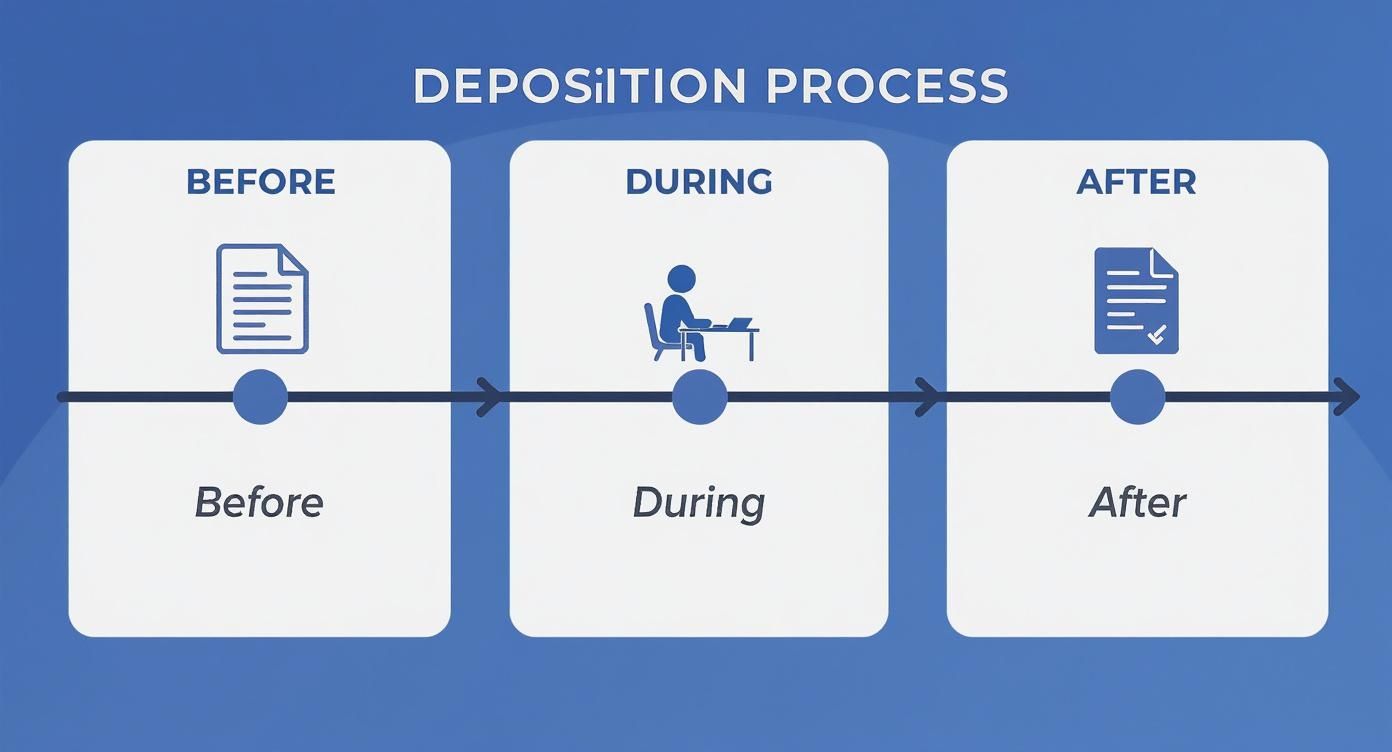
As you can see, the work you put in before you ever sit down for the deposition has a direct impact on how well you do during it, which ultimately shapes the final transcript.
Your Essential Document Checklist
Your attorney will absolutely guide you on exactly what's needed, but getting a head start never hurts. Start pulling together the following documents—they paint a complete picture of your case.
Accident and Incident Reports: This is the first official record of what happened. You need to review the police report or any incident report from the property owner to make sure your memory is crystal clear. Our guide on essential steps to take after an accident dives deeper into why this initial paperwork is so important.
Medical Records and Bills: This is everything. From the first ER visit to physical therapy notes, specialist consultations, and pharmacy receipts. These documents are the undeniable proof of your injuries and their financial cost.
Proof of Lost Wages: Grab your pay stubs from before and after the incident. If you have them, find any letters or emails from your employer that confirm the time you had to miss from work. This is how we draw a direct line from the injury to your financial losses.
Photos and Videos: A picture is truly worth a thousand words here. Any photos of the accident scene, your injuries as they healed, and damage to your car or other property are incredibly powerful. They tell a story that words just can't.
Don't Overlook Personal Records
It's not just about the "official" documents. Your personal records can provide crucial details and context. The defense lawyer can—and often will—ask about them, so you must review them with your lawyer first.
Your personal communications and records can become evidence. Being prepared means reviewing texts, emails, and even social media posts related to your accident and recovery to ensure consistency with your testimony.
Don't forget about these less-obvious but equally important items:
Personal Journals or Notes: Did you keep a diary about your pain levels, daily struggles, or recovery? Review it. It can be a goldmine for recalling specific details about your pain and suffering.
Text Messages and Emails: Any texts or emails you sent about the accident, your injuries, or how you were feeling are fair game. Go back through them so you remember what you said and to whom.
Social Media History: Be ready for this. Defense attorneys love to scour social media profiles for anything that might contradict what you're saying about your injuries. Review your posts with your attorney to get ahead of anything that could be twisted out of context.
When you and your attorney have gone through every piece of paper, every photo, and every digital message, you build a cohesive story that's tough to challenge. This groundwork is your best defense against tough questions and is the key to walking into that deposition room feeling prepared, knowledgeable, and confident. In pain? Call Caine.
Practicing Your Testimony with Your Attorney
Once you and your lawyer have gone through the documents and pieced together a solid timeline, it's time to practice. This is where we shift from theory to reality. Real, active rehearsal is what turns nervous jitters into confidence. We're not trying to memorize a script; we're building the muscle memory you'll need to give clear, truthful, and strategic answers when the pressure is on.

This is the point where I switch roles from your guide to your coach. The single most effective way to prepare is with a mock deposition. I’ll play the part of the opposing counsel, asking you the tough questions and simulating the feel of the real thing. It helps you get comfortable with the rhythm of being questioned.
The whole point is to make the actual deposition feel familiar. When you’ve already been through the wringer and faced the kinds of questions you're likely to hear, you’ll be far less rattled on the day.
The Golden Rules of Testifying
During our practice sessions, I’ll drill you on a few fundamental rules. They sound simple, but they are absolutely crucial for protecting your credibility and keeping your testimony airtight.
Rule #1: Listen to the Entire Question. Never, ever start thinking about your answer while the other attorney is still talking. Let them finish completely. This stops you from answering the question you think they’re asking instead of the one they actually asked.
Rule #2: Pause Before You Speak. After the question is done, take a beat. A deliberate pause gives you a moment to process what was asked and form a concise, accurate answer. It also gives me a chance to object if the question is out of line.
Rule #3: Never Guess or Speculate. This is the big one. If you don't know the answer, the only correct response is, "I don't know" or "I don't recall." Guessing, even with the best intentions, can create contradictions that the other side will use against you.
A deposition isn’t an interrogation or a memory test. If you can’t remember a specific detail, saying so is the most truthful and effective answer you can give. Honesty about what you don’t know is just as critical as honesty about what you do.
Learning Through Practice: Strong vs. Weak Answers
Let’s look at a couple of common scenarios you'll likely face. Seeing the difference between a weak, unpracticed response and a strong, thoughtful one really drives home why rehearsal is so important.
Scenario 1: The Vague Question
The defense attorney asks, "How have you been since the accident?"
Weak Answer: "Oh, it's been awful. My back hurts all the time, I can't sleep, and I'm just miserable. I used to go to the gym, but now I can barely get out of bed some days. It’s completely ruined my life."
Strong Answer: "I experience daily pain in my lower back, and I have trouble sleeping through the night."
The weak answer is a ramble. It’s emotional and volunteers extra information that wasn't requested. The strong answer is factual, direct, and answers only the question asked. This forces the attorney to ask specific follow-up questions to get more details.
Scenario 2: The "How Much" Question
The defense attorney asks, "How much did you have to drink at the party before you left?"
Weak Answer: "Not much, just a couple of beers. I was fine to drive."
Strong Answer: "I had two beers over a period of three hours."
The first answer is defensive and subjective ("not much," "I was fine"). The second is a simple, objective fact without any added justification. It's a far more credible response.
To help you get a better feel for this, here's a quick reference table comparing effective and ineffective ways to handle common deposition questions.
Answering Tough Questions Dos and Don'ts
A comparison of effective versus ineffective ways to respond to common deposition questions, helping you understand the strategy behind your answers.
Question Type | Do This (Effective Response) | Don't Do This (Ineffective Response) |
|---|---|---|
Leading Questions (e.g., "So your injuries weren't that bad on the first day, were they?") | "I was in pain from the first day." (Corrects the premise) | "Yes, but they got worse later." (Agrees with their false premise) |
Compound Questions (e.g., "When you left the house and got in the car, were you distracted?") | "Can you please ask one question at a time?" | "No, I wasn't distracted when I got in the car." (Answers only part of the question) |
"Why" Questions (e.g., "Why did you wait three days to see a doctor?") | "That was the earliest appointment I could get." (Factual reason) | "I don't know, I guess I thought it would get better on its own." (Speculative and opens the door for doubt) |
"Yes or No" Traps (e.g., "Have you ever had back pain before this accident, yes or no?") | "Yes, I've had minor muscle aches from working out." (Answers and provides necessary context) | "Yes." (Allows them to falsely equate minor aches with your current injury) |
Thinking through these scenarios in advance is key. The goal isn't to be a robot, but to be precise and deliberate in how you communicate the facts.
Preparing for the Modern Deposition
In recent years, how we do depositions has changed, which means our preparation has to change, too. The legal world has shifted heavily toward virtual proceedings, and that comes with its own set of rules.
This means our practice sessions need to cover the technical side of testifying on camera. According to a 2023 survey, over 70% of law firms now conduct at least some depositions remotely, a massive leap from just a few years ago. You can read more about these changes by exploring the top deposition trends reshaping the litigation landscape.
I'll help you get ready for this by:
Testing your video conferencing software.
Making sure your internet connection is stable and reliable.
Helping you set up a neutral, professional background.
Practicing how to handle and review digital exhibits on screen.
Mastering these technical details is now a non-negotiable part of preparing for a deposition. The last thing we want is for technology to get in the way of you telling your story clearly.
By thoroughly practicing both the substance of your testimony and the format you'll deliver it in, we can build a powerful, unified front. This preparation is your best tool for navigating the process with poise and precision. In pain? Call Caine.
Handling Deposition Day Pressure and Attorney Tactics
The day is here. You’ve prepped with your lawyer, you've reviewed your documents, but now it’s time for the real thing. It's completely normal to feel a bit on edge, but how you carry yourself during the questioning is just as important as what you say. Your demeanor—how you act, react, and communicate—sends a powerful message to the other side about your credibility.
Your main job today is to stay calm and professional. This can be tough, especially if the questioning feels aggressive or personal. Remember, the defense attorney’s goal is to test you and your story. By remaining composed, you show them you're a confident, truthful witness, which can do wonders for your case.
Identifying Common Defense Attorney Tactics
Defense lawyers have a playbook of questioning strategies designed to get information and poke holes in your story. Spotting these tactics is your best defense against getting flustered or giving an answer that can be twisted later. When you know what to look for, you stay in control.
Here are a few common moves to watch out for:
The Double-Barreled Question: The attorney will fire off a question with two parts, like, "When you left the house and got into your car, were you on the phone?" This is designed to trick you into a simple "yes" or "no" that isn't accurate for the whole question.
The Pregnant Pause: After you answer, the lawyer might just stare at you in silence. It can feel awkward, and most people have an urge to fill that silence by talking more. Don't. It’s a classic trick. Just give your answer and wait patiently for the next question.
Trying to Get a Rise Out of You: Some attorneys will adopt a skeptical, or even accusatory, tone. The goal is to make you angry or defensive, hoping you’ll blurt out something in frustration that hurts your case.
Rapid-Fire Questions: By asking a series of questions in quick succession, the lawyer tries to rush you. They don't want you to have time to think. This is where taking a deliberate pause before every single answer becomes your superpower.
Your attorney is your shield against improper questions, but being able to recognize these tactics yourself helps you stay focused on giving clear, honest answers.
If you remember one thing, make it this: Listen. Pause. Answer. Stop. Listen to the entire question without interrupting. Pause to think it through. Give a short, truthful answer. And then stop talking. This simple four-step rhythm is your best defense against nearly any trick in the book.
Responding to Objections and Taking Breaks
At some point, you'll probably hear your attorney say, "Objection." This is their signal that the question is legally improper in some way. It’s not your job to worry about the legal reasoning behind it. Just stop talking immediately, listen to what your lawyer says, and wait for their instruction.
99% of the time, they will object for the record and then tell you, "You can answer." But in those rare instances where they instruct you not to answer, you must follow their lead.
Depositions are marathons, not sprints. They are mentally draining, and you are not expected to sit there for hours without a break. You have the right to ask for a pause whenever you need one. If you’re tired, overwhelmed, or just need to clear your head, simply say, "I'd like to take a short break."
This is especially critical if you feel confused by a line of questioning or need a moment to speak privately with your attorney. Taking a five-minute break to regroup is always a smarter move than pushing through fatigue and making a mistake. These tactics are often ramped up in complex cases, like tough insurance disputes, where the insurer’s lawyers are trying to catch you in any little contradiction to minimize what they have to pay.
By staying calm, spotting attorney tactics, and knowing your rights, you can navigate the pressures of deposition day with confidence. This isn't about outsmarting anyone; it's about being the most credible and honest witness you can be for your own case.
If you're facing a tough legal battle and need an experienced attorney to guide you through this process, we're here to help. In pain? Call Caine.
Mastering Your Virtual Deposition Setup
More and more, legal proceedings are happening over a video call. Virtual depositions have become a common reality, which means preparing for your testimony now includes a few technical details you can't ignore. The goal is simple: make the technology feel invisible so your story can take center stage.
You want everyone focused on what you're saying, not on a fuzzy video feed or choppy audio. That means you need to treat your remote setup with the same seriousness as you would showing up in person at the law office.

Your Tech and Environment Checklist
Before you even think about logging on, run through this list with your attorney. Nailing these details ahead of time prevents technical glitches from throwing you off your game or disrupting the flow of your testimony.
Internet Connection: A stable, high-speed connection is non-negotiable. If you can, plug your computer directly into your router with an ethernet cable. It's far more reliable than Wi-Fi.
Clear Audio: A good headset with a built-in microphone is your best friend here. It cuts out echoes and background noise, making sure every word you say is heard clearly. Test it out with your lawyer beforehand.
The Right Background: Find a quiet, private room where you won't be interrupted. Your background should be neutral and distraction-free—a blank wall or a tidy bookshelf is perfect. A big no-no is sitting with a window behind you; you'll turn into a silhouette.
Your Device: Make sure your computer is fully charged and, better yet, plugged in. Close every other program and turn off all notifications. The last thing you need is a pop-up or a ding in the middle of a crucial answer.
The legal world has really embraced this shift. A recent survey showed that 83% of attorneys plan to keep using remote depositions, a massive jump from just 13% before the pandemic. It’s clear that mastering virtual testimony is more important than ever. You can read more about how litigation is adapting by checking out the latest trends in remote depositions.
Mastering Virtual Etiquette
Beyond the tech, how you come across on camera is critical. You have to project the same seriousness and credibility you would in a conference room, and small adjustments to your virtual demeanor can make a huge difference.
Here’s a key tip I give all my clients: look directly into the camera when you answer. Don't stare at the other attorney's face on the screen. Looking into the camera is the virtual equivalent of making eye contact, and it helps you build a connection and come across as more trustworthy.
Also, be ready to handle digital documents. Your attorney will practice with you on how to view and discuss exhibits that get shared on your screen, so the whole process feels seamless when it happens for real.
By taking these extra steps, you make sure the technology works for you, not against you. Proper preparation ensures your testimony is powerful and persuasive, no matter the format.
If you are preparing for a deposition and need an experienced guide, our team is ready to help you every step of the way. In pain? Call Caine.
What Happens After Your Deposition?
Alright, you've made it through the deposition. Take a breath. That was the hard part, but don't check out just yet. What comes next is just as important for making sure your story is told accurately.
Once the cameras and recorders are off, the court reporter gets to work. They’ll turn every word spoken during your deposition into an official, written document called a transcript. Think of it as the script of your testimony. You and your attorney will get a copy to review, and this is your one and only chance to get it right.
Reading and Signing: Your Final Review
This next step is often called "reading and signing," and it's exactly what it sounds like. You need to read through that entire transcript, line by line, to make sure it's 100% accurate. This isn't something you skim. You'll go over it carefully with your lawyer.
If you spot an error—maybe a word was transcribed wrong or a date is incorrect—you'll note it down on what's called an errata sheet. This is your formal list of corrections. It's a critical step because once that transcript is finalized, it’s set in stone. The other side will use it to poke holes in your story, so we need to make sure it's perfect.
Your sworn testimony is a cornerstone of your case. Ensuring the transcript perfectly reflects what you said is a non-negotiable step in protecting your credibility and the strength of your claim.
It's also worth noting how seriously the legal world is taking the security of this information. A recent survey showed that 57% of legal professionals are more focused than ever on the data security of deposition platforms. Protecting your sensitive testimony is a top priority. You can read more about data security trends in legal proceedings if you're interested.
Once your review is complete and the transcript is final, both legal teams will use your testimony to size up the case. This heavily influences whether they offer a fair settlement or decide to push toward trial. Having a skilled attorney in your corner ensures nothing gets missed. In pain? Call Caine.
Answering Your Lingering Questions Before Deposition Day
Even after you've prepared with your lawyer, it's completely normal to have some last-minute questions pop up as your deposition gets closer. Let's tackle some of the most common ones I hear from clients. Getting these sorted out can give you that final boost of confidence.
How Long Is This Going to Take?
This is probably the most common question, and the honest answer is: it depends on your case.
Florida law puts a general cap on depositions at seven hours in a single day, but that's the absolute maximum. Most of the personal injury depositions I handle are wrapped up in about two to four hours. Don't let that seven-hour number scare you; it’s rarely a reality for cases like yours.
Your attorney will give you a much better time estimate based on the specifics of your accident and injuries. Still, my best advice is to clear your schedule for the entire day. The last thing you want is to be glancing at the clock, stressed about another appointment. Give yourself the space to focus completely on giving clear, accurate testimony.
What Should I Wear?
Think of it like a job interview or a day in court. How you present yourself matters, and your clothing should reflect that you're taking this seriously.
Business casual is the perfect way to go. You can’t go wrong with something like:
A pair of slacks and a collared shirt or blouse
A simple, professional dress or skirt
Steer clear of anything that could be distracting. That means no t-shirts with big logos, no flashy jewelry, and definitely no shorts or sandals. You want the defense attorney focused on your words, not your wardrobe.
A Pro Tip From Experience: Your appearance is the first thing the opposing lawyer sees. Dressing professionally sends a powerful, non-verbal message: "I am a credible witness, and I am serious about my case."
What if My Mind Goes Blank and I Can't Remember Something?
First off, take a breath. It happens to everyone. A deposition is not a memory test, and no one expects you to have perfect recall of every single detail.
The most important rule here is to never, ever guess. If you're not sure about something, the right and only answer is, "I don't remember" or "I don't recall." It's as simple as that.
Trying to fill in the blanks, even if you have good intentions, can really come back to bite you. If you make something up and it's later proven wrong, your credibility takes a massive hit. If you can only give a ballpark figure for a time or distance, make sure you say so. "I'd estimate it was about..." is a perfectly fine answer. Being honest about what you don't know is a strength, not a weakness.
Can I Talk to My Lawyer During the Questioning?
For the most part, once a question has been asked, you can't huddle up with your attorney for advice on how to answer. The other side has a right to hear your own, uncoached testimony.
But that doesn't mean your lawyer isn't there for you. They are your shield.
If you start to feel confused, exhausted, or like the defense attorney is backing you into a corner, you can absolutely ask for a break. This gives you a chance to step outside and talk privately with your lawyer. Also, listen closely for your attorney to say "Objection." When you hear that, stop talking immediately. Don't say another word until your lawyer gives you the green light to continue.
Navigating the complexities of a personal injury claim requires an experienced legal partner who understands how to prepare you for critical moments like a deposition. At CAINE LAW, we ensure our clients are confident, prepared, and ready to tell their story effectively. In pain? Call Caine. Contact us today for a free consultation.
