
In Pain? Call Caine
how to negotiate with insurance adjuster - win bigger

5 Min read
By: Caine Law
Share
That first phone call from the insurance adjuster is a make-or-break moment. It sets the tone for your entire claim, so you absolutely have to be ready. The game plan is simple: give them only the bare-bones information, say a firm "no" to a recorded statement, and never forget their goal is to pay you as little as possible. Never give a recorded statement on this initial call. Trust me, it can and will be used against you down the road.
Your First Conversation with the Insurance Adjuster

The minutes and hours after a crash are a blur. But when that call from the adjuster comes through, you need to snap into focus. This isn't just a friendly check-in; it's the opening play in a negotiation where the stakes are high.
The adjuster’s job is to protect their company’s bottom line, which means finding any reason to pay out less on your claim. These are trained professionals, skilled at steering conversations and getting you to say things that can sink your case. From their perspective, every question is a probe. They might sound caring, but their real job is to find ammunition to devalue your injuries or even shift the blame onto you. Knowing this from the jump is your best defense.
What to Have Ready Before You Speak
Confidence on that call comes from one thing: preparation. Before you even think about picking up the phone, get your key documents in order. Having the facts in front of you keeps you from guessing or giving them shaky information under pressure.
Police Report: Have a copy handy. It’s got the official details, officer notes, and any witness info.
Your Claim Number: You’ll want to give them this right away so everything is properly logged in their system from the start.
Basic Incident Details: Know the exact date, time, and location. Stick to these facts and don't offer opinions or guess about who was at fault.
Pulling this info together is a key part of the essential steps to take after an accident.
The Dangers of a Recorded Statement
One of the first things the adjuster will ask for is a recorded statement. Here’s the deal: you are under no legal obligation to give one, and it’s almost always a bad idea. These recordings don't benefit you in any way. The adjuster will ask broad, open-ended questions designed to trap you.
For example, a simple question like, "How are you feeling today?" is a classic setup. If you automatically say, "I'm fine, thanks," they will use that little phrase to argue your injuries aren't that serious, even if you’re in agony.
Key Takeaway: Politely but firmly turn down any request to be recorded. All you need to say is: "I'm not comfortable providing a recorded statement at this time, but I can give you the basic information to get the claim started."
Setting the Right Tone from the Start
Your goal for this first call is to take control and protect your rights. You can be cooperative without giving away the farm. Keep your answers short, sweet, and strictly factual.
What It's OK to Say:
Your full name, address, and phone number.
The date and location of the accident.
The make and model of the car you were driving.
What You Should Absolutely Avoid Saying:
Don't get into the specifics of your injuries. A simple, "I'm still under a doctor's care," is all they need to know.
Never apologize or admit any fault. Let the evidence and the police report speak for itself.
Don't guess about what caused the crash or what you think the other driver was doing. Stick to what you know for a fact.
By managing this first interaction with a clear strategy, you build a strong foundation for the rest of the negotiation. You’ve given them just enough to move the claim forward while shielding yourself from the common tactics adjusters use to lowball you. This measured approach is your first step toward getting the fair settlement you deserve.
Calculating the Real Value of Your Claim

Let's be clear: the insurance adjuster's first offer is almost never their best one. Think of it as an opening bid. They're testing the waters to see if you’ll bite on a quick, low payout and just go away.
To push back effectively, you can't just feel like the offer is too low—you have to prove it. And you prove it by doing the math yourself and presenting a detailed calculation of your claim's true worth. This means tallying up every single cost, both the obvious and the hidden, so you can build a demand package based on hard evidence, not emotion.
A solid claim value is built from two key pieces: economic damages and non-economic damages. The first part is the straightforward, billable losses. The second is all about the human cost of the accident.
Tallying Up Your Economic Damages
Economic damages are the bedrock of your claim because they represent direct financial losses with a clear paper trail. This is the easiest part to calculate, but it demands meticulous organization. You have to track every single expense, no matter how small it seems.
These damages include:
All Medical Expenses: This isn't just the big hospital bill. It’s every co-pay, prescription, physical therapy session, and piece of medical equipment like crutches or a brace. Don't forget to include the mileage for driving to and from all your doctor's appointments.
Lost Wages: Calculate the exact income you've lost because you couldn't work. If you had to burn through sick days or vacation time to recover, that counts, too. Those are earned benefits you were forced to use.
Future Lost Income: If your injuries are serious enough to prevent you from returning to your old job or will limit your earning capacity down the road, this has to be projected and included.
Property Damage: This covers the cost to repair or replace your vehicle and any personal items that were wrecked in the crash—think laptops, phones, or even your eyeglasses.
This kind of detailed accounting is critical for any type of crash. To get a better sense of how we dig into the specifics, you can learn more about how we handle the complexities of auto and motorcycle accident claims.
Before you make your demand, you need a crystal-clear picture of every dollar you've lost. The table below breaks down the key components to include in your settlement calculation.
Key Components of Your Settlement Demand
Damage Category | What to Include | Documentation Example |
|---|---|---|
Medical Expenses | ER visits, hospital stays, surgery, prescriptions, physical therapy, medical devices, chiropractic care, and future medical needs. | Itemized hospital bills, pharmacy receipts, physical therapy invoices, and expert medical opinions on future treatment costs. |
Lost Income | Wages lost from missed work, used sick/vacation days, and diminished future earning capacity if injuries are long-term. | Pay stubs showing your typical earnings, a letter from your employer confirming missed time, and W-2 forms. |
Property Damage | Vehicle repair/replacement costs and the value of any personal items destroyed in the accident (e.g., phone, laptop). | Body shop repair estimates, a "total loss" valuation from the insurer, and receipts for damaged personal property. |
Pain & Suffering | Physical pain, emotional distress, anxiety, loss of enjoyment of life, and the general disruption caused by the injury. | Personal journal detailing daily pain levels, photos of injuries, and statements from friends or family about the accident's impact on you. |
Having this documentation organized and ready to go shows the adjuster you're serious and have a claim grounded in fact, not just feelings.
Putting a Price on Pain and Suffering
This is where things can get tricky. How do you put a dollar figure on your physical pain, emotional distress, and the complete disruption of your life? These are non-economic damages, and they are just as real and just as important as your medical bills.
Insurance companies often use a formula to get a starting point for pain and suffering. One of the most common methods is the "multiplier approach." With this system, your total economic damages (usually just the medical costs) are multiplied by a number, typically between 1.5 and 5.
The multiplier you argue for depends entirely on the severity of your injuries and how profoundly they've impacted your life. A minor sprain might only justify a 1.5x multiplier, but a permanent injury that required surgery could easily support a 4x or 5x multiplier.
For example, let's say you have $10,000 in medical bills from an injury that took you out of commission for months. You could reasonably argue for a multiplier of 3, which would value your pain and suffering at $30,000.
Assembling Your Total Settlement Value
Once you've calculated both parts, you put them together to arrive at your total settlement demand.
Economic Damages: $15,000 (Medical Bills + Lost Wages)
Non-Economic Damages: $45,000 ($15,000 in Medicals x 3 Multiplier)
Total Initial Demand: $60,000
This final number isn't just pulled out of thin air; it’s a logical figure you can stand behind and defend. When you present this to the adjuster, you aren't just asking for money—you're showing them your work. This immediately shifts the conversation from their lowball number to your evidence-backed calculation, giving you a much stronger position to negotiate from.
If this whole process feels overwhelming, just remember that help is available. In pain? Call Caine.
Proven Tactics for Insurance Negotiations
https://www.youtube.com/embed/81C3rd5XjZk
Once you’ve done the math and know what your claim is really worth, the real work begins. Negotiation is a delicate dance, a strategic conversation where every single word matters. The key isn't to be aggressive; it's to be prepared, professional, and persistent.
Your goal is to completely flip the script. Instead of just reacting to the adjuster's lowball offers, you need to lead the discussion with confidence, anchored by the facts and documentation you've already put together. This is how you stay in control and move the needle toward a fair settlement.
Making Your First Demand
Your initial demand isn't just a number—it's a statement. It immediately tells the adjuster you’ve done your homework and you understand what your claim is truly worth. This demand should always be made in writing, usually in a formal demand letter.
This letter needs to clearly and concisely lay out:
The facts of the accident.
A summary of your injuries and the medical treatment you've received.
A complete breakdown of your economic damages (medical bills, lost wages).
Your calculation for non-economic damages (pain and suffering).
The total settlement amount you are demanding.
By presenting a well-reasoned demand backed by solid evidence, you force the adjuster to engage with your numbers, not just their own internal formulas. This sets a high, strong anchor for the negotiation that follows.
Countering the Inevitable Low Offer
Let's be clear: the adjuster's first counteroffer will almost certainly be low. It's a standard tactic, a test to see if you're desperate or uninformed enough to take it. Don't get discouraged or offended—just expect it.
Your response needs to be calm and fact-based. Instead of just saying "no," you have to explain exactly why their offer is inadequate.
Pro Tip: When the adjuster gives you that low offer, put the ball back in their court. Ask them, "Can you please walk me through how you arrived at that figure?" This forces them to explain their logic, which often reveals weak spots in their valuation that you can immediately challenge.
For example, you could say, "I appreciate you providing that figure, but it doesn't seem to account for the future physical therapy my doctor has recommended, which is estimated to cost another $4,000. It also seriously undervalues the three months of chronic pain I've had to live with."
Exposing and Defeating Common Adjuster Maneuvers
Insurance adjusters are trained negotiators with a whole playbook of tactics designed to save their company money. Spotting these strategies is the first step to beating them.
Common Adjuster Tactics to Watch For:
Creating Unnecessary Delays: They know that the longer a claim drags on, the more financial pressure you feel. They might "lose" your paperwork or take forever to return calls, hoping you'll get frustrated and accept a low offer just to be done with it. Your counter is simple: be persistent. Follow up every phone call with an email summarizing the chat and keep a detailed log of every single communication.
Downplaying Your Injuries: The adjuster will dig through your medical records looking for any gap in treatment or pre-existing condition they can use to argue your injuries aren't as bad as you claim. This is precisely why consistent medical care and complete documentation are so critical.
Requesting Unnecessary Information: They may ask for your entire life's medical history, hoping to find something totally unrelated they can use against you. Only provide records that are directly related to the injuries from this accident.
If you sense these tactics being used, don't lose your cool. Just firmly and politely steer the conversation back to the documented facts of your case. Your polite persistence shows them you won't be easily intimidated.
Staying Firm Without Being Aggressive
Throughout the negotiation, your demeanor is your secret weapon. Yelling or getting emotional will only give the adjuster a reason to label you as "difficult" and slow the process down even more. Remember, politeness and firmness are not mutually exclusive.
You can hold your ground effectively by using phrases like:
"My documentation supports a higher valuation."
"I'm not in a position to accept an offer that doesn't cover my documented losses."
"Let's focus on what the medical reports and financial records actually show."
This professional approach keeps the negotiation centered on evidence. It proves to the adjuster that while you're reasonable, you will not settle for less than what is fair. And you don't have to give in. Reports show that a surprising number of appealed claims succeed, yet very few people even try. Over 50% of appealed claims are ultimately successful, but only about 1% of policyholders actually pursue an appeal after an initial denial. You can read about insurance claim appeal success rates to see why challenging an insurer's decision is often worth it.
If the adjuster refuses to offer a fair amount and you feel like you've hit a wall, it may be time to consider the next step. Sometimes, the strongest negotiating tactic is knowing when to bring in a professional.
If the back-and-forth feels like a losing battle, don't give up. In pain? Call Caine.
Navigating Florida’s Unique Insurance Claim Rules
Dealing with an insurance adjuster is never easy, but in Florida, you’re playing on their home turf. The Sunshine State has its own playbook for insurance claims, and you can bet the adjuster knows every single rule by heart. They often use these regulations to their advantage, not yours.
This isn't about you becoming a lawyer overnight. It's about knowing the specific rules that can make or break your personal injury claim. One wrong move, like waiting too long to see a doctor, can hand the adjuster all the proof they need to slash your settlement or deny it altogether.
What Florida's "No-Fault" System Really Means
Florida is a "no-fault" state, a term that trips a lot of people up. It definitely doesn't mean the at-fault driver gets a free pass. It simply means your own car insurance is the first to pay for your medical bills, no matter who caused the accident.
This is all handled through your Personal Injury Protection (PIP) coverage. PIP is a required part of most Florida auto policies and it’s designed to get you quick access to money for medical care.
Initial Coverage: Your PIP policy covers 80% of your initial medical bills and 60% of your lost wages, up to a limit of $10,000.
Who It Covers: PIP covers you, any relatives living with you, and passengers in your car who don’t have their own PIP insurance.
The at-fault driver's insurance adjuster will absolutely use your PIP coverage as an excuse to drag their feet. They know your immediate bills are being taken care of, so they might create delays or go silent, hoping you’ll eventually just give up.
The 14-Day Rule: A Critical Deadline You Can't Miss
This is easily one of the most important—and most frequently missed—rules in Florida insurance law. After a car accident, you have exactly 14 days to get initial medical treatment. If you don't see a qualified medical professional within that two-week window, your own PIP insurance can legally refuse to pay for any of your medical care.
An insurance adjuster will always check the date of your first medical visit. If you went to the doctor on day 15, they have a rock-solid, legal reason to argue that your insurer shouldn't pay a dime. They’ll then use that to question how badly you were really hurt.
Even if you think you feel fine after a crash, get checked out immediately. Adrenaline is a powerful pain-masker, and waiting too long doesn't just put your health at risk—it jeopardizes your entire financial recovery.
How "Comparative Negligence" Can Shrink Your Settlement
Another key Florida rule you need to know is comparative negligence. This law acknowledges that sometimes, more than one person is partly to blame for an accident. Under this system, your final settlement gets reduced by whatever percentage of fault is assigned to you.
For example, if your total damages are calculated at $50,000 but you're found to be 20% at fault, your settlement is automatically cut by $10,000. The most you could recover would be $40,000.
Insurance adjusters love this rule. They will dig for any reason to pin a small piece of the blame on you just to lower their payout. This is precisely why you should never apologize or admit any fault at the scene of an accident.
Knowing these Florida-specific rules isn't optional; it's essential. When an adjuster realizes you understand things like the 14-day rule and comparative negligence, they're far less likely to try and use those technicalities to cheat you out of a fair settlement. If you feel an adjuster is twisting these rules against you, don’t try to fight them on your own. In pain? Call Caine.
Knowing When to Hire a Personal Injury Attorney
While you might be able to handle a minor fender-bender on your own, every claim has a tipping point. It’s that moment when the adjuster’s tactics get too aggressive, the injuries are too severe, or the whole process just becomes too much to manage alone. Recognizing that moment is crucial for protecting your financial future.
Trying to go it alone past this point is like showing up to a gunfight with a spoon. The insurance adjuster is a trained professional whose entire job is to minimize what their company pays out. When they realize you're unrepresented in a serious case, they often double down on their lowball tactics, betting that you don't have the legal know-how to fight back effectively.
Red Flags That Signal You Need a Lawyer
Certain situations should set off alarm bells, telling you it’s time to stop talking to the adjuster and start talking to an attorney. If any of these sound familiar, the playing field is no longer level, and you need a professional in your corner.
You've Suffered Serious or Permanent Injuries: If your injuries require surgery, ongoing physical therapy, or will leave you with a long-term impairment, the value of your claim is substantial. Calculating future medical bills and lost earning capacity is incredibly complex—it’s not something you should ever try to do on your own.
The Insurance Company Disputes Fault: Is the adjuster trying to pin some or all of the blame on you? They’re setting up to use Florida’s comparative negligence rule to slash your settlement. A lawyer can bring in accident reconstruction experts and track down witnesses to prove who was truly at fault and protect your claim’s full value.
The Adjuster Is Using Bad-Faith Tactics: Are they dragging their feet for months, ignoring your calls, or twisting the words of your policy? These are classic signs of an insurer acting in bad faith. An attorney can hold them accountable and pursue legal action for these complex insurance disputes.
This decision tree can help you visualize when it's time to get professional help after an accident here in Florida.
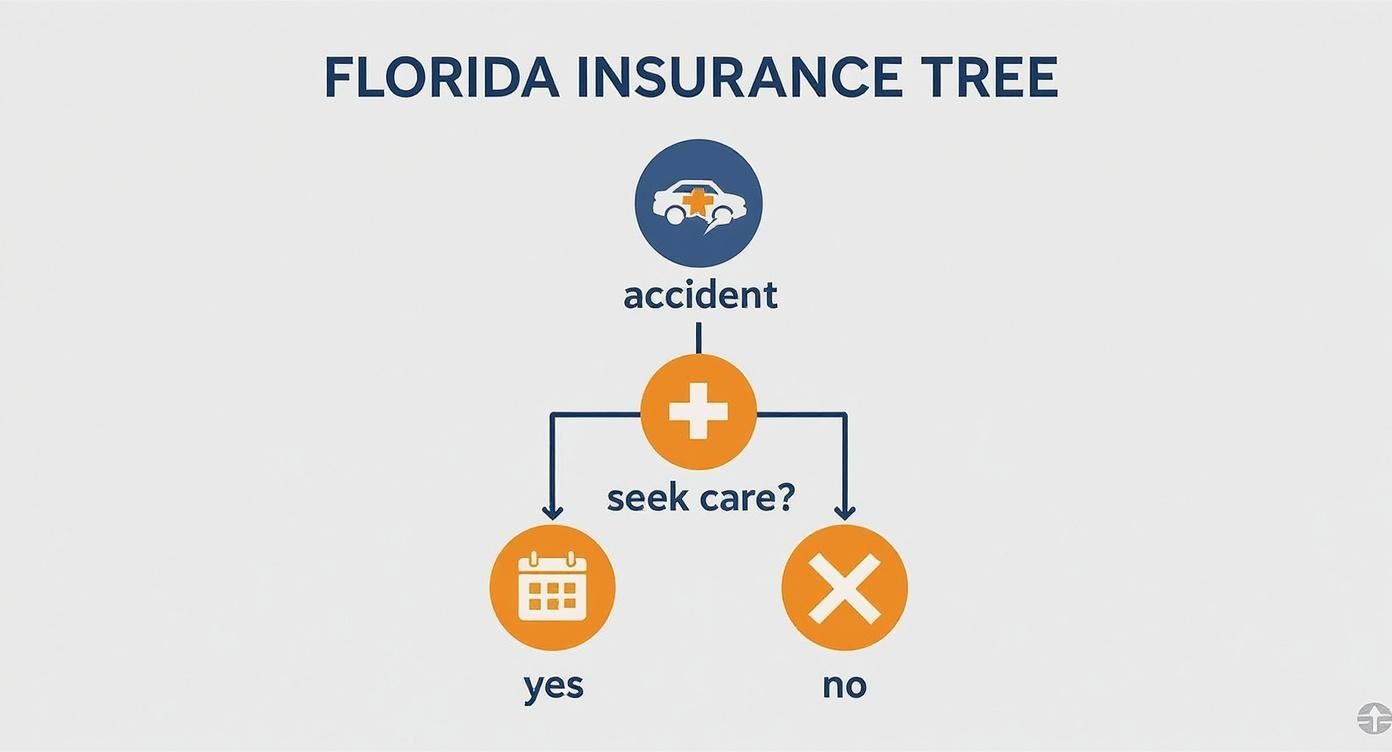
As the chart shows, that first decision to seek medical care is a critical fork in the road. It has a massive impact on the viability and value of any insurance claim you make under Florida law.
Do I Need a Lawyer? A Self-Assessment Checklist
Still on the fence? This checklist can help you gauge whether the complexity of your case means it's time to bring in a professional.
Situation | Handle on Your Own (Maybe) | Strongly Consider a Lawyer (Yes) |
|---|---|---|
Injury Severity | Minor bumps, bruises, sore muscles. No follow-up treatment needed. | Broken bones, surgery, head trauma, permanent scarring, or long-term care required. |
Who's at Fault? | The other driver's fault is 100% clear and admitted in the police report. | The other driver is blaming you, or fault is shared or unclear. |
Adjuster's Offer | The offer seems fair and covers all your documented medical bills and lost time from work. | The offer is insultingly low, or they are refusing to cover certain medical treatments. |
Communication | The adjuster is responsive, clear, and seems to be processing the claim fairly. | The adjuster is ghosting you, delaying, or using confusing, intimidating language. |
Type of Damages | Your claim is only for property damage and a few specific medical bills. | Your claim involves future medical costs, lost earning potential, or significant pain and suffering. |
If you checked "Yes" for even one of these situations, you're venturing into territory where professional legal guidance isn't just helpful—it's essential for getting a fair outcome.
How an Attorney Immediately Changes the Game
Hiring an experienced personal injury lawyer completely flips the power dynamic. The moment our firm sends a letter of representation, the adjuster knows the game has changed. They’re no longer dealing with an individual they can pressure; they’re up against a legal professional who knows every trick in their playbook and, more importantly, knows the true value of your claim.
An attorney takes over all communication with the insurance company. This puts an immediate stop to the adjuster's constant calls and protects you from accidentally saying something that could damage your case. You get to focus on what matters—your recovery—while a professional handles the fight.
We launch a full-scale investigation, gathering all the necessary evidence, consulting with medical and financial experts, and building an ironclad case. This level of preparation sends a clear message to the insurer: we are ready to go to court if a fair settlement isn't put on the table.
The Financial Impact of Legal Representation
Many people hesitate to call a lawyer because they're worried about the cost. But the data shows that good legal representation doesn't just pay for itself—it can dramatically increase your final settlement.
Research from the Insurance Research Council found that people who hire lawyers for their car accident claims receive settlements that are, on average, 3.5 times higher than those who go it alone. The statistics are even more stark when it comes to getting paid at all: 91% of claimants with a lawyer receive a payout, compared to just 51% of those without one.
An attorney levels the playing field, ensuring you aren't taken advantage of by a multi-billion dollar corporation. We know how to maximize the value of your economic damages (like medical bills) and non-economic damages (like pain and suffering), fighting for compensation you might not even realize you're entitled to.
If you’re stuck in a tough negotiation and the adjuster refuses to be reasonable, don't just walk away with less than you deserve. In pain? Call Caine.
How to Finalize Your Insurance Settlement

After all the back-and-forth negotiations, hearing the adjuster finally agree to a fair number feels like a massive win. And it is. But the fight isn't quite over yet. A verbal agreement is just a promise—it’s the paperwork that makes it real and legally binding.
This is the last mile, and it’s all about the details. If you rush through this part or don't read the fine print, you can accidentally undo all your hard work. You have to be absolutely certain that the written agreement says exactly what you discussed and doesn't hide any nasty surprises.
Never Settle on a Handshake
A verbal "yes" over the phone means nothing in the eyes of the law. The golden rule of finalizing any claim is this: get everything in writing. Don't even think about considering the matter closed until you have the settlement agreement in your hands, whether it's a paper copy or a digital one.
This document is your only proof of the deal you struck. It’s what protects you if the adjuster conveniently "forgets" a key detail or the insurance company tries to walk back their offer. You have to politely—but firmly—insist on reviewing the full agreement before you sign a single thing.
Read the Settlement and Release Form Like a Hawk
The most important document you’ll receive is the settlement and release form. This is the big one. When you sign it, you're agreeing to take the money in exchange for releasing the at-fault party and their insurer from all future liability for the accident. It's a final, permanent step.
Before your pen ever touches that paper, you need to read every single word. I mean it. Look for these specific items:
The Settlement Amount: Does the dollar figure perfectly match the number you agreed on? Double-check for typos or any discrepancies.
Who You're Releasing: The form should only release the at-fault driver and their insurance company. Be wary of broad language that tries to release "all other persons, firms, or corporations," as it could stop you from pursuing other legitimate claims you might have.
The Scope of the Release: Make sure the release is strictly limited to this specific accident. It shouldn't block you from filing a claim for an entirely different incident in the future.
Signing a release form is the point of no return. Once it’s signed, you can never go back and ask for more money for this accident, even if your injuries get worse down the road. Meticulously reviewing this document isn't just a good idea—it's absolutely critical.
Understanding Where the Money Goes
The settlement amount you and the adjuster agreed upon isn't usually the amount that hits your bank account. It's crucial to understand the common deductions so you aren't shocked when the check arrives.
Here's what's typically taken out:
Medical Liens: If your health insurance or a hospital covered your treatment, they likely placed a lien on your settlement. This means they get paid back directly from your settlement funds before you see a dime.
Attorney Fees: If you hired a lawyer, their fees and costs are deducted from the final amount as outlined in your agreement.
While you can handle your own claim, many people get tangled up in the complexity of negotiating liens and finalizing payments. This is where professional help can make a huge difference. On average, third-party negotiation services can achieve savings of around 30% on medical bills, potentially turning a $10,000 bill into a more manageable $7,000. You can discover more insights about third-party claims savings to see how the pros work to maximize what you actually take home.
At CAINE LAW, we handle this entire finalization process for our clients, from making sure the paperwork is perfect to explaining every single deduction. If you're at the final stages of your settlement or need a professional to step in and finish the fight, we're here for you. In pain? Call Caine. Learn more at https://cainelegal.com.
