
In Pain? Call Caine
How to File Wrongful Death Lawsuit: Florida Guide

5 Min read
By: Caine Law
Share
When you lose someone you love, the last thing on your mind is a legal battle. The grief can be all-consuming. But when that loss happens because someone else was careless or negligent, understanding how to file a wrongful death lawsuit in Florida is a crucial first step toward getting answers and holding the right people accountable.
The process doesn't start with the whole family filing a claim together. It begins with the court appointing a personal representative for your loved one's estate. This person then files the claim on behalf of all the surviving family members who have been affected.
Your First Steps in a Florida Wrongful Death Claim

Grappling with a sudden, tragic loss is overwhelming enough without trying to decipher the legal system. A wrongful death claim is a civil action—it’s how the law holds a negligent person or company responsible for causing a death. Florida has very specific rules about who can bring this kind of lawsuit and how to get it started.
It all hinges on one key person: the personal representative. This individual, who might be named in the deceased's will or appointed by a judge, essentially becomes the legal voice for the estate and its survivors. Their job is to manage the lawsuit for the benefit of those left behind—usually a spouse, children, or parents.
Immediate Priorities After a Tragic Loss
The days right after a death are pure chaos, but some actions are incredibly time-sensitive. The clock on your legal rights starts ticking immediately, and critical evidence can be lost forever if you wait too long.
Here are the foundational things you need to focus on right away:
Get the Official Death Certificate. This is the single most important legal document. It confirms the cause of death and is non-negotiable for opening an estate and filing a claim.
Start Gathering Paperwork. Collect every document you can find related to the incident. Think police reports, medical records from the hospital, or any workplace incident reports. Our guide on what to do when accidents happen offers more detail on this.
Preserve All Physical Evidence. This is huge. Don't get the car repaired. Don't throw away a faulty product. Don't fix the broken staircase. This tangible evidence is often the most compelling proof you have.
This checklist can help you keep track of what needs to happen right away.
Initial Checklist for a Florida Wrongful Death Claim
Action or Role | What It Means | Why It's a Priority |
|---|---|---|
Personal Representative | The court-appointed individual who acts on behalf of the estate. | No claim can be filed without one. It's the first legal hurdle. |
Obtain Death Certificate | Getting the official, certified copy from the state or county. | This is the primary document required to open the estate. |
Gather Key Documents | Collecting all police reports, medical records, and incident reports. | These documents provide the factual basis for proving negligence. |
Preserve Evidence | Protecting any physical items or scenes related to the incident. | Evidence can be lost or destroyed quickly, weakening your case. |
Consult an Attorney | Speaking with an experienced wrongful death lawyer. | To understand your rights and avoid missing the strict legal deadline. |
Taking these initial steps lays the groundwork for a strong and successful claim.
A wrongful death claim isn't just about money. It's about accountability. It's about making sure the people responsible are held to account so another family doesn't have to go through the same nightmare.
Don’t Miss Florida’s Strict Deadline
In any wrongful death case, the law sets a firm time limit for filing a lawsuit, known as the statute of limitations. This window varies by state, but it's an absolute deadline.
In Florida, that window is dangerously short. You generally have just two years from the date of your loved one's death to file a lawsuit. If you miss this deadline, your right to seek justice is gone forever. It's not a suggestion; it's a hard-and-fast rule.
This is why getting legal guidance quickly is so important. An experienced attorney will make sure that deadline is met, that crucial evidence is saved, and that your family is protected from the very beginning.
If your family is facing this impossible reality, you don't have to figure it all out on your own. We are here to help you understand your options and take the first steps toward justice. In pain? Call Caine.
Who Can File a Florida Wrongful Death Claim and What Must Be Proven?
Not just anyone can step forward and file a wrongful death lawsuit in Florida. The law is incredibly specific about who holds the legal standing to bring a claim and what, exactly, needs to be proven for that claim to have a chance. Getting these foundational pieces right from the very beginning isn't just important—it's everything.
The entire legal process is channeled through a single, crucial figure: the personal representative of the deceased person's estate. This is the only person the law allows to file the lawsuit. They don't act for themselves, but as a fiduciary for all the survivors, managing the claim on their collective behalf.
Who Is the Personal Representative?
This individual is formally appointed to handle the deceased's final affairs, which includes pursuing any legal action. How they get this role usually happens in one of two ways:
Named in a Will: If your loved one left a valid will, they probably named a specific person to act as the personal representative (an older term for this is "executor").
Appointed by the Court: If there’s no will, a probate court will have to appoint someone. Florida law sets a clear order of preference, which usually starts with the surviving spouse, followed by an adult child.
Once the court officially appoints this person, they have the legal green light to hire an attorney and move forward with the wrongful death suit.
Who Are the Survivors That Can Recover Damages?
While the personal representative is the one who files the suit, they're doing it for the benefit of the survivors. These are the close family members who have suffered direct, profound losses from the death.
Under Florida law, survivors typically include:
The surviving spouse
The children of the deceased (both minor and adult)
The parents of the deceased
Any blood relatives or adoptive siblings who depended on the deceased for support or services
The specific relationship each survivor had with the person who passed away will shape the types of damages they can recover. We’ll get into the details on that a bit later.
Think of a wrongful death case as a four-legged stool. If you’re missing even one of those legs, the whole thing comes crashing down. You have to prove all four elements to have a solid claim.
The Four Elements of a Successful Wrongful Death Case
To win, your attorney has to prove four distinct elements. This is the legal framework that every single successful wrongful death claim is built upon.
1. A Duty of Care Existed First, we have to show that the person or company at fault (the defendant) had a legal obligation to act with a certain level of care toward your loved one. This "duty of care" is all around us. For example, every single driver on the road owes a duty to everyone else to operate their vehicle safely.
2. That Duty of Care Was Breached Next, we prove the defendant failed to live up to that obligation. This failure is the negligent act. A driver who gets behind the wheel drunk and plows through a red light has obviously breached their duty to drive safely.
3. The Breach Directly Caused the Death (Causation) This is the connection. We have to draw a clear, undeniable line from the defendant's breach of duty to your loved one's death. The fatal accident must be a direct result of that driver’s decision to drink and drive recklessly. It can't be a coincidence.
4. The Death Resulted in Damages Finally, we have to show that the death caused real losses—both financial and emotional—for the estate and the survivors. These damages range from funeral expenses, lost income, and medical bills to the devastating emotional pain and loss of companionship the family is forced to endure.
Picture a construction site accident. A contractor fails to properly secure heavy equipment on a high-rise, and it falls, killing a pedestrian on the sidewalk below. The contractor had a duty to secure that site. They breached it. That breach caused the death, and the family suffered immense damages. That’s how the four elements lock together to form a powerful case.
Understanding these roles and requirements is the first major step. If you’re struggling to figure out who should be the personal representative or how to start piecing together the evidence for your case, we can help bring clarity to the path forward. In pain? Call Caine.
The Critical Investigation and Evidence Gathering Phase

The moments immediately following a fatal incident are chaotic and emotionally shattering. But these first few hours and days are also the most critical for building a strong wrongful death claim. Evidence is fragile. It can disappear, get wiped, or be altered in a heartbeat, making swift, decisive action absolutely non-negotiable.
This is where the real investigation begins. An experienced legal team doesn't just sit back and wait for official reports to trickle in. We get to work immediately, actively uncovering and preserving the proof needed to show exactly what happened and who was responsible. Think of it as laying the foundation for your case, brick by brick, before the other side even has a chance to cover their tracks.
Preserving Evidence That Vanishes Quickly
Some of the most crucial pieces of evidence have an incredibly short shelf life. For instance, in a fatal trucking accident, the truck’s “black box,” or Electronic Control Module (ECM), holds a treasure trove of data on speed, braking, and driver hours. That data can be easily overwritten or erased if it isn't secured right away.
It's the same story with surveillance footage. A camera at a nearby storefront that captured a car crash might be set to automatically delete its recordings within 24 to 72 hours. A seasoned legal team knows to send out a spoliation letter immediately. This formal notice legally obligates the at-fault party and other entities to preserve all relevant evidence, preventing its destruction.
Here are a few examples of time-sensitive evidence we move to secure:
Vehicle Data Recorders: Securing the "black box" from commercial trucks, buses, or even modern passenger cars before critical data is lost forever.
Surveillance Video: Obtaining time-stamped video from traffic cameras, businesses, or doorbell cameras that might have caught the incident.
Scene Documentation: Taking detailed photographs and measurements of an accident scene or hazardous property before it's cleaned up, repaired, or changed.
The strength of a wrongful death lawsuit is directly tied to the quality of the evidence gathered in the first few days. What you can prove is far more important than what you know.
Identifying All Potential Defendants
One of the most common missteps is assuming only one person or company is at fault. A truly thorough investigation often uncovers a whole chain of negligence involving multiple parties. Pinpointing every single potential defendant is vital because it can significantly increase the resources available for your family’s compensation.
Let's take a fatal slip-and-fall on a wet floor in a retail store. The obvious defendant is the store itself. But a proper investigation might also reveal liability for:
The property management company responsible for maintenance.
A third-party cleaning service that failed to use "wet floor" signs.
The building owner who knew about plumbing leaks but did nothing.
Uncovering every responsible party is a key part of learning how to file a wrongful death lawsuit effectively.
Essential Evidence for Different Case Types
The specific evidence needed really depends on the nature of the case. A claim for a car accident demands a different approach than one for medical malpractice.
In medical malpractice situations, for example, the investigation zeroes in on medical records, hospital policies, and testimony from medical experts. These cases are notoriously complex and, frankly, often go unfiled. While medical errors are estimated to cause up to 250,000 deaths a year in the U.S., the National Practitioner Data Bank reported only about 3,046 medical malpractice payments for wrongful death claims in a recent year. You can learn more about these medical malpractice statistics and the uphill battle families face.
For other common types of cases, the evidence we hunt for might include:
Accident Claims: Witness statements, police reports, and analysis from accident reconstruction experts.
Defective Products: The product itself, design schematics, and internal company documents.
Negligent Security: Records of prior crimes on the property, security guard logs, and lighting inspection reports.
This investigative phase is demanding and requires immediate action. If your family is facing this difficult journey, having a skilled team to handle the evidence gathering from day one is essential. In pain? Call Caine.
Calculating the Damages Your Family Can Recover
No amount of money can ever fill the void left by a loved one. We know that. But understanding the full scope of damages your family is entitled to is a critical step in securing your financial future after a devastating loss.
Florida law is very specific about this. It recognizes that a wrongful death causes profound, lasting losses that are both financial and deeply personal. The process for figuring out what those losses are worth is a central part of any wrongful death lawsuit. The law breaks them down into two main buckets: damages paid to the deceased's estate and damages paid directly to the surviving family members.
Damages Recovered by the Estate
Think of the estate as the legal entity left behind. The damages it can recover are meant to cover the specific, calculable economic losses that occurred because of the wrongful act, from the moment of the injury until the time of death.
These are often the most straightforward parts of a claim to tally up because they come with invoices, receipts, and a clear paper trail.
Here's what that typically includes:
Final Medical Bills: Any costs for the ambulance, ER visit, hospital stay, surgeries, or other medical care your loved one received before they passed.
Funeral and Burial Expenses: The full, documented cost of the funeral, burial, or cremation.
Lost Wages and Benefits: All the income, health insurance contributions, and retirement benefits the deceased would have earned from the time they were injured until their death.
On top of these, the estate can also recover something called net accumulations. This is a projection of how much money the deceased would have likely saved and left to their heirs if they had lived a full life. Calculating this is complex and almost always requires bringing in an economist to build a credible model based on earning potential, spending habits, and savings history.
Damages Recovered by Survivors
This is where the true human cost of the tragedy is addressed. These damages are paid directly to the surviving spouse, children, and sometimes parents to compensate them for their unique and personal suffering.
These losses are a mix of the financial support that's now gone and the emotional devastation that remains:
Lost Support and Services: This covers the value of the income the deceased would have provided for the family's future. It also includes the value of services they performed, like caring for children, managing the household, or doing home repairs.
Loss of Companionship and Protection (for a spouse): This acknowledges the irreplaceable loss of the unique relationship, emotional support, and partnership a spouse provides.
Loss of Parental Companionship, Instruction, and Guidance (for children): This is meant to compensate minor children for the immense loss of a parent's love, wisdom, and nurturing presence in their lives.
Mental Pain and Suffering (for all survivors): This is direct compensation for the profound grief, sorrow, and mental anguish each surviving family member is forced to endure.
Calculating these non-economic damages isn't about putting a price on a life. It's about the law's attempt to acknowledge the depth of the human loss and provide the resources a family needs to even begin to rebuild.
A Closer Look at Wrongful Death Damages
To make it clearer, here’s a breakdown of which damages are paid to the estate versus the survivors.
Type of Damage | Recoverable By | Common Examples |
|---|---|---|
Lost Wages (Pre-Death) | The Estate | Income lost between the injury and death. |
Medical Expenses | The Estate | Hospital bills, ambulance costs, surgery fees. |
Funeral & Burial Costs | The Estate | All expenses related to the final arrangements. |
Lost Future Earnings | The Estate | Projected "net accumulations" the deceased would have saved. |
Loss of Support & Services | Surviving Family | Lost future income and the value of household contributions. |
Loss of Companionship | Surviving Family | Loss of love, affection, and partnership (for a spouse). |
Loss of Parental Guidance | Surviving Family | Loss of a parent's nurturing and guidance (for minor children). |
Pain and Suffering | Surviving Family | Emotional and mental anguish from the loss. |
This table helps illustrate how the law separates the financial impact on the deceased's assets from the personal impact on the family left behind.
We've seen a dramatic rise in wrongful death awards, especially in cases against large corporations. So-called "nuclear verdicts"—jury awards topping $10 million—are becoming more common. In just one recent year, there were 135 such verdicts across the country, totaling an incredible $31.3 billion. That’s a 52% jump from the year before. You can read more about these large-scale verdict trends on marathonstrategies.com.
Of course, accurately valuing a claim is where the fight with the insurance company usually begins. They have their own formulas designed to pay out as little as possible. This is why having an attorney who knows how to handle complex insurance disputes is so important. A good legal team will bring in economic and vocational experts to build a powerful, evidence-based case for the full compensation your family truly deserves.
If you're facing this overwhelming task, you don't have to figure it out alone. We can help you understand what your family is entitled to and fight to secure your future. In pain? Call Caine.
Navigating the Lawsuit and the Legal Process
Once our investigation is in full swing and we've locked down the crucial evidence, the next chapter begins: filing the actual lawsuit. This is the moment the case officially moves from our private investigation into the public court system. It can feel like a big, intimidating step, but understanding the milestones ahead can take a lot of the mystery out of it and give you a clear roadmap.
The whole journey starts with a single, powerful document called the complaint. This is the formal paperwork our team drafts and files with the court to kick things off. It clearly lays out who is involved, the facts as we know them, the legal grounds for the claim (like negligence), and the specific damages your family is seeking. After filing, a copy is formally delivered—or "served"—to the defendants, officially putting them on notice that they are being sued.
The Discovery Phase: Where Both Sides Show Their Cards
After the complaint is filed and the defendants have responded, the case enters a long but absolutely critical stage known as discovery. Think of it as the formal process where both sides are forced to lay their cards on the table by exchanging information and evidence. The goal here is to prevent any surprises or "gotcha" moments at trial; everyone gets to see the strengths and weaknesses of the other side's case.
Discovery isn't just one thing; it involves several key legal tools:
Interrogatories: These are basically written questions we send to the other side, which they are required to answer under oath. For instance, we might ask an at-fault driver to list every single medication they were taking at the time of the crash.
Requests for Production: This is our chance to demand relevant documents. In a trucking accident case, we would demand the company's maintenance logs, the driver's qualification files, and all the electronic data from the truck's "black box."
Depositions: This is where we get to question defendants, witnesses, and experts under oath, but outside of a courtroom. It's sworn testimony, recorded by a court reporter, and it’s invaluable for locking in someone's story long before we ever see a judge.
This entire process is designed to uncover every relevant fact. The information we gather here becomes the foundation for building a powerful case, whether we're heading into settlement talks or preparing for a jury trial.
This infographic gives you a good visual of the general flow, from calculating your family's losses to getting a successful recovery.
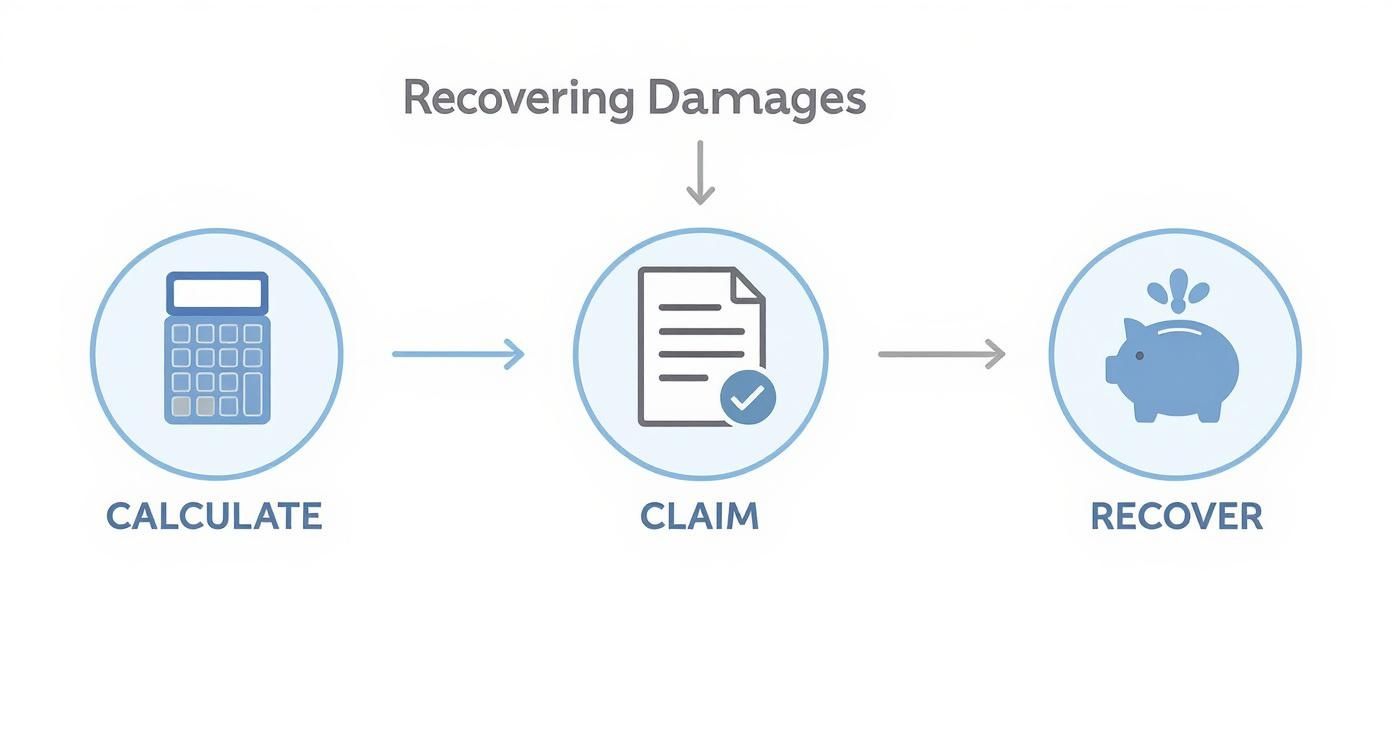
As you can see, the legal system methodically moves from establishing the true value of your claim to formally pursuing and recovering the compensation your family is owed.
Negotiations and the Path to Settlement
It's a common myth that every lawsuit ends in a dramatic courtroom showdown you see on TV. The truth is, the vast majority of cases—well over 90% of wrongful death and personal injury claims—are resolved through a negotiated settlement.
Talks with the insurance companies can start at any time, sometimes even before a lawsuit is filed. But they almost always heat up during the discovery phase as more evidence comes to light. An experienced attorney knows exactly how to use the facts we uncover in depositions and documents to create leverage. We show the insurer the significant risk they’re facing if they let a jury decide the case.
A settlement isn't a sign of a weak case. In my experience, it's usually the result of a very strong one. When the evidence is so compelling that the other side knows they'll likely lose at trial, a fair settlement becomes their best and only real option.
What Happens if the Case Doesn’t Settle?
For that small percentage of cases that don't settle, the lawsuit moves toward trial. This phase has a few more important steps.
Mediation is almost always a required stop before you can go to trial. It’s a formal negotiation session where a neutral, third-party mediator comes in to help both sides find common ground. It's a structured, final attempt to resolve the case before everyone has to deal with the expense and uncertainty of a trial.
If mediation doesn't work out, the attorneys will file pre-trial motions. This is where we ask the judge to make rulings on legal issues, like deciding what evidence is or isn't allowed at the trial. Finally, the case moves to the trial itself, where our team presents your family's story and all the evidence to a judge or jury, who will then deliver a final verdict.
Knowing this process helps you prepare for the journey to justice. If you have questions about filing a wrongful death lawsuit or where your case might be headed, we’re here to give you answers. In pain? Call Caine.
Why You Need an Experienced Wrongful Death Attorney
Trying to navigate a wrongful death lawsuit while mourning the loss of a family member is an impossibly heavy burden. Grieving families are vulnerable, and unfortunately, they're often targeted by aggressive insurance adjusters looking to offer a quick, lowball settlement before you even have a chance to understand your rights.
This is exactly why partnering with a specialized attorney isn't just a good idea—it's essential protection for your family.
From day one, an experienced lawyer steps in and takes over all communications, shielding your family from the pressure. We manage every single detail, from launching an independent investigation to handling the mountains of complex legal paperwork, giving you the space you need to heal.
Maximizing Your Family's Compensation
One of the most critical roles a wrongful death attorney plays is accurately calculating your family's total losses. This goes so much further than just adding up medical bills and funeral expenses. A skilled legal team knows how to build an ironclad case for the full value of your claim by bringing in a network of trusted experts.
This often involves hiring:
Accident Reconstructionists to prove exactly how the incident occurred and who was at fault.
Economists and Vocational Experts to project the full lifetime of lost income, benefits, and financial support.
Medical Specialists to draw a direct, undeniable line from the negligent act to the fatal injuries.
Without this level of expert support, families almost always accept settlements that are just a fraction of what they truly need and deserve for their future. You can learn more about how we build powerful cases for our clients in our personal injury practice area.
An attorney's job is to ensure the compensation reflects the full measure of your loss—not just the numbers on a spreadsheet, but the human cost of a life cut short. We fight for a result that provides true financial security for your family's future.
No Upfront Costs and No Financial Risk
Many families hesitate to call a lawyer because they worry about the cost. Let me put that fear to rest. Wrongful death cases are handled on a contingency fee basis.
What does that mean for you? You pay absolutely nothing upfront. There are no hourly fees and no out-of-pocket costs for the investigation or for hiring those critical expert witnesses.
Our fee is simply a percentage of the compensation we successfully recover for you. If we don't win your case, you owe us nothing. This arrangement gives every family, regardless of their financial situation, access to justice without any risk. It allows us to relentlessly pursue the accountability you and your family deserve.
When you're facing the unimaginable, you need a powerful ally in your corner. In pain? Call Caine.
Common Questions About Florida Wrongful death Lawsuits
When you're grieving the loss of a family member, the last thing you want to do is try to decipher complex legal statutes. The questions can feel overwhelming. Below, I’ve answered some of the most common questions families ask us when they're trying to figure out the next steps.
How Long Do I Really Have to File a Lawsuit?
This is one of the most critical questions, and the answer is unforgiving. In Florida, the statute of limitations for the vast majority of wrongful death claims is a firm two years from the date your loved one passed away.
This isn't a guideline; it's a hard and fast deadline. If you try to file a claim even one day late, the court will almost certainly throw it out, permanently barring you from seeking justice for your family. That's why it is absolutely vital to speak with an attorney as soon as you feel able, so we can protect your family's rights before it's too late.
What's the Difference Between a Wrongful Death Claim and a Survival Action?
It’s a great question, and one that often causes confusion. While they are often pursued in the same lawsuit, they are two completely different legal actions designed to compensate for different losses.
A wrongful death claim is for the survivors. It’s meant to compensate the family members—a spouse, children, or parents—for their specific losses. Think of damages like the loss of the deceased’s future income and support, lost companionship, and the profound mental pain and suffering the family is now enduring.
A survival action, on the other hand, is filed on behalf of the deceased person’s estate. It’s designed to recover the damages they suffered between the moment of their injury and the moment they passed away. This can include things like the medical bills they incurred, the wages they lost, and the pain and suffering they experienced before their death.
Can We Still Sue if There's a Criminal Case Going On?
Yes, and you absolutely should. A wrongful death lawsuit is a civil matter, and it operates on a completely separate track from any criminal charges. The two legal systems have entirely different goals, and the outcome of one does not legally determine the outcome of the other.
A civil lawsuit is about one thing: securing the financial compensation your family needs and deserves after such a devastating loss. A criminal case is about the state punishing the person who broke the law.
You can—and should—move forward with a civil claim for your family's damages no matter what is happening (or not happening) in the criminal courts.
Trying to manage these legal complexities while grieving is an impossible burden for any family to carry alone. The experienced attorneys at CAINE LAW are here to take the legal weight off your shoulders, allowing you to focus on what matters most: healing. If someone’s negligence took a loved one from you, let us fight for the justice and financial security your family deserves. Contact us today for a free, no-obligation consultation. In pain? Call Caine.
