
In Pain? Call Caine
How to file a personal injury claim in Florida - quick guide

5 Min read
By: Caine Law
Share
The moments right after you get hurt are a blur of confusion, pain, and adrenaline. But what you do in these first few minutes and hours can set the entire course for your personal injury claim. Knowing how to file a personal injury claim isn't just about paperwork—it starts with the critical actions you take on the scene.
Your first step, always, is to seek immediate medical care. This isn't just about your health; it's about creating a rock-solid, official record that connects your injuries to the incident. From there, it's about officially reporting what happened and, just as importantly, avoiding common mistakes that can sink your case before it even starts.
Your First Moves After an Injury in Florida
It’s tough to think clearly when you're in pain, but focusing on a few key priorities can protect both your physical well-being and your legal rights. What you say, what you do, and who you talk to can all dramatically impact your ability to get fair compensation down the road.
This isn't a rare occurrence. In the U.S., about 39.5 million people need medical help for injuries each year. Car accidents are the biggest culprit, making up a staggering 52% of all personal injury claims. Your situation is serious, and it deserves to be treated that way from the very beginning.
Prioritize Your Health and Safety Above All Else
Your number one priority is your health. Full stop. Even if you think you’re okay or just have minor bumps and bruises, go see a doctor right away. Adrenaline is a powerful painkiller and can easily mask serious conditions like internal bleeding or a traumatic brain injury, which might not show symptoms for hours or even days.
Getting prompt medical attention achieves two critical goals:
It protects your health. An early diagnosis and treatment plan are essential for making a full and fast recovery.
It creates a legal record. When a doctor sees you, it generates official proof connecting your specific injuries to the exact time and date of the accident. This medical record is gold when you're up against an insurance company.
If you wait to see a doctor, you're handing the insurance adjuster an easy excuse to argue your injuries aren't that bad or that something else caused them after the accident. Don't give them that opening.
This infographic lays out the basic flow for what to do right after you're hurt.
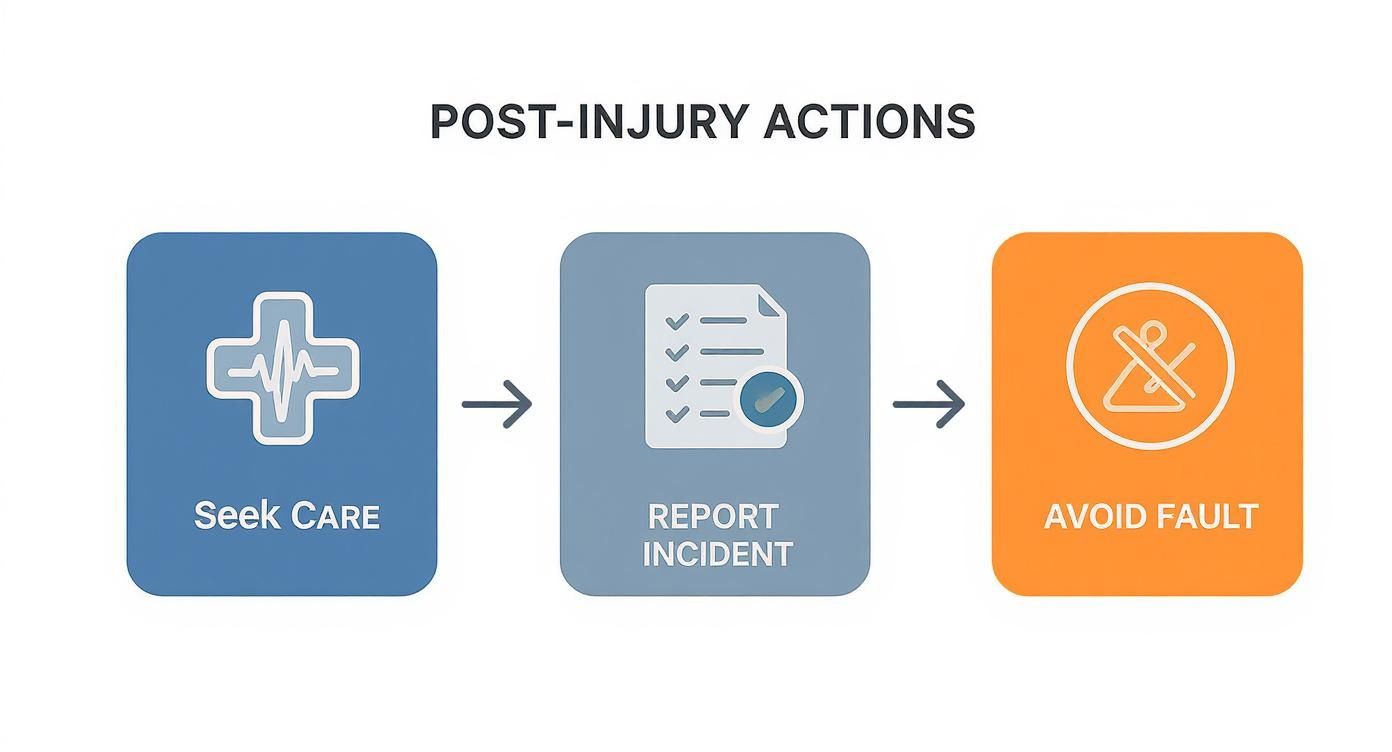
As you can see, it comes down to three pillars for a strong start: taking care of yourself, officially reporting the incident, and being incredibly careful with what you say.
To help you remember what to do in the heat of the moment, we've put together a quick checklist.
Immediate Post-Injury Action Checklist
This is a quick reference guide to help you protect both your health and your legal rights in the critical moments after an injury.
Action Item | Why It's Crucial for Your Claim |
|---|---|
Ensure everyone's safety. | Moves you and others out of harm's way and shows responsible behavior. |
Call 911. | Creates an official police report and gets medical personnel on the scene. |
Seek immediate medical attention. | Protects your health and creates a direct, dated link between the incident and your injuries. |
Take photos and videos. | Captures the scene, your injuries, and property damage before it can be cleaned up or changed. |
Get witness information. | Independent third-party accounts can be invaluable for proving what happened. |
Report the incident. | Notifies the property owner, manager, or police, creating an official record of the event. |
Following these steps provides a solid foundation for any claim you may need to file.
Report the Incident and Avoid Costly Mistakes
Once you've handled any urgent medical needs, you need to officially report what happened. If you were in a car crash, that means calling 911 so police can create an accident report. If you slipped and fell in a store, you need to tell the manager or owner right away so they can file an incident report.
Your words carry immense weight in these initial conversations. What you say—and what you don't say—can be used against you later.
It is absolutely vital that you do not admit fault, even a little bit. An automatic "I'm so sorry" or a casual "I should have been paying more attention" can be twisted into an admission of guilt by an insurance adjuster looking for any reason to deny your claim.
On that same note, never say "I'm fine" or "I'm not hurt." You aren't a doctor, and as we've covered, many serious injuries have delayed symptoms. Stick to the facts of what happened. Don't guess, don't speculate, and don't apologize. For a more detailed walkthrough, you can check out our guide on what to do when accidents happen for more essential steps and legal guidance.
If you've been hurt and you're not sure what to do next, don't wait. In pain? Call Caine.
Building Your Evidence and Documenting Everything

When you're hurt, your word alone isn't enough to win a personal injury claim. A strong case is built on a mountain of proof—evidence that tells a clear, undeniable story about what happened, who was to blame, and how badly you were injured.
Think of yourself as the lead investigator on your own case. The details you collect right after the incident and during your recovery are the very foundation of your future demand for compensation. Insurance companies are built to find holes in your story, so your goal is to leave them no room for doubt.
The Power of Visual Evidence
They say a picture is worth a thousand words, and in a personal injury case, it can be worth a whole lot more. Your smartphone is your most powerful tool in the moments after an accident. Once you've made sure everyone is safe and help is on the way, start documenting.
You can't take too many photos or videos. Details that seem small now can become incredibly important later on.
The Big Picture: Get wide shots of the entire scene. Show the position of the cars, skid marks, traffic lights, and any road signs.
The Damage Up Close: Zoom in on the damage to every vehicle involved. If you slipped and fell, get close-ups of the wet floor, the broken step, or whatever caused your fall.
Your Injuries: Take pictures of your injuries right away. Then, keep taking photos every few days to show the bruising, swelling, and healing process over time.
The Environment: Was it raining? Were the streetlights out? Was there debris on the road? Capture any conditions that played a part in the accident.
This visual diary freezes the moment in time, making it much harder for the at-fault party to change their story later.
A strong claim is built on irrefutable proof. The more detailed and organized your documentation is, the more seriously the insurance company will take your demand for compensation.
Gathering Official Reports and Witness Accounts
Beyond the photos you take yourself, official documents and witness statements add a ton of credibility to your claim. The police report (for a car crash) or an incident report from the store manager (for a slip and fall) is one of the most critical pieces of evidence you can get. These reports provide an official, third-party account of what happened.
Just as crucial are the people who saw it happen. Witnesses offer an unbiased view that can back up your story. Be polite, and get their full name, phone number, and email. A single statement from a neutral observer can completely shut down any arguments about who was at fault.
This level of documentation is important in any injury case, including those at work. For example, recent data shows that workers in their first year on the job accounted for about 36% of workplace injuries and 34% of the total claim costs. These numbers show just how critical it is to keep meticulous records, especially when a claim gets complicated. You can read the full research about these injury impact trends to learn more.
Creating a Pain and Recovery Journal
The evidence doesn't stop once you leave the scene. The real impact of an injury unfolds over weeks, months, or even years, and you need to track it. Grab a simple notebook or start a note on your phone to serve as your "pain journal."
Every day, jot down a few notes about:
Physical Pain: Rate your pain from 1-10. Describe what it feels like—is it a sharp, stabbing pain or a dull, constant ache?
Emotional Toll: Are you feeling anxious? Depressed? Are you having trouble sleeping? Write it all down.
Daily Limitations: Document the things you can't do. Maybe you couldn't lift your child, tie your shoes, or go to work. These details matter.
Medical Journey: Keep a running list of every doctor's visit, physical therapy session, medication you take, and any costs associated with your treatment.
This journal will become priceless when it's time to prove your non-economic damages—the pain and suffering that doesn't come with a neat price tag. If this all feels like too much to handle, you don't have to do it alone. In pain? Call Caine.
Handling Talks with Insurance Adjusters

It won't take long. After an accident, you can count on getting a call from the at-fault party's insurance adjuster. They’ll sound friendly, maybe even concerned. But make no mistake, they are not your friend.
An adjuster has one job: to protect their company's money. That means looking for any angle they can to pay you as little as possible—or nothing at all. Every word you say to them can be twisted and used to devalue your claim.
They are trained professionals, masters of subtle tactics designed to get you to say the wrong thing. And they’re very, very good at what they do.
The First Phone Call Minefield
That initial call is a minefield. It's where so many people without a lawyer make mistakes that sink their case before it even starts. The adjuster will ask for your side of the story and will almost certainly ask for a recorded statement to "help speed things up."
Politely but firmly, you must decline.
A recorded statement is a trap. It’s a tool they use to lock you into a version of events before you even know the full extent of your injuries. They'll pick apart your words later, searching for tiny inconsistencies to paint you as untruthful or claim you weren't really that hurt.
Never, ever give a recorded statement without talking to an attorney first. You have no legal obligation to give one, and it almost always comes back to haunt you.
So, what should you do? Stick to the absolute basics. You can confirm your name and contact info, but that's it. When the questions turn to the accident or how you're feeling, you have a simple, powerful response: "I'm not ready to discuss the details right now."
What You Should and Should Not Say
Controlling the conversation is your best defense. Think of it as a game of chess where your opponent is a grandmaster. You need to protect your pieces.
Here’s a quick guide to keep you from making a critical error.
What to Avoid Saying:
"I'm sorry." Even if you're just being polite, they will try to frame this as an admission of guilt.
"I'm fine" or "I feel okay." Adrenaline is a powerful painkiller. You might have serious injuries that won't show up for days. Let your doctors be the ones to assess your health.
Guessing or speculating. If you aren't 100% sure how fast you were going or the exact time of the crash, don't guess. Sticking to the facts you know for certain protects you.
Giving too much detail. Don't volunteer anything. Answer the specific question asked and nothing more. Keep it short.
The less you say, the better. Your words are ammunition, so don't hand it over to the other side.
Understanding Florida PIP and Your Rights
Here in Florida, your own car insurance policy is your first line of defense through Personal Injury Protection (PIP). It’s a mandatory no-fault coverage, which means you turn to your own insurer first, regardless of who caused the accident.
Your PIP policy will typically cover 80% of your medical bills and 60% of your lost wages, but only up to a total of $10,000.
This means you’ll be dealing with two insurance companies: yours and the other driver's. You might think your own insurer is on your side, but remember, they are a business, too. They also have a financial incentive to pay out as little as possible. The same rules apply—be careful what you say.
Juggling multiple adjusters and complex policies is overwhelming, especially when you're trying to heal. If your claim gets unfairly delayed, lowballed, or denied, you could be dealing with a separate issue of bad faith. Knowing your rights in these insurance disputes is absolutely critical.
The adjuster’s goal is to close your file for the lowest dollar amount they can get away with. They know you’re hurt, stressed, and in a tough spot—and they will use that to their advantage. If you feel pressured or confused, or if the settlement they offer feels like a slap in the face, it’s time to get help. You don't have to face them alone. In pain? Call Caine.
Figuring Out What Your Claim is Worth & Making Your Demand
So, how much is your claim really worth? This is the million-dollar question, and getting the answer right is critical before you even think about approaching the insurance company. It's not just about adding up the medical bills you have so far; it's about looking at the total picture of how this injury has rocked your world—and what the future holds.
To get a handle on this, we break down your losses (what we lawyers call damages) into two distinct buckets. You need a solid grasp of both before you can put a fair number on the table.
Economic Damages: The Black-and-White Costs
First, we have the economic damages. These are the straightforward, tangible costs you can prove with a paper trail. Think of it this way: if you have a receipt, invoice, or pay stub for it, it probably falls into this category.
But don't stop at the initial ER bill. This bucket needs to include every single related cost.
Medical Bills: This is the big one. We’re talking about everything from the ambulance ride and hospital stay to future physical therapy sessions, prescriptions, and any medical gear you now need.
Lost Wages: If you couldn't work because of your injuries, you're owed compensation for that lost income. This isn't just your base salary; it includes missed overtime, bonuses, or commissions you would have earned.
Loss of Earning Capacity: This is about your future. If the injury permanently impacts your ability to do your job—or forces you to take a lower-paying one—you can claim damages for that long-term financial blow.
Property Damage: If you were in a car crash, this is the cost to get your vehicle repaired or replaced.
The key here is to be a meticulous record-keeper. Every bill, every receipt, and every pay stub helps build an ironclad case for your financial losses.
Non-Economic Damages: The Human Cost
Next up are the non-economic damages. These are much tougher to calculate because they represent the very real, but intangible, human cost of what happened. This is where the pain journal we talked about earlier becomes one of your most powerful tools.
Insurance adjusters love to dismiss or downplay the “human cost” because it’s not as simple as adding up receipts. But your pain, your anxiety, and your lost hobbies are just as real as your medical bills, and you deserve to be compensated for them.
Non-economic damages are all about the impact on your quality of life. For instance, if a back injury from a fall means you can no longer pick up your toddler or enjoy a weekend round of golf, that's a genuine loss.
This category is meant to compensate you for:
Pain and Suffering: The actual physical pain, discomfort, and limitations you deal with day-to-day.
Emotional Distress: The anxiety, depression, fear, or insomnia that stems from the trauma of the accident and your recovery.
Loss of Enjoyment of Life: Your inability to do the things that once brought you joy, whether it’s hobbies, social activities, or family events.
Loss of Consortium: This applies to the negative impact the injury has had on your relationship with your spouse.
Putting a number on these damages is more of an art than a science, often involving formulas that use your economic damages as a starting point. An experienced lawyer knows how to evaluate the full scope of your suffering and fight to make sure it’s not ignored.
Putting It All Together: The Settlement Demand Letter
Once you have a full and complete tally of your damages, it's time to formally lay out your case for the insurance company. This is done with a settlement demand letter. This isn't just a quick note asking for a check; it's a detailed, professional argument that explains why their client was at fault and why you're demanding a specific amount to make things right.
A powerful demand letter immediately signals that you're organized and serious. It should always contain a few key elements:
A Clear Summary of What Happened: A straightforward account of the accident, making it clear why the other person was negligent.
A Detailed Rundown of Your Injuries: A thorough description of your injuries, referencing your medical records and the treatment you've received.
A Complete Breakdown of Your Damages: List every single one of your economic damages (bills, lost income, etc.) with the documents to back them up. Then, articulate your non-economic damages, pulling powerful examples from your pain journal.
A Specific Dollar Amount: End with a clear, firm number that you are demanding to settle the claim.
This letter is the official kickoff for negotiations. When you start with a strong, well-documented case, you force the adjuster to sit up and take you seriously from the get-go. If this all feels like a lot to handle on your own, you're right—it is. But you don't have to navigate it alone. In pain? Call Caine.
Florida's Statute of Limitations and When to File a Lawsuit
So, you’ve calculated your damages and your demand letter is sent. Now what? You’ve entered a new phase of your claim: waiting and negotiating. Sometimes, an insurance company does the right thing and comes back with a fair offer.
More often than not, their first offer is just a lowball starting point, and you might find yourself at a standstill. This is where the legal system—and its non-negotiable deadlines—comes into play.
In every personal injury case, there’s a legal countdown timer running in the background. It’s called the statute of limitations, and it’s one of the most critical laws affecting your right to compensation. It sets a hard deadline for how long you have to file a formal lawsuit in court.
Miss this deadline, and you lose your right to pursue your case forever. It doesn't matter how clear the other party's fault is or how severe your injuries are. The courthouse doors will be locked to you.
Understanding Florida's Strict Deadlines
Florida's statute of limitations can get tricky, and the specific deadline depends on the type of injury claim. For years, the window for most negligence cases was four years. However, a major change in state law has slashed this timeframe.
For most personal injury cases based on negligence that happened on or after March 24, 2023, the deadline is now just two years from the date of the incident. This is a massive change that has caught many people by surprise.
This two-year clock applies to most common injury cases, including:
Car accidents
Motorcycle crashes
Slip and fall incidents
Other general negligence claims
This much shorter window means you have to act fast. Two years might sound like a long time, but it disappears quickly when you're building a case, gathering evidence, and trying to negotiate with an insurer who is in no hurry.
Waiting too long is one of the biggest mistakes you can make. Insurance companies know these deadlines inside and out. Some will use delay tactics, dragging their feet and hoping you'll simply run out of time to hold them accountable in court.
The Difference Between a Claim and a Lawsuit
It’s vital to understand that filing an insurance claim is not the same thing as filing a lawsuit. They are two completely different processes.
Making an Insurance Claim
What it is: An informal process where you notify the at-fault party's insurer about your injuries and demand payment.
Who you deal with: An insurance adjuster.
The goal: To reach a private settlement agreement without ever setting foot in a courtroom.
Filing a Lawsuit
What it is: A formal legal action filed in the Florida court system. This is the start of litigation.
Who you deal with: The at-fault party's defense attorneys.
The goal: To have a judge or jury legally decide who is at fault and the amount of compensation you are owed.
The vast majority of personal injury cases—over 95%—settle out of court. But filing a lawsuit is often the exact step needed to force a stubborn insurance company to finally make a fair offer. The threat of a trial gives you the leverage you need.
Filing a lawsuit starts by serving the defendant with a "complaint," which is the legal document that outlines your case. This kicks off a structured process involving evidence exchange (discovery), depositions, and formal motions. It is a serious escalation from just talking with an adjuster, and if you get to this point, you absolutely need an experienced litigator on your side.
If you're worried about deadlines or an insurer that won't negotiate fairly, it’s time to take control. In pain? Call Caine.
Knowing When to Partner with Caine Law
Maybe it was just a minor fender-bender. You might feel like you can handle that on your own. But what happens when you’re dealing with serious injuries, the medical bills are piling up, and the insurance company has decided to play hardball? The fight is no longer on even ground.
Knowing how to file a Florida personal injury cases is one thing; winning it is something else entirely.
There are a few classic red flags that tell you it’s time to stop talking to the adjuster and call in a professional. If the insurer denies your claim outright, tries to pin the blame on you, or slides a ridiculously low settlement offer across the table, they’re basically daring you to challenge them. This isn't a good-faith negotiation; it's a power play.
Leveling the Playing Field
Bringing in a firm like Caine Law immediately changes the dynamic. We take over all communications, which means you’re shielded from the adjuster's high-pressure tactics and scripted questions. Our team gets to work right away, launching our own independent investigation, consulting with medical experts to prove the true extent of your injuries, and building a case designed to win.
When you hire an experienced attorney, you're not just getting legal advice. You're getting an advocate who can force a massive insurance company to treat your claim with the seriousness it deserves.
This is especially critical in complex cases involving severe or long-term injuries. We handle these fights on a contingency fee basis, which is just a straightforward way of saying you owe us nothing unless we win your case.
We take on the fight so you can focus on healing. In pain? Call Caine.
Common Questions About Florida Injury Claims
After you've been hurt, your mind is probably racing with questions. It’s completely normal. As you try to figure out what comes next, you need straight answers about your rights and what this process really looks like.
Let's cut through the noise and tackle some of the most common concerns we hear from injured people across Florida. While every case has its own unique twists and turns, getting a handle on these basics will help you make smarter decisions for your recovery and your claim.
How Much Is My Personal Injury Claim Worth?
This is the big one—the question we hear first, almost every time. The most honest answer? It truly depends on the specific facts of what happened to you. There's no magic calculator or "average" settlement that applies to everyone, because no two injuries impact a person's life in the same way.
The real value comes from adding up all your damages, which fall into two main buckets:
Economic Damages: This is the black-and-white stuff. It includes all your medical bills (past and future), wages you've lost from being out of work, and any impact on your ability to earn a living down the road.
Non-Economic Damages: This is the human cost. It covers your physical pain, the emotional and mental toll, and the loss of your ability to enjoy life the way you used to.
An experienced lawyer can give you a realistic valuation by digging into your specific losses and drawing on their experience with thousands of similar cases. We look at the severity of your injuries, how clear the fault is, and the total financial and personal chaos this incident has caused in your life.
What If I Am Partially at Fault?
Florida uses what’s called a “modified comparative negligence” rule. It’s a legal way of saying that even if you share some of the blame for an accident, you can still get compensation—but there's a catch.
As long as you are found to be 50% or less at fault, you can recover damages. The catch is that your final award gets reduced by whatever percentage of fault is assigned to you. So, if a jury awards you $100,000 but decides you were 20% to blame, your award is cut by $20,000, and you walk away with $80,000.
You have to be ready to fight back against unfair blame. Insurance adjusters love to shift as much fault as possible onto the injured person to shrink the amount they have to pay out.
How Long Does It Take to Settle?
The timeline for an injury claim is all over the map. Some straightforward cases—maybe a minor injury where liability is crystal clear—can wrap up in just a few months. But getting a fair result often requires a healthy dose of patience.
More complicated cases, especially those involving serious injuries, disagreements over fault, or the need for long-term medical care, can easily take a year or more to resolve. If the insurance company digs in its heels and refuses to make a fair offer, a lawsuit becomes necessary, which naturally extends the timeline. Remember, the goal isn't just to get the fastest settlement; it's to get the best one.
Trying to navigate the complexities of a personal injury claim on your own is a tough road, especially when all your energy should be on getting better. The experienced team at CAINE LAW is here to take on the legal fight for you, making sure your rights are protected from start to finish. If you've been hurt and have questions about what to do next, we're ready to give you the answers and the aggressive advocacy you deserve. In pain? Call Caine.
Find out how we can help by visiting us at https://cainelegal.com.
