
In Pain? Call Caine
How Long Does a Car Accident Case Take: how long does a car accident case take

5 Min read
By: Caine Law
Share
When you're hurt, the last thing you want is more uncertainty. You're trying to heal, and a big question looms: How long will this all take? A simple Florida car accident claim might wrap up in a few months, but cases with serious injuries can easily stretch out for over a year.
This timeline isn't just random. It’s a journey with clear stages, from what you do right after the crash to getting medical care and, if it comes to it, taking your case to court.
Your Florida Car Accident Case Timeline Explained
After a wreck, one of the first and most stressful questions we hear is, "How long is my car accident case going to take?" There's no single answer, because every case is different. Think of it like building a house—a simple, pre-designed home on a perfectly flat lot gets built fast. But a custom mansion on a tricky, sloped piece of land? That's going to take a lot longer. Your case works the same way.
The specific details of your accident and your recovery dictate the pace. Understanding the stages involved can help set realistic expectations and show you the road ahead. Our job is to navigate this process for you, making sure every step is handled correctly to build the strongest possible claim.
To give you a clearer picture, here’s a quick breakdown of how these cases typically unfold.
Florida Car Accident Claim Phases at a Glance
Case Phase | Typical Duration | Key Activities |
|---|---|---|
Immediate Aftermath & Initial Treatment | 1-4 Weeks | Seeking medical care, reporting the accident, gathering initial evidence (photos, witness info), and hiring an attorney. |
Investigation & Medical Treatment | 1-6 Months | Your attorney investigates fault, gathers police reports, and you continue medical treatment until you've fully recovered. |
Reaching Maximum Medical Improvement (MMI) | 3-12+ Months | You reach a point where your doctor says your condition has stabilized. This is a critical milestone before a demand can be sent. |
Demand & Negotiation | 1-4 Months | Your attorney drafts a settlement demand package with all your medical records and bills and sends it to the insurance company to begin negotiations. |
Settlement or Litigation | Varies Greatly | If a fair settlement is reached, the case concludes. If not, a lawsuit is filed, which can extend the timeline by 1-2+ years. |
This table provides a general overview, but several key factors can dramatically shift these timelines.
Key Factors That Shape Your Timeline
A few critical elements will determine whether your case is a sprint or a marathon. Each one can add weeks, months, or even years to the process.
Severity of Your Injuries: This is the single biggest factor. We can't properly value your claim until you reach what's called Maximum Medical Improvement (MMI). That’s the point when your doctor confirms your condition is as good as it’s going to get. Rushing this step is a huge mistake.
Clarity of Fault: When it’s obvious who was at fault—like a classic rear-end collision with a police report backing it up—things move much faster. If fault is disputed, we have to launch a full investigation, which takes time.
Insurance Company Tactics: Let's be frank. Some insurance adjusters negotiate fairly. Many others, however, use deliberate delay tactics. They might make ridiculously low offers or bury us in paperwork requests, all in an effort to wear you down so you’ll accept less.
The Need for Litigation: The vast majority of cases settle out of court. But if an insurance company simply refuses to offer a fair settlement, we won't hesitate to file a lawsuit. That move introduces court schedules, formal legal procedures, and a whole new timeline.
This visual helps put the general timelines into perspective, from quick settlements to more drawn-out court battles.
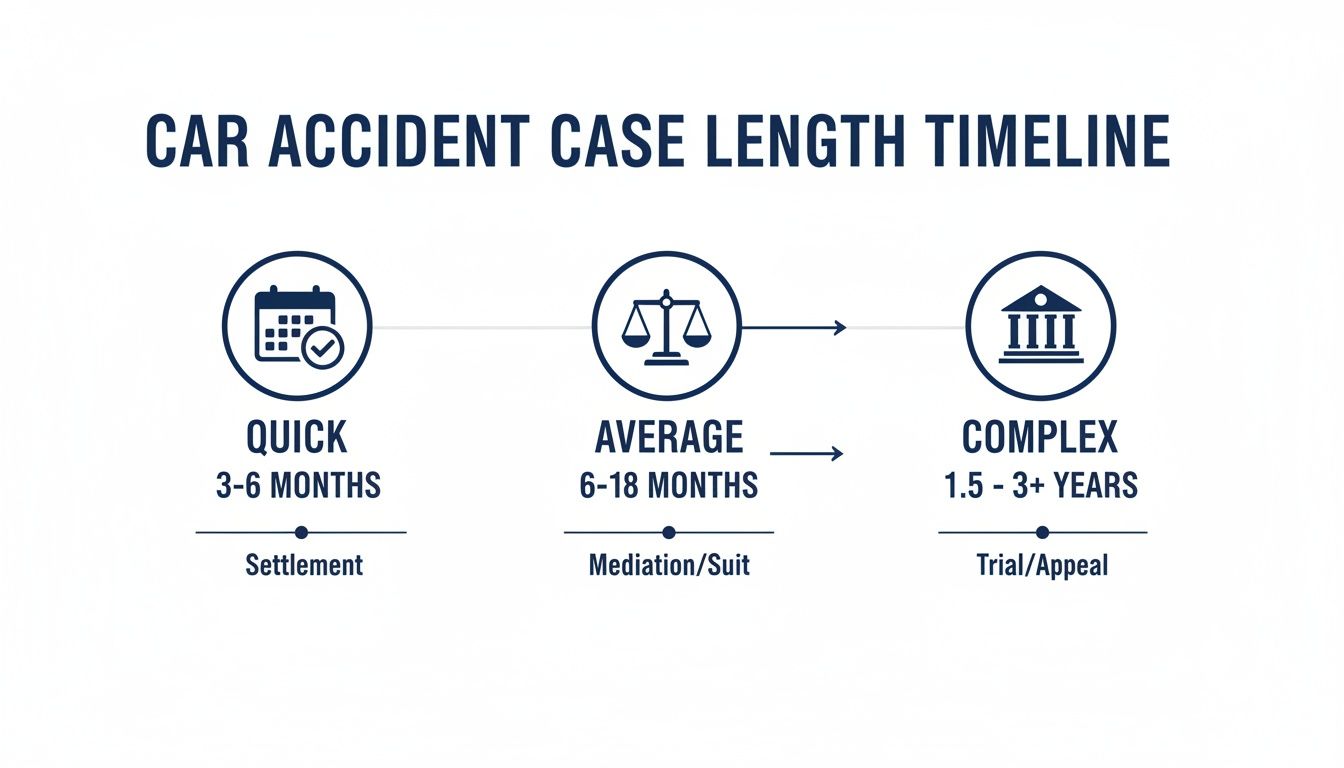
As you can see, while minor claims can be resolved in a matter of months, cases that involve extensive medical treatment or litigation often go on for well over a year. No matter how complex your situation is, understanding these factors is the first step toward getting the result you deserve.
At Caine Law, we are experts in handling all types of auto and motorcycle accidents, and we guide our clients through every single phase with clarity and strength. In pain? Call Caine.
The First 24 Hours: Setting the Stage for Your Claim

The moments right after a car crash are a blur of confusion and adrenaline. But what you do in those first 24 hours lays the groundwork for your entire claim.
How you navigate this critical window can make a huge difference in how long your case takes, either preventing frustrating delays or accidentally creating them. Think of it like pouring the foundation for a house—if it's not solid from the start, everything built on top of it will be shaky.
Every step you take is about protecting two things: your health and your legal rights. Getting this part right sets your case on the right track from day one.
Prioritize Immediate Medical Attention
Before anything else, your health comes first. Even if you walk away feeling okay, getting a medical evaluation right after a crash is non-negotiable. The adrenaline pumping through your body can easily mask serious injuries like a concussion or internal bleeding, which might not show symptoms for hours or even days.
This is also a critical legal step in Florida. To use your Personal Injury Protection (PIP) benefits, you must get initial medical care within 14 days of the accident. If you wait any longer, you could lose your right to that coverage, leaving you on the hook for the first $10,000 of your medical bills.
Seeing a doctor immediately creates a direct, undeniable link between the crash and your injuries. That medical record becomes a cornerstone of your claim, making it much tougher for an insurance company to argue your injuries were pre-existing or happened somewhere else.
Document Everything at the Scene
While the details are still fresh in your mind, gather as much evidence as you possibly can. This on-the-ground documentation is invaluable because it's often impossible to recreate later. It helps paint a clear picture of what happened and who was at fault.
Here’s a quick checklist of what to grab:
Photos and Videos: Take wide shots of the whole scene, close-ups of the damage to both cars, photos of skid marks, and pictures of any relevant traffic lights or road signs.
Contact Information: Swap insurance and contact details with the other driver. Just as important, get the names and phone numbers of anyone who saw the crash happen.
Police Report: Always call the police. The official police report is a vital piece of evidence that provides an objective account of the incident.
For a more detailed breakdown, check out our guide on the essential steps to take after an accident.
Report the Accident—But Watch Your Words
You definitely need to notify your own insurance company about the accident. However, you are under no obligation to give a recorded statement to the other driver's insurance adjuster. Their job is to find any reason to pay out as little as possible, and they are masters at twisting your words to hurt your claim.
Think about a multi-car pileup where it’s not clear who's at fault. While some straightforward cases might settle in 3-6 months, these more complex situations can easily stretch to 1-2 years. In 2022, the average bodily injury claim was $26,501, which gives insurance companies a huge incentive to dig in their heels and drag things out for months.
By carefully managing these first 24 hours, you build a strong foundation for your case. If you've been hurt, the next call you make can define your entire recovery. In pain? Call Caine.
Reaching Maximum Medical Improvement: Your Healing Journey

After the initial shock of a car accident, your focus rightfully shifts to the most important part of this whole ordeal: your recovery. This phase of medical treatment is almost always the longest part of a car accident case, and for good reason. Your health comes first, and the timeline of your healing sets the pace for your entire legal claim.
The whole process hinges on a crucial medical and legal concept known as Maximum Medical Improvement (MMI). This is the point when your doctor determines that your condition has improved as much as it's going to. It doesn't mean you're 100% back to your old self, but it does mean your medical future is clear and predictable.
Reaching MMI is a fundamental milestone because until you get there, the true, full cost of your injuries is still a question mark. We can't put an accurate number on your claim until we have the complete picture of your medical needs.
Why MMI Is the Most Important Milestone
Trying to build a case without MMI is like asking a contractor for a final bill when they’ve only just laid the foundation. You just don't have enough information to know the final cost. Settling your case before you and your doctors understand the full extent of your medical needs is a huge gamble.
Why? Because an early settlement could leave you paying for future medical care out of your own pocket. A settlement is final—once you sign on the dotted line, you can't go back and ask for more money if you find out later you need another surgery or long-term physical therapy.
Waiting to reach MMI is a strategic necessity. It ensures every past, present, and future cost related to your accident is accounted for, from the initial ER visit to potential lifelong limitations. This patience is what allows us to demand full and fair compensation for you.
This phase covers the entire spectrum of your medical care. Every single appointment, test, and therapy session helps tell the story of your injuries.
The Role of Consistent Medical Treatment
Following your doctor's prescribed treatment plan isn't just vital for your health—it's absolutely critical for your legal case. You have to remember, insurance companies are always on the lookout for a reason to pay you less or deny your claim altogether.
One of their go-to tactics is to poke holes in your medical treatment history. If you miss appointments or wait too long to see a specialist, they’ll argue that your injuries must not be as serious as you're claiming. They might even try to say your pain is from a pre-existing condition or something else that happened during that "gap" in treatment.
Here’s why sticking to your treatment schedule is non-negotiable:
It Builds a Clear Record: Every visit creates another entry in your medical records, documenting your pain, your progress, and how the injuries are affecting your life.
It Proves Severity: Following through with all prescribed care, from physical therapy to specialist consultations, shows you're serious about your recovery and that your injuries demand ongoing attention.
It Shuts Down Insurance Company Arguments: A consistent treatment history makes it nearly impossible for an adjuster to successfully argue that you weren't truly hurt.
Our job is to support you through this. We make sure every medical bill and record is meticulously collected and organized. This documentation becomes the undeniable proof we need to build a powerful case for all your damages, protecting you from the insurance company's unfair tactics. If you're feeling overwhelmed by medical bills and legal questions, let us help. In pain? Call Caine.
Building Your Case and Negotiating with Insurers

Once your doctor says you’ve reached Maximum Medical Improvement (MMI), the focus of your case finally pivots from physical recovery to financial recovery. This is where our legal team really steps into the spotlight, taking your months of treatment, pain, and frustration and turning it all into a powerful, undeniable story for the insurance company.
This phase isn't just about collecting paperwork anymore; it's about building an airtight argument. We systematically assemble every single piece of evidence to prove not just what happened in the crash, but exactly how it turned your life upside down. This is precisely where a skilled attorney's experience becomes your biggest advantage.
Crafting a Powerful Demand Package
Our first big move is to create and send a demand package to the at-fault driver's insurance company. This is so much more than a stack of medical bills. It's a comprehensive legal document that lays out the complete story of your case from start to finish.
Think of the demand package as our opening argument in a trial we're trying to avoid. It’s designed to be so thorough and compelling that the insurance adjuster has no choice but to take your claim seriously right out of the gate.
A well-crafted demand package forces the insurance company to see you as a person, not just a claim number. By detailing your pain, your lost wages, and the day-to-day struggles you've endured, we make it clear that a lowball offer will not be accepted.
This package meticulously organizes and presents all the evidence we've been gathering for months:
Medical Evidence: Every single medical record, bill, MRI result, and doctor's note related to your treatment goes in.
Economic Losses: We provide concrete proof of your lost wages, backed up by pay stubs and letters from your employer, along with projections for any future lost earning capacity.
Pain and Suffering Argument: This is a detailed narrative explaining the human cost of the accident—the physical pain, the emotional distress, and the simple joys of life you've had to give up.
Liability Analysis: We include the police report, witness statements, photos from the scene, and any other evidence that proves the other driver was clearly at fault.
Entering the Negotiation Battlefield
Once the insurance company gets the demand package, the real back-and-forth begins. This negotiation process is a strategic dance that can last anywhere from a few weeks to several months. How long this part of the car accident case takes often comes down to the insurance company's initial reaction.
Let's be clear: insurance adjusters are trained negotiators. Their number one job is to save their company money. They almost always start with an insultingly low offer, hoping you're desperate enough to take it. They might also drag their feet, asking for documents they don't need or just going silent for weeks to wear you down.
This is where having an experienced attorney in your corner is non-negotiable. We know these tactics inside and out, and we know exactly how to shut them down. We use our deep knowledge of Florida law and our reputation for taking cases all the way to trial to build leverage. When an adjuster knows your lawyer isn’t afraid to file a lawsuit, their whole approach changes. We can also provide expert guidance on handling complex insurance disputes that pop up along the way.
Setting Realistic Timelines for Settlement
So, how long does this all take once negotiations start? It really depends. Imagine you're rear-ended at a red light here in Florida and end up with whiplash and a concussion. According to the Bureau of Justice Statistics, the average motor vehicle accident case lasts about 20 months from the day it’s filed to the day it’s resolved. A big reason it takes that long is that victims often need months of medical care before a lawyer can even begin to figure out what the claim is truly worth and start negotiating.
By preparing every single case as if it's going to court, we put you in the strongest possible position to get a fair settlement without ever having to see the inside of a courtroom. If you're tired of battling the insurance company alone, let us take the fight from here. In pain? Call Caine.
Understanding the Litigation Process When a Lawsuit is Necessary
So far, we've walked through the steps that lead to a settlement. But what happens when the insurance company just won't budge? When they dig in their heels and refuse to make a fair offer, we have to shift gears from negotiation to litigation. It's a strategic move that shows them we mean business.
Filing a lawsuit might sound like a huge, intimidating step. But here’s something crucial to understand: filing a lawsuit doesn't automatically mean your life is about to become a dramatic courtroom trial. In reality, the overwhelming majority of cases that enter litigation still settle long before a judge or jury ever hears them.
Litigation is really about one thing: leverage. It's a formal process that forces the insurance company’s hand and gives us access to powerful evidence-gathering tools we simply don't have during informal negotiations.
The Four Main Stages of a Florida Lawsuit
Once a lawsuit becomes necessary, the timeline of your car accident case enters a new, more structured phase. Everything is now governed by official court rules, creating a methodical process designed to give both sides a fair chance to present their case.
The journey through litigation really breaks down into four main stages:
Filing the Complaint: This is the official starting pistol. We draft a formal legal document—the "complaint"—that lays out the facts of the crash, details your injuries and damages, and legally argues that the other party was negligent. Once this is filed with the court and "served" to the at-fault party, the legal battle has officially begun.
The Discovery Phase: Get ready, because this is the longest and most critical stage of litigation. Discovery is the formal process of exchanging information and evidence. It’s where we uncover the true strengths of our case and expose the weaknesses in their defense.
Mediation: In Florida, mediation is a required step before any case can go to trial. Think of it as a high-stakes, structured negotiation where a neutral third-party mediator helps both sides try to find common ground and hammer out a settlement.
Trial: This is the final step, but only if every other attempt to resolve the case fails. Here, we present all our evidence to a judge and jury, who will then make the final decision.
A Deep Dive into the Discovery Process
The discovery phase is the real engine of the litigation process. This is where we leave no stone unturned. We use a whole host of legal tools to gather every single piece of information relevant to your case, which often puts immense pressure on the insurance company.
Key activities during discovery include:
Interrogatories: These are basically formal, written questions that the other side is required to answer under oath.
Requests for Production: We can demand that the other side turn over relevant documents, like internal company reports, hidden photos, or even maintenance logs for a commercial truck.
Depositions: This is sworn testimony taken outside of court. We'll question the at-fault driver, key witnesses, and their experts under oath while a court reporter records every word. It's how we lock them into their story.
This intensive evidence-gathering is often a complete game-changer. It’s what frequently convinces an insurance company that taking their chances at trial is a gamble they're not willing to take.
The secret to securing a strong settlement is preparing every single case as if it's going to trial. This meticulous preparation during discovery gives us the ultimate leverage to demand what you rightfully deserve.
Let’s be clear: litigation adds time to your case—often a year or more, depending on court schedules and how complex the discovery process gets. But that time isn't wasted. It's spent building an undeniable, rock-solid case. While it's true that over 90% of personal injury cases settle before trial, it’s our readiness and willingness to go all the way that forces the best results.
If an insurance company is giving you the runaround, you need a team that isn't afraid to take them to court. In pain? Call Caine.
Factors That Can Stall Your Car Accident Case
Even when you do everything right, some things can pop up and grind your case to a halt. Knowing what these potential roadblocks are from the get-go is the key to setting realistic expectations for how long everything might take. While you can't sidestep every delay, a good lawyer knows how to navigate around most of them.
Think of it like planning a drive from Miami to Pensacola. You can map out the quickest route on your phone, but you can’t predict a sudden pile-up on I-75 or an unexpected road closure. In the same way, a few common factors in a legal case can create delays that are completely out of your hands.
Disputes Over Who Was at Fault
The fastest way to get a case resolved is when everyone agrees on who caused the crash. If the police report, eyewitnesses, and dashcam footage all point the finger at the other driver, the insurance company doesn't have much room to argue.
But the moment fault becomes even a little murky, the timeline can stretch out dramatically. The insurance adjuster will likely try to pin some of the blame on you to lower their payout, which forces a much deeper investigation. This can mean hiring accident reconstruction experts and sitting through multiple depositions, easily adding months to your case.
The Complexity of Your Injuries
The seriousness of your injuries has a huge impact on how long your case will take. A claim involving soft-tissue injuries like whiplash, which might clear up with some physical therapy, is going to move a lot faster than one for a traumatic brain injury (TBI) or spinal cord damage.
Serious injuries mean long-term treatment and an uncertain future. We can't responsibly settle your claim until you've reached what's known as Maximum Medical Improvement (MMI)—the point where your doctor says you're as recovered as you're going to be. This waiting period is absolutely necessary to make sure all your future medical needs are paid for, but it naturally extends the timeline.
Here’s a rough idea of how injury severity can affect things:
Minor Injuries (sprains, bruising, etc.): Your case might be ready for settlement talks within 3-6 months after the crash.
Serious Injuries (broken bones, herniated discs): It often takes 6-18 months or even longer to hit MMI before real negotiations can start.
Catastrophic Injuries (TBI, paralysis): These cases can take several years because they require detailed lifelong care plans and expert medical testimony.
Cases with Multiple Defendants
Accidents with more than one potentially at-fault driver—think multi-car pileups or a crash involving a commercial truck—are a whole different ballgame. Each defendant has their own insurance company and their own legal team, and you can bet they'll all be pointing fingers at each other instead of taking responsibility.
This creates a complicated web of legal claims and counter-claims that has to be untangled before you can get paid. Just coordinating depositions, sharing evidence, and negotiating with several insurance companies at once is a marathon, not a sprint, and can easily add a year or more to the process.
When an insurance company deliberately uses delay tactics, they aren't just being difficult—they're using a calculated strategy. They hope that financial pressure will force you to accept a settlement that is far less than you deserve.
Deliberate Insurance Company Delay Tactics
Finally, one of the most maddening delays comes from the insurance companies themselves. Some are notorious for operating in bad faith, intentionally dragging their feet to wear you down. They might ignore your calls, ask for the same documents over and over, or make insultingly low offers, all in the hope that you'll just get fed up and take whatever they're offering.
An experienced attorney sees these tactics from a mile away and knows exactly how to shut them down. We apply legal pressure, filing motions with the court to force them to act. Frankly, having a lawyer with a reputation for taking cases all the way to trial is often the best way to make an insurance company stop stalling and start negotiating fairly.
If you feel like your case is being held up for no good reason, you need a team that knows how to fight back. In pain? Call Caine.
Common Questions About Florida Accident Timelines
When you're dealing with a car accident claim, a lot of questions pop up. It's completely normal. Here are some straightforward answers to the concerns we hear most often, giving you a realistic picture of how these cases unfold.
Why Can't My Lawyer Give Me an Exact Settlement Date?
Trying to nail down an exact settlement date is like trying to predict the weather in Florida—we know the general patterns, but we can't tell you if a storm will hit at 2:15 PM next Tuesday. Too many pieces of the puzzle are out of our direct control.
The final timeline really hinges on your unique recovery journey, how cooperative (or uncooperative) the insurance company decides to be, and the court's schedule if we need to file a lawsuit. A good, honest attorney will give you a realistic timeframe based on their experience with similar cases and keep you updated as things progress. If a lawyer ever promises you a specific payout date, that's a major red flag.
If We File a Lawsuit, Does That Mean We’re Going to Trial?
Not at all. In fact, it's pretty rare. Filing a lawsuit is a strategic step, not a one-way ticket to the courtroom. It’s our way of telling the insurance company that we're not backing down and that their lowball offers won't cut it. It also opens up the formal "discovery" process, which gives us powerful tools to gather evidence we couldn't get otherwise.
Here's the reality: the vast majority of personal injury cases—we're talking more than 90%—settle long before a trial ever starts. Often, the looming pressure of a trial date is the exact motivation an insurance adjuster needs to finally come to the table with a fair offer during mediation.
How Does Florida's Statute of Limitations Affect My Case?
Think of the statute of limitations as a hard deadline, a countdown clock on your right to seek justice in court. For most car accident cases in Florida, that clock was recently shortened from four years down to just two years from the date of the crash.
This doesn't mean your case will drag on for two years. What it does mean is that if you don't file a lawsuit within that two-year window, you lose your right to sue forever. This change makes it absolutely critical to speak with an attorney as soon as possible to make sure your rights are protected and every important deadline is met.
At CAINE LAW, we’re here to walk you through every single stage. Our goal is to make sure you understand the process and feel confident in the strategy we build together. If you're tired of waiting and ready for a team that will fight for you, let our experience get to work. In pain? Call Caine.
