
In Pain? Call Caine
How Long Do Personal Injury Cases Take A Realistic Timeline

5 Min read
By: Caine Law
Share
When you're hurt, stressed, and trying to heal, the last thing you want is a legal process that feels like a black box. You just want to know: how long is this going to take?
For most folks in Florida dealing with a personal injury claim, especially one with clear fault and moderate injuries, you’re often looking at a timeline of 9 to 18 months to reach a settlement. But that's just a starting point. More complicated situations can easily stretch to two years or even longer.
Your Florida Personal Injury Case Timeline at a Glance
After an accident throws your life off course, getting a realistic picture of the road ahead is crucial. Think of it this way: while every journey is different, knowing the general route and potential detours helps you prepare. The path to getting the compensation you deserve isn't always a straight shot. It has key stages, and plenty of things can influence how long each one takes.
The good news? The vast majority of these cases never step foot inside a courtroom. National data shows that only about 4-5% of personal injury claims actually go to trial. That means a whopping 95-96% of cases are resolved through negotiation and settlement long before a judge or jury gets involved. For more on the numbers, check out these personal injury case statistics on daveabels.com.
Estimated Timelines for Florida Personal Injury Cases
To help you get your bearings, we've put together a quick look at the typical timeframes for common injury claims here in Florida. This table shows how long it generally takes to get from the day of the incident to a final resolution.
Case Type | Average Time to Settle (No Lawsuit) | Average Time if Lawsuit is Filed |
|---|---|---|
Clear-Fault Car Accident | 9 - 18 Months | 18 - 24+ Months |
Slip-and-Fall (Disputed) | 12 - 24 Months | 2 - 3+ Years |
Medical Malpractice | 18 - 36 Months | 3 - 5+ Years |
Wrongful Death | 12 - 24 Months | 2 - 4+ Years |
Remember, this is just a guide. The specifics of your case—how severe your injuries are, whether the other side is fighting liability, and how the insurance company behaves—will ultimately shape your unique timeline.
If you're hurt and trying to figure this all out, you don't have to do it alone. In pain? Call Caine.
Mapping The Four Key Stages Of Your Injury Claim
When people ask, "how long will my personal injury case take?", the honest answer is, "it depends." But that doesn't mean the process is a complete mystery. Think of it less like a single, confusing legal battle and more like a journey with a clear roadmap.
Your claim moves through four distinct stages. Knowing what happens in each phase helps you see exactly where you are, what's coming next, and why every step is critical to building a rock-solid case.
This visual gives you a quick overview of the path most cases follow, starting with settlement talks and, only if necessary, moving toward a lawsuit or trial.
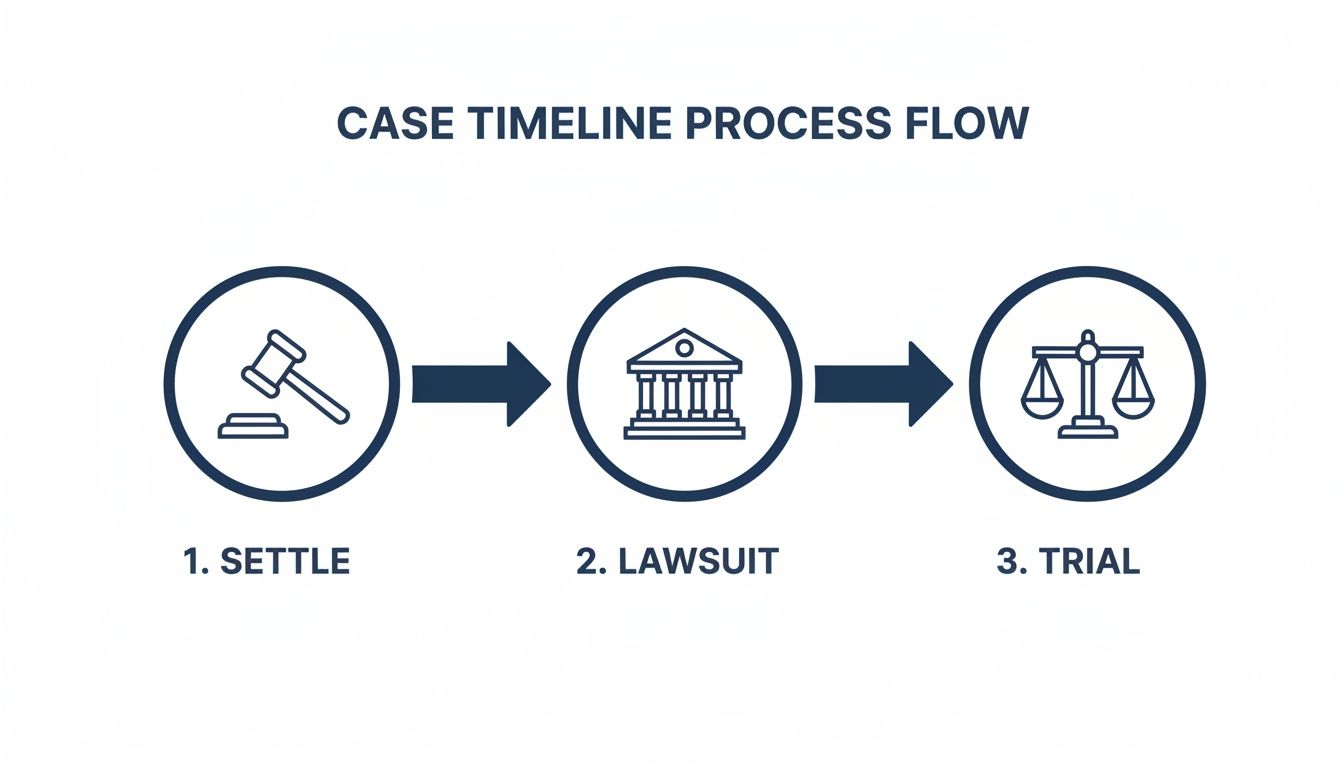
The goal is always to get you a fair settlement as efficiently as possible. But sometimes, pushing forward is the only way to get the full compensation you deserve.
Stage 1: Medical Treatment And Initial Fact-Finding
The moment an accident happens, two things need to start immediately: your physical recovery and our legal investigation. Your health is, without question, the top priority. Following your doctor’s orders and going to every appointment isn't just for your well-being—it creates the official medical record we need to prove the extent of your injuries.
While you focus on healing, we get to work gathering evidence. We're talking police reports, photos of the scene, witness interviews, and any video footage we can find. The steps you take right after the incident are huge; our guide on what to do when accidents happen walks you through it. This initial phase can take a few months or even over a year, because it lasts as long as your medical treatment does.
Stage 2: Building Your Case And Issuing A Demand
Once your doctors determine you’ve reached Maximum Medical Improvement (MMI), we have a clear picture of your damages. MMI doesn't always mean you're 100% healed. It means your condition has stabilized, giving us a reliable understanding of any future medical care you might need.
Now, we can finally calculate the true value of your claim by adding up all your medical bills, lost wages, and future costs. We package all of this—your medical records, expert opinions, and financial documents—into a comprehensive demand letter. This is the formal document we send to the at-fault party's insurance company, laying out our case and demanding a specific settlement.
Stage 3: The Negotiation Process
This is where the real back-and-forth begins. After the insurance adjuster gets our demand letter, they’ll come back with a counteroffer. You can bet on one thing: it will be far lower than what you actually deserve.
This stage is a strategic negotiation, not a simple transaction. An insurance company's initial offer is a starting point designed to test your resolve and see if you’ll accept a fraction of your claim's true worth.
Our job is to fight back. We systematically pick apart their arguments, present more evidence, and negotiate forcefully to close the gap between their lowball offer and the fair compensation you're owed. The vast majority of personal injury cases get resolved right here, though it can take anywhere from a few weeks to several months of tough negotiation.
Stage 4: Filing A Lawsuit And Potential Trial
What if the insurance company just won't be reasonable? Then we move to the final stage: litigation.
Filing a lawsuit doesn't mean you're automatically heading to a courtroom drama. In fact, the very act of filing often gets the insurer to take negotiations seriously. The threat of court costs and a jury’s decision can be a powerful motivator.
This stage involves formal legal procedures like discovery, where both sides have to exchange information and answer questions under oath in depositions. Many cases settle during this phase, too. If an agreement still can't be reached, the case goes to trial for a judge or jury to decide. Very few cases ever get this far, but we prepare every single case from day one as if it’s going to trial. That way, we're always ready to fight for you in court.
If you're dealing with an injury and facing this complex process, don’t do it alone. In pain? Call Caine.
Key Factors That Accelerate Or Delay Your Case

If you've ever wondered why your friend's car accident case settled in nine months while your neighbor's slip-and-fall is still dragging on after two years, the answer comes down to a few critical variables. No two cases are ever the same, and several key factors can either put your claim on the fast track or pump the brakes, stretching out the timeline significantly.
Getting a handle on these elements is crucial. It helps you set realistic expectations and allows us to build a strategy that anticipates potential roadblocks before they happen. Knowing what slows a case down is the first step toward keeping it moving forward.
The Severity Of Your Injuries
One of the single biggest factors controlling your case's timeline is the nature of your injuries. This isn't just about how badly you were hurt in the moment; it's about the time it takes to understand the full, long-term impact this accident will have on your life.
Before we can even think about serious settlement talks, you have to reach what's called Maximum Medical Improvement (MMI). This is a non-negotiable milestone in your case.
MMI doesn’t mean you're completely healed. It means your medical condition has stabilized, and your doctors can now reasonably predict what your future medical needs, ongoing costs, and any permanent limitations will look like.
Rushing to settle before you hit MMI is a huge mistake. You could end up accepting an offer that completely misses a future surgery, the need for lifelong physical therapy, or a permanent disability that stops you from returning to your job. Your attorney will always advise waiting until MMI so we can calculate and demand compensation for every single past, present, and future cost. That patience is absolutely vital to securing the full amount you deserve.
Disputes Over Fault And Liability
Another major issue that can stretch out your timeline is a fight over who was actually at fault. If liability is crystal clear—think a straightforward rear-end collision where the other driver was caught texting—the case can move along much more quickly.
But the moment the other party denies responsibility or, even worse, tries to pin the blame on you, things get a lot more complicated. This kicks off a much deeper and longer investigation.
To prove fault when it's being contested, our legal team might need to:
Hire accident reconstruction experts to break down the physics of the crash.
Depose multiple witnesses and the at-fault party, getting their testimony under oath.
Consult with engineering or medical experts to draw a direct line from the defendant's actions to your injuries.
Each one of these steps adds more time to the clock. Insurance companies won't offer fair compensation until your attorney has built an ironclad case proving the other party’s negligence, and that kind of meticulous work can take months.
Common Insurance Company Tactics
Finally, the insurance company's behavior plays a massive role in your case's timeline. You have to remember that insurance carriers are businesses, and their main goal is to protect their bottom line by paying out as little as possible.
Many insurers use delay tactics as a core part of their strategy. They know injured people are often under immense financial pressure from mounting medical bills and lost paychecks. By dragging their feet, they hope you'll get desperate enough to accept a lowball offer that's a fraction of your claim's true value.
Some of their go-to moves include:
Unreasonable Delays: Taking weeks to return a simple phone call or email.
Excessive Paperwork Demands: Requesting duplicate or pointless documents just to slow things down.
Lowball Offers: Making an initial offer that is insultingly low to see if you'll give up.
An experienced attorney sees these tactics from a mile away and knows exactly how to fight back with consistent legal pressure. While we can't force an insurer to be fair overnight, we can hold them accountable and stop them from stalling your case indefinitely. If you're running into these roadblocks, having a skilled negotiator in your corner is essential. In pain? Call Caine.
How Florida Laws Uniquely Shape Your Case Timeline
While the basic stages of a personal injury claim look similar nationwide, Florida has its own rulebook that can dramatically change your case's timeline. These aren't just minor details buried in legal jargon; they're fundamental laws that can add months to your case or, if you miss a deadline, stop it cold.
Think of it like playing a game. You have to know the rules of the specific field you're on, not just the general idea of the sport. Florida’s legal landscape has its own set of built-in hurdles and waiting periods that directly impact how long everything takes.
The Statute Of Limitations Clock
First up is the big one: Florida’s statute of limitations. This is a hard, non-negotiable deadline for filing a lawsuit. For most personal injury claims based on negligence, you now have just two years from the date of the incident to file. This was recently slashed from four years, which means acting quickly is more critical than ever.
Missing this deadline is catastrophic. If you try to file a lawsuit even one day late, the court will almost certainly throw it out. You’ll lose your right to recover any compensation—forever. This deadline is the ticking clock that hangs over every single claim, and it waits for no one.
The statute of limitations isn't just a suggestion; it's an absolute barrier. It's designed to keep evidence fresh and resolve disputes promptly, but it puts the burden squarely on the injured person to take action.
How Comparative Fault Adds Complexity
Florida is what’s known as a modified comparative fault state. In plain English, this means if you’re found partially responsible for the accident, your compensation gets reduced by your percentage of fault. Here’s the critical part: if a jury decides you were more than 50% at fault, you get nothing. Zero.
This rule often turns a straightforward negotiation into a long, drawn-out fight. Insurance adjusters will jump on any chance to pin some of the blame on you. They’ll argue you were going a few miles over the speed limit, glanced at your phone, or weren't paying perfect attention—anything to drive up your percentage of fault and drive down their payout. These back-and-forth arguments can add a ton of time to the process.
Special Rules For Certain Claims
On top of all that, some types of cases in Florida have their own mandatory waiting periods and procedural hoops you have to jump through. These aren't delays caused by the other side’s tactics; they are required steps that must be finished before you can even think about filing a lawsuit.
Medical Malpractice: Before you can sue a doctor or hospital, you’re forced into a complex pre-suit investigation process. This involves getting a sworn opinion from a medical expert and formally notifying the potential defendant. They then get a 90-day period to investigate your claim. This requirement automatically tacks three months onto your timeline right from the start.
Claims Against the Government: If a government entity injured you—say, a city bus accident or a fall on a poorly maintained public sidewalk—you have to provide a formal notice of your claim. The government agency then has a six-month investigation period where they are legally immune from being sued.
Understanding these Florida-specific rules is absolutely key. They create the legal framework that dictates the pace of your claim. An attorney who knows these laws inside and out can navigate them efficiently, but the timelines they impose are often unavoidable. If you're navigating this complex system, you need an expert guide. In pain? Call Caine.
Real-World Examples Of Florida Injury Case Timelines
Theory is one thing, but seeing how these cases play out in the real world is another. To give you a better sense of how long a personal injury case can take, let's walk through a few common scenarios. These stories show just how much things like clear evidence, arguments over fault, and overall case complexity can change the timeline for getting compensation in Florida.
You'll see why one person’s case might be done in a year, while someone else’s journey takes much, much longer.
Scenario 1: The Straightforward Car Accident
Picture this: Sarah is waiting at a red light when another car slams into her from behind. The driver was texting, and the police report puts them 100% at fault. It’s a clear-cut case of negligence. Sarah ends up with a herniated disc, which means months of physical therapy and a few rounds of steroid injections to manage the pain.
This case has two things going for it that really speed up the process: liability isn't in dispute, and her injuries are moderate and well-documented.
Months 1-8: Sarah’s main focus is on her medical care. She works with her doctors until she reaches what we call Maximum Medical Improvement (MMI). During this time, our firm is busy gathering every medical record, bill, and piece of evidence showing her lost wages.
Month 9: With all the documentation in hand, we put together a detailed demand package and send it off to the at-fault driver's insurance company.
Months 10-12: The insurance adjuster reviews everything. After a bit of back-and-forth negotiation, they make a fair settlement offer. Honestly, the evidence against their driver is just too strong for them to put up a real fight.
Because fault was so obvious and the damages were clearly laid out, Sarah's case settles in about 12 months without us ever having to file a lawsuit. If your accident sounds similar, you can get more details on how we handle these situations on our page for auto and motorcycle accidents.
Scenario 2: The Contested Slip-And-Fall
Now let's look at David's situation. He's shopping in a big box store when he slips on a puddle of clear liquid, fracturing his wrist. Right away, the store manager is on the defensive, claiming an employee had just checked that aisle and it was bone-dry. There were no witnesses, and wouldn't you know it, the store's security footage of that spot is "unclear."
This case gets complicated fast because liability is the central fight.
Months 1-6: While David is having surgery and going through rehab for his wrist, we immediately file a lawsuit. This forces the store to preserve all its evidence and brings them to the table for the discovery process.
Months 7-15: This is the discovery phase. We're taking sworn depositions from the store manager and employees. We also bring in an expert to pick apart their cleaning logs and safety procedures, looking for holes.
Months 16-20: After finding major inconsistencies in the employees' stories, we head to a court-ordered mediation. Faced with the real possibility of losing at trial, the store's insurance company finally starts making a serious offer.
Months 21-24: After some intense negotiating, we hammer out a settlement that David is happy with, just a few weeks before we were set to see them in court.
David’s case took around 24 months from start to finish. That long fight over who was at fault and the need for a full-blown lawsuit are what stretched out the timeline.
Scenario 3: The Complex Wrongful Death Claim
Finally, we have the heartbreaking case of a family filing a wrongful death claim. Their loved one was killed in a massive multi-vehicle pile-up on the interstate involving three commercial trucks and two passenger cars. It's a mess, with every driver and company pointing fingers at everyone else.
This is as complex as it gets, with multiple defendants and catastrophic damages.
In multi-defendant cases, each party's insurance company will try to shift blame to the others. This creates a web of legal maneuvering that requires a coordinated and aggressive litigation strategy to untangle.
The timeline for a case this massive often breaks down like this:
Investigation (First Year): We spend the first year hiring accident reconstruction experts to piece together what happened. We depose every driver and witness involved and dig deep into the trucking companies' logs and maintenance records to figure out who is responsible for what.
Litigation (Second Year): The second year is a flurry of legal motions flying back and forth between all the different law firms. We bring in more experts, like economists who can calculate the full lifetime of financial loss for the family, and they all have to be deposed.
Resolution (Third Year): With a mountain of evidence pointing to shared fault among the trucking companies, all the defendants’ insurers finally agree to a global mediation. After a multi-day negotiation, a significant settlement is reached.
This incredibly difficult case takes nearly three years to resolve. That timeline is a direct result of the immense complexity, the high stakes, and the sheer number of parties involved. As you can see, every case has its own unique timeline. To understand yours, you need an experienced guide in your corner. In pain? Call Caine.
The Role Of An Experienced Attorney In Managing Your Timeline

Trying to manage an injury claim on your own is like navigating a storm without a captain. A skilled personal injury attorney doesn't just steer the ship; they have the experience to chart a course that can significantly influence how quickly and successfully you reach a fair resolution.
While the number one goal is always to secure the full and fair compensation you deserve—not just a fast one—an experienced lawyer streamlines the process from day one. They know how to avoid the unforced errors and missteps that can add months, or even years, to your case.
Proactive Case Management From The Start
A seasoned attorney understands that a strong case is built on a solid foundation from the very beginning. They don’t sit back and wait for the insurance company to dictate the pace. Instead, they take control.
This proactive approach involves critical, time-saving actions:
Swift Evidence Preservation: Immediately firing off spoliation letters to preserve crucial evidence like security footage or a truck's "black box" data before it’s legally erased.
Expert Engagement: Knowing the right moment to bring in an accident reconstructionist or a medical expert to build a rock-solid claim before the other side can poke holes in it.
Accurate Damage Calculation: Meticulously documenting every single dollar of your damages—past, present, and future—to build a comprehensive demand package right out of the gate.
This kind of aggressive, early preparation sends a clear signal to the insurance company: we’re serious, and we’re ready. That alone can bring them to the negotiating table much faster.
An attorney’s deep knowledge of legal procedure and negotiation is your best defense against the delay tactics insurance companies use to wear you down into accepting a lowball settlement.
Overcoming Insurance Company Roadblocks
Let's be clear: insurance adjusters are trained negotiators whose primary job is to minimize what their company pays out. They know that people without lawyers often don't understand legal deadlines, evidence rules, or what their claim is truly worth. An attorney completely levels that playing field.
Your lawyer will manage the adjuster's tactics, handling every phone call and email to shield you from the pressure. They can anticipate and shut down common stalling techniques, like endless requests for irrelevant information or making insultingly low initial offers. Knowing the right questions to ask is vital, which is why we put together a guide with 9 questions to ask your slip and fall attorney before hiring.
Ultimately, having a respected trial lawyer in your corner sends a powerful message: we will not be pushed around. If a fair offer isn't put on the table, we are fully prepared to take this case to a jury. That credible threat is often the single most effective tool for breaking through delays and bringing your case to a successful close.
If you're tired of the runaround and want a fighter on your side, just remember: In pain? Call Caine.
Your Top Questions About Personal Injury Timelines
When you're dealing with an injury, the legal process can seem like a long, winding road. It's completely normal to wonder how long it will all take. We hear these questions a lot, so we've put together some straightforward answers to help our Florida clients know what to expect.
Every case moves at its own pace, but understanding these key points can help manage the waiting game.
Can I Get Financial Help While My Case Is Ongoing?
Yes, but it's important to know where that help comes from. In Florida, your own Personal Injury Protection (PIP) insurance is your first line of financial defense. It’s designed to cover your initial medical bills and a portion of lost wages right away, long before a final settlement is reached.
Some people consider lawsuit funding, but be very careful here. These are essentially high-interest loans that can take a huge bite out of your final settlement. We generally advise against them. Our primary goal is to get you the full compensation you deserve, but we can also point you toward more stable resources to help with immediate needs without mortgaging your future settlement.
Does Filing A Lawsuit Mean I'll Have To Wait Longer?
Not always. In fact, sometimes it’s the best way to speed things up. Filing a lawsuit can be a powerful strategic move, especially when an insurance company is dragging its feet or refusing to make a fair offer. The prospect of going to court—with all the associated costs and the risk of a jury siding with you—is often the exact motivation an insurer needs to come back to the table with a reasonable number.
While a case that goes all the way to a jury trial will certainly take longer, many, many cases settle shortly after a lawsuit is filed. Think of it less as a delay tactic and more as a tool to break a stalemate and get things moving.
An experienced attorney knows when filing a lawsuit will act as a catalyst, pushing the insurance company toward a fair resolution rather than simply extending the timeline.
Does The Insurance Company I'm Up Against Matter?
Absolutely. It matters a great deal. Insurance companies are not all the same; each one has its own playbook. Some are known for being relatively straightforward and efficient, wanting to close out clear-cut claims quickly. Others, however, have built their business model on a "deny, delay, defend" strategy. They will intentionally stall, make ridiculously low offers, and do everything they can to wear you down until you give up or take pennies on the dollar.
A seasoned local attorney knows the reputation and tactics of every major insurer operating in Florida. That inside knowledge is a huge advantage. It allows us to anticipate their moves, counter their strategies, and manage your case timeline much more effectively.
At CAINE LAW, we know the stress and pressure you’re under. Our team is here to fight for every penny you deserve while making sure you’re kept in the loop every step of the way. If you’re wondering about your own case, give our experienced legal team a call at https://cainelegal.com.
In pain? Call Caine.
