
In Pain? Call Caine
Hiring a Personal Injury Lawyer in Florida Explained

5 Min read
By: Caine Law
Share
Let's be honest—the thought of hiring a lawyer can be intimidating. But after an accident caused by someone else's carelessness, it's often the single most important decision you can make. It’s not about being confrontational; it’s about leveling the playing field. Insurance companies are businesses, and their goal is to protect their bottom line by paying out as little as possible. When you’re facing serious injuries, overwhelming medical bills, and a confusing legal system, you need an expert in your corner.
When Do You Really Need a Personal Injury Lawyer

The moments after an accident are a blur. Deciding whether you need to lawyer up is a huge question. Not every fender-bender requires calling an attorney. If you walked away from a minor bump with no injuries, you can probably handle it directly with the insurance companies.
But many situations are far more complicated than they look on the surface.
Navigating Complex Accident Scenarios
Think about the difference between a simple slip-and-fall in a quiet grocery aisle and a chaotic multi-car pile-up on I-95. Both can leave you hurt, but that highway wreck involves a tangle of multiple drivers, different insurance companies, conflicting stories, and a messy fight over who’s truly at fault. In these scenarios, a lawyer's job is to cut through the noise, piece together the facts, and build a rock-solid case for you.
Insurance adjusters are skilled negotiators. It’s their job. Their loyalty is to their employer, and their objective is to settle your claim for the smallest amount they can get away with.
An experienced lawyer knows their playbook. We counter their tactics with hard evidence, legal precedent, and aggressive negotiation to make sure your claim gets the serious attention it deserves.
This kind of expert representation is critical. Personal injury is one of the biggest legal fields in the country, with over 164,000 lawyers practicing in this area. That’s because the need is so great—in 2023 alone, over 62 million Americans needed medical care for preventable injuries. You can find more detail on these trends in recent injury statistics studies.
Recognizing the Signs You Need Help
So, how do you know when it’s time to make that call? Certain red flags are clear signals that you shouldn’t go it alone. Usually, these signs pop up when the stakes are high and getting fair compensation is anything but guaranteed.
To make it simple, here’s a quick rundown of situations where getting legal advice is a must.
Situation or Red Flag | Why It Means You Need a Lawyer |
|---|---|
Severe or Long-Term Injuries | If you need surgery, ongoing physical therapy, or face a permanent disability, the costs are massive. An attorney makes sure your future medical needs and lost quality of life are fully accounted for in your claim. |
Disputes Over Fault | The other driver’s insurance is blaming you? That’s a clear sign you’re in for a fight. A lawyer will dig up evidence—from police reports to expert testimony—to prove what really happened. |
Lowball Settlement Offers | A quick, small offer is a classic insurance tactic. They want you to sign away your rights before you know the full extent of your injuries and losses. An attorney will tell you what your case is really worth. |
Your Injuries Are Complex | Things like traumatic brain injuries or spinal cord damage have lifelong consequences. Calculating the true cost requires a deep understanding of medicine and law, something only an experienced lawyer can provide. |
The Insurance Company is Stalling | If the adjuster is dodging your calls or refusing to make a fair offer, they’re betting you’ll just give up. A lawyer forces them to act. |
If any of these scenarios sound familiar, it’s a strong sign you need an advocate on your side. Trying to manage a serious claim by yourself can lead to a settlement that doesn't even begin to cover your needs. Don't leave your future to chance. In pain? Call Caine.
Finding and Vetting the Right Florida Injury Attorney
So, you’ve decided it’s time to get legal help. Good. Now comes the hard part: finding the right attorney. The sheer number of options can feel overwhelming, and a quick Google search is just the beginning. The process of hiring a personal injury lawyer is about more than just picking a name from a list; it’s about finding a genuine advocate who gets your situation and has the courtroom chops to fight for you.
And there are a lot of options. The personal injury law industry is massive—it's projected to hit $61.7 billion in 2025, with over 50,000 firms out there. It's a fragmented market, meaning no single firm has a monopoly. This is great for you in terms of choice, but it also means you have to be extra diligent in your search.
Start Your Search with Trusted Sources
Forget the flashy TV commercials and billboards for a minute. Your best starting point is often closer to home. Personal referrals from friends or family who’ve been in a similar spot can be pure gold. They’ll give you the real story on an attorney’s communication style and, most importantly, their results.
After that, turn to professional resources to build your shortlist:
The Florida Bar Association: This should be your first stop for any lawyer you're considering. It’s the official organization for every attorney licensed in Florida. You can instantly verify their license and check for any disciplinary actions. Make sure they’re in good standing.
Legal Directories: Reputable online directories can be helpful, especially for reading peer reviews and client testimonials. This gives you a broader look at a lawyer's reputation and their track record from people who have actually worked with them.
These steps will help you narrow down the field to a few qualified candidates before you ever pick up the phone.
Crucial Questions for Your First Meeting
The initial consultation is your interview. This meeting is almost always free, and it’s your best chance to see if a lawyer is the right fit for you and your case. Don't be shy—this is the time to ask tough, specific questions.
Here’s what I’d focus on to really understand their expertise:
Experience with Cases Like Yours: Don’t just ask if they handle personal injury. Ask, "How many cases just like mine have you taken on?" An attorney who has deep experience with your specific type of personal injury case already knows the playbook and the specific challenges you'll face.
Trial Experience: This one is critical. Ask, "Are you willing to take my case to trial if the insurance company won't offer a fair settlement?" A lot of lawyers just want to settle fast and move on. You need someone who is a tough negotiator but is also a proven litigator, completely unafraid of a courtroom battle.
Case Management and Communication: You need to know how your case will be handled day-to-day. Ask, "Who will be my main point of contact, and how often will I get updates?" Clear, consistent communication is non-negotiable. You want to hear from the actual attorney handling your case, not just a paralegal you’ve never met.
A lawyer's answers to these questions tell you more than just the facts. Listen to how they answer. It reveals their confidence, their transparency, and how much they truly care about their clients. Vague responses or high-pressure sales tactics are major red flags.
Another huge warning sign? Any attorney who guarantees a specific outcome or promises you a certain dollar amount. Every single case is different. Promising a win isn't just unrealistic, it's unethical. You're looking for an attorney who gives you a straight, honest assessment of your case and lays out a logical plan for moving forward.
Making the right choice here sets the tone for your entire claim. Take your time, ask the right questions, and most importantly, trust your gut. In pain? Call Caine.
Understanding Contingency Fees and Legal Costs
One of the first things people worry about after an accident is how they’ll ever afford a lawyer. It’s a huge source of stress, but I’ve got good news. When you’re hiring a personal injury lawyer, you’ll almost always work on what’s called a contingency fee basis. This entire model was designed to give everyone a fair shot at justice, no matter what their bank account looks like.
Put simply: you don’t pay us a dime in attorney fees unless we win your case.
Our fee is just a percentage of the money we recover for you, whether that comes from a negotiated settlement or a verdict in court. If for some reason we don’t win, you owe us nothing for all the hours and work we put in.
This setup puts us on the exact same team. We’re just as invested in getting you the absolute maximum compensation as you are, because our success is directly tied to yours.
How Contingency Fees Work in Florida
Here in Florida, contingency fees are typically structured on a sliding scale. The percentage we receive often changes depending on how far along your case gets. For instance, it's common to have a lower percentage if the case settles before we even have to file a lawsuit. That percentage might go up if the fight continues into litigation and a full-blown trial.
We lay all of this out in a written agreement before we start any work. Total transparency from day one is our policy. You will never, ever get a surprise bill from CAINE LAW.
The whole point of a contingency agreement is to let us carry the financial risk of the fight. That way, you can put all your energy into getting better. It completely levels the playing field when you're up against a massive insurance company with seemingly endless resources.
Attorney Fees vs. Case Costs
It’s really important to know the difference between attorney fees and case costs. The fee is what you pay the lawyer for their expertise and time. Case costs, on the other hand, are the out-of-pocket expenses needed to actually build and fight your case.
Think of it like building a house. The attorney's fee is for the architect and builder, while the costs are for the lumber, nails, and concrete.
These expenses can include things like:
Court Filing Fees: The money required just to get your lawsuit officially filed with the court.
Expert Witness Payments: Fees for doctors, accident reconstruction specialists, or economists who can provide critical testimony.
Deposition Costs: Paying for court reporters and official transcripts when we question witnesses under oath.
Evidence Gathering: The cost of getting our hands on every medical record, police report, and other document we need.
At CAINE LAW, we typically advance these costs for our clients so you don’t have to pay anything upfront. Once we win your case, these expenses are simply reimbursed from the settlement or award, separate from our attorney's fee. We’ll give you a crystal-clear breakdown showing our fee, the reimbursed costs, and the final amount that goes directly to you.
The scale of this industry is massive. U.S. businesses recently spent over $1 billion a week on workplace injuries, which is part of a staggering $167 billion annual cost. With nearly 400,000 personal injury claims filed every year and litigation on the rise, having a clear and fair financial agreement with your lawyer is more crucial than ever. You can dig into these personal injury law statistics to see the bigger picture.
Our transparent approach means you know exactly where you stand from the very beginning. In pain? Call Caine.
What Your Lawyer Will Need to Build Your Case
When you team up with a personal injury lawyer, you become a crucial part of the legal team. I always tell my clients that a strong case is built on a foundation of solid proof, and the more organized you are from the very beginning, the better our chances. While we handle the legal heavy lifting, you’re in the best position to provide the raw materials we need to prove your claim.
Think of it like this: your attorney is building the house, but you're supplying the bricks. The sooner you start gathering those key pieces of information, the stronger that foundation will be. It helps us move quickly and build a powerful strategy on your behalf right out of the gate.
Your Initial Evidence Checklist
Immediately after an accident, your top priority is always your health. But once you're safe, gathering evidence becomes the next critical mission. You'd be surprised how often a seemingly small detail becomes a major piece of the puzzle down the road.
Here are the absolute must-haves your attorney will ask for:
Official Police or Incident Reports: This is the official first draft of what happened. It contains the responding officer’s findings, witness details, and often a preliminary opinion on who was at fault.
Photos and Videos from the Scene: A picture truly is worth a thousand words. Snap photos of everything: vehicle damage, your injuries, the hazardous condition that caused a fall (like a wet floor), and the general area. A visual record is often far more powerful than words alone.
Contact Information for Witnesses: If anyone saw what happened, get their name and phone number. Independent testimony from a neutral third party can be incredibly valuable in backing up your version of events.
Medical Records and Bills: This is the paper trail of your injuries. It includes everything from the first ER visit to follow-up appointments and physical therapy sessions. These documents are the primary proof of your injuries and the financial toll they've taken.
For a more detailed rundown of what to do in the moments after a crash, check out our guide on essential steps and legal guidance in our blog.
Proving Your Financial Losses
A personal injury claim is about more than just your medical bills. It has to account for all the financial damage you've suffered. This is where proof of your lost income and other out-of-pocket expenses becomes vital.
Your claim isn't just about the injuries you suffered; it's about making you financially whole again. That means documenting every single dollar the accident has cost you.
Your lawyer will need documents like pay stubs or a letter from your employer to calculate the wages you’ve lost while you couldn't work. Start a folder and keep receipts for everything related to the accident—prescription co-pays, gas for trips to the doctor, even parking fees. Every piece of paper helps paint the full picture of your losses, which strengthens our argument for maximum compensation.
Essential Document Checklist for Your Injury Claim
To help you get organized, we've put together a checklist of the key documents and evidence you'll need. Don't worry if you don't have everything right away; your lawyer can help you track down official reports and records. The goal is to start collecting what you can.
Document/Evidence Type | Why It's Important | Where to Find It |
|---|---|---|
Police/Incident Report | Provides an official, unbiased account of the accident and identifies parties/witnesses. | The law enforcement agency that responded (e.g., local police, sheriff's office). |
Photos & Videos | Visually documents the scene, property damage, and the severity of your injuries. | Your smartphone. Take more photos than you think you need. |
Witness Information | Corroborates your story and provides an independent perspective on what happened. | Ask for names and phone numbers at the scene of the accident. |
Medical Bills & Records | Proves the extent of your injuries and documents the full cost of your treatment. | The hospital, your doctors' offices, pharmacy, and physical therapy centers. |
Proof of Lost Wages | Calculates the income you've lost due to being unable to work during your recovery. | Pay stubs, a letter from your HR department, or past tax returns. |
Repair Estimates | Shows the cost to repair or replace damaged property, like your vehicle. | Auto body shops or other professional repair services. |
Receipts for Expenses | Documents all out-of-pocket costs related to the accident (prescriptions, travel, etc.). | Keep a dedicated folder or envelope for all related receipts. |
Gathering these documents empowers your legal team to build the strongest case possible from day one. It puts you in control and shows the insurance company that you mean business. In pain? Call Caine.
From Settlement Talks to Courtroom Battles: What to Expect
Once you've chosen a lawyer and we have the documents we need, the real work on your personal injury case begins. This part of the process is often a black box for clients, but I find that pulling back the curtain helps ease a lot of the anxiety. Understanding the roadmap from negotiation to a potential trial can make all the difference.
This flowchart shows the core pillars we use to build a powerful case from the ground up.
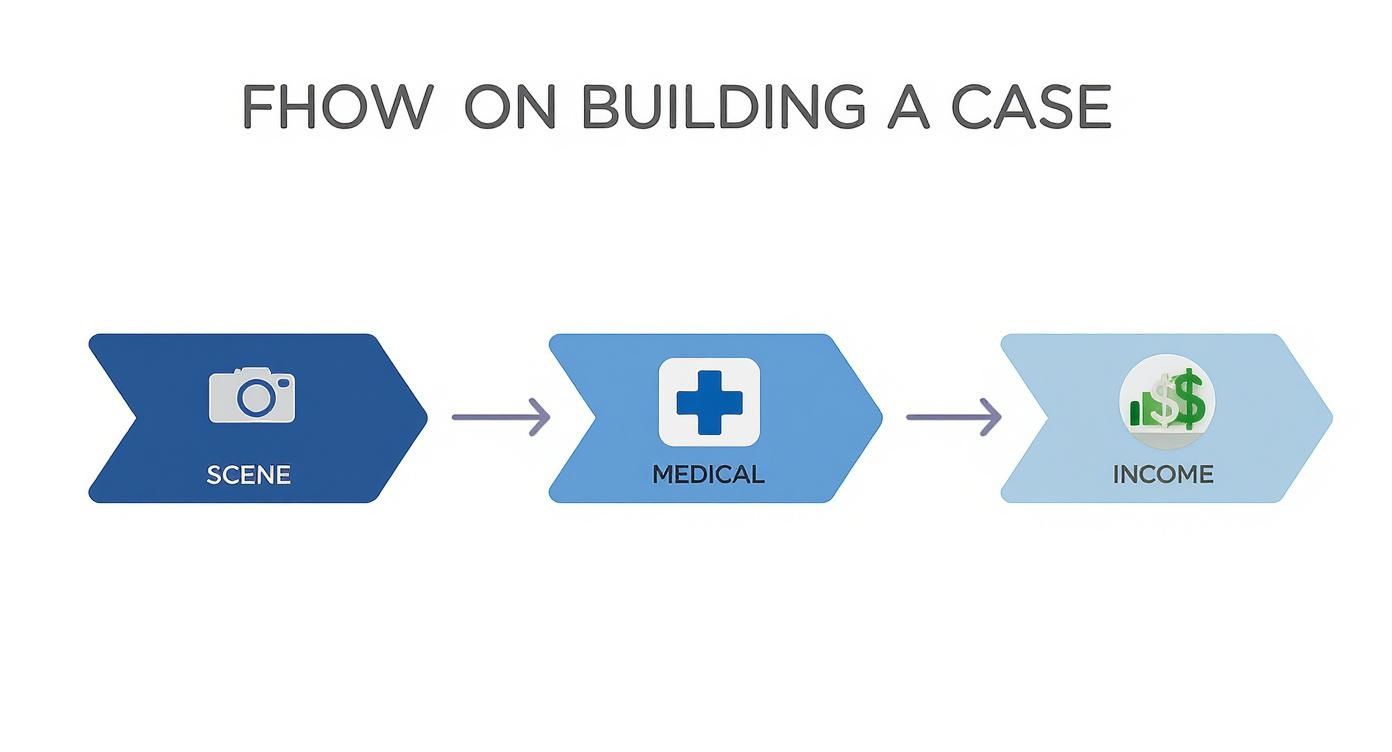
As you can see, a strong claim isn't just one thing. It’s built layer by layer with solid evidence from the scene, detailed medical records, and a clear accounting of every dollar you've lost. Each piece is crucial for demanding the compensation you truly deserve.
The Demand Letter and the Art of Negotiation
Our first big move is to draft and send a demand letter to the at-fault party's insurance company. This is far more than a simple request for money; it's a meticulously crafted legal document. We lay out the facts, prove the other party’s negligence, detail your injuries, and present a complete breakdown of your damages—from medical bills and lost wages to the very real cost of your pain and suffering.
Once the insurer gets the demand, the negotiation dance begins. You can almost always expect their first offer to be a lowball. It’s a classic tactic to see if you’re desperate enough to take a quick, cheap payout and go away. This is where a skilled negotiator earns their keep.
The back-and-forth between your attorney and the insurance adjuster is a strategic battle. We use the evidence we've gathered to reject unfair offers and build a compelling argument for why you deserve significantly more.
This can take some time, and patience is your best friend here. A rushed settlement almost always means leaving money on the table.
When Talks Break Down, Litigation Begins
So, what happens if the insurance company digs in its heels and refuses to offer a fair amount? This is the moment when having a lawyer with real trial experience becomes non-negotiable. If we hit a wall in negotiations, we don't think twice about filing a lawsuit and taking the fight to the courthouse.
Filing a lawsuit officially kicks off the litigation phase. Now, this doesn't mean you're walking into a courtroom tomorrow. It starts a formal process called discovery, where both sides are legally required to exchange information under oath.
Discovery involves a few key tools we use to build your case:
Interrogatories: These are written questions the other side must answer in writing, under penalty of perjury.
Requests for Production: We can legally demand that the other party hand over important documents like internal accident reports, driver logs, or maintenance records.
Depositions: This is our chance to question the at-fault party, witnesses, and experts in person, under oath, with a court reporter typing down every single word.
The goal of discovery is to uncover all the facts and lock the other side into their story. More often than not, the evidence we unearth during this phase is what finally pressures the insurance company to come to the table with a serious settlement offer.
Mediation: The Last Stop Before Trial
Before a case ever sees the inside of a courtroom in Florida, it almost always goes through mediation. This is a formal but confidential meeting where both sides, their lawyers, and a neutral third-party mediator sit down to hash things out. The mediator’s job isn't to pick a side but to help everyone find common ground and hopefully reach a settlement.
It’s a fact that over 95% of personal injury cases settle before trial. But here’s the critical part: the best settlements are won by lawyers who prepare every single case as if it's going all the way to a jury. Insurance companies keep score. They know which law firms are bluffing and which ones will actually see them in court.
That reputation is our biggest piece of leverage.
At CAINE LAW, we treat every case like it's heading to trial from day one. This obsessive preparation sends a clear message to the other side: we won't be bullied, and we won't back down. In pain? Call Caine.
Got Questions About Hiring an Injury Lawyer?
Even after getting a feel for the legal process, most people still have specific questions running through their minds when they think about hiring a personal injury lawyer. That’s completely normal.
Getting straight answers to these common concerns can make all the difference, helping you feel more confident as you navigate a truly stressful time. Here are some of the questions we hear most often.
How Long Do I Have to File a Personal Injury Lawsuit in Florida?
This is a critical one. In Florida, the deadline—what we call the statute of limitations—for most personal injury cases based on negligence is now just two years from the date of the accident. This is a recent change, so you have to move quickly.
If you miss that two-year window, the courthouse doors will almost certainly be closed to you forever, no matter how strong your case is. This is why it’s so important to contact an attorney soon after your injury; it ensures all those critical deadlines are locked in and met.
What if I Was Partially at Fault for the Accident?
We hear this worry all the time, but being partially at fault doesn't automatically mean you can't recover a dime. Florida operates under a “modified comparative negligence” rule.
What that means is you can still get compensation even if you were partly to blame, as long as your share of the fault isn't more than 50%. Your final award, however, will be reduced by whatever percentage of fault is assigned to you. An experienced lawyer’s job is to build a case that minimizes your assigned fault to protect your final recovery.
Let’s say you’re awarded $100,000 but a jury finds you were 20% at fault for the incident. Your award would be cut by that 20%, leaving you with $80,000. It’s a perfect example of why having a skilled advocate fighting in your corner is so crucial.
Will I Have to Go to Court if I Hire a Lawyer?
The thought of a courtroom showdown is enough to make anyone anxious, but it’s not what usually happens. The reality is that the vast majority of personal injury cases—well over 95%—are settled out of court through tough, strategic negotiation.
Here’s the key: a good lawyer prepares every single case as if it's going to trial. It’s that meticulous preparation that often puts enough pressure on the insurance company to make a fair settlement offer, long before a judge is ever involved. While court is always a possibility, our main goal is to get you the best possible compensation, whether that comes from a settlement or a trial verdict.
For a deeper dive, check out our guide on the 9 questions to ask your slip and fall attorney before hiring, which touches on similar topics.
At CAINE LAW, we believe you deserve clear answers and a powerful advocate. If you've been injured and have more questions, our team is ready to provide the guidance you need. In pain? Call Caine.
