
In Pain? Call Caine
Your Guide to Winning Florida Hip Implant Lawsuits

5 Min read
By: Caine Law
Share
Hip implant lawsuits are more than just legal paperwork. They're a powerful tool for patients who have been harmed by a faulty hip replacement device. When you file a claim, you’re holding a manufacturer accountable for design flaws, shoddy manufacturing, or a failure to warn doctors and patients about the real risks. The goal is to get you compensation for your medical bills, lost income, and the immense pain and suffering you've been forced to endure.
The Hidden Crisis of Defective Hip Implants
A hip replacement is supposed to be a second chance at an active life. It promises to end chronic pain and restore mobility. But for thousands of people here in Florida and across the country, that promise turns into a nightmare. The very device meant to bring relief ends up causing debilitating pain, serious health complications, and the trauma of going through more invasive surgeries to fix the problem.
This isn't just a string of bad luck. It's often the direct result of a defective medical product pushed to market too quickly.
When an implant fails years before it should, it's a massive breach of trust. Patients trust that the devices being surgically implanted into their bodies are safe. Unfortunately, some manufacturers have put profits ahead of people, and the consequences have been devastating. Filing a hip implant lawsuit is a way for victims to fight back, seek justice, and reclaim some control over their lives.
You Are Not Alone in This Fight
If you're going through this, it's important to know the problem is widespread. Major medical device companies have faced thousands of lawsuits over specific, flawed hip implant models. If you're dealing with unexplained pain, swelling, or have trouble walking after your surgery, your implant could be the culprit.
The signs of a failing hip implant can show up in different ways, but common red flags include:
Constant, worsening pain in your hip, groin, or down your thigh.
Strange grinding, clicking, or popping sounds coming from the joint.
A feeling of instability, like your hip is about to "give out."
Visible swelling and inflammation around the hip.
These aren't just minor side effects you should try to ignore. They are serious warning signs that your medical device is failing. It could be breaking down, or worse, releasing toxic metal particles into your bloodstream.
This guide is your roadmap to understanding these complicated legal claims. We'll break down the specific device failures, name the manufacturers involved, and walk you through the legal process step-by-step. You have options, and the first step is knowing what they are. If a faulty hip implant has turned your life upside down, you deserve to be compensated for everything you've lost.
In pain? Call Caine.
Why Good Hips Go Bad: Defective Designs Explained
When you get a hip implant, you're putting your trust in a medical device that's supposed to be safe, durable, and last for years. So why do so many fail prematurely, forcing patients into more pain and invasive revision surgeries? The answer, unfortunately, often lies in the implant’s fundamental design—a flaw that puts people at risk from day one.
One of the most notorious culprits involves metal-on-metal (MoM) hip implants. Picture rubbing two metal coins together over and over. Tiny metallic particles would eventually start flaking off. That’s exactly what happens inside the body with an MoM implant, where a metal ball grinds against a metal cup with every step you take.
This constant friction releases microscopic cobalt and chromium ions into your bloodstream and the surrounding tissues. Your body sees these particles as foreign invaders and launches a powerful inflammatory response. This painful chain reaction is where many of the devastating complications that lead to hip implant lawsuits begin.
The Dangers of Metallosis
This buildup of toxic metal debris causes a condition called metallosis, which is essentially metal poisoning localized around the hip joint. It’s a destructive process that can systematically break down the very bone and tissue the implant was meant to support.
The path from a hopeful surgery to a failed implant and the need for legal action is an all-too-common one for many patients.
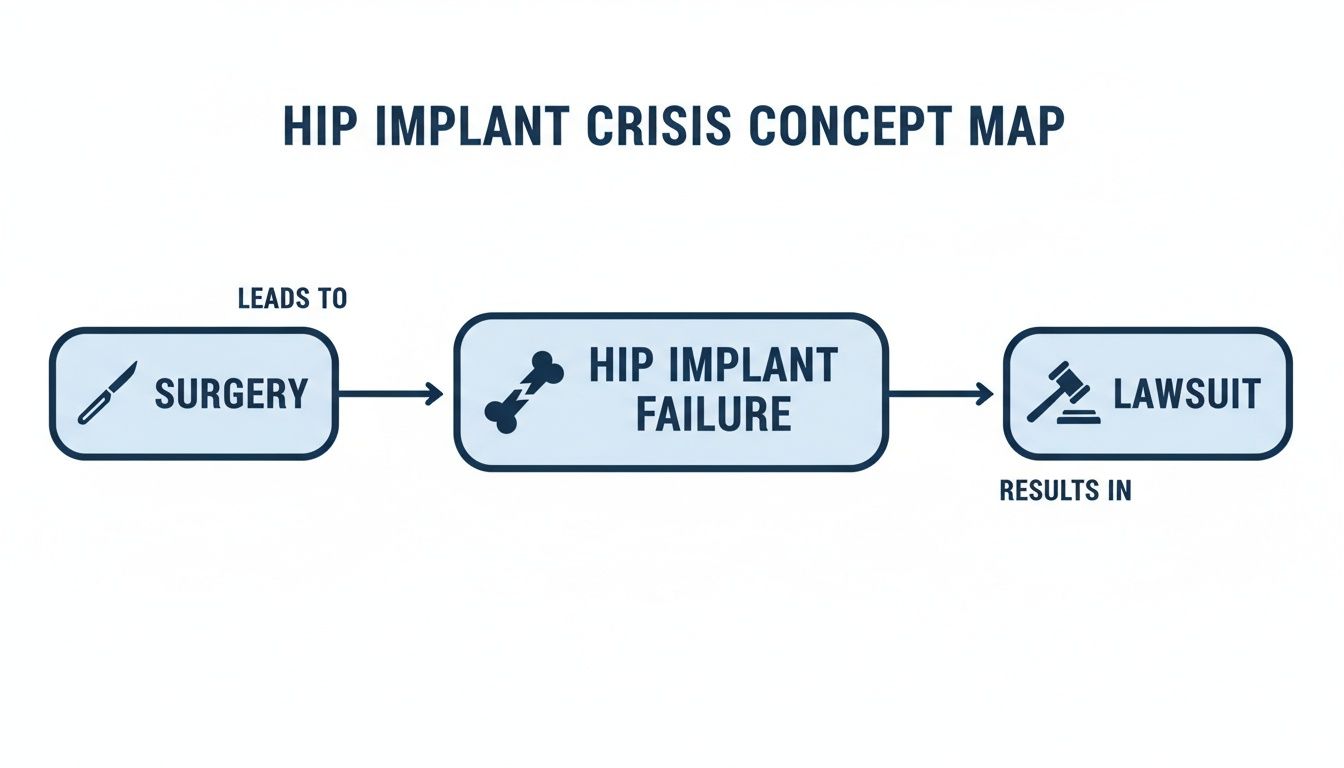
As you can see, a device failure isn't just a medical problem; it's often the event that forces patients to seek justice and hold manufacturers accountable.
The consequences of metallosis are severe and can include:
Tissue Death (Necrosis): The toxic metal particles can kill off healthy soft tissue around the hip, leading to instability and chronic pain.
Bone Loss (Osteolysis): Inflammation can eat away at the bone anchoring the implant, causing the device to become loose.
Pseudotumors: These are large, non-cancerous masses of fluid and inflamed tissue that can form around the joint, causing extreme pain and often requiring complex surgery to remove.
Metallosis isn't just a localized issue. These metal ions can travel through the bloodstream, potentially causing systemic problems like cognitive issues, skin rashes, and even heart or vision complications. It’s a chilling example of how a single design flaw can impact a person's entire well-being.
More Than Just Metal-on-Metal Failures
While MoM implants have been the focus of major litigation, they aren't the only devices with dangerous flaws. Many newer implants have a modular design, meaning they are built from separate, interchangeable parts like a neck and a stem. This approach gives surgeons more flexibility, but it also creates built-in weak points.
The junction where two components connect is highly susceptible to fretting and corrosion. Tiny micromovements between these parts can scrape away at the metal, releasing debris just like in MoM systems. This was the exact problem behind the massive recalls of the Stryker Rejuvenate and ABG II hip stems—devices that weren't traditional MoM implants but still caused metallosis because of their faulty modular junctions.
To help you better understand what might be going on with your own hip implant, we've put together a table outlining the most common types of failures and the symptoms they can cause.
Common Hip Implant Failures and Their Symptoms
Type of Defect | What Causes It | Common Symptoms You Might Feel |
|---|---|---|
Metallosis | Grinding of metal-on-metal or modular metal parts releases toxic metal ions into the body. | Groin pain, swelling, grinding noises, numbness, skin rashes, and cognitive fog. |
Component Loosening | The implant fails to properly bond with the bone, often due to a defective surface coating. | A feeling of instability, pain when walking or standing, and the sensation that the hip might "give out." |
Fretting & Corrosion | Micromovements at the junction of modular components (like the neck and stem) scrape away metal particles. | Similar to metallosis, causing localized pain, inflammation, and potential bone and tissue damage. |
Premature Liner Wear | The plastic (polyethylene) liner between metal parts breaks down too quickly due to manufacturing or packaging defects. | Increased pain, clicking sounds, and a reduced range of motion as the smooth surface wears away. |
Recognizing these issues is the first step. If you're experiencing pain, swelling, or instability, it may be directly linked to one of these known design flaws. Understanding that connection empowers you to start seeking both the medical and legal answers you deserve.
In pain? Call Caine.
Recalled Devices and Major Manufacturers
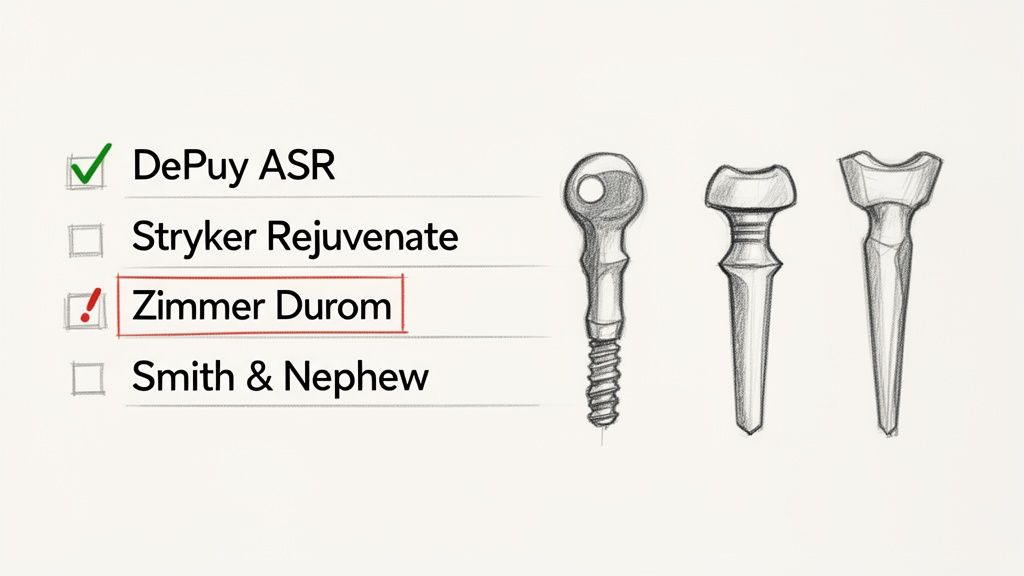
Knowing why an implant might fail is the first piece of the puzzle. The next, and just as critical, question is: who made the device currently inside your body? The medical device industry is dominated by a handful of massive corporations, and a few of them have become notorious names in the world of hip implant lawsuits.
These companies are at the heart of widespread litigation because of specific, flawed devices they designed, aggressively marketed, and sold to surgeons across the country. Figuring out if your implant is on this list is a huge step toward understanding your legal options.
DePuy Orthopaedics (A Johnson & Johnson Company)
If one name is synonymous with hip implant failures, it's DePuy, a subsidiary of Johnson & Johnson. They are the manufacturers behind two of the most infamous metal-on-metal systems, the ASR and the Pinnacle, which have led to tens of thousands of lawsuits and billions of dollars in settlements.
Back in August 2010, DePuy finally recalled its ASR Hip Resurfacing System and ASR XL Acetabular System. This move impacted roughly 93,000 patients worldwide. The company’s own data showed staggering failure rates of 12% to 13% within just five years, causing devastating complications like metallosis. By 2013, more than 10,453 lawsuits had piled up, and DePuy ultimately paid a jaw-dropping $4.42 billion to settle nearly 9,800 of those claims. You can discover more insights about the DePuy ASR litigation and its fallout.
DePuy ASR XL Acetabular System: This metal-on-metal device was yanked from the market globally because of its unacceptably high failure rate. Its core design flaw caused it to shed toxic cobalt and chromium ions, leading directly to metallosis, pseudotumors, and catastrophic tissue damage.
DePuy Pinnacle Hip System: While the Pinnacle was never officially recalled, the all-metal version (using the Ultamet liner) shared the same dangerous design as the ASR. It has been the subject of over 10,000 lawsuits, with juries awarding enormous verdicts to patients who were severely injured.
Stryker Orthopaedics
Stryker is another industry giant that found itself in hot water over its modular-neck hip stems. These weren't your typical metal-on-metal hips. Instead, their unique failure point was the junction where the neck and stem components connected—a critical design weakness.
The problem was fretting and corrosion at this modular junction, which released metallic debris into the body and caused metallosis, the very same issue plaguing the MoM implants.
These devices were pitched to surgeons as “high performance” options for younger, more active patients. The reality was a design that introduced a new and dangerous point of failure, leading to a massive recall and thousands of personal injury claims.
In 2012, Stryker recalled its Rejuvenate and ABG II hip stems, finally admitting the devices posed serious risks of fretting and corrosion. This came only after the company had sent urgent safety warnings to surgeons about the "excessive metal debris" these implants could generate.
Other Notable Manufacturers in Hip Implant Litigation
DePuy and Stryker have certainly been in the spotlight, but they aren't the only ones. Other manufacturers have faced major legal battles over their own defective hip products. If you see their name, it’s worth paying attention.
Zimmer Biomet: Faced a mountain of lawsuits over its Durom Cup, an MoM component that had high rates of loosening because it simply failed to bond properly with the patient's bone.
Smith & Nephew: Pulled its Birmingham Hip Resurfacing (BHR) system from the U.S. market after data showed high failure rates, especially in women.
Wright Medical: Paid out hundreds of millions to settle thousands of lawsuits over its CONSERVE and PROFEMUR metal-on-metal hip systems.
If your implant was made by one of these companies and you’re now dealing with pain, instability, or other strange symptoms, you need to take action. Identifying your device is the first step toward getting the help and justice you deserve.
In pain? Call Caine.
Building Your Product Liability Case
Going through the pain of a failed hip implant is a medical nightmare. But getting justice for it? That’s a legal fight. When your implant fails, you have a clear path to hold the device manufacturer accountable through what’s called a product liability claim.
Let’s be clear: this isn't about blaming your surgeon. Your battle is with the multi-billion-dollar corporation that designed, manufactured, and sold a product that ended up causing you harm.
To build a strong case, you first have to understand the legal arguments we can use. These aren't just about getting a settlement; they're about holding these companies accountable for the decisions that put patients like you at risk. Your lawsuit will likely stand on one of three foundational legal theories.
Defective Design: The Blueprint Was Flawed
The most common claim we see in hip implant lawsuits is defective design. This argument is simple: the implant was dangerous from the moment it was conceived on the drawing board. It’s like a car designed with a faulty braking system—it doesn't matter how perfectly it’s put together, the core design itself is a hazard.
The infamous metal-on-metal (MoM) hip implants are the perfect example. Their very design guaranteed that metal parts would grind against each other, shedding toxic metallic debris into the body. This wasn't a fluke; it was a predictable result of a flawed concept. That made the product unreasonably dangerous for every single person who received one.
Manufacturing Defect: An Error on the Assembly Line
A manufacturing defect is a different beast. In this scenario, the overall design might be perfectly fine, but a mistake during the production process made your specific implant unsafe. Think of it as one car rolling off the assembly line with its brake lines installed backward, while thousands of others were made correctly.
Maybe a batch of implants was contaminated with an industrial chemical during production. Or perhaps a plastic liner was packaged improperly, causing it to break down years ahead of schedule. These aren't design-wide issues but isolated mistakes that cause individual devices to fail. Proving this means we have to pinpoint the exact error that made your implant different and dangerous.
Failure to Warn: Hiding the Ugly Truth
Finally, there's the failure to warn claim. This argument alleges that the manufacturer knew about potential risks but deliberately failed to tell doctors and patients. Medical device companies have a legal duty to be honest about the dangers of their products. When they bury negative clinical data or downplay high failure rates, they've breached that duty.
A manufacturer might know from its own internal studies that a modular-neck implant has a high risk of corroding, but they market it as a durable, long-lasting solution anyway. By hiding that critical information, they rob surgeons and patients of the ability to make an informed choice. It's a clear case of putting profits before patient safety.
This is a powerful and unfortunately common claim in many hip implant lawsuits. It exposes a company's conscious choice to gamble with people's health for the sake of sales. To hold them accountable, we have to uncover evidence showing they knew far more than they were telling the public.
A huge part of this is properly documenting your entire medical journey. For more on this, check out our guide on how to document evidence needed for a personal injury claim in Florida.
Each of these legal arguments provides a different path toward justice. An experienced attorney can dig into the details of your implant failure and figure out the strongest approach for your specific situation. Whether the blueprint was bad from the start or the company just hid the dangers, the goal is always the same: getting you the compensation you deserve.
In pain? Call Caine.
What Your Hip Implant Lawsuit Is Worth

When a defective hip implant turns your life upside down, the most pressing question is often the most practical one: what is my case actually worth? While every hip implant lawsuit is different, the goal is always to get a settlement or verdict that covers the full scope of your losses.
To figure out what that looks like for you, we need to break down the two main kinds of damages you can claim. These categories separate the clear, calculable costs from the profound, personal suffering you've been forced to endure. Together, they build the foundation of your claim and help a court understand the total impact this nightmare has had on your life.
Economic Damages: The Tangible Costs
Think of economic damages as all the real, out-of-pocket expenses you've been saddled with because of the faulty implant. These are the straightforward financial losses that can be proven with receipts, pay stubs, and medical records. They are the concrete costs of your ordeal.
Your legal team will meticulously gather every piece of paper to prove the full extent of these damages, which almost always include:
All Medical Bills: This covers everything. We’re talking about the initial replacement surgery, the painful and often more complex revision surgery, hospital stays, follow-up appointments, physical therapy, and every prescription filled.
Lost Wages and Income: If you were unable to work while recovering—and most people are—you can be paid back for that lost income. It's a direct financial hit caused by the implant's failure.
Diminished Earning Capacity: In some of the most tragic cases, the damage is so severe that it permanently affects your ability to do your job. This damage category is meant to compensate you for the future wages you'll no longer be able to earn.
Non-Economic Damages: The Human Toll
While economic damages add up the bills, non-economic damages address the immense human cost. These losses are just as real, but they don’t come with a simple price tag. This is compensation for the physical pain and emotional trauma that have completely disrupted your life.
These damages are meant to acknowledge the devastating, but less tangible, impact the implant failure has had on your quality of life. They recognize that your suffering goes far beyond just medical bills.
Common types of non-economic damages include:
Pain and Suffering: This is for the chronic physical pain, constant discomfort, and emotional distress you’ve been forced to live with.
Loss of Enjoyment of Life: If your injuries stop you from playing with your grandkids, golfing, gardening, or enjoying the hobbies you once loved, this helps account for that devastating loss.
The potential value of these claims can be huge. Just look at the DePuy Pinnacle litigation, which saw staggering jury verdicts that ultimately pushed the company toward massive settlements. One Texas jury awarded $502 million to five plaintiffs in 2016, and that was followed by a jaw-dropping $1 billion verdict for six more patients later that same year.
These landmark trials helped pave the way for a $1.7 billion settlement for thousands of victims. All told, hip implant manufacturers have paid out over $6.5 billion to resolve these claims. You can learn more about these groundbreaking hip implant verdicts and their impact.
Getting this level of compensation absolutely requires an experienced legal team. An attorney who lives and breathes these cases knows how to build a powerful claim that reflects both your financial and personal losses, fighting to make sure you get every penny you rightfully deserve.
In pain? Call Caine.
Why You Need an Experienced Advocate on Your Side
Let's be blunt: taking on a multi-billion-dollar medical device company is not a fair fight. These corporations are armed with teams of aggressive lawyers whose entire job is to shut down claims, minimize payouts, and protect their bottom line. Going it alone is an uphill battle you simply can’t win.
But with the right advocate in your corner, the scales of justice can be tipped back in your favor.
At CAINE LAW, we step in to even the odds. Your journey with us starts with a free, no-obligation case evaluation. We’ll sit down with you, listen to your story, and explain your legal options in plain English. There are no confusing contracts or hidden fees—just clear, honest advice on how we can fight for the compensation you deserve.
The Advantage of Insider Knowledge
Daniel Caine brings over 20 years of experience to your case, including a critical background defending these very same large corporations in high-stakes litigation. This is our secret weapon. We know the manufacturer's playbook because we’ve seen it from the inside out. This gives us an invaluable understanding of their defense strategies, delay tactics, and exactly how they value cases like yours.
We use this insider knowledge to your advantage, anticipating their next move and building a proactive, ironclad case designed to counter their every argument. This unique perspective is often the key to securing the maximum possible compensation for our clients.
Building Your Case for Victory
A successful hip implant lawsuit isn't won on emotion; it's won with evidence. We are meticulous in our preparation, leaving no stone unturned as we gather everything needed to build a winning claim. Our team will handle it all, including:
Securing all your medical records, from initial surgical reports to post-op diagnostic imaging.
Obtaining the implant logs and device identification stickers to prove precisely which product failed you.
Consulting with leading medical experts and engineers who can provide powerful testimony on the device’s defects and how they caused your injuries.
We want to be clear about one thing: you pay absolutely nothing unless we win your case. Our contingency fee arrangement means our goals are perfectly aligned with yours—securing a victory. We stand with the injured against powerful corporations.
You've already been through enough. Let us take on the legal battle so you can focus on what truly matters: your health and recovery. To learn more about how we champion the rights of the injured, explore our approach to personal injury representation in Florida.
We have the experience, the resources, and the unwavering dedication to fight for you.
In pain? Call Caine.
Questions We Hear All the Time About Hip Implant Cases
When you're dealing with the pain and frustration of a failed hip implant, it's natural to have a lot of questions. We've put together some straightforward answers to the concerns we hear most often from people just like you.
How Can I Tell If My Hip Implant Is the Problem?
Your body is usually the first to tell you something's wrong. You might feel a deep, persistent pain in your groin or thigh, or notice swelling that just won’t go away. Some people even hear strange grinding or clicking sounds when they move.
If any of this sounds familiar, your very next call should be to your doctor. Ask them about getting specific blood tests to check for metal ions (like cobalt and chromium) and imaging scans, such as an MRI, to get a clear picture of what’s happening with the implant.
What Will It Cost to Hire a Lawyer for This?
This is a big one, and the answer is simple: it costs you zero upfront to get our help. We handle these cases on what’s called a contingency fee basis.
That just means our firm only gets paid if we win your case and recover money for you. If we don't get you a recovery, you don't owe us a dime.
Have I Waited Too Long to File a Lawsuit in Florida?
Not necessarily, but the clock is definitely ticking. Florida has a strict deadline known as the statute of limitations, which can be tricky. It doesn’t always start from the date of your surgery. Instead, it often starts from the moment you discovered—or reasonably should have discovered—that the defective implant was the source of your problems.
Because this is so time-sensitive, it's crucial to talk to an attorney right away to make sure you don't lose your chance. For a deeper dive into what to do after an injury, take a look at our guide on essential steps and legal guidance when accidents happen.
You've been through more than enough. You don't have to take on a massive medical device company by yourself. The experienced team at CAINE LAW knows how these corporations operate, and we're ready to stand up and fight for you. We have the resources and the know-how to build a powerful case and demand the full compensation you deserve.
In pain? Call Caine. Contact us today for a free, no-obligation consultation at https://cainelegal.com.
