
In Pain? Call Caine
Navigating the Florida Wrongful Death Statute

5 Min read
By: Caine Law
Share
Losing a loved one is one of the most painful things anyone can go through. When that loss happens because of someone else's carelessness, the grief is often mixed with a sense of injustice and confusion. The legal world that follows can feel like a maze, but Florida law provides a clear, though complex, path for families to seek accountability.
This is where the Florida Wrongful Death Act comes in. It’s a set of laws designed specifically for these tragic situations, creating a civil action—completely separate from any criminal charges—that aims to compensate survivors for their profound losses.
What Is the Florida Wrongful Death Act?
When you're trying to heal, the last thing you need is a mountain of dense legal text. So let's break this down in plain English. The Florida Wrongful Death Act, found in Florida Statutes §768.16 through §768.26, is a legal framework designed to help families find their footing after a preventable death has turned their world upside down.
Think of this law not as a way to put a price on a cherished family member—that’s impossible. Instead, see it as a critical tool for civil justice. It focuses on the real-world fallout of a tragedy, acknowledging that a sudden death leaves behind far more than just memories. It often creates devastating financial burdens and a void that can never be filled.
Core Purpose of the Statute
At its heart, the statute's main goal is to shift the financial weight of the tragedy from the shoulders of the grieving family to the party whose negligence caused the death. This legal framework specifically addresses a few key areas:
Financial Support: It helps replace the income and other support the deceased would have provided for their family.
Final Expenses: It covers the often-staggering costs of medical bills from their final injury or illness, as well as funeral and burial expenses.
Emotional Suffering: The law explicitly recognizes the immense mental pain, suffering, and loss of companionship that close family members endure.
Navigating the Legal Process
This guide is meant to be a clear roadmap, explaining each part of the statute without the confusing jargon. We'll walk through the most critical elements you absolutely need to know, starting with the strict two-year filing deadline. This isn't just a suggestion; it's a hard-and-fast rule. The clock starts ticking on the date of death, making timely action absolutely essential.
We'll also clarify who the law legally considers a "survivor" and who actually has the right to file a claim on behalf of the family. Not every relative is eligible, and the rules are very specific. Finally, we'll outline the different types of compensation—what lawyers call "damages"—that may be available to the estate and to the surviving family members.
Understanding these basics is the first step toward protecting your family’s rights. And while this area of law is related to general personal injury claims in Florida, the rules for wrongful death are unique and demand specialized attention. If your family is facing this unimaginable situation, you don’t have to figure it out alone. In pain? Call Caine.
The Critical Two-Year Statute of Limitations
When you’re reeling from the loss of a family member, the last thing on your mind is a legal deadline. But in a wrongful death claim, one rule is more unforgiving than any other: the statute of limitations. Think of it as a legal countdown clock. In Florida, that clock is set for two years, and once it runs out, the opportunity to seek justice is almost always gone for good.
This isn't just an arbitrary rule. The state put this strict timeframe in place to be fair to everyone involved and to make sure claims are based on solid ground. Over time, evidence breaks down, witnesses' memories get fuzzy, and crucial documents disappear. A deadline pushes for timely action, ensuring the case is built on the clearest, most reliable information possible.
When Does the Countdown Begin?
This is where things can get a little tricky, and it’s a point of confusion for many families. The two-year clock does not start ticking on the day of the accident or the negligent act that caused the harm.
Instead, the countdown officially begins on the date of the deceased person’s death. That specific day is the legal trigger.
Let's walk through a real-world example. Say someone is in a serious car wreck on January 15, 2024. They're rushed to the hospital and fight for months, but they tragically pass away from their injuries on May 10, 2024.
Date of the Accident: January 15, 2024
Date of Death: May 10, 2024
Filing Deadline: May 10, 2026
In this scenario, the family has until May 10, 2026, to file a wrongful death lawsuit. The time the person spent in the hospital doesn't count against the two-year window for the wrongful death claim itself.
This timeline helps visualize the path from the initial act of negligence to the family's pursuit of accountability.
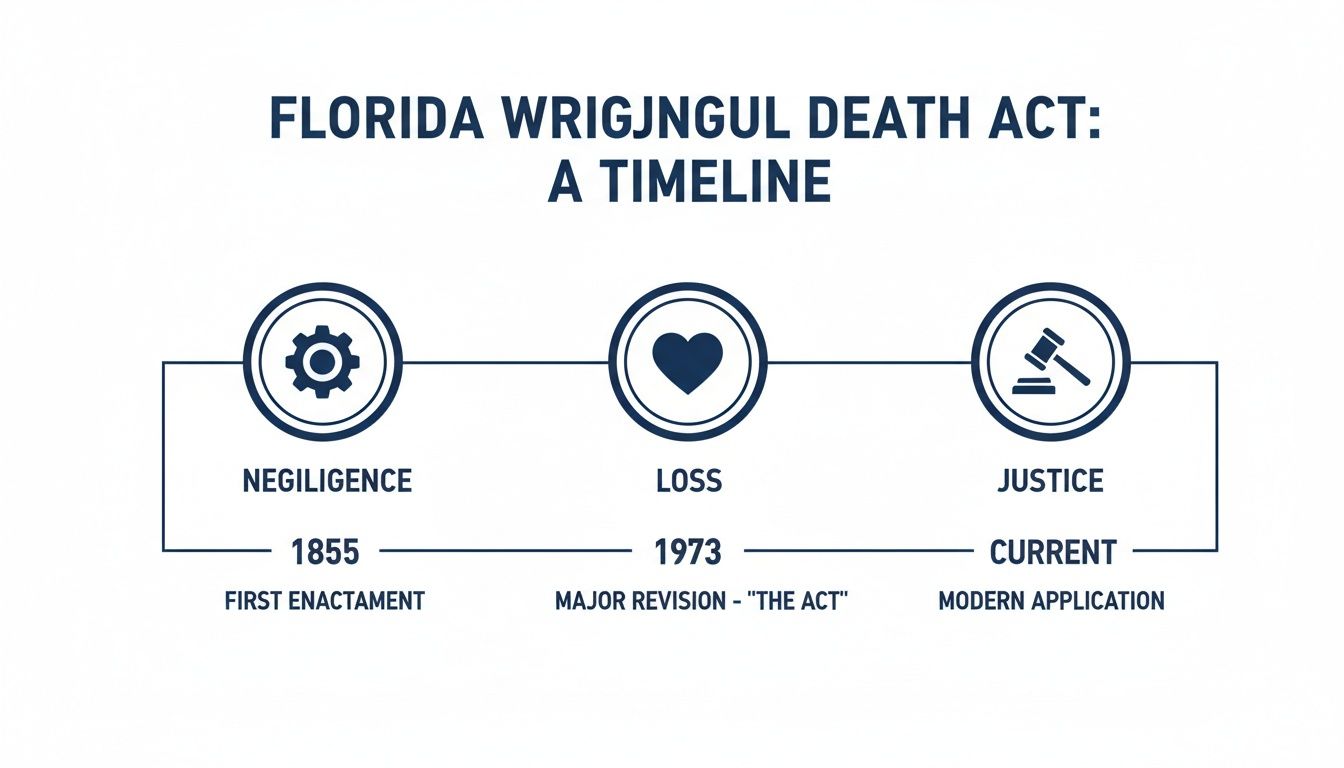
As the graphic shows, the moment of loss is what starts the legal journey, and that journey must begin long before the two-year deadline approaches.
Florida Wrongful Death Filing Timeline Scenarios
To make it even clearer, here’s a table showing how the deadline works in a few different situations.
Event Scenario | Date of Incident | Date of Death | Filing Deadline |
|---|---|---|---|
Immediate Death | March 1, 2023 | March 1, 2023 | March 1, 2025 |
Delayed Death | June 20, 2023 | September 5, 2023 | September 5, 2025 |
Medical Malpractice | January 10, 2024 | February 15, 2024 | February 15, 2026 |
The key takeaway is always the same: the clock starts on the date of death.
The Strict Consequences of Missing the Deadline
Florida courts don't bend on this rule. The Florida wrongful death statute of limitations, outlined in Florida Statute § 95.11(4)(d), is strictly enforced. It gives families exactly two years from the date of death to file, no matter when the car crash, medical error, or other incident happened.
Court statistics in Florida are sobering: missing this deadline bars recovery in over 90% of late-filed cases.
The two-year filing window is absolute. It is not a suggestion or a guideline; it is a hard legal barrier that will stop a case in its tracks, no matter how strong it is.
Can the Clock Ever Be Paused?
While the rule is firm, the law does recognize that some rare situations can make it impossible for a family to file on time. This is where a legal concept called "tolling" comes into play. Tolling is like hitting the pause button on the statute of limitations countdown.
For example, the clock might be paused if the surviving claimant is a minor or if the person responsible actively and fraudulently hid what they did. These exceptions are incredibly narrow and complex. We'll dive into them more deeply in the next section, but it's important for you to know they exist.
Even so, no family should ever assume they have more than two years. The stakes are simply too high. If you are navigating the aftermath of a loved one's death, the single most important step you can take is to get clear on your legal timeline right away. In pain? Call Caine.
Are There Exceptions to the Two-Year Filing Deadline?
While Florida’s two-year statute of limitations is one of the toughest deadlines in the legal world, it’s not completely set in stone. A few rare but critical exceptions exist that can “toll,” or pause, the countdown clock. This gives families more time to file a claim, but be warned: these situations are legally complex and only apply in very specific circumstances.
The most common reason for pausing the clock is when the harm caused by negligence isn't immediately obvious. This is often called the “discovery rule.” Imagine a situation where a medical mistake during surgery leads to a fatal complication months down the road, but the link between the two is either intentionally hidden or simply not discoverable with normal effort.
Think of it like a locked door. A family knows they’ve lost their loved one, but they don’t have the key—the critical piece of information—to understand that someone else’s negligence was the real cause. Under this rule, the legal clock doesn’t start ticking until that key is found and the family discovers, or reasonably should have discovered, the true cause of death.
The Jeffrey Klee Memorial Act
The most significant exception to the Florida wrongful death statute comes from a heartbreaking, decades-long fight for justice. The Jeffrey Klee Memorial Act applies specifically to deaths caused by murder or manslaughter, completely removing the two-year filing deadline for those cases.
This powerful change came after the 1977 murder of Jeffrey Walter Klee went cold for over 30 years. By the time a suspect was finally identified, the standard two-year limit was long gone, shutting the door on his family’s ability to seek civil justice. In response, the Florida legislature passed the Act in 2010, ensuring no other family would lose their right to hold a wrongdoer accountable just because a criminal investigation took years, or even decades, to solve.
As a landmark exception to Florida's two-year wrongful death statute, the 2010 Jeffrey Klee Memorial Act eliminated time limits for homicide-related deaths. The Act, which passed unanimously, declares there is no statute of limitations for wrongful death lawsuits when the death results from murder or manslaughter. Since its passage, dozens of cases have relied on the Act, leading to settlements of over $150 million and guaranteeing that justice is never lost to time in these devastating cases. You can read more about the impact of this law on the Hevia Law Firm's website.
Other Potential Loopholes in the Deadline
Beyond the discovery rule and the Jeffrey Klee Memorial Act, a few other narrow exceptions might come into play. These situations almost always demand the guidance of a seasoned attorney to navigate successfully.
Fraudulent Concealment: If the person or company responsible for the death actively tries to hide their wrongdoing, the court may pause the clock. This isn't easy to prove; you have to show there was an intentional deception designed to keep the family from finding out they had a legal claim.
Minor Survivors: When the only survivor eligible to file a claim is a minor child, the statute of limitations may be tolled until they legally become an adult.
Defendant Skips Town: If the defendant leaves Florida after the incident to avoid being sued, the time they are gone may not count against the two-year deadline.
These exceptions really highlight how intricate the Florida wrongful death statute can be. You should never just assume one of them applies to your situation without a deep dive from a legal professional. The consequences of miscalculating the deadline are absolute—losing your right to file a claim is a devastating and permanent outcome.
If you believe your circumstances might fall under one of these exceptions, it's critical to seek legal advice immediately. In pain? Call Caine.
Who Is Eligible to File a Claim in Florida
After a tragic loss, one of the first and most confusing questions is, "Who can actually take legal action?" Many grieving family members naturally assume they can file a lawsuit directly, but the Florida wrongful death statute lays out a very specific, and often surprising, process. It’s not a free-for-all where every relative can bring their own claim.
Instead, Florida law is designed to be efficient and fair. It requires a single, unified lawsuit to be filed on behalf of all eligible survivors. This prevents the chaos of multiple lawsuits over the same death, which could easily lead to conflicting court rulings and unfair results for the family. So, who's in charge of this one unified claim?

The Role of the Personal Representative
The lawsuit is officially filed by the personal representative of the deceased person’s estate. You can think of this person as the captain of the ship, steering the case through the legal system for the benefit of everyone on board—the survivors.
This individual is either named in the deceased's will or, if there isn't a will, appointed by a probate court. Their job is to act in the best interests of the estate and all its survivors, not just themselves. They are the ones who gather the documents, work with the attorney, and manage the legal proceedings from beginning to end.
The personal representative is the only party legally permitted to file the wrongful death lawsuit. They act as a fiduciary, meaning they have a legal and ethical obligation to represent the interests of all statutory survivors.
Defining the Survivors
While the personal representative is the one filing the paperwork, the lawsuit is brought for the benefit of the survivors. But who does Florida law actually consider a "survivor"? The Florida wrongful death statute is very precise about this.
The term “survivors” isn't a broad catch-all; it includes specific family members who have suffered a loss because of the death. The primary survivors are usually:
The surviving spouse
The deceased's children (both minor and adult)
The deceased's parents
In some cases, the circle widens. Any blood relative or adoptive sibling who was "partly or wholly dependent on the decedent for support or services" might also qualify as a survivor. This could be a niece who relied on their uncle for financial help or a sibling who depended on the deceased for daily care.
Who Can Recover What Types of Damages
This is where things can get even more complex. Not every survivor is eligible for the same kind of compensation. The law carves out specific rules for who can recover for what, especially when it comes to damages for emotional pain versus lost financial support.
To make this clearer, here’s a simplified breakdown of who is generally eligible for different categories of damages under the Florida wrongful death statute.
Eligible Survivors and Potential Damages Under Florida Law
The table below breaks down which family members can typically claim damages for financial losses (like lost income and services) versus emotional losses (like mental pain and lost companionship).
Survivor | Eligible for Loss of Support/Services | Eligible for Loss of Companionship & Mental Pain |
|---|---|---|
Spouse | Yes | Yes |
Minor Children | Yes | Yes |
Adult Children | Generally No (unless no surviving spouse) | Generally No (unless no surviving spouse) |
Parents of Minor Child | Yes | Yes |
Parents of Adult Child | Generally No (unless no other survivors) | Generally No (unless no other survivors) |
As you can see, a surviving spouse and minor children almost always have the right to claim compensation for both their financial losses and their profound emotional suffering. For adult children or the parents of an adult child, however, the ability to recover for that mental pain and suffering is much more limited and often depends on whether a spouse or other survivors exist.
Understanding these distinctions is absolutely critical for your family. The rules are strict, and a misunderstanding could put your entire claim at risk. An experienced attorney can sit down with you, explain how the law applies to your unique family, and make sure every single eligible survivor's claim is properly represented. If you're facing this difficult process, let us help you understand your rights. In pain? Call Caine.
Types of Damages You Can Recover
When a family is shattered by a preventable death, no amount of money can ever fill that void. But the legal system does offer a way to secure your family's financial future. Under the Florida wrongful death statute, "damages" are the legal term for the compensation designed to cover the very real losses—both tangible and intangible—caused by someone else's negligence.
It's crucial to understand the full scope of these damages. Florida law wisely separates them into two main categories: compensation paid to the deceased's estate, and compensation paid directly to the surviving family members.
Damages Paid to the Estate
Think of the "estate" as the legal and financial entity your loved one left behind. The damages paid to the estate are meant to compensate for losses the deceased person themselves suffered or the financial growth that was stolen from them.
These are mostly economic losses that can be calculated with a good degree of certainty. The estate's personal representative is responsible for collecting these funds. It's important to know that these funds might be subject to claims from creditors before they can be distributed to heirs.
The key damages the estate can recover include:
Lost Future Earnings: This is the income your loved one would have reasonably earned over a natural lifespan, minus what they would have spent on their own living expenses.
Lost Net Accumulations: This calculates the value of what the deceased would have saved and built up in their estate if they had lived a full life. In essence, it’s the measure of the future inheritance that was lost.
Medical and Funeral Expenses: The estate can be reimbursed for all medical bills from the final injury or illness, as well as the costs for the funeral and burial.
Damages Paid Directly to Survivors
While the estate recovers its own financial losses, the law also recognizes the deeply personal and devastating impact on the surviving family members. This compensation goes directly to the survivors to address both their financial struggles and profound emotional pain.
These are broken down a bit further.
Economic Losses for Survivors
This category covers the direct financial hole left in the family's life.
Loss of Support: This is the value of the income, benefits like health insurance, and other financial support the deceased provided to their dependents.
Loss of Services: This is an often-underestimated but incredibly important category. It covers the real-world value of all the tasks and chores your loved one handled—from childcare and home repairs to managing the family budget and driving kids to school.
To put it in perspective, if a stay-at-home parent is wrongfully killed, the "loss of services" would represent the massive cost of hiring people to provide the childcare, housekeeping, and household management they once handled every single day. The value here can be substantial.
Non-Economic Losses for Survivors
This is where the Florida wrongful death statute truly acknowledges the human cost of the tragedy. These damages are for the kind of suffering that can’t be tallied on a spreadsheet.
Mental Pain and Suffering: This compensates eligible survivors (usually the spouse, minor children, and sometimes parents) for their grief, sorrow, and anguish.
Loss of Companionship, Protection, and Guidance: A surviving spouse can recover damages for losing their partner's companionship and protection. A minor child can recover for the loss of a parent's invaluable guidance and instruction.
Florida's Wrongful Death Act (§768.16-768.26), which has roots going back to 1883, allows for significant awards. Recent jury verdicts show wrongful death payouts averaging $2.8 million. Survivors can recover economic damages like medical bills (averaging $150,000) and lost wages ($1.2 million median), plus non-economic damages for pain and suffering. The law even has special protections, like ensuring a claim can proceed even if a spouse dies within 30 days from the same negligent act. You can find more on the law's background over at Kubicki Draper's legal blog.
Maximizing your family's recovery often means facing down uncooperative insurance companies. Knowing your rights is essential, which is why we’ve put together a guide on handling common insurance disputes.
Figuring out and proving these damages requires a deep understanding of the law and a lot of skill. An experienced attorney will make sure every single loss is accounted for, giving your family the best possible chance to secure the financial stability you deserve. In pain? Call Caine.
How to Protect Your Family's Legal Rights
Navigating the aftermath of a loved one’s passing is an incredibly painful and overwhelming experience. While legal matters might feel like the last thing you want to think about, acting quickly is essential to protect your family's rights under the florida wrongful death statute. The initial steps you take can make a huge difference in the strength of a future claim.

One of the most immediate and critical tasks is preserving evidence. This means carefully gathering every relevant document connected to the incident and your loved one before things get lost in the chaos.
Critical First Steps for Your Family
Taking organized, proactive steps now can build a strong foundation for your case. Focus on these key areas to safeguard crucial information before it fades or disappears.
Gather All Documents: Collect absolutely everything related to the incident. This includes police reports, all medical records, the death certificate, and any related bills, invoices, or receipts.
Document the Scene: If you can, collect photos or videos of the accident location, any property damage, and visible injuries. This kind of visual evidence can be incredibly powerful down the road.
Identify Witnesses: Make a list of anyone who saw what happened. Get their full names and contact information—their testimony could be vital.
Avoid Social Media: As hard as it may be, refrain from posting details about the incident, your grief, or any legal plans on social media. Insurance companies actively monitor these platforms, looking for anything they can use against you.
While these steps are important, the single most critical action you can take is to seek professional legal guidance. For more detailed information, you can review our guide covering essential steps and legal guidance after an accident.
Consulting with an experienced wrongful death attorney is the single most important step in protecting your family’s future. An initial consultation is typically free and confidential, offering clarity without any obligation.
This initial conversation empowers you. It helps you understand your specific legal options and make informed decisions during an impossibly difficult time. A compassionate legal team can assess your situation, explain the complexities of the florida wrongful death statute in plain English, and outline a clear path forward.
If you are navigating this challenging time and need guidance, our team is here to help you secure the justice your family deserves. In pain? Call Caine.
Answering Your Questions About Florida's Wrongful Death Law
Losing someone you love is devastating. When you're trying to navigate that grief, the last thing you need is a mountain of confusing legal questions. Let's clear up some of the most common points of confusion about the Florida wrongful death statute.
Wrongful Death vs. Survival Action: What's the Difference?
It’s easy to get these two mixed up, but they cover different types of losses. Think of them as two separate claims that arise from the same tragic event.
A wrongful death claim is filed on behalf of the survivors—like a spouse, child, or parent—for their personal losses. This is about compensating the family for the financial support they’ve lost, the services their loved one provided, and the profound pain and suffering of losing their companionship.
A survival action, which falls under Florida Statute § 46.021, is different. It's brought by the estate to recover the losses the deceased person themselves suffered before they passed away. This claim essentially "survives" their death and typically covers things like the medical bills they racked up between the injury and their death, plus any wages they lost during that time.
Can We Still File a Lawsuit if No Criminal Charges Were Filed?
Yes, absolutely. This is a huge point of misunderstanding for many families, and it's critical to get it right. A wrongful death lawsuit is a civil action, which operates in a completely separate world from the criminal justice system.
The goal of a civil wrongful death claim is to secure financial compensation for the family's devastating losses. A criminal case, on the other hand, is about punishing the person who broke the law. Someone can be found financially liable in a civil case even if they were never arrested or were found not guilty in a criminal trial.
The two systems also have completely different standards of proof. A criminal conviction requires proof "beyond a reasonable doubt," which is an incredibly high bar to clear. Civil cases, however, only require a "preponderance of the evidence." This just means we have to show that it's more likely than not that the other party’s negligence caused the death.
What if My Loved One Was Partially to Blame?
This is a common worry, but Florida law has a system for it. The state follows a rule called pure comparative negligence. In plain English, it means your family can still recover financial damages even if your loved one was partially at fault for the incident.
Here’s how it works. A jury will look at all the evidence and assign a percentage of fault to everyone involved.
For example, let's say the jury decides the total damages in the case are $1,000,000. But, they also find that your loved one was 20% responsible for the accident. The total award would simply be reduced by that 20%. In that scenario, your family would still be able to recover $800,000.
How Much Will It Cost to Hire a Lawyer?
Most established wrongful death attorneys, our firm included, handle these cases on a contingency fee basis.
What does that mean for you? You pay absolutely nothing upfront. There are no hourly rates or out-of-pocket costs to get started. Your lawyer's fee is simply a pre-agreed-upon percentage of the final settlement or court award they win for your family. If for some reason there is no recovery, you owe nothing in legal fees. It’s that simple.
Navigating the complexities of the florida wrongful death statute isn't something any family should do alone. At CAINE LAW, we fight for families whose lives have been shattered by someone else's negligence, making sure they get the resources they need to start rebuilding. If your world has been turned upside down, you don't have to face this fight by yourself. In pain? Call Caine. Contact us for a free, no-obligation consultation today.
