
In Pain? Call Caine
Difference Between Negligence and Malpractice: Key Legal Distinctions

5 Min read
By: Caine Law
Share
When you've been hurt because of someone else's mistake, you'll hear two words thrown around a lot: negligence and malpractice. People often use them interchangeably, but in the eyes of the law, they are worlds apart. Understanding the difference is the first crucial step in figuring out how to pursue justice.
The simplest way to think about it is that malpractice is a specific type of negligence. It's negligence committed by a licensed professional. While both legal concepts hinge on someone failing to act with the proper level of care and causing harm, the standard they're judged against is what truly sets them apart.
Understanding Negligence and Malpractice in Florida
So, let's break this down. Negligence is a very broad legal term that applies to just about anyone. It happens when a person doesn't use the reasonable level of care that any ordinary, prudent person would in the same situation, and that failure leads to someone else getting hurt.
Think about a driver texting and running a red light, or a grocery store manager who sees a puddle on the floor and just walks away. These are failures in everyday duties, not specialized professional mistakes. You can see how these principles work across different situations by looking at common personal injury claims in Florida.
Malpractice, on the other hand, is a much more specific form of professional negligence. This concept is reserved exclusively for licensed professionals—like doctors, surgeons, lawyers, and accountants—who have a special duty of care to their patients or clients.
The key distinction lies in the standard of care. For general negligence, we ask, "What would a 'reasonable person' have done?" For malpractice, the question becomes, "What would a reasonably competent professional in the same field have done under similar circumstances?"
That higher standard makes malpractice claims significantly more complex. It's not enough to show that a doctor or lawyer made a mistake. You have to prove that their actions fell below the accepted standards of practice within their profession. This almost always requires bringing in an expert witness—another professional from the same field—to testify about what the proper standard was and how your provider failed to meet it.
Key Distinctions At a Glance
To make it even clearer, here's a side-by-side comparison of the core elements that separate a general negligence case from a professional malpractice claim.
Characteristic | General Negligence | Professional Malpractice |
|---|---|---|
Who is liable? | Any person or business can be found negligent. | Only licensed professionals acting in their professional capacity. |
Standard of Care | The "reasonable person" standard. | The "professional standard of care" set by peers in the same field. |
Proof Required | Evidence that shows a breach of ordinary care. | Expert witness testimony is almost always required to prove the breach. |
Common Examples | Car accidents, slip and falls, dog bites. | Surgical errors, misdiagnosis, legal errors, accounting mistakes. |
Grasping these differences is essential to starting on the right legal path. If you've been harmed, knowing whether you're dealing with ordinary carelessness or a professional's failure to meet their obligations is critical. In pain? Call Caine.
The Four Pillars of a Standard Negligence Claim
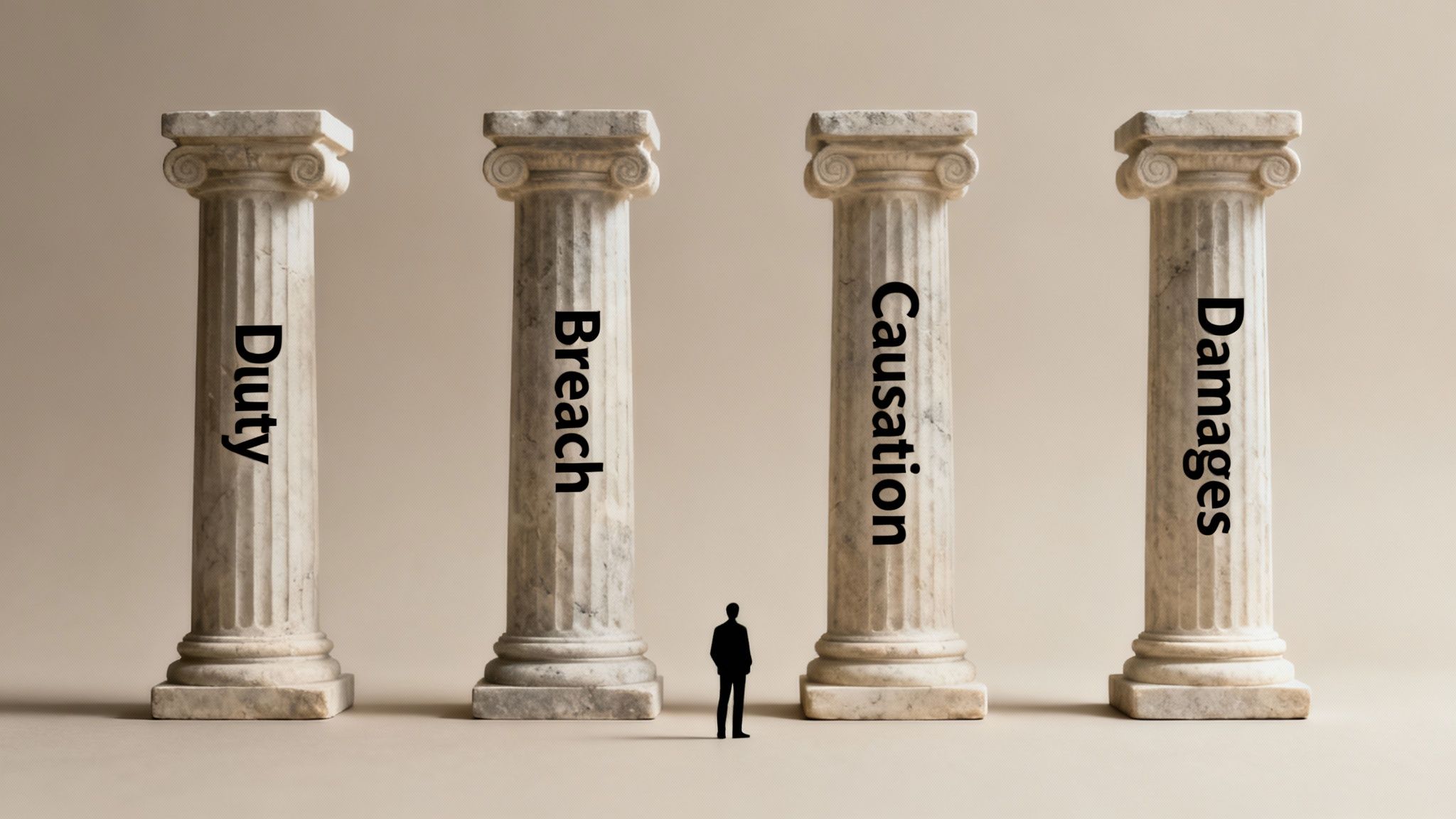
Before you can really see the difference between general negligence and the more specific world of malpractice, you have to get a handle on the framework that supports nearly every personal injury case. Think of a successful negligence claim as a structure built on four essential pillars. If even one is missing, the whole case falls apart.
These four pillars are Duty, Breach, Causation, and Damages. They follow a logical path that courts use to figure out if one person's carelessness is legally responsible for another's harm. Let’s walk through each one using real-world scenarios you'd see right here in Florida.
Pillar 1: Duty of Care
The first pillar we need to establish is Duty of Care. This simply means the person you’re suing (the defendant) had a legal responsibility to act with a certain level of caution toward you (the plaintiff). For most of us, this is a general duty to behave in a way that doesn't put others at an unreasonable risk of harm. It's often called the "reasonable person" standard.
This standard isn’t about what the defendant was personally thinking. It’s an objective test that asks: what would a reasonably careful person have done in that same situation? It’s all about meeting a basic societal expectation of safety.
Example 1 (Driving): Every single driver on a Florida road has a duty to drive safely, follow traffic laws, and keep an eye out for others to prevent a crash.
Example 2 (Property Owners): The owner of a grocery store has a duty to keep their store reasonably safe for shoppers. That means cleaning up a spill quickly or putting out a "wet floor" sign.
This duty is the foundation. Without it, there’s nothing to build a case on.
Pillar 2: Breach of Duty
Once we’ve shown a duty existed, the second pillar is proving a Breach of Duty. This is the moment things go wrong. It means the defendant failed to live up to that legal duty we just talked about. Simply put, their actions—or sometimes, their failure to act—fell short of what a reasonable person would have done.
This is the negligent act itself. It’s the slip-up, the moment of carelessness that created the dangerous situation.
A breach of duty isn't just any old mistake. It's a failure to meet a specific, legally recognized responsibility. It's the distracted driver looking at their phone instead of the road or the store manager who knows about a hazard and just ignores it.
For example, a driver who blows through a red light has clearly breached their duty to drive safely. A store owner who knows their freezer has been leaking for hours but does nothing to fix it or warn customers has breached their duty to keep the property safe. The breach is the specific failure that violates the established duty.
Pillar 3: Causation
The third pillar is Causation, and this is often where cases get tricky. It's not enough to show someone was careless. You have to prove that their specific breach of duty is what actually caused your injuries. This element is the critical link between the defendant's mistake and your harm.
Causation really has two parts:
Actual Cause (Cause-in-Fact): We use the "but-for" test here. But for the defendant’s action, would you have been injured? If the crash wouldn’t have happened but for the other driver running the red light, you have actual cause.
Proximate Cause (Legal Cause): This part deals with foreseeability. Was the injury you suffered a reasonably predictable result of their actions? This keeps people from being held responsible for wild, completely unpredictable chains of events.
A broken leg is a foreseeable outcome of getting hit by a speeding car. Proving this direct link is absolutely essential for a negligence claim to succeed.
Pillar 4: Damages
The final pillar is Damages. To have a case, you must prove you suffered actual, measurable harm because of the defendant’s actions. Even if someone acted with extreme negligence, if nobody got hurt and no property was damaged, there’s no lawsuit.
Damages are the real-world losses that the law can provide compensation for. This includes things like:
Medical Expenses: Every bill from the hospital, surgeon, physical therapist, and any future medical care you'll need.
Lost Wages: The income you lost because you couldn't work, and what you may lose in the future.
Pain and Suffering: Compensation for the physical pain and emotional trauma you've gone through.
Property Damage: The cost to get your car or other property fixed or replaced.
Understanding these four pillars is the key to knowing whether you have a valid negligence case. If you've been hurt and believe all four elements are present in your situation, it's probably time to get some legal advice. In pain? Call Caine.
How Malpractice Raises the Bar for Standard of Care
The line between a simple mistake and professional malpractice is defined by one critical concept: the standard of care. While general negligence is measured against what a hypothetical "reasonable person" would do, malpractice cases operate on a much higher standard. This elevated bar exists for licensed professionals—people whose specialized training and knowledge mean they are held to a greater level of accountability than an ordinary citizen.
When you hire a doctor, lawyer, or accountant, you enter into a professional relationship built on an implicit promise. That promise is that the professional will use the degree of skill, care, and learning expected of any other competent professional in their field under similar circumstances. A simple error in judgment might not be malpractice, but falling short of this accepted professional standard certainly can be.
This is the real heart of the difference between negligence and malpractice. It’s not about judging a surgeon's actions against what a bystander would do. It’s about judging them against what another competent surgeon would have done.
The Professional Standard of Care Explained
The professional standard of care isn’t a one-size-fits-all rule. It's a highly specific benchmark defined by the profession itself, and it’s always evolving with new technologies, research, and best practices. To figure out if this standard was breached, courts and juries have to answer a very specific question: Did the professional act in a way that a prudent, similarly qualified peer would have in the exact same situation?
This nuance is exactly why malpractice cases are so complex. Proving a breach requires much more than just showing a bad outcome. Many medical procedures and legal strategies carry inherent risks, so a negative result doesn't automatically equal malpractice. The focus is entirely on the professional's conduct.
Several key factors help define this standard:
Specialty and Field: A general practitioner is held to a different standard than a board-certified neurosurgeon.
Geographic Location: In some situations, the "locality rule" comes into play, which compares the professional's actions to those of others in the same or a similar community.
Available Information: The professional is judged based on the facts and information reasonably available to them when the decision was made, not with the 20/20 vision of hindsight.
The Crucial Role of the Expert Witness
Since the average juror can't be expected to understand the intricate standards of neurosurgery or corporate law, the legal system relies on expert witnesses. In Florida, and just about everywhere else, expert testimony isn't just helpful in a malpractice case—it's a legal requirement. This expert witness must be a qualified professional from the same field as the person being sued.
Their job is two-fold:
Establish the Standard: They explain to the court and jury what the accepted professional standard of care was for the specific circumstances of the case.
Demonstrate the Breach: They then offer a professional opinion on how the defendant’s actions fell below that established standard, directly causing the injuries.
Without a credible expert witness to connect these dots, a malpractice claim has almost no chance of success. Their testimony is the bridge that allows a jury to see the clear difference between an unfortunate outcome and an actual breach of professional duty.
Historically, the legal line between negligence and malpractice sharpened as studies began exposing systemic professional errors. One landmark analysis from the 1990s found that while 3.7% of hospitalizations involved adverse events, only 27.6% of those were actually caused by negligence—the specific territory where malpractice lives. You can explore more about the research that shaped these legal standards. This distinction highlights why proving malpractice requires such a high level of specialized evidence, setting it far apart from more straightforward negligence claims.
If you believe a professional’s failure to meet their standard of care has harmed you, understanding these complexities is the first step toward seeking justice. In pain? Call Caine.
Comparing Real-World Negligence and Malpractice Scenarios
Legal theories are one thing, but seeing how they play out in the real world is what really makes the difference between negligence and malpractice clear. The line often comes down to one simple factor: the professional status of the person who caused the harm.
Let's walk through two scenarios that could happen in the very same building—a hospital. By breaking them down, you'll see how the role of the person at fault completely changes the nature of the legal claim.
Scenario 1: The Negligence Claim
Picture this: a hospital janitor is mopping a hallway after a spill. He’s in a rush and forgets to put out a "wet floor" sign before heading off to his next task. A moment later, a visitor walks down that same hall, doesn't see the slick spot, and slips, breaking their wrist.
This is a textbook example of general negligence. Here’s why:
Duty Owed: The hospital and its employees (like the janitor) owe a duty of care to keep visitors reasonably safe.
Standard of Care: The janitor is held to the "reasonable person" standard. What would a reasonable person do? They’d know a wet floor is a hazard and put up a sign. It’s common sense.
Breach and Consequence: By failing to place the sign, the janitor breached that duty. That failure directly caused the visitor’s injury, making the hospital liable for the damages.
This case doesn't turn on professional expertise. You don't need another janitor to testify about mopping protocols. The argument rests on the simple, common-sense expectation that a wet floor should be marked.
Scenario 2: The Malpractice Claim
Now, let's shift our focus to a patient’s room in that same hospital. A registered nurse is responsible for giving a patient their medication. She misreads the chart and administers ten times the prescribed dose of a powerful blood thinner, causing the patient to suffer from severe internal bleeding.
This is a clear-cut case of medical malpractice. Let's break it down:
Duty Owed: As a licensed healthcare professional, the nurse owes a professional duty of care to her patient. This is a much higher and more specific duty than the general duty to avoid causing harm.
Standard of Care: The nurse is judged against the "professional standard of care." This means her actions are compared to what a reasonably skilled and competent nurse would have done in the same situation. That standard absolutely includes triple-checking dosages and following medication protocols.
Breach and Consequence: Giving a massive overdose is a serious departure from the accepted standards of nursing. This breach directly caused the patient's life-threatening injuries and is the foundation of a malpractice claim.
Medical errors are a shocking global problem. The World Health Organization estimates that one in ten patients worldwide is harmed by medical mistakes. These aren't just tragic—they're expensive. Prescription errors alone rack up $42 billion in annual costs. You can learn more about the widespread issue of medical errors and their consequences from recent studies.
Scenario Analysis: Negligence vs. Malpractice
Seeing these two situations side-by-side really drives the point home. The janitor's slip-up was a failure of ordinary caution, something anyone would be expected to do. The nurse's error, on the other hand, was a failure to apply her specialized medical training—a mistake judged by the standards of her profession.
Analysis Point | Negligence Example (Janitor's Spill) | Malpractice Example (Nurse's Medication Error) |
|---|---|---|
Who Owes the Duty? | The hospital/janitor, a non-professional in this context. | The nurse, a licensed healthcare professional. |
What is the Standard? | The "reasonable person" standard. What would an ordinary, prudent person do? | The "professional standard of care." What would a competent nurse with similar training do? |
How is Breach Proven? | Through common-sense arguments. A jury can easily understand the danger of an unmarked wet floor. | Through expert testimony. Another medical professional must explain the standard of care and how the nurse violated it. |
Type of Error | A simple act of carelessness or forgetfulness. | A failure to use specialized knowledge, skill, and training correctly. |
This distinction is crucial because proving malpractice almost always requires an expert witness—another professional in the same field—to explain what the standard of care was and how it was violated.
If you’ve been injured and aren't sure whether your case involves simple carelessness or a professional's failure, I hope these examples bring some clarity. In pain? Call Caine.
Filing Your Claim Under Florida Law
When you’re hurt because someone else was careless, navigating Florida’s legal system can feel like trying to find your way through a maze. The rules are complex, and the clock starts ticking the moment you're injured. Understanding these deadlines and procedures isn't just a good idea—it’s absolutely critical to protecting your right to seek compensation.
Florida law draws a firm line between a standard negligence claim and a malpractice claim, starting with the deadlines, or statutes of limitations. For a typical negligence case, like a slip-and-fall, you generally have two years from the date of the incident to file a lawsuit. For medical malpractice, the deadline is also two years, but it starts from the date you discovered the injury, or reasonably should have.
That distinction is a big deal. The "discovery rule" in malpractice cases acknowledges that it might take months, or even years, to realize a surgeon made a critical error. But make no mistake: these deadlines are unforgiving. Miss them, and the door to justice can slam shut for good.
The Unique Hurdles of Florida Malpractice Claims
Beyond the time limits, Florida puts up some serious procedural roadblocks for medical malpractice claims that you just don't see in ordinary negligence cases. These rules are meant to weed out frivolous lawsuits, but they often add layers of complexity and cost for people with legitimate injuries.
Before you can even think about filing a malpractice lawsuit, you have to get through a mandatory pre-suit investigation. This process includes:
Notifying the Healthcare Provider: You are required to formally notify every potential defendant that you intend to sue. This kicks off a 90-day period for them to investigate your claim and maybe offer a settlement.
Securing an Expert Affidavit: This is the make-or-break step. You must get a written, sworn opinion from a qualified medical expert who confirms your claim has merit. This expert has to state, under oath, that the healthcare provider breached the professional standard of care and that this breach caused your injury.
This side-by-side comparison shows the fundamental differences between these two types of claims at a glance.
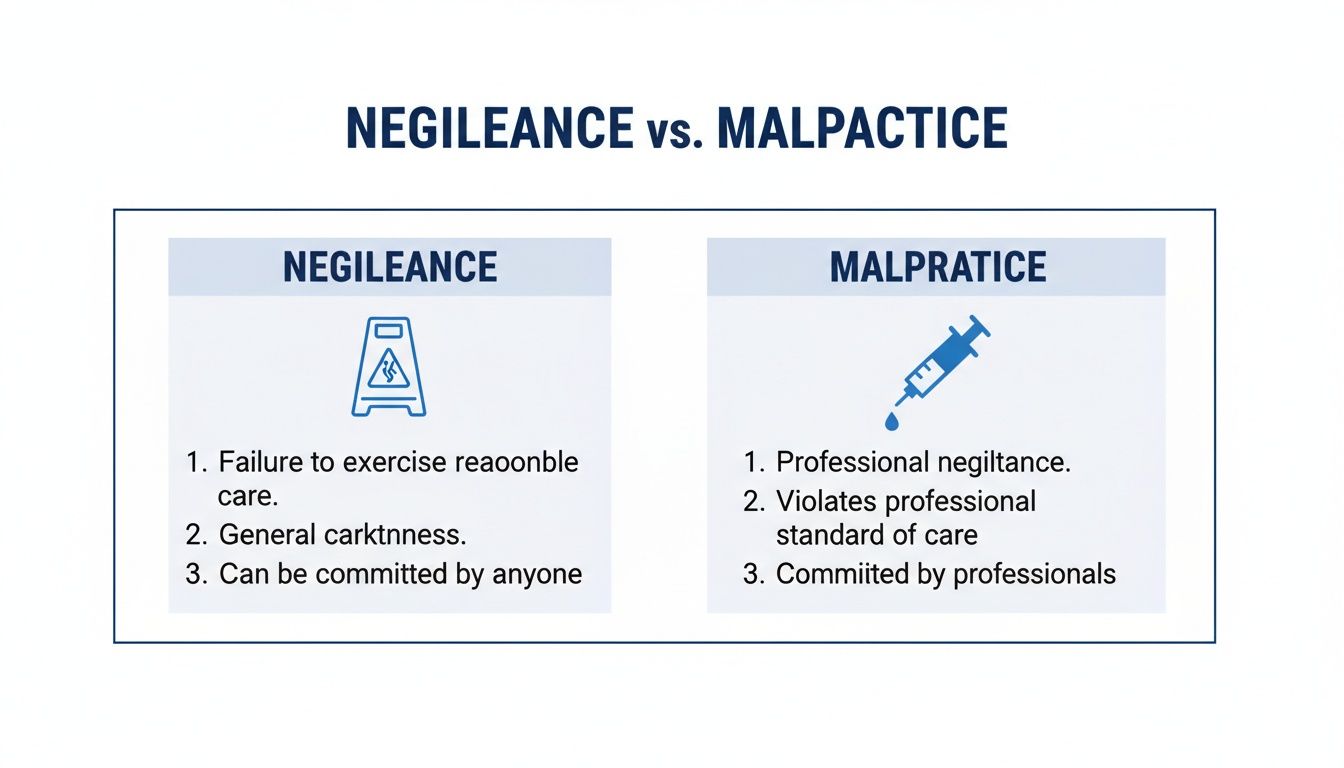
As you can see, a malpractice claim is all about the professional context and requires another expert to validate it, while a negligence claim hinges on a failure to provide ordinary, reasonable care.
The pre-suit requirements for malpractice in Florida are a legal minefield. Failing to secure a valid expert affidavit or follow the notification process precisely can get your case dismissed before it ever reaches a courtroom.
These extra steps make malpractice cases far more demanding and expensive from the start. You have to gather complex medical records, find a credible expert willing to go on record, and navigate the tricky pre-suit process—all of which require deep legal experience and significant resources. If you're ever unsure what to do after an accident, it’s vital to understand the essential steps and legal guidance that can protect your rights from day one.
Whether your injury was caused by a moment of simple carelessness or a professional's failure to uphold their duty, knowing Florida’s specific legal landscape is the first step toward a successful claim. In pain? Call Caine.
Knowing When You Need a Personal Injury Attorney
Figuring out whether to take legal action after you've been hurt can feel like a massive undertaking. But the core question is pretty straightforward: did someone else’s carelessness cause you significant harm? If the answer is yes, it’s time to start thinking about your legal options.
The first step is recognizing the signs of a valid claim. If you've suffered a serious injury, are drowning in medical bills, losing wages because you can’t work, or just received a devastating diagnosis after a medical procedure, your situation is more than just an inconvenience. These are life-altering events, and you deserve to hold the responsible party accountable.
Clear Signs It Is Time to Act
Waiting too long is one of the biggest mistakes you can make. The law has strict deadlines, and you don’t want to miss your window to file a claim. You should get in touch with an attorney if:
Your injury is severe or long-term: Any harm that requires surgery, ongoing physical therapy, or results in a permanent disability needs to be evaluated by a legal professional.
The fault is disputed: If the other party or their insurance company is trying to deny responsibility, you need an experienced advocate to build your case and prove they were at fault.
A professional’s error is suspected: If you have a gut feeling that a doctor, lawyer, or another licensed professional made a critical mistake that cost you physically or financially, you might have a malpractice claim.
The line between a simple mistake and legally actionable harm is often what separates a negligence case from a malpractice case. An experienced attorney can dig into the specifics and determine the right legal path for you.
This isn't a new problem. Professional errors have been a major concern for years. Back in 2005, a Commonwealth Fund survey found that a staggering one-third of patients in the U.S. had experienced medical errors—a rate much higher than in other developed countries. You can discover more insights about these medical error studies to see just how widespread this issue is.
Ultimately, you don’t have to make this decision on your own. A consultation can give you a clear picture of your rights and the real strength of your case. For any injury, from a straightforward slip-and-fall to a complex professional error, it’s crucial to know what to ask. That’s why we put together a guide with 9 questions to ask your slip and fall attorney before hiring.
If someone's carelessness has turned your life upside down, protecting your rights is the most important next step you can take. In pain? Call Caine.
Common Questions About Florida Injury Claims
After an injury, your mind is probably racing with questions. The legal world can feel like a maze of confusing terms and rules, especially when you're trying to figure out if what happened to you was negligence or malpractice. Let's clear up some of the most common questions we hear from clients to help you understand your situation better.
Getting a handle on these concepts is the first step to knowing your rights and deciding what to do next.
Can I Sue for a Bad Outcome Even if There Was No Malpractice?
No, and this is a really important distinction. A disappointing result, on its own, isn't enough to file a malpractice lawsuit. The law understands that certain professions, especially medicine, come with inherent risks. Sometimes, bad outcomes happen even when a professional does everything right.
To have a valid malpractice case, you have to prove that the professional’s care fell below the accepted standard for their field and that this specific failure caused your injury. It’s all about the breach of duty, not just the unfortunate result.
What Is the Difference Between Ordinary Negligence and Gross Negligence?
Think of it as a spectrum. Ordinary negligence is a simple failure to use reasonable care—a moment of inattention that leads to an accident. Gross negligence, on the other hand, is a whole different level of carelessness. It’s a conscious and reckless disregard for the safety of others.
This isn't just a mistake; it's behavior that shows a shocking indifference to the potential harm. In Florida, proving gross negligence is much tougher, but doing so can open the door to punitive damages, which are designed to punish the wrongdoer, not just to cover your losses.
Gross negligence implies a level of recklessness so severe that it shocks the conscience. Think of a driver speeding through a school zone at 80 mph—this is far beyond a simple failure to pay attention and shows a blatant disregard for human life.
This distinction can dramatically change the kind of compensation you might be able to recover.
Why Is an Expert Witness So Crucial in a Malpractice Case?
A jury is made up of everyday people. They can't be expected to know the intricate standards of care for a doctor, an engineer, or an accountant. That's where an expert witness comes in. They are a qualified professional from the same field as the person you're suing, and their job is to bridge that knowledge gap for the jury.
An expert witness serves two critical functions in court:
They Explain the Standard of Care: The expert testifies about what a reasonably competent professional should have done in that situation.
They Pinpoint the Breach: They then offer their professional opinion on how the defendant failed to meet that standard and directly caused your injuries.
Here in Florida, a malpractice claim is almost guaranteed to fail without strong testimony from a credible expert. They are the essential link that makes your case legally sound.
Does Malpractice Only Apply to Medical Professionals?
Not at all. While "medical malpractice" is the term we hear most often, the concept of malpractice applies to any licensed professional who owes a higher duty of care to their clients.
Other professionals who can be held liable include:
Lawyers for legal malpractice, like missing a statute of limitations or giving disastrous legal advice.
Accountants for accounting malpractice, such as making huge errors on tax returns that lead to audits and penalties for their client.
Architects and Engineers for professional negligence when their design flaws cause a building to be unsafe or fail.
The core legal ideas are the same, no matter the profession. You have to show there was a professional duty, the professional breached the standard of care for their specific industry, and that this failure caused you real, measurable harm.
If you've been hurt because of someone else's mistake, you don't have to sort through this legal maze by yourself. At CAINE LAW, our team has the experience to help you understand your rights and fight for the full compensation you deserve. We know the difference between negligence and malpractice and how to build the strongest possible case for you. In pain? Call Caine. Find out more by visiting us at https://cainelegal.com.
