
In Pain? Call Caine
Your Guide to a Defective Medical Device Lawsuit

5 Min read
By: Caine Law
Share
When you agree to a medical procedure, you're placing immense trust in the doctors, the hospital, and the devices they use. These tools are meant to improve your life, not cause more harm. But when that trust is shattered by a product that fails, the fallout can be catastrophic, leading to chronic pain, unexpected revision surgeries, and a heavy emotional toll.
A defective medical device lawsuit is your chance to hold a manufacturer accountable for the harm their product caused. If a flaw in its design, a mistake during its production, or a failure to warn you about the real risks led to your injury, you could be entitled to significant compensation for your medical bills, lost income, and suffering.
When Medical Devices Cause More Harm Than Good

The first step is figuring out why the device failed. Not every negative medical outcome means you have a case, but if the product itself was unreasonably dangerous, the company that made it can—and should—be held responsible.
The Three Core Types of Device Defects
In the legal world, these cases almost always boil down to one of three types of product liability claims. Identifying which one fits your situation is a crucial first step for your attorney.
To make this clearer, we've broken down the three primary categories of defects that can form the basis of a product liability lawsuit.
Understanding the Types of Medical Device Defects
Defect Type | What It Means | Common Example |
|---|---|---|
Design Defects | The problem is baked into the product's blueprint. Even if it's made perfectly, the device is inherently unsafe for its intended purpose. | A metal-on-metal hip implant whose design causes it to shed toxic metal particles into the patient's bloodstream and surrounding tissue. |
Manufacturing Defects | The design itself is safe, but a critical error happened during the production or assembly process. It’s a one-off or batch-specific mistake. | A single batch of surgical mesh becomes contaminated during production, or a pacemaker is assembled with faulty wiring that quality control misses. |
Marketing Defects (Failure to Warn) | The manufacturer knew (or should have known) about serious risks but failed to adequately warn doctors and patients about them. | An IUD maker downplays the significant risk of the device perforating the uterus or breaking apart during removal, leaving patients and doctors in the dark. |
Pinpointing the exact type of defect is the key to building a strong case against the manufacturer.
A recall from the manufacturer often strengthens a claim, but it's not a requirement. Many successful lawsuits involve devices that were never officially recalled but still caused devastating harm due to one of these core defects.
From Legal Theory to Real-Life Harm
Let’s see how these legal ideas play out in the real world.
Imagine a patient who received a hernia mesh implant. If that mesh is made from a material known to shrink, harden, and migrate over time—leading to organ perforation and agonizing pain—that’s a classic design defect. The product was flawed from the very beginning.
Now, consider a different scenario. A spinal fusion cage breaks shortly after being implanted. An investigation reveals that the specific cage the patient received was accidentally made from a weaker metal alloy than the approved design specified. That’s a manufacturing defect. The problem wasn't with the entire product line, just the specific batch that patient’s device came from.
If your own experience sounds like one of these scenarios, it’s a sign you need to explore your legal options. Understanding the nuances of a personal injury claim is the first step. An experienced attorney can dig into the device's history, find evidence of similar failures, and map out the strongest legal path for your defective medical device lawsuit.
Gathering the Evidence for Your Lawsuit
Once you suspect a medical device is to blame for your suffering, the focus shifts to proving it. The strength of your lawsuit won’t be built on feelings or suspicions; it will stand on a solid foundation of organized, hard evidence. This is the point where you go from being a patient to being the most important member of your own legal team.
Think of us as the architects designing your case. You’re the one who supplies the crucial raw materials. The more detailed and high-quality evidence you can gather, the stronger and more compelling your case will be.
If Possible, Preserve the Device
The most powerful piece of evidence you can possibly have is the defective device itself. It’s the smoking gun. If you’ve had surgery to remove or replace a faulty implant, it is absolutely critical that the device is preserved and not thrown away by the hospital as medical waste.
Make sure you tell your surgeon and the hospital staff—in writing, if you can—that you want the device saved for legal and investigative purposes. Having the actual device allows experts to physically examine it for design flaws, material breakdowns, or manufacturing errors. This kind of direct proof can make or break a case.
A preserved medical device takes a case from a theoretical argument about what might have happened and turns it into a direct examination of the product that actually caused the harm. It's undeniable.
Your Essential Document Checklist
Beyond the device itself, your story is told through a paper trail. It's time to start collecting every document related to your medical journey. Each one adds another layer of proof, and thorough, organized documentation is the bedrock of a successful claim.
Your evidence-gathering should include:
All Medical Records: This is non-negotiable. Get everything from the initial implantation surgery, all follow-up appointments, and any treatments or revision surgeries. These files contain the notes, diagnoses, and test results that connect your injury directly to the device.
Pharmacy and Billing Records: Track down receipts for all prescriptions, co-pays, and medical bills. This isn't just about paperwork; it's how we calculate the economic damages you’ve had to endure and show the real financial cost of your injury.
Manufacturer Communications: Did you or your doctor ever reach out to the device manufacturer? Save every email, letter, or note you have from phone calls. This kind of correspondence can be surprisingly important.
Photographs and Videos: Visual evidence is incredibly powerful. Take clear photos of your injuries, like surgical scars or areas of inflammation, as you go through your recovery.
This process of collecting documents is very similar to the first steps you should take after any kind of personal injury. For a more general overview, you can check out our guide on essential steps and legal guidance after an accident.
Create a Personal Pain and Suffering Journal
Some of the most significant damages in a defective medical device case are what we call "non-economic." They’re meant to compensate you for your pain, suffering, and the loss of quality of life. These are much harder to prove than a medical bill, which is why keeping a personal journal is so incredibly valuable.
Use a simple notebook or a document on your computer to regularly write about your experience. The key is to be specific.
Describe your pain: Don't just write "my hip hurt." Instead, describe it. "Felt a sharp, stabbing pain in my right hip today, an 8 out of 10. It was impossible to walk without my cane."
Note daily limitations: Write down the things you can no longer do. "Couldn't lift my granddaughter today." "Had to miss my son's school play because I knew I couldn't sit for that long." "Woke up four times last night from the pain."
Track your emotional state: Be honest about the emotional toll this has taken. Write down your feelings of depression, anxiety, frustration, or hopelessness that are tied to your condition.
This detailed log gives a powerful, human account of your suffering that goes far beyond what a cold medical record can ever show. It helps a judge or jury truly understand the devastating impact the defective device has had on your life.
The numbers surrounding these failures are staggering. An analysis of FDA data from the last decade found that defective medical devices in the U.S. have been linked to more than 80,000 deaths and nearly 2 million injuries. This reality underscores just how critical it is for victims to hold manufacturers accountable.
By meticulously gathering this evidence, you’re doing more than just preparing for a lawsuit. You are taking control of your story and making sure it gets told with the detail and force it deserves.
When you're ready to have an experienced attorney review your evidence and fight for you, we are here to help. In pain? Call Caine.
Florida's Critical Filing Deadlines
After an injury, an invisible clock starts ticking. For a defective medical device lawsuit in Florida, this isn't just a technicality—it’s one of the single most important factors determining if you can file a claim at all. If you wait too long, the door to compensation can slam shut forever, no matter how strong your case is.
The main deadline you need to be aware of is the statute of limitations. This is a state law that puts a strict time limit on filing your lawsuit. Miss this window, and the court will almost certainly throw your case out.
The Discovery Rule Explained
Thankfully, Florida law has a crucial provision for these types of cases called the discovery rule. This rule was created for situations where an injury isn't immediately obvious. It means the countdown for filing a lawsuit doesn't automatically start the day a device was implanted.
Instead, the clock starts ticking the moment you discovered—or reasonably should have discovered—that the defective device was the source of your harm. This is a vital distinction, as the damage from a faulty medical implant can take months, or even years, to fully surface.
Let’s put this into a real-world scenario:
A woman gets a Paragard IUD implanted in 2018.
By 2022, she's suffering from severe chronic pain and other complications, but her doctors can't seem to pinpoint the cause.
In 2024, during a removal procedure, the IUD fractures. Fragments are left embedded in her uterus, leading to emergency surgery.
Under the discovery rule, her time to file a lawsuit would likely start in 2024—the year she and her doctors definitively linked the device to her injuries—not way back in 2018 when she first received it.
The Absolute Deadline: Statute of Repose
While the discovery rule offers some much-needed flexibility, there's another, more rigid deadline called the statute of repose. Think of this as the final, absolute cutoff. The statute of repose sets a hard limit on when a product liability claim can be filed, regardless of when you discovered the injury.
This final deadline makes it incredibly urgent to act quickly. Even if you only just connected your health problems to an old implant, this unforgiving timeline could still prevent you from filing a claim.
The way the statute of limitations and the statute of repose interact can get complicated. The only way to know for sure which deadlines apply to your unique situation is to talk to an attorney as soon as you suspect a problem. They can tell you exactly how much time you have left to act.
Once you decide to move forward, these are the first steps you or your lawyer will take to start building a solid case.
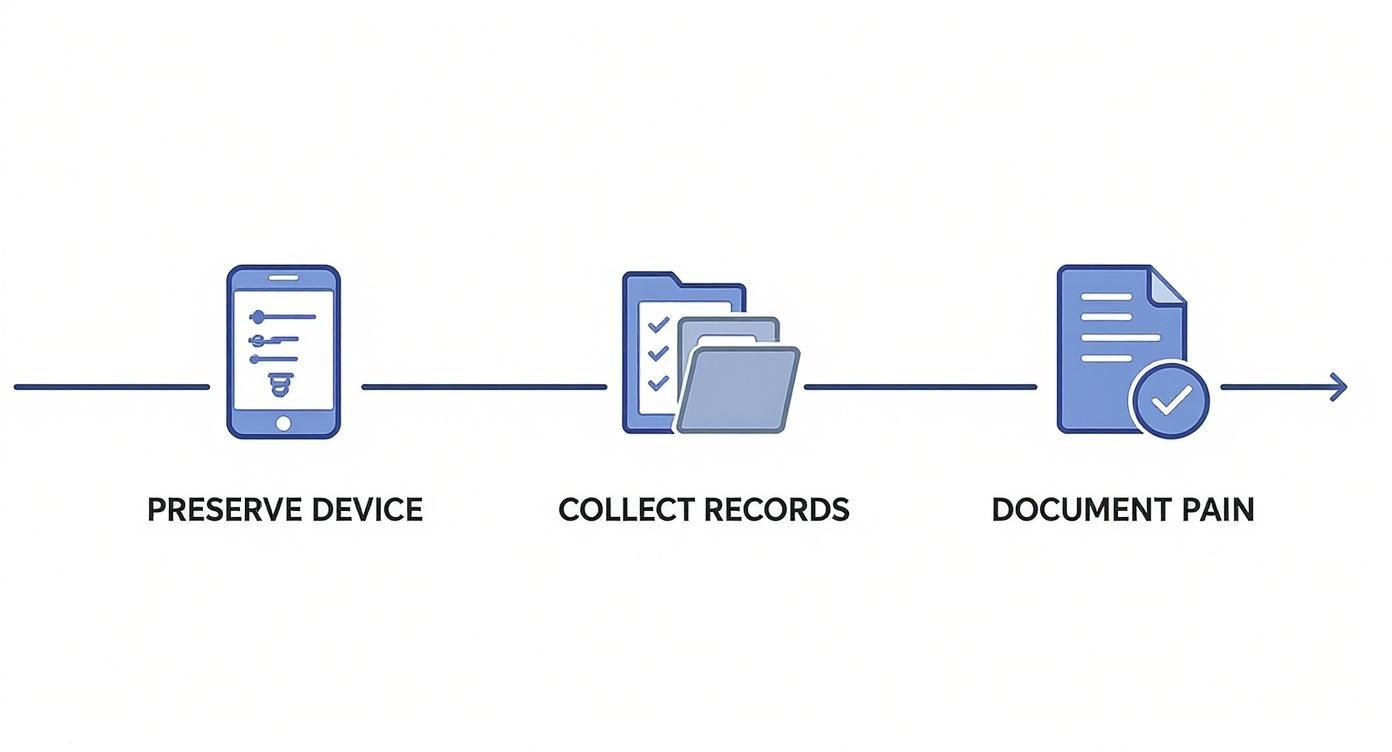
This visual really drives home the foundational pillars of a successful claim: preserving the device itself, gathering all your paperwork, and carefully documenting your personal experience.
Because these deadlines are so strict and unforgiving, time is truly of the essence. The moment you even suspect a medical device has hurt you, the best thing you can do is get legal advice. Don't let a technicality on the calendar stop you from getting the justice you deserve.
If you are dealing with complications from a medical device, don't wait for the clock to run out on your claim. In pain? Call Caine.
Understanding MDLs and Class Action Lawsuits

When a single medical device—think of a hip implant or hernia mesh—harms hundreds or thousands of people in similar ways, the court system needs an efficient way to manage all those claims. That’s where mass tort litigation comes in, and you’ll often hear two terms thrown around: class action lawsuits and Multidistrict Litigation (MDL).
People often use these terms interchangeably, but they are fundamentally different. If you’re dealing with a defective medical device lawsuit, your case will almost certainly be handled through an MDL, and understanding the "why" is crucial.
Why MDLs Are Preferred for Device Cases
At its core, the difference between these legal paths comes down to how they treat you as an individual. A class action lawsuit lumps everyone with a similar claim into one big case, led by a single "class representative." Everyone in that group is then bound by the same outcome, whether it's a settlement or a verdict.
An MDL is different. It’s built to preserve the unique facts of your personal injury claim. This structure just makes more sense for these cases because no two medical injuries are identical. One person's revision surgery for a faulty hip implant could be far more complex and costly than someone else’s.
In an MDL, your lawsuit remains your lawsuit. It gets grouped with similar cases for efficiency during pretrial stages, but the final outcome—your settlement or award—is based on the specific damages you personally suffered.
This approach really gives you the best of both worlds. All the victims can pool their resources to present a united front against a powerful corporate defendant, but your compensation still reflects your unique journey of pain, medical bills, and lost income.
MDL vs Class Action Lawsuit: What You Need to Know
To clear up any confusion, it helps to see a direct comparison. While both legal tools handle large-scale litigation, their approach and impact on your individual case are worlds apart.
Feature | Multidistrict Litigation (MDL) | Class Action Lawsuit |
|---|---|---|
Case Individuality | Each plaintiff's lawsuit remains separate and is valued based on their specific injuries and damages. | All plaintiffs are grouped into a single "class" with one lawsuit. |
Common Use Case | Defective medical devices, dangerous drugs, and complex product liability where injuries vary widely. | Consumer fraud, data breaches, or situations where all class members suffered the same financial loss. |
Settlement/Award | Compensation is calculated on an individual basis. | All class members typically receive the same, often small, settlement payout. |
Control | You and your attorney retain control over the decision to accept a settlement offer. | The class representative and their lawyers make decisions for the entire group. |
Ultimately, the MDL is designed for situations where the cause of the injury is the same (the defective device), but the effect (the personal harm) is different for everyone.
How an MDL Works in Practice
So what does this look like? Imagine hundreds of lawsuits filed in federal courts all over the country against the manufacturer of a specific surgical mesh. An MDL consolidates all these cases before one federal judge for every pretrial proceeding.
This streamlined process includes:
Discovery: The hunt for evidence, like digging into internal company documents and deposing key employees, happens just once instead of hundreds of times. This saves an incredible amount of time and money.
Expert Witnesses: The plaintiffs' attorneys work as a team to hire and prep top-tier medical and engineering experts. This collaboration builds the strongest possible argument that the device was defective.
Bellwether Trials: The judge selects a few representative cases to go to trial first. The outcomes of these "bellwether" trials give both sides a reality check on the strengths and weaknesses of their arguments, often paving the way for a global settlement.
You've probably heard of some of the big ones. Litigations involving the Paragard IUD and DePuy hip implants were handled as MDLs, bringing thousands of individual voices together into a powerful, coordinated legal effort.
The human and financial toll of these device failures can be staggering. Back in 2013, Johnson & Johnson agreed to a settlement of over $4 billion to resolve more than 7,000 claims related to its DePuy ASR hip implants. You can see more about the history of these cases and other product liability litigations on Drugwatch.com.
What to Expect If Your Case Joins an MDL
If your lawsuit becomes part of an MDL, your attorney will navigate all the complex legal maneuvers. You’ll still be responsible for providing evidence specific to your own situation—things like your medical records and a pain journal. This information is absolutely vital for calculating your final settlement amount.
While the MDL process isn't quick—it can take several years because of the sheer scale—it's the most powerful tool we have for holding massive medical corporations accountable. It levels the playing field, giving individual victims the collective strength they need to fight for justice.
If you think your injuries might be part of a larger litigation, it’s critical to get expert legal advice. An attorney experienced in mass torts can find out if an MDL exists for your device and guide you every step of the way. In pain? Call Caine.
Recovering Compensation for Your Injuries

When you pursue a defective medical device lawsuit, you're doing more than just holding a company accountable. You're fighting to get the resources you and your family desperately need to cover the staggering costs of an injury you never saw coming.
The legal term for this financial recovery is "damages." The goal isn't just to get a check; it's to secure the stability that allows you to focus on what really matters—your health and putting your life back together. These figures aren't pulled out of thin air; they are meticulously calculated to reflect every single loss, both financial and personal.
Economic Damages: The Tangible Costs
The most straightforward part of any personal injury claim is what we call economic damages. Think of these as the black-and-white, receipt-based losses you've incurred because of the faulty device. It's a full accounting of every dollar that has left your pocket.
Our job is to leave no stone unturned in documenting these costs. This includes:
Medical Bills (Past and Future): We're not just talking about the initial revision surgery. This covers everything—hospital stays, physical therapy, prescriptions, and any specialized medical equipment you now rely on.
Lost Wages and Income: If you were out of work, we calculate the exact income you lost. That means salary, bonuses, and any other benefits that disappeared while you were recovering.
Reduced Earning Capacity: Sometimes, the damage is permanent. If your injury prevents you from returning to your old job or limits your ability to earn a living down the road, we calculate that long-term financial hit.
Non-Economic Damages: The Human Toll
Beyond the bills and lost paychecks is the real human cost of the injury. This is where non-economic damages come in. They are designed to compensate you for the kind of suffering that doesn't come with a price tag but is often the most devastating part of the experience.
This is about the deep, personal impact the defective device has had on your day-to-day life.
These damages are meant to acknowledge the daily pain, the emotional trauma, and the moments of joy that have been stolen from you. A detailed pain and suffering journal is one of the most powerful tools for demonstrating the true extent of these losses to a judge or jury.
Examples of non-economic damages include:
Pain and Suffering: Compensation for the physical pain and chronic discomfort you live with.
Emotional Distress: This covers the anxiety, depression, PTSD, and mental anguish caused by the ordeal.
Loss of Enjoyment of Life: For when you can no longer participate in hobbies, family activities, or social events you once loved.
Punitive Damages: Punishing Gross Negligence
In some rare and egregious cases, a third type of compensation might be on the table. Punitive damages aren't about compensating you for a loss; they are about punishing the manufacturer for extreme recklessness or intentional misconduct. This is reserved for situations where a company knew its device was dangerous but sold it anyway, putting profits over people.
We often see these claims in major product liability cases, like the ongoing litigation surrounding the Paragard IUD. As of late 2025, more than 3,500 lawsuits have been filed against the manufacturer. The lawsuits allege that the company was aware of a design defect that causes the device to fracture during removal, leading to severe internal injuries and follow-up surgeries. You can get details on the ongoing Paragard IUD litigation to see how these complex cases unfold.
Understanding the full scope of compensation available is a critical step in your journey. It ensures your claim reflects not just the financial costs, but the complete human story of your suffering.
If you are struggling with the aftermath of a failed medical device, you don't have to bear this burden alone. In pain? Call Caine.
Why an Experienced Attorney Is Essential
https://www.youtube.com/embed/mumvfHUxTMM
Trying to file a lawsuit against a multi-billion-dollar medical device company is not a fair fight. It’s David versus a Goliath backed by an army of lawyers. These corporate legal teams exist for one reason: to challenge, deny, and minimize claims just like yours. Going up against them alone is, frankly, a recipe for disaster.
This is where partnering with an experienced product liability attorney becomes the single most important decision you can make. It levels the playing field. We understand the complex legal and medical arguments needed to prove your case because we've done it time and time again. More importantly, we know the playbook these corporate lawyers use, and we know exactly how to counter their tactics.
Navigating the Legal Maze
A dedicated attorney takes the entire weight of the case off your shoulders, managing every critical detail so you can focus on what truly matters—your health and recovery. This role goes far beyond just filing paperwork; think of your lawyer as your personal strategist, investigator, and staunchest advocate.
Here’s what that looks like in practice:
Hiring the Right Experts: Your case will almost certainly need testimony from top-tier medical specialists, biomedical engineers, and even life care planners. These experts are crucial for proving the device was defective and calculating the true cost of your future needs.
Dealing with the Opposition: We handle all communications with the manufacturer's aggressive attorneys. This shields you from their high-pressure tactics and constant attempts to wear you down.
Managing Deadlines and Procedures: From meeting Florida’s strict statute of limitations to navigating the complex rules of a Multi-District Litigation (MDL), we ensure no critical deadlines are ever missed.
At the end of the day, an attorney's job is to build a wall of evidence so strong that the manufacturer has no choice but to take your claim seriously. We transform your personal story of pain and loss into a powerful legal argument for justice.
You Don't Pay Unless We Win
One of the biggest hurdles for many people is the fear of how much a lawyer will cost. That's a valid concern, but here's the good news: reputable personal injury attorneys work on a contingency fee basis.
This is a simple concept. You pay absolutely nothing upfront. No retainers, no hourly bills, nothing. Our payment is a pre-agreed percentage of the compensation we successfully recover for you.
Put simply: if you don't win, you don't owe us a dime. This model ensures that anyone, regardless of their financial situation, can get top-tier legal help. It also means our goals are perfectly aligned with yours—we are 100% motivated to get you the maximum possible settlement or verdict.
Knowing the right questions to ask is a crucial first step. Our guide on 9 questions to ask an attorney before hiring can help you make a confident and informed choice.
Your focus should be on healing, not on fighting a legal war. Let a professional handle the battle. In pain? Call Caine.
Common Questions We Hear About Device Lawsuits
When you're dealing with the fallout from a defective medical device, your head is probably swimming with questions. It's overwhelming, and frankly, a bit scary. Let's tackle some of the most common concerns we hear from people who are considering taking on a powerful medical company.
"How Much Is This Going to Cost Me?"
This is usually the first question people ask, and it's a completely fair one. Here's the good news: most reputable attorneys who handle these complex cases, including our firm, work on a contingency fee basis.
What does that mean for you? You pay absolutely nothing upfront. No hourly rates, no retainer fees. Our payment is a pre-agreed percentage of the final settlement or verdict we win for you. If we don’t secure compensation for you, you don't owe us a dime. This approach levels the playing field, ensuring anyone can get top-tier legal help, regardless of their financial situation.
"How Long Will My Lawsuit Take?"
There’s no one-size-fits-all answer here, as the timeline depends heavily on the specifics of your case. A more straightforward claim that settles early on could wrap up in less than a year.
However, many of these cases, especially those that get consolidated into a larger Multidistrict Litigation (MDL), can take several years to resolve. The timeline is influenced by a few key things: the complexity of the medical evidence, the sheer number of people injured nationwide, and whether the manufacturer wants to negotiate a fair settlement or dig in for a fight. Once we review your case, we can give you a much clearer estimate.
A recall is a public admission that the device has a potential defect or poses a safety risk. While it doesn't guarantee you will receive compensation, it often serves as powerful evidence in your lawsuit, clearly showing that the product was unreasonably dangerous.
"Does It Matter If the Device Was Already Recalled?"
Yes, you absolutely still have a case—in fact, a recall often makes your case much stronger. It’s a common myth that a recall somehow takes care of everything for the patients who were harmed.
A recall is an important safety measure, but it does nothing to compensate you for your personal injuries. To recover damages for your medical bills, lost income, and the immense pain and suffering you've been through, you must file a defective medical device lawsuit to prove the faulty product directly caused your harm.
At CAINE LAW, we've seen firsthand the physical, emotional, and financial devastation these faulty devices can cause. Our team isn't afraid to stand up to massive corporations to fight for the justice you deserve. You don't have to go through this alone.
In pain? Call Caine. Contact us today for a free, no-obligation consultation to discuss your case by visiting https://cainelegal.com.
