
In Pain? Call Caine
Can You Sue a Hospital for Negligence in Florida?

5 Min read
By: Caine Law
Share
Yes, you can absolutely sue a hospital for negligence in Florida. But let's be clear: it's rarely a straightforward process. A hospital is on the hook not just for its own policies and procedures, but also for the actions of its entire staff. This means a single mistake anywhere in the chain of care can be grounds for a lawsuit.
Understanding When You Can Sue a Hospital

When you’ve been harmed in a hospital or medical facility, the legal path to holding that institution accountable almost always splits into two main avenues. Figuring out which path your case belongs on is the critical first step.
The table below breaks down the two primary legal claims against a hospital, helping you understand which category best fits your situation.
Two Main Grounds for Suing a Hospital
Type of Negligence Claim | What It Involves | Real-World Example |
|---|---|---|
Medical Malpractice | The harm was caused by a healthcare professional—a doctor, nurse, or surgeon—failing to meet the accepted medical standard of care. | A surgeon botches a procedure, a doctor misdiagnoses a serious illness, or a nurse administers the wrong medication. |
General Negligence | The harm was caused by the hospital's failure to maintain a safe environment, unrelated to actual medical treatment. | A patient slips and falls on a wet, unmarked floor, or a faulty piece of equipment in a hospital room collapses and causes an injury. |
Grasping this distinction is essential because it dictates the entire strategy for your case, from the evidence you need to the specific Florida laws that apply.
The Sobering Reality of Hospital Negligence
Medical errors aren't just isolated incidents; they are a massive public health crisis. Globally, a shocking 43 million instances of medical negligence happen every single year.
Closer to home, a landmark study found that in high-income countries like the U.S., medical errors are a leading cause of death, claiming anywhere from 250,000 to 400,000 lives annually. Holding hospitals liable for these preventable tragedies isn't just an option—it's a fundamental right.
Differentiating Your Claim: A Simple Analogy
Think about it this way. If a surgeon accidentally leaves a sponge inside you during an operation, that’s a textbook case of medical malpractice. The injury came directly from a failure in clinical care.
But what if you slip on a puddle from a leaky ceiling in the hospital lobby and break your ankle? That falls squarely under general negligence. The hospital failed in its basic duty to keep its property safe for visitors, which is the core of most Florida personal injury claims.
A successful lawsuit, regardless of the type, hinges on one thing: proving the hospital or its staff breached a duty of care owed to you, and that this specific failure directly caused your injuries and the damages that followed. Whether the breakdown was clinical or operational, the principle is the same.
Knowing which box your situation fits into is the key. It determines the rules of the game and the kind of evidence we’ll need to win. If you’ve been harmed, the next step is figuring out how to build your case. In pain? Call Caine.
The Four Pillars of a Hospital Negligence Claim

To win a hospital negligence lawsuit in Florida, your case needs to be built on four solid pillars. Think of it like a sturdy table—if even one leg is wobbly or missing, the whole thing comes crashing down. It isn't enough to just show you were hurt; you have to prove each of these four legal elements, one by one.
These pillars are Duty, Breach, Causation, and Damages. Each one logically connects to the next, creating a clear chain that links the hospital's responsibility directly to the harm you suffered. Let's dig into what each one really means for your case.
Pillar 1: Duty of Care
First up is the Duty of Care, which is the absolute foundation of your claim. This pillar establishes that the hospital had a legal obligation to you—a duty to provide competent medical care and keep its facility safe. The moment you're admitted or seek treatment, that duty is automatically created.
This isn't just a vague promise to "do no harm." It's a specific legal standard. The hospital and its staff must act the way any reasonably careful medical provider would in a similar situation. That duty covers everything from hiring qualified doctors and nurses to making sure the surgical equipment is sterile.
Pillar 2: Breach of Duty
With the duty established, the second pillar is showing a Breach of Duty. This is where you prove that the hospital or its staff failed to live up to that standard of care. Put simply, this is the point where the mistake happened.
A breach can be a specific action someone took or a failure to take necessary action. For example, a doctor amputating the wrong leg is a clear action that breaches their duty. On the flip side, a hospital that fails to follow its own infection-control rules is an omission—a failure to act—that also counts as a breach.
Here are a few real-world examples of a breach:
Surgical Errors: A surgeon leaves a sponge inside a patient or operates on the wrong side of the body.
Misdiagnosis: An ER doctor dismisses obvious stroke symptoms as a migraine, causing a devastating delay in life-saving treatment.
Medication Mistakes: A pharmacy mixes up prescriptions, or a nurse gives a patient a drug they're allergic to.
Unsafe Premises: The hospital staff knows about a leaky ceiling in a hallway but does nothing, leading to a visitor slipping and suffering a head injury.
To prove a breach, we almost always need testimony from other medical experts who can review the facts and confirm that the care you received fell below the accepted medical standard.
Pillar 3: Causation
The third pillar, Causation, is the vital link connecting the hospital's mistake to your injury. It’s not enough to show they messed up; you have to prove that their specific mistake is what actually caused you harm.
Think about it this way: a patient has a severe, pre-existing heart condition and suffers a heart attack hours after a nurse gave them the wrong—but harmless—medication. While the nurse definitely breached their duty, the medicine didn't cause the heart attack. In that situation, the causation pillar is missing, and the case fails.
Causation is the bridge between the hospital's error and your injury. We have to prove that "but for" the hospital's negligence, you either wouldn't have been harmed or your outcome would have been much better.
This is often the most complicated part of a hospital negligence claim. It requires a deep dive into medical records and powerful expert opinions to draw a straight line from the error to the tragic result.
Pillar 4: Damages
The last pillar is Damages. This refers to the real, measurable losses you've suffered because of the injury the hospital's negligence caused. Even if the other three pillars are solid as a rock, without damages, there is no case.
Damages are typically broken down into two main types:
Economic Damages: These are the concrete financial losses you can add up with a calculator. Think medical bills, future therapy costs, lost income from being out of work, and any reduction in your ability to earn a living in the future.
Non-Economic Damages: These are meant to compensate you for the intangible, human cost of the injury. This includes your physical pain and suffering, emotional trauma, loss of enjoyment of life, and permanent disability or disfigurement.
Proving damages means gathering a mountain of paperwork—from hospital bills and pay stubs to personal testimony about how the injury has turned your life upside down. Together, these four pillars create the complete structure needed for a successful hospital negligence claim. If you believe your situation involves all these elements, your next step should be getting legal advice. In pain? Call Caine.
How Hospitals Get Held Liable for Staff Mistakes
When you're hurt in a hospital, it’s easy to focus on the person who made the mistake—the nurse, the technician, or even the doctor. But the hospital itself, the institution overseeing your care, can often be held legally responsible for what its team does. Figuring out how this works is a crucial first step if you're thinking about suing a hospital for negligence.
It's not just about one person's error. A few powerful legal ideas allow victims to hold the entire organization accountable. These principles exist because, at the end of the day, the hospital has the final say over its environment, its people, and the quality of care it provides.
Respondeat Superior: The Master Answers
The most common way hospitals are held liable is through a legal doctrine called Respondeat Superior, which is just Latin for "let the master answer." This principle says that an employer is responsible for the negligent acts of its employees, as long as those actions happened while they were on the job.
Think of it this way: if a delivery driver for a big company causes a wreck while on their route, the company is on the hook for the damages. The same logic applies inside a hospital. When a staff nurse—who is a hospital employee—gives you the wrong medication, the hospital is responsible for the harm because that nurse was doing their job.
This rule covers a whole range of hospital staff:
Nurses who don't properly monitor a patient's vital signs.
Medical Technicians who botch a critical lab test.
Hospital-employed Pharmacists who fill a prescription incorrectly.
This doctrine is so important because it ensures the entity with the resources and control—the hospital—is the one who has to answer for the harm caused under its roof.
Corporate Negligence: The Hospital's Own Failures
But sometimes, the blame doesn’t just trickle up from an employee’s mistake; it starts right at the top. That's where the doctrine of Corporate Negligence comes into play. With this theory, the hospital is held directly liable for its own institutional failures.
This isn't about one person messing up. It's about systemic problems that create a dangerous environment for everyone who walks through the doors. The hospital has a direct duty to every patient to maintain a safe facility and enforce proper safety protocols. When it drops the ball, that’s a direct failure of the corporation itself.
Corporate negligence is about holding a hospital accountable for failing to do its most basic job: ensuring a safe environment, providing working equipment, and maintaining enough staff to keep patients from being harmed.
You see this happen in a few common ways:
Chronic Understaffing: Forcing nurses to juggle too many patients at once, which inevitably leads to critical oversights.
Faulty Equipment: Failing to repair, maintain, or replace essential medical devices like ventilators or heart monitors.
Ignoring Safety Rules: Lacking clear infection control protocols—or just not enforcing them—leading to preventable hospital-acquired infections.
The human cost of these institutional failures is absolutely staggering. The World Health Organization attributes 2.6 million deaths a year to medical negligence, with another 138 million patients harmed by preventable errors. Right here in the U.S., medical errors kill between 250,000 and 400,000 people annually, making it a leading cause of death. You can explore further insights into these statistics about medical errors and their global impact. These aren't just numbers; they represent people whose lives were shattered because an institution failed.
Negligent Credentialing: A Failure to Vet Doctors
There’s a third critical way a hospital can be held liable: Negligent Credentialing and Supervision. This happens when a hospital gives practicing privileges to a doctor they knew—or absolutely should have known—was incompetent, unqualified, or had a dangerous track record.
While many doctors are independent contractors, not direct hospital employees, the hospital still has a fundamental duty to carefully vet every single physician it allows to treat patients in its facility. That means doing a deep dive into their background, checking their credentials, and looking for any history of malpractice claims or disciplinary actions.
For example, if a hospital gives privileges to a surgeon with a known history of alcoholism and that surgeon botches an operation, the hospital can be held liable. The failure wasn't just the surgeon's mistake in the OR; it was the hospital's earlier failure to protect its patients by letting a known risk operate within its walls.
These legal theories show that when you sue a hospital for negligence, you're often challenging an entire system, not just one person. If you believe your injury was caused by a staff mistake or a systemic failure, it’s time to get some answers. In pain? Call Caine.
Understanding Florida's Strict Lawsuit Rules
Trying to sue a hospital in Florida isn’t as simple as just filing paperwork at the courthouse. The state has a whole maze of strict, time-sensitive rules you absolutely must follow to the letter. If you miss a step or a deadline, your case can be thrown out before a judge even hears it, no matter how strong your evidence is.
These rules were put in place to weed out frivolous lawsuits, but in practice, they often create massive hurdles for people with legitimate, serious injuries. Getting a handle on these Florida-specific requirements is the first, most critical step in holding a negligent hospital accountable.
This flowchart breaks down the basic path from a staff member's mistake to a formal legal claim, showing how the hospital sits right in the middle of it all.
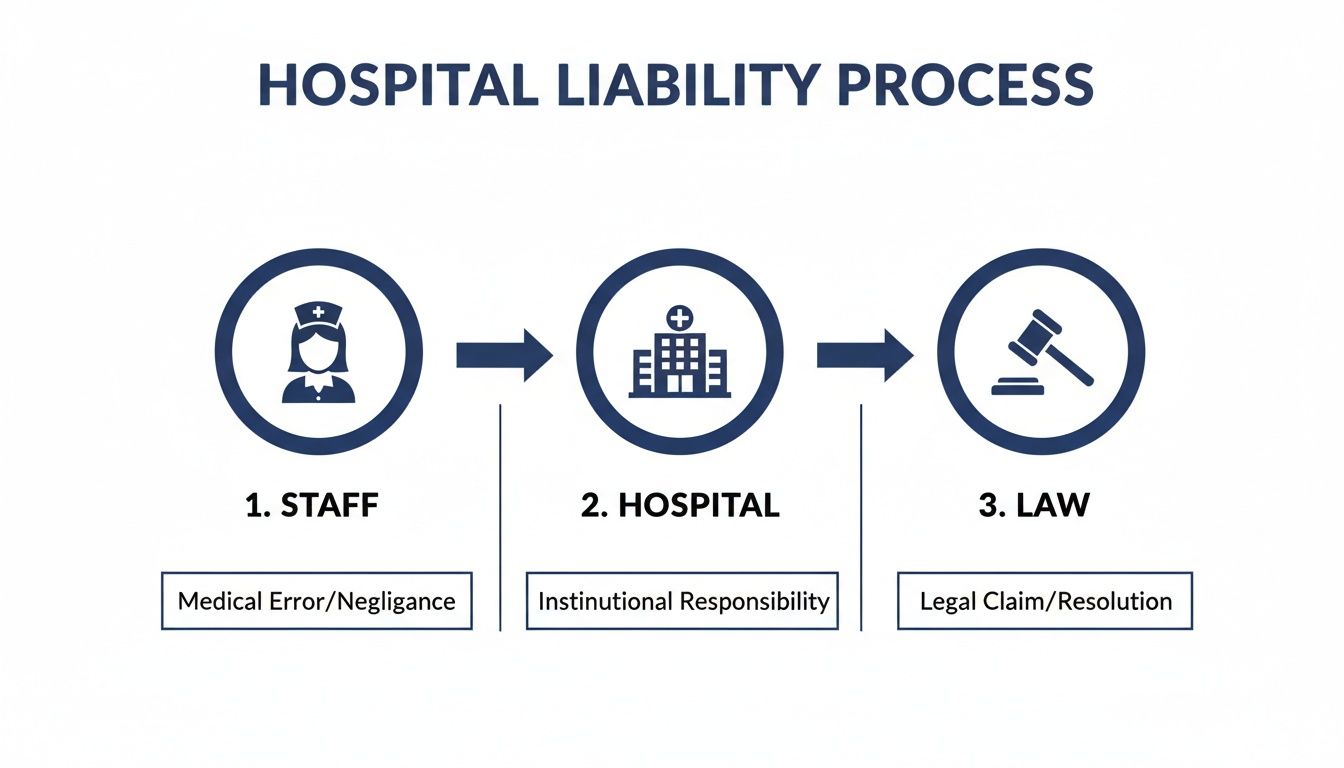
As you can see, the hospital's direct responsibility is the crucial link between an employee's negligent act and your ability to take legal action. This is why the hospital itself often becomes the main defendant in the case.
Florida's Statute of Limitations: The Ticking Clock
The most important deadline you need to know about is the statute of limitations. For most medical malpractice claims in Florida, you have just two years to file a lawsuit. That clock starts ticking from the moment you either knew, or reasonably should have known, that your injury was caused by a medical error. This is often called the "discovery rule."
But there’s another layer. Florida also has a hard-and-fast cutoff called the statute of repose. With only a few rare exceptions, you are completely barred from filing a claim more than four years after the date the malpractice actually happened—even if you had no way of discovering the injury until after that four-year mark. It’s an unforgiving deadline.
That two-year window is dangerously short. It starts the moment you even suspect something went wrong, not when you have ironclad proof. Waiting too long is one of the most common and heartbreaking mistakes we see people make.
And make no mistake, holding medical institutions accountable is not only possible but essential. A study of U.S. malpractice claims paid between 1992 and 2014 found 280,368 paid claims during that time. Tragically, 32.1% of those cases involved the patient's death. This data shows that these lawsuits are a vital tool for driving real safety improvements in our hospitals.
The Mandatory Pre-Suit Investigation
Before you can even set foot in a Florida courtroom, you have to go through a mandatory pre-suit investigation. This is a formal, in-depth process where your attorney must conduct a full review of your potential claim.
A key part of this is getting a written, signed affidavit from a qualified medical expert. This expert has to be in the same specialty as the doctor or provider you’re suing, and they must state under oath that there are reasonable grounds to believe medical negligence occurred. This step is non-negotiable and takes a lot of time and resources to do correctly.
Special Rules for Public Hospitals
Things get even more complicated if the hospital that harmed you is a public or state-run facility. When you’re suing the government, a concept called sovereign immunity kicks in. While Florida allows people to sue government entities, it puts special roadblocks in the way:
Notice Requirement: You must give formal written notice of your claim to the government agency and the Florida Department of Financial Services within a tight timeframe, usually three years from the date of the incident.
Damage Caps: Sovereign immunity also puts strict limits on how much money you can recover. Currently, damages are often capped at $200,000 per person and $300,000 per incident. While there are some ways to seek more through the legislature, it's a difficult uphill battle.
The table below breaks down these critical deadlines.
Key Deadlines for Florida Hospital Negligence Claims
This table summarizes the crucial timelines and procedural steps you must follow when filing a medical negligence lawsuit in Florida.
Procedural Milestone | Florida's Legal Deadline | Why It's Critical for Your Case |
|---|---|---|
Notice of Intent | Sent before the statute of limitations expires. | This formal notice is the first step in the mandatory pre-suit process and alerts the hospital to your claim. |
Statute of Limitations | Two years from the date of discovery. | If you miss this deadline, you lose your right to sue, no matter how strong your case is. It's an absolute bar. |
Statute of Repose | Four years from the date of the incident. | This is the final, absolute cutoff. Even if you discover the harm late, your claim is extinguished after four years. |
Sovereign Immunity Notice | Three years for claims against public hospitals. | Failing to provide this specific notice to the correct government agencies will get your case against a public hospital dismissed. |
Missing any one of these deadlines can be fatal to your case.
Navigating these rules demands an attorney with deep, practical knowledge of Florida's specific procedures. The legal team at CAINE LAW serves clients across the state and has the local expertise needed to handle these complexities. You can see our Florida service area locations to find out if we can help. We manage the procedural headaches so you can focus on healing.
These intricate rules make one thing perfectly clear: you need an experienced guide on your side. One wrong move can derail your entire case. In pain? Call Caine.
Types of Compensation You Can Pursue
When a hospital’s mistake leaves you injured, the law provides a path to get compensation for what you’ve lost. This isn't about a windfall; it's about holding the hospital accountable and giving you the resources needed to put your life back together. In legal terms, these recoverable losses are called damages.
Getting a handle on the different types of damages you can seek is a huge step in fighting for justice. In Florida, the compensation you can receive is broken down into three main categories, with each one designed to cover a specific kind of harm caused by the hospital's negligence.
Economic Damages: The Calculable Costs
The most clear-cut category of compensation is for economic damages. Think of these as the concrete, out-of-pocket expenses and financial hits you can tally up with receipts, bills, and pay stubs. They are the tangible financial burdens that the hospital's mistake has saddled you and your family with.
Economic damages are meant to pay you back for every dollar the injury has cost you, both now and what it's projected to cost you down the road.
These costs almost always include:
Past and Future Medical Bills: This covers everything from the first ER visit and any corrective surgeries to long-term needs like physical therapy, prescription drugs, and in-home care.
Lost Wages and Income: If the injury kept you out of work, you have the right to recover the income you couldn't earn during that time.
Diminished Earning Capacity: For truly devastating injuries, you might not be able to go back to your old job—or work at all. This compensation is for the future income you'll lose over the rest of your working life.
Non-Economic Damages: The Human Cost
While the financial toll is easy to see on paper, the deepest wounds from hospital negligence are often invisible. Non-economic damages are there to compensate you for the immense physical and emotional suffering that doesn’t come with a neat price tag. It's the law’s way of acknowledging the very real human cost of the injury.
This is compensation for the intangible ways your quality of life has been diminished.
While no amount of money can ever truly erase trauma, non-economic damages are the legal system's way of recognizing the immense personal toll of an injury. They validate your suffering and provide resources to help you cope with a new, often difficult, reality.
Examples of non-economic damages include:
Pain and Suffering: This is for the physical pain, chronic discomfort, and agony you’ve had to live with.
Emotional Anguish: This covers the mental distress, anxiety, depression, and trauma that came from the injury.
Loss of Enjoyment of Life: This addresses your inability to do the things that once brought you joy, whether it’s a hobby, playing with your kids, or simple daily routines.
Disfigurement or Disability: For permanent scars, amputations, or physical limitations that have changed your appearance and what you're able to do.
Punitive Damages: Punishing Extreme Misconduct
Finally, in a few very rare and extreme situations, a court might award punitive damages. Unlike the other two types, these aren't meant to pay you back for a specific loss. Their one and only purpose is to punish the hospital for truly outrageous, reckless, or intentional misconduct and send a clear message to deter other institutions from doing the same.
Because the bar is set so incredibly high, punitive damages aren't awarded in most hospital negligence cases. They are reserved for situations where the hospital showed a conscious and blatant disregard for the safety of its patients. A skilled attorney can look at the facts of your case and tell you if pursuing this type of claim is even a remote possibility.
Understanding what you can recover is the first step toward securing your future. In pain? Call Caine.
What to Do After Suspecting Hospital Negligence
If the question "can I sue a hospital?" is on your mind, it's a sign that something has gone terribly wrong. The moments after a medical injury are a blur of confusion and pain, but the steps you take right now are incredibly important for protecting your health and your legal rights. Your focus has to be sharp and deliberate.
Your first priority, always, is your physical well-being. Don't delay in getting the right medical care, even if that means going to a different hospital or finding an independent specialist. A second opinion not only ensures you're being treated correctly but also creates a separate, unbiased medical record of your injuries.
Become Your Own Best Advocate
Next, you need to put on your detective hat and become a meticulous record-keeper. The success of any hospital negligence claim is built on a foundation of solid documentation. Start gathering every piece of paper connected to your medical care—this evidence will become the backbone of your case.
This initial file should include:
All Medical Records: Request your complete charts, lab results, and physician's notes from the hospital where the incident happened. Do the same for any doctors you see afterward.
Bills and Invoices: Keep every single bill, receipt, and explanation of benefits from hospitals, doctors, pharmacies, and physical therapists.
Photographic Evidence: Take clear photos of your injuries from a few different angles. It's also a good idea to keep taking pictures as they heal or change over time to document the process.
A Written Timeline: As soon as you can, sit down and write out a detailed story of everything that happened. Include dates, times, the names of nurses or doctors you spoke with, and what they said. Memories can fade fast, so a written record is priceless.
Protect Your Claim from the Start
It’s very likely that a hospital administrator, risk manager, or their insurance adjuster will try to contact you. It is absolutely vital that you do not speak with them about what happened or agree to give them a recorded statement. Their only job is to protect the hospital's bottom line, not yours. Anything you say can be twisted and used against you to reduce or even deny your claim.
The single most important step you can take is to contact an experienced Florida personal injury lawyer for a free, confidential consultation. An attorney acts as your shield, handling all communications with the hospital and its insurance company while you focus on recovery.
An attorney can immediately get to work preserving evidence and navigating Florida’s complex pre-suit requirements for medical malpractice claims. For more general guidance on what to do after an injury, you can review our essential steps for handling accidents and their legal aftermath.
Taking these proactive steps—putting your health first, documenting everything, and getting legal help—is the best way to build a strong foundation for holding a negligent hospital accountable. In pain? Call Caine.
Answering Your Questions About Hospital Lawsuits
When you're thinking about taking legal action against a hospital, a flood of questions is completely normal. Here are some straightforward answers to the questions we hear most often.
How Much Does It Cost to Hire a Hospital Negligence Lawyer?
At Caine Law, we handle these cases on a contingency fee basis. What does that mean for you? Simple: you pay absolutely nothing upfront to get your case started.
Our fee is just a percentage of the compensation we successfully recover for you, whether that comes from a settlement or a jury verdict. If we don’t win your case, you don’t owe us a dime. There’s zero financial risk in getting an experienced legal team on your side.
Can I Sue if the Doctor Wasn't a Hospital Employee?
Yes, in many cases, you can—even if the doctor was technically an independent contractor. Hospitals can still be held responsible for an independent doctor's mistakes under a few key legal principles.
One common path is through a concept called "apparent agency." This applies when the hospital made it seem like the doctor was part of their team—for example, by having them work in the ER wearing a hospital-branded coat. Another is "corporate negligence," which holds the hospital responsible for its own failure to properly screen, credential, and monitor the doctors practicing in its facility.
At the end of the day, the hospital has a fundamental duty to ensure that everyone providing care within its walls is competent and safe.
What if I'm Not Sure if It Was Negligence?
Feeling uncertain is one of the most common things we hear from potential clients. The line between a known medical complication and actual negligence can be blurry, involving complex medical and legal details. You aren't expected to figure that out on your own.
This is exactly why we offer a free, no-obligation case evaluation. It’s a chance for you to tell your story and for us to listen. We’ll review the facts with our team and our network of medical experts to help you understand your legal options. You have absolutely nothing to lose by getting clear answers and finding out exactly where you stand.
If you suspect that a hospital's mistake caused harm to you or a loved one, you deserve answers. The team at CAINE LAW is here to provide them. Contact us today for a free, confidential consultation to discuss your case and learn how we can help you fight for the justice you deserve. In pain? Call Caine.
