
In Pain? Call Caine
Can you claim car accident without police report in Florida

5 Min read
By: Caine Law
Share
Let's get straight to the point: Yes, you can absolutely file a car accident claim in Florida without a police report. It’s a common misconception that no report means no claim. While an officer’s report is definitely a helpful piece of the puzzle, not having one isn't a dealbreaker.
Understanding Your Claim Without a Police Report
This scenario plays out more often than you'd think. Maybe it was a minor fender-bender in a parking lot, a tap on private property, or a situation where everyone seemed fine and agreed to just exchange information. Life happens.
The most important thing to grasp is that without an official report, the burden of proof shifts squarely onto your shoulders. The insurance company won’t have a neutral, third-party account from an officer to review. Because of this, the evidence you collect becomes the bedrock of your entire claim.
Why You Still Have a Valid Claim
At its core, an insurance claim is a matter of contract between you and your provider. A police report is just one type of evidence—it documents facts, but it doesn't legally assign fault. Think of it this way: the success of your claim hinges on the quality and quantity of your evidence, not on the presence of a single document.
Insurance adjusters deal with this all the time, especially in low-speed collisions where no one appears hurt. In fact, a surprising number of claims are filed this way. A 2022 analysis, for instance, showed that roughly 14% of vehicle-related claims were submitted without an accompanying police report, particularly for minor damage. You can dig deeper into these kinds of statistics in this helpful guide to claims without police reports.
Key Takeaway: The absence of a police report doesn’t invalidate your right to seek compensation. It simply means you must be more diligent in documenting the accident yourself to build a convincing case for the insurer.
Without that official paperwork, you are in control of the narrative. Your job is to create such a detailed and clear record of events that it leaves no room for the insurance adjuster to doubt or dispute your version of what happened. If you ever feel overwhelmed by this process, getting professional guidance is always your best first step. In pain? Call Caine.
Claim Differences With and Without a Police Report
When you don't have a police report, the claims process looks a bit different. You'll need to step up and fill the gaps an officer's report normally would.
Claim Aspect | With a Police Report | Without a Police Report |
|---|---|---|
Establishing Facts | Official, third-party account of the incident, including diagrams, statements, and citations. | Relies entirely on your photos, videos, notes, and witness statements. The narrative is up to you. |
Proving Fault | The officer’s opinion and any issued citations provide a strong (though not final) indicator of fault. | You must build the case for fault using your own evidence. Can be more easily disputed by the other party. |
Information Exchange | Officer ensures all driver, vehicle, and insurance information is collected and documented accurately. | You are solely responsible for getting correct information from the other driver. Mistakes or omissions can complicate things. |
Dispute Resolution | Provides a neutral baseline for adjusters to reference, often speeding up the liability decision. | Higher potential for a "he said, she said" scenario. Delays are more common as the insurer investigates. |
Credibility | Seen as a credible, unbiased source of information by insurance companies. | Your credibility is based on the thoroughness and consistency of the evidence you provide. |
Ultimately, a police report acts as a powerful, impartial foundation for your claim. Without it, you're the architect and the builder, responsible for creating a solid structure of proof from the ground up.
Why a Police Report Still Matters in Florida
So, can you file a car accident claim without a police report? Technically, yes. But should you? That's a completely different question, and from my experience, the answer is almost always no.
Think of a police report as the official, unbiased foundation of your entire claim. Insurance adjusters are paid to be skeptical, and an officer’s report provides a credible, third-party narrative that cuts through the he-said, she-said and can dramatically speed up the process of figuring out who was at fault.
This document is so much more than a simple summary of what happened. It’s a detailed snapshot of the incident, capturing critical evidence that’s often impossible to get later. Those details give your claim immediate weight and clarity right out of the gate.
What an Official Report Captures
When an officer arrives at the scene, they’re trained to document specific things that insurance companies look for immediately. This information helps build a clear, initial picture of the accident.
Officer Observations: This is their impartial account of the scene—where the cars ended up, what the damage looked like, road conditions, and anything else that stands out.
Driver and Witness Statements: They capture what everyone said right after the crash happened, before stories have a chance to get fuzzy or change.
Scene Diagrams: A simple sketch from the officer can be incredibly powerful, showing a visual of how the collision likely went down.
Citations Issued: If the other driver got a ticket for running a red light or speeding, that’s a massive indicator of fault.
Without this official record, you're left trying to piece this all together on your own. It's not impossible, but it leaves the door wide open for the other driver's insurance company to poke holes in your story and dispute the facts.
Florida Law and When a Report Is Required
Beyond just being a good idea, there are times in Florida when you are legally required to report a crash. Knowing these rules is critical, because failing to make that call can create serious legal headaches for you later on.
According to Florida Statutes § 316.065, you must report a crash to law enforcement if it involves any injuries, a death, or apparent property damage of $500 or more.
Let's be realistic—that $500 threshold covers almost any accident these days. A single cracked headlight or a dented bumper can easily exceed that amount. The law also requires a report for any crash involving a suspected drunk driver or a hit-and-run.
If you’re in a crash and the other driver tries to talk you out of calling the police, treat that as a major red flag. They might be trying to avoid a ticket, or worse, they might not have insurance. Always protect yourself by insisting on an official report, especially if anyone is hurt or the damage looks significant.
When you're standing on the side of the road, shaken up and unsure what to do, just remember that a police report is your best first step. And if you're ever in doubt about your rights or obligations, don't hesitate to get legal advice. In pain? Call Caine.
How To Build Your Case Without a Police Report
When there's no official police report, you essentially become the lead investigator for your own accident claim. Your mission is to gather so much clear, compelling evidence that the insurance adjuster has no room to second-guess the facts. This process has to start right there at the scene, while everything is still fresh and undisturbed.
Without that official narrative from law enforcement, the documentation you create becomes the absolute backbone of your claim. Insurers will naturally scrutinize your proof more closely, so you have to be thorough. You can still absolutely pursue a claim, but you must be ready to substitute the police report with robust, on-the-spot proof like photos, witness info, and a prompt medical evaluation.
Documenting the Scene Like a Pro
In the moments after a crash, your smartphone is your most powerful tool. Don't just snap one or two pictures; you need to create a complete visual record that tells the whole story from every angle.
Go Wide: Capture the entire scene from several different spots. Make sure to include the intersection, any traffic signs or stoplights, and landmarks that establish the exact location and context.
Zoom In on Damage: Take detailed, close-up photos of the damage on both cars. Get shots from multiple angles to clearly show the points of impact.
Capture the Details: Get clear, readable photos of the other driver's license plate and the Vehicle Identification Number (VIN), which is usually visible on the dashboard through the windshield.
Don't Forget the Road: Document any skid marks, debris scattered on the road, or hazards like puddles or slick spots from the weather.
This level of detail makes it incredibly difficult for the other driver to change their story later. You're creating a freeze-frame of the accident's immediate aftermath. For more tips on this, check out our guide on essential steps to take after an accident.
Gathering the Human Evidence
Beyond the physical scene, the information you get from people is priceless. Never, ever leave an accident without collecting these details.
First, exchange information with the other driver. The quickest and most accurate way to do this is to take a clear photo of their driver's license and their insurance card. It’s faster than writing everything down and eliminates the chance of errors.
Next, look around for witnesses. If anyone saw what happened, their perspective can be a game-changer. A neutral, third-party account can provide the same kind of unbiased view a police report would. Politely ask for their full name and phone number. Sometimes, a single credible witness is the one thing that decides a disputed claim.
The flowchart below gives a good overview of the general process, from the initial collision to the legal steps that often come next.
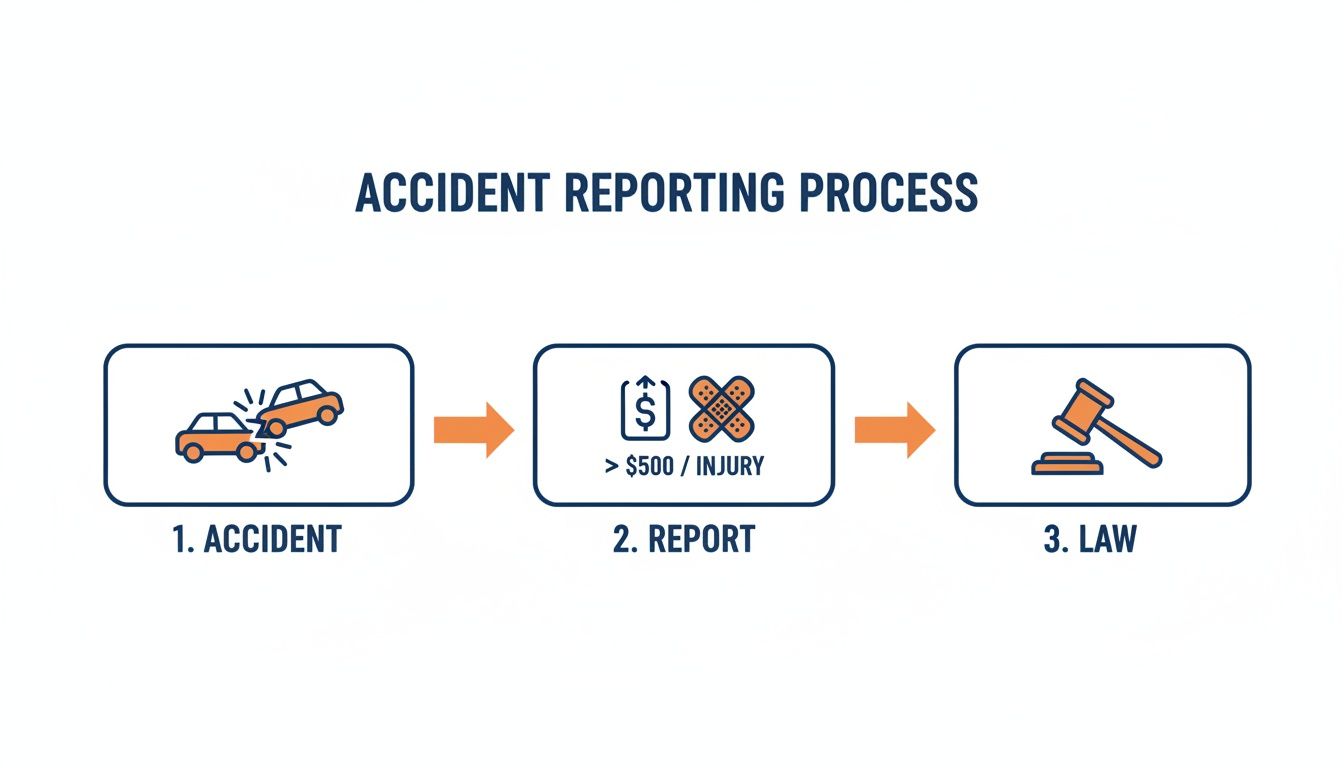
As this shows, when an accident involves injuries or significant damage, the reporting and legal steps become even more critical to protecting your rights.
Creating Your Own Narrative and Medical Trail
As soon as you’re somewhere safe, write down everything you can remember. Do this while the details are still sharp in your mind. Note the time, location, weather, and what you were doing right before the crash. Describe exactly how it happened from your point of view.
Crucial Final Step: Get checked out by a doctor right away, even if you feel fine. The adrenaline pumping through your body can easily mask serious injuries like whiplash or even a concussion. Seeing a doctor creates an official medical record that directly links your injuries to the date of the accident—vital evidence for your claim.
If this all feels overwhelming, you don’t have to go through it alone. A skilled attorney can help you organize your evidence, build a powerful case, and handle the insurance companies for you. In pain? Call Caine.
Notifying Your Insurance Company the Right Way
After an accident, the clock starts ticking. Almost every insurance policy has a clause that requires you to report an incident "promptly." So, once you're safe, calling your insurer should be at the top of your list.
How you handle this first phone call can really set the tone for your entire claim, especially when you have to explain the absence of a police report. This initial conversation isn't the time for a long story or guessing what happened. Stick to the hard facts you documented at the scene.
What to Say and What to Avoid
When you get on the phone, your goal is to be helpful and factual without accidentally saying something that could damage your claim.
Here’s what to focus on during that crucial first call:
State the basics: Give them the date, time, and location of the accident.
Mention your evidence: Let them know you have photos, the other driver's information, and contact details for any witnesses.
Explain the missing report: Be direct and honest about it. You could say something like, "The accident happened in a private parking lot, so we just exchanged information directly."
What's absolutely critical is that you avoid speculating about who was at fault. Insurance adjusters are trained to listen for any hint of self-blame. Phrases like "I think I might have..." or "Maybe I should have..." can be twisted and used against you later.
It's far better to say something simple like, "I'm still processing what happened and need to review my notes," than to guess or admit even a tiny bit of responsibility. Protect your rights by sticking only to what you know for sure.
A Real-World Script for Your First Call
That first call can be nerve-wracking. Having a basic script ready can help you stay on track and only give the necessary information, which is key when you need to claim a car accident without a police report.
Here’s a simple, effective way to handle it:
"Hello, my name is [Your Name], and my policy number is [Policy Number]. I’m calling to report an accident that happened on [Date] around [Time] at [Location]. I have the other driver’s name and insurance details, plus photos of the scene and the damage. There isn't a police report because it was a minor accident on private property. Could you please give me a claim number and tell me the next steps?"
This script is direct, factual, and doesn't offer any opinions on fault. It clearly establishes that you've done your homework by collecting evidence and are officially starting the claims process. If the adjuster starts pushing for more details about how the accident unfolded, it’s perfectly fine to say that you’ve documented everything in your notes and can provide a written statement later.
If you feel like you're being pushed for answers you aren't ready to give, or if the whole process just feels overwhelming, that's a good sign you might need some backup. In pain? Call Caine.
What to Do When the Insurer Pushes Back
Let’s be honest. When you file a claim without a police report, some insurance adjusters see it as an open invitation to challenge your story. You should be prepared for some pushback.
It's their job to protect the company's bottom line, and a missing official report gives them an angle to question everything. They might try to downplay your injuries, hint that you were partially at fault, or toss a quick, lowball offer your way, hoping you’ll take the money and disappear. This is the exact moment where all the evidence you gathered becomes your most powerful asset.
Responding to the Adjuster with Confidence
Your detailed documentation is your best defense. When an adjuster starts poking holes in your story or disputing the timeline, don't get drawn into an argument. Instead, just calmly and methodically present the facts you've collected.
Doubting the damage? Email them the clear, time-stamped photos you took right after the crash.
Questioning the other driver's fault? Mention that you have the names and numbers of witnesses who saw exactly what happened.
Skeptical about your injuries? Provide the paperwork from your urgent care or doctor’s visit.
This simple shift changes the entire dynamic. The conversation moves from a frustrating "he said, she said" back-and-forth to a straightforward review of the evidence. It signals to the adjuster that you’re organized, serious, and not going to be easily pushed around.
Create a Paper Trail for Everything
From this point on, every single interaction with the insurance company needs to be in writing. If you have a phone call, immediately send a follow-up email to recap the conversation.
Think of it as creating your own record. For example:
"Hi [Adjuster's Name], just wanted to confirm our phone call from this afternoon. My understanding is that you'll be reviewing the three repair estimates I sent over and will get back to me with an update by this Friday. Please let me know if I misunderstood anything."
This creates an undeniable paper trail. Whether it's email or even certified mail for critical documents, having a record of every interaction prevents the adjuster from conveniently "forgetting" what they promised or backtracking on their word.
Recognizing When Resistance Is a Red Flag
So, what happens if the adjuster just won't budge? If they keep disputing who's at fault, refuse to make a fair offer, or start dragging their feet, don't lose hope. This kind of resistance is often a sign that they know your claim is legitimate but are banking on you giving up.
This is a massive red flag and a clear signal that it's time to bring in a professional. Navigating these tricky insurance disputes is exactly what a good attorney does. We can step in, take over all communications, and make it clear to the insurer that you won't be intimidated or lowballed. We know their tactics, and we know how to fight back to get you the compensation you actually deserve.
If you're hitting a wall with the insurance company, don't wait. In pain? Call Caine.
When You Need to Call a Car Accident Attorney
There are moments when trying to handle a claim on your own just isn't worth the risk, especially if you have to **claim a car accident without a police report**. A minor fender-bender might seem manageable, but certain red flags should be a clear signal that it’s time to bring in professional legal help.
If you were injured in any way—even if it just feels like stiffness or soreness at first—calling an attorney is a critical move. The adrenaline rush after a crash can easily hide serious injuries like whiplash or a concussion. A lawyer ensures your medical needs are properly documented and that you're fighting for the care you actually need.
When the Situation Becomes Complicated
Another tell-tale sign is when the other driver's story suddenly changes. Without a police report to lock in the facts from the scene, the driver who seemed apologetic can flip the script a week later and deny fault. That instantly throws you into a "he said, she said" battle that's incredibly difficult to win by yourself.
You also need to be on high alert if the insurance company starts giving you the runaround. They have a playbook of common tactics, and it usually looks something like this:
Delaying Your Claim: Taking forever to process your evidence or even return your calls.
Disputing Liability: Trying to pin some or all of the blame on you to justify paying less.
Making a Lowball Offer: Throwing a quick, small settlement your way, hoping you're frustrated enough to take it and go away.
These aren't just annoying administrative hurdles; they are calculated strategies designed to save the insurance company money at your expense. Simply recognizing these tactics for what they are is the first step toward protecting yourself.
An experienced personal injury attorney has seen it all before and knows exactly how to push back. They can take over all the frustrating communications, bring in investigators to strengthen your case if needed, and build a legal strategy designed to demand the compensation you deserve for your auto accident injuries.
The absence of a police report doesn't mean your case is a lost cause. It just means the playing field isn't level. A skilled lawyer can change that and make sure your voice is heard loud and clear.
In pain? Call Caine.
Answering Your Top Questions About Florida Accident Claims
After a car wreck, your head is probably swimming with questions. It's a confusing and stressful time, and things get even trickier when you're trying to claim a car accident without a police report. Let's cut through the noise and get you some clear answers to the questions we hear most often from Florida drivers.
Can I Still File a Police Report Days After the Fact?
Yes, you can absolutely go down to a local police station and file a delayed accident report. But here’s the reality: it won’t carry nearly the same weight as a report filed right at the scene.
Think about it from the officer's perspective. When they show up days later, all they can do is take down your version of what happened. They didn't see the cars, the road conditions, or the immediate reactions of everyone involved. While this late report officially documents that something happened, insurance adjusters know this and won't give it much authority.
What Happens if the Other Driver Admitted Fault but Now They're Lying?
This is one of the most maddening situations you can face, and it happens all the time. One minute they're apologetic, the next their insurance company is calling you to say you caused the crash. Suddenly, it’s just your word against theirs.
This is exactly why gathering your own proof is so critical. Your claim now depends entirely on the evidence you collected on your own:
Witnesses: A neutral third-party witness who saw what happened is now your most powerful asset.
Photos: Pictures of the cars' final positions, the damage, and the surrounding area can tell a story that words can't.
Messages: Did you get an "I'm so sorry" text from the other driver? Save it. That's a huge piece of evidence.
If the other driver has flipped their story, it's a massive red flag. This is the point where you should seriously consider getting professional legal help to keep your claim from being unfairly shot down.
Key Insight: A driver's verbal "I'm sorry, it was my fault" at the scene is basically worthless once they drive away. Without a police report or a witness to back you up, it’s like it never happened. Always get your own proof.
Will My Insurance Rates Go Up if I File a Claim?
It's the question on everyone's mind. The possibility of a rate hike is real, but it’s not really about whether you have a police report—it’s about fault. If you weren't at fault, Florida law is on your side and generally prohibits your own insurance company from raising your rates just because you filed a claim.
But—and this is a big but—the lack of a police report makes proving you weren't at fault much harder. Without that officer's independent assessment, you open the door for a dispute between insurance companies, which can complicate everything.
At CAINE LAW, we know how to piece together a strong claim, even when the initial evidence seems weak. If you’re stuck in a "he said, she said" battle or just feeling lost in the insurance maze, let our experience guide you. In pain? Call Caine. Reach out today for a free, no-obligation consultation at https://cainelegal.com.
