
In Pain? Call Caine
Your Guide to Auto Accident Concussion Settlement Claims

5 Min read
By: Caine Law
Share
When you hear "concussion," you might think of a mild bump on the head that clears up in a few days. But after a car accident, a concussion settlement in Florida can range anywhere from $55,000 to over $1,250,000. The final number all comes down to the severity of the injury, the quality of your medical records, and proving the long-term impact on your life.
What starts as a seemingly minor head injury can quickly spiral into a complicated legal and financial fight. That’s why having a smart approach from day one is so important.
Understanding the True Value of Your Concussion Claim

Picture a typical scene on a busy Florida road—a sudden stop, the squeal of tires, and the jolt of a rear-end collision. You might walk away feeling shaken but okay, chalking up a slight headache to the stress of the moment.
But then days, or even weeks, go by. That "slight" headache has turned into a constant migraine. You're feeling dizzy, foggy, and can't focus on your work.
This is an all-too-common story. Your headache isn't just a headache; it’s a concussion, which is medically defined as a Traumatic Brain Injury (TBI). The real cost goes far beyond a single ER visit. This is where an auto accident concussion settlement comes in. It’s about getting compensated for the full picture of your losses—both the ones you can see and the ones you can't.
Why Concussion Settlements Vary So Widely
There’s no magic calculator for a concussion settlement. Instead, it’s a careful assessment of how deeply the injury has disrupted your life. For example, data from markets similar to Florida shows average concussion settlements ranging from $55,000 to $750,000. More severe TBIs can command settlements from $500,000 to $1,250,000.
In one recent T-bone crash case, the insurance company's first offer was just $27,618. After the attorneys proved the lifelong effects on the victim's ability to work and care for their family, the settlement jumped to $1,250,000. You can discover more insights about these verified TBI settlement amounts and see just how much difference a strong legal strategy can make.
So, why the huge variation in these numbers? It all comes down to the core factors that build a convincing claim.
A concussion is often called an "invisible injury" because its most damaging effects—cognitive challenges, emotional distress, and chronic pain—can't be seen on an X-ray. A fair settlement must make these invisible struggles visible to the insurance company.
Think of building your claim like building a house. You need a solid foundation of medical evidence, a sturdy framework proving your lost income, and a detailed blueprint—your legal strategy—to create something of true value.
Let's break down the main elements that will influence your concussion settlement.
Key Factors That Shape Your Concussion Settlement
The table below outlines the primary factors we look at when building a case for a concussion victim. Each piece is critical in telling the complete story of your injury and its impact on your life.
Factor | How It Influences Your Claim | Impact on Settlement |
|---|---|---|
Severity of Injury | A mild concussion with a quick recovery is valued differently than Post-Concussion Syndrome (PCS) or long-term cognitive issues. | The more severe and long-lasting the symptoms, the higher the potential settlement value. |
Medical Evidence | Strong, consistent records from specialists like neurologists and neuropsychologists are the backbone of your claim. | Detailed diagnostics (MRIs, CT scans) and documented treatment plans directly link the injury to the accident, increasing value. |
Economic Damages | This includes all medical bills, therapy costs, lost wages from time off work, and any impact on your future earning capacity. | Thoroughly documented financial losses provide a concrete number for compensation, which significantly boosts the claim's base value. |
Non-Economic Damages | This covers your pain and suffering, emotional distress, loss of enjoyment of life, and the impact on your family relationships. | While harder to quantify, this is a major component. Compelling evidence of life changes strengthens this part of the claim. |
Liability | How clearly can you prove the other driver was at fault? Was there any shared fault? This is a foundational element. | Clear proof of the other party's negligence is essential. Any ambiguity or shared fault can reduce the final settlement amount. |
Quality of Legal Counsel | An experienced attorney knows how to gather the right evidence, consult with top medical experts, and negotiate effectively. | A skilled legal team can often multiply the value of a claim compared to handling it alone or with an inexperienced lawyer. |
As you can see, every detail matters. From the first doctor's visit to the final negotiation, each factor plays a role in ensuring you are compensated fairly for everything you’ve been through.
If you are dealing with the aftermath of a car accident and a potential concussion, understanding these key factors is your first step toward protecting your rights and getting the resources you need to recover. In pain? Call Caine.
Calculating the True Cost of a Concussion
The financial impact of a concussion is a lot like an iceberg. That initial ER bill is just the tip you can see above the water. The real, crushing costs are often hidden beneath the surface, building up silently over time. To get a fair auto accident concussion settlement, you have to account for every single loss—the obvious ones and the not-so-obvious ones. Your claim isn't just a stack of medical bills; it’s the full story of your life before and after the crash.
To figure out what your claim is truly worth, lawyers and insurance adjusters group your losses into two main buckets: economic and non-economic damages. Getting a handle on both is the only way to make sure you aren't left paying for someone else's mistake years from now.
Tallying Up the Economic Damages
Economic damages are the straightforward, calculable costs you’re facing because of the accident. Think of these as anything you can prove with a receipt, an invoice, or a pay stub. These numbers form the concrete foundation of your settlement demand.
A thorough accounting here is non-negotiable. It’s not just about the big-ticket items; every little expense adds up and helps paint a clear picture of what your recovery has really cost you.
Here’s a practical checklist of the economic damages you need to be tracking:
Immediate Medical Bills: This is everything from the ambulance ride and the emergency room visit to hospital stays and initial diagnostic scans like CTs or MRIs.
Ongoing Medical Care: Don't forget the follow-up appointments with specialists. This could be neurologists, neuropsychologists, or physical therapists who are managing your recovery.
Rehabilitative Therapies: Many concussion survivors need specialized help. This includes physical therapy for balance, occupational therapy to relearn daily tasks, and cognitive therapy for memory and focus issues.
Prescription Medications: The cost of painkillers, anti-nausea drugs, or even medications for anxiety and depression linked to the trauma should all be included.
Lost Wages: This one is simple: it’s the income you lost because you couldn't work. You need to document every single missed hour.
Future Lost Earning Capacity: This is a big one. If your concussion causes long-term cognitive problems that stop you from returning to your old job or earning what you used to, that future loss is a critical part of your claim.
These costs can spiral, especially if symptoms linger. Post-concussion syndrome (PCS) is a silent thief that can rob you of your sense of normal after what seemed like a "minor" fender bender. In Georgia, a market very similar to Florida, PCS settlements can range anywhere from $20,000 to over $2 million. Even a "mild" case with headaches and dizziness can average $10,000 to $50,000. But when those symptoms stick around—and for many people, they do—the value jumps dramatically with ongoing therapy bills and serious wage loss. You can learn more about post-concussion syndrome settlement values to see just how significant these financial impacts can be.
Valuing the Invisible Wounds: Non-Economic Damages
While economic damages are about what the accident took from your wallet, non-economic damages are about what it took from your life. These are the invisible wounds that don’t come with a neat price tag but are often the most devastating part of a concussion.
How do you put a dollar value on not being able to play with your kids without getting a splitting migraine? Or the constant fear of forgetting something important? Or giving up a hobby you love because of chronic dizziness? This is the central challenge—and importance—of non-economic damages.
Florida law recognizes these profound personal losses and allows you to seek compensation for them. A skilled attorney knows how to translate this very real human suffering into a monetary value that an insurance company is forced to take seriously.
Common non-economic damages in a concussion claim include:
Pain and Suffering: This covers the physical pain—the chronic headaches, the neck pain, and all the other physical symptoms you endure.
Emotional Distress: This includes the anxiety, depression, irritability, and even PTSD that so often follow a traumatic event and a brain injury.
Loss of Enjoyment of Life: If your injury stops you from enjoying activities, hobbies, or social events you once loved, you deserve to be compensated for that loss.
Mental Anguish: This speaks to the psychological toll—the brain fog, the trouble concentrating, and the deep frustration of feeling like you're not the same person anymore.
Successfully proving these damages takes more than just saying you’re suffering. It often means keeping a journal to detail your daily struggles and gathering powerful testimony from family, friends, and coworkers who can speak to the changes they’ve seen in you since the accident. By painting a vivid, human picture of these life-altering changes, you can secure a settlement that truly reflects the full scope of what you’ve been through.
If you are struggling with the aftermath of a car accident, remember that every part of your experience matters. In pain? Call Caine.
How Injury Severity Shapes Your Settlement Value
Not all head injuries are created equal, and insurance companies know this better than anyone. When it comes to an auto accident concussion settlement, the single most influential factor is how severe your injury actually is. The difference between a mild concussion that resolves in a few weeks and a long-term brain injury is massive—and your compensation needs to reflect that reality.
Think of a mild concussion like a temporary computer glitch. The system freezes for a moment, and a quick reboot (a few days of rest) gets everything running smoothly again. It’s frustrating, sure, but the impact is short-lived.
A severe concussion or the development of Post-Concussion Syndrome (PCS), on the other hand, is like a corrupted operating system. The core functions are damaged, causing persistent, system-wide problems that mess with everything you do. This isn't a glitch; it's a fundamental impairment that requires intensive, ongoing help.
Concussion Severity and Potential Settlement Ranges
To get a clearer picture of how this works, let's break down how different levels of injury are viewed and valued. The symptoms you experience and how long they last are the primary drivers of what an insurance company might offer.
Injury Severity | Common Symptoms | Typical Florida Settlement Range |
|---|---|---|
Mild Concussion | Temporary headache, mild dizziness, brief confusion. Symptoms resolve within 2-4 weeks with minimal treatment. | $20,000 – $80,000 |
Moderate Concussion | Persistent headaches, nausea, sensitivity to light/sound, memory issues. Symptoms last for several months. | $80,000 – $250,000+ |
Severe TBI / PCS | Chronic migraines, long-term cognitive deficits, vertigo, personality changes, inability to work. Requires extensive medical care. | $300,000 – $1,000,000+ |
As you can see, a claim's potential value skyrockets when symptoms become chronic and disrupt your ability to live and work normally.
Distinguishing Mild TBI from Severe Injury
An insurance adjuster will be looking for clear medical evidence that separates a minor head knock from a life-altering Traumatic Brain Injury (TBI). While a mild concussion might involve a brief headache and some temporary fogginess, PCS and more severe TBIs show up as debilitating, long-term symptoms.
These are the red flags that point to a more serious injury and justify a much higher settlement value:
Chronic Migraines: Headaches that don't just go away but become a persistent part of your daily life.
Persistent Dizziness or Vertigo: A constant feeling of being off-balance that can make simple tasks like walking or driving dangerous.
Cognitive Deficits: This includes significant memory loss, an inability to concentrate, and a pervasive "brain fog" that gets in the way of work and personal tasks.
Sensory Issues: Heightened sensitivity to light and sound, which can be isolating and overwhelming.
Personality and Mood Changes: Unexplained anxiety, depression, irritability, or mood swings that weren't there before the accident.
Sleep Disturbances: Insomnia or sleeping way more than usual, throwing your body's natural rhythms completely out of whack.
This image helps break down how the total costs of a concussion are split between the concrete, economic losses and the more personal, non-economic suffering.
It’s a clear visual reminder that a fair settlement has to cover both the bills you can stack up and the profound personal losses that are much harder to put a price on.
Proving Long-Term Impact Through Medical Evidence
To get a settlement that truly reflects a serious injury, you have to prove its long-term nature with undeniable medical evidence. Your word just isn't enough; you need objective documentation from experts.
An "invisible injury" like a concussion becomes visible through specialized testing and consistent medical records. This documentation is the language insurance companies understand and the foundation of a high-value claim.
Let’s say you're driving down a busy Florida highway when a distracted driver slams into you from behind. The jolt causes a concussion that lingers far longer than expected, turning into Post-Concussion Syndrome. This isn't just a headache—it's persistent dizziness, memory fog, and emotional turmoil that disrupts your job and your family life. Based on data from Florida personal injury firms, the average settlement for PCS from a car accident in the Sunshine State can range from $300,000 to over $1,000,000, all depending on the severity and proof of long-term impact. You can learn more about Florida post-concussion syndrome settlements to see how these values are calculated.
This is where advanced diagnostics become absolutely critical. Neuropsychological testing, for instance, is a series of assessments that measure cognitive functions like memory, attention, and problem-solving. When the results show a clear drop from your baseline abilities, it provides powerful, objective proof of a brain injury. This is the kind of evidence that connects the dots for the insurance company, showing that your symptoms are real, measurable, and directly tied to the accident.
At the end of the day, the more serious the diagnosis and the stronger your medical proof, the more leverage you have in negotiations. A file full of specialist reports and diagnostic results tells a story that is impossible for them to ignore.
If you're facing a long recovery, you need a settlement that accounts for every future need. In pain? Call Caine.
Building an Unbeatable Concussion Claim
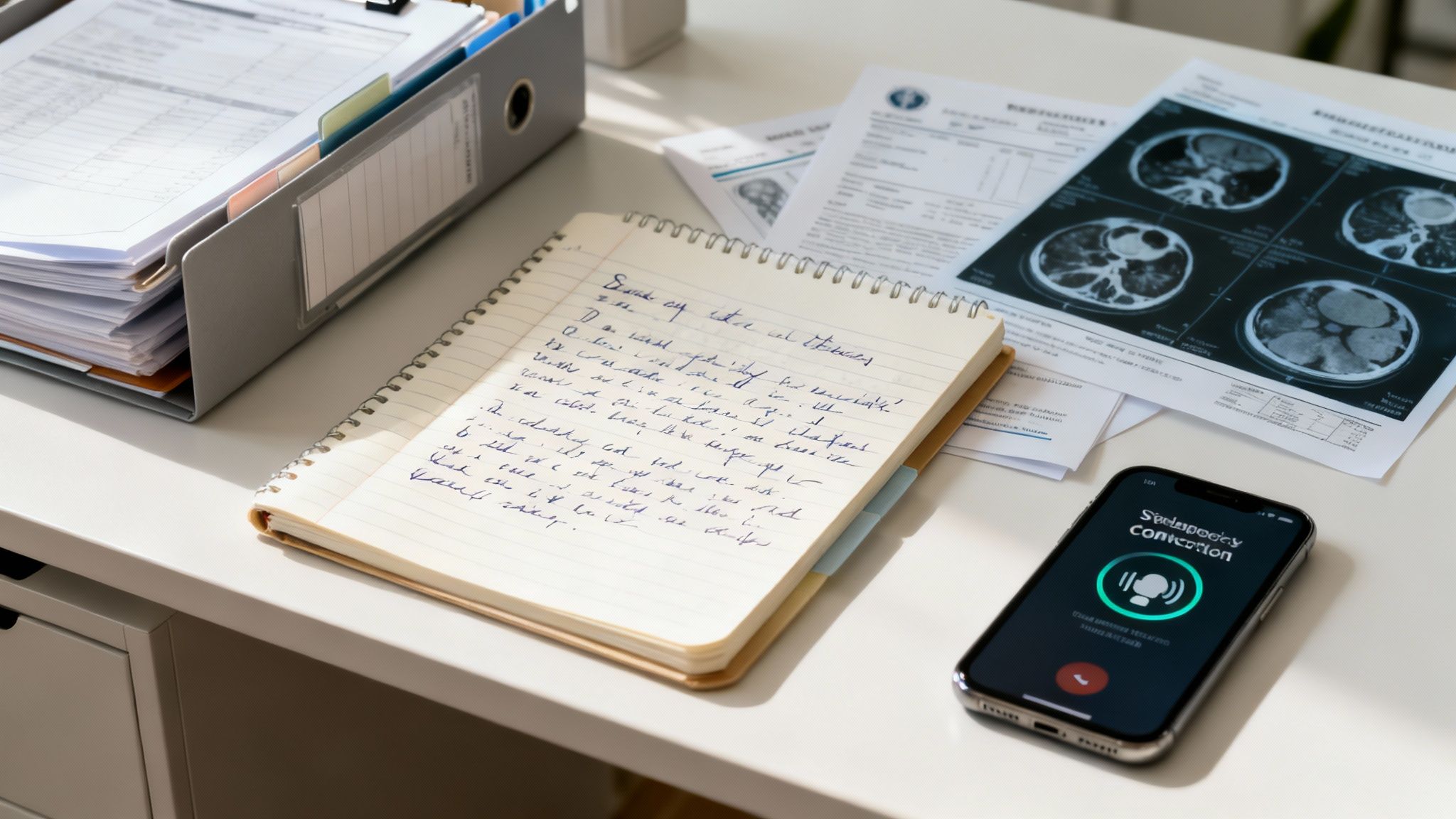
A concussion is often called an "invisible injury" for a good reason. The most debilitating symptoms—like brain fog, chronic headaches, and sudden mood swings—don't show up on a standard X-ray. To get a fair auto accident concussion settlement, your job is to make those invisible struggles visible and undeniable.
You have to build a fortress of proof, piece by piece, that leaves the insurance company no room to argue. Think of yourself as the lead detective in your own case. You need to gather every clue and piece of evidence that tells the complete story of how this concussion has turned your life upside down.
The Foundation: Official Documentation
Every strong claim is built on a solid foundation of official records. These documents provide the objective backbone for your case, clearly establishing the who, what, when, and where of the accident and your medical care. Without them, you’re trying to build a house on sand.
Here are the first pieces of evidence you absolutely must get your hands on:
The Police Report: This is the first official story of what happened. It identifies everyone involved, notes if any tickets were issued, and gives a preliminary opinion on who was at fault.
Emergency Room Records: If you went to the ER after the crash, these records are gold. They create the critical first medical link between the collision and your head injury, which is vital for proving the accident caused your condition.
Follow-Up Medical Records: This might be the most important part of your paper trail. You need every single record from every single provider—your family doctor, neurologist, physical therapist, and any other specialist you've seen.
These records create a clear, consistent timeline of your treatment and prove that your symptoms are real and persistent. For a deeper dive, check out our guide on how to document evidence needed for a personal injury claim in FL.
Transforming Subjective Pain into Concrete Evidence
So, how do you prove something as personal as a splitting headache or the frustration of forgetting what you were saying mid-sentence? You turn your personal experience into objective evidence by documenting it relentlessly. This is where a simple journal becomes one of your most powerful tools.
An insurance adjuster can try to argue with a doctor’s diagnosis, but it’s much harder for them to argue with a detailed, consistent, month-by-month log of your daily suffering. Your journal gives your pain a voice they can’t ignore.
In your journal, you need to track everything related to your concussion:
Pain Levels: On a scale of 1-10, how bad are the headaches? How often do they happen?
Cognitive Issues: Jot down every time you experience memory loss, confusion, or can't concentrate.
Emotional State: Make notes about feeling anxious, irritable, or depressed when it's not your norm.
Life Impact: Did you have to miss work? Did you skip a family get-together or have to give up a hobby you loved because of your symptoms? Write it down.
This simple habit transforms your personal struggle into a powerful pattern of evidence.
The Power of Witness Statements
You aren't the only person who sees how this injury has changed you. Statements from family, friends, and even coworkers can be incredibly powerful. Their testimonials paint a "before and after" picture from an outsider's perspective, reinforcing just how much this concussion has impacted your life.
Ask them to write down specific examples of how you've been different since the accident. Maybe your spouse can talk about your new-found irritability, or a colleague can confirm your struggles with focus at work. These stories add a human element that a stack of medical bills just can't convey.
An attorney can also bring in expert witnesses, like a vocational expert who can testify about how your concussion will impact your ability to earn a living in the future. It's just one more critical layer of proof for your claim.
If you are struggling to prove the impact of your injury, we can help. In pain? Call Caine.
Navigating Florida Law and Insurance Company Tactics
Getting a fair auto accident concussion settlement in Florida isn’t just about proving you were hurt. It’s about knowing how to navigate a tricky legal system and understanding the playbook insurance companies use to lowball you at every turn.
The path to compensation is rarely a straight line. It's filled with traps, deadlines, and strategic hurdles designed to save the insurance company money—at your expense.
The Critical 14-Day Rule
Here’s the first big hurdle: in Florida, you have exactly 14 days from the date of the accident to get medical treatment. If you wait until day 15, you lose your right to use your Personal Injury Protection (PIP) benefits. That’s up to $10,000 in coverage for medical bills and lost wages, gone.
This rule is a nightmare for concussion victims, whose symptoms often take days or even weeks to fully appear.
Even if you make the deadline, that $10,000 in PIP coverage is often just a starting point. The costs for neurologists, MRIs, cognitive therapy, and time off work can blow past that limit in no time. Once that happens, you have to go after the at-fault driver's insurance company. And that’s where the real fight starts.
Pulling Back the Curtain on Insurance Adjuster Tactics
Insurance adjusters are professional negotiators. Their job is to protect their company’s profits by paying you as little as possible. They are not your friend, and they are not on your side.
Here are a few of the classic tactics they’ll use to dismantle your concussion claim:
Downplaying Your Symptoms: Concussions are often called "invisible injuries" for a reason. Adjusters love this. They’ll argue your headaches are just from stress or your dizziness is from a pre-existing issue—anything to disconnect your symptoms from the crash.
Digging for Pre-Existing Conditions: They will ask you to sign a broad medical authorization, giving them access to your entire medical history. They're not being thorough; they're on a fishing expedition, hoping to find an old injury they can blame for your current pain.
Offering a Quick, Lowball Settlement: Before you even know how serious your concussion is, they might dangle a check in front of you. This "nuisance value" offer is almost always a fraction of your claim's true worth. They're betting you'll take the quick cash and sign away your rights before the real, long-term costs surface.
Using Your Words Against You: The adjuster will ask for a recorded statement. They’ll sound friendly, but their goal is to get you to say something that hurts your case. A simple "I'm doing okay" can be twisted to mean you aren't really injured.
An insurance company's first offer is never their best offer. It's a test to see if you know what your claim is actually worth.
Dealing with these tactics is exhausting, especially while you’re trying to recover from a brain injury. If you’re getting the runaround from an adjuster, it’s a red flag. It’s time to get professional help. You can learn more about how a skilled attorney pushes back against these strategies by reading about insurance disputes.
Florida’s Statute of Limitations
On top of the insurance games, there’s a hard legal deadline you absolutely cannot miss: the statute of limitations. In Florida, you now have just two years from the date of the accident to file a personal injury lawsuit. This recently changed from four years, making it even more important to act fast.
Miss that two-year window, and your right to sue the at-fault driver is gone forever. It doesn’t matter how severe your injuries are. The clock is ticking from day one, and building a strong concussion case takes time.
The combination of a short 14-day rule for PIP, aggressive insurance adjusters, and a strict two-year deadline to file a lawsuit makes getting fair compensation a serious challenge. You need a guide who knows the system and won't let you get pushed around. In pain? Call Caine.
Why an Experienced Concussion Attorney Is Essential
Trying to handle a complex concussion settlement from a car accident on your own is a massive gamble. Insurance companies have entire teams of adjusters and lawyers trained to protect their profits, and they are counting on you not knowing the ins and outs of the legal system.
Hiring an experienced concussion attorney isn't just about getting advice; it's about leveling the playing field.
The first thing a skilled lawyer does is calculate the true, lifetime cost of your injury. This is so much more than just adding up your current medical bills. A good attorney collaborates with medical and financial experts to project what you'll need for future treatments, ongoing therapy, and how this injury will impact your ability to earn a living down the road.
Building Your Case for Maximum Value
A great attorney knows how to turn your personal story and medical records into a powerful legal argument that an insurance company simply can't ignore. They step in as your chief investigator and strategist, gathering all the critical pieces of evidence needed to build an ironclad claim.
Here's what that actually looks like:
Hiring Credible Medical Experts: They bring in respected neurologists or neuropsychologists whose testimony can confirm the severity of your concussion and explain its long-term effects in a way adjusters (and juries) understand.
Gathering Powerful Evidence: They know exactly what to look for, from specialist reports and diagnostic scans to witness statements that paint a clear "before and after" picture of your life.
Expert Negotiation: They take over all communication with the insurance adjuster, shielding you from lowball offers and the high-pressure tactics designed to make you settle for less.
An experienced attorney sends a clear message to the insurance company: you are serious, you know what your claim is worth, and you are fully prepared to go to court if they refuse to be fair.
Don't Settle for Less Than You Deserve
Ultimately, hiring the right legal counsel is the single most important decision you can make to protect your financial future. They understand the specific nuances of Florida law and have seen every trick in the book that adjusters use to devalue concussion claims.
To get a better feel for what this involves, you can learn more about our firm's approach to personal injury cases.
Without a real expert on your side, you run the risk of accepting a settlement that is only a fraction of what you're rightfully owed. That leaves you to cover future medical costs and lost income out of your own pocket. Don’t let that happen. In pain? Call Caine.
Frequently Asked Questions About Concussion Settlements
The moments and months after a car wreck can feel like a blur, especially when you're grappling with a concussion. It’s completely normal to have a ton of questions. Let's walk through some of the most common ones we hear from our clients in Florida.
How Long Does a Concussion Settlement Take?
This is the million-dollar question, and the honest answer is: it depends. A more straightforward case—where fault is crystal clear and the injuries are minor—might wrap up in about six to nine months.
But when you're dealing with a serious Traumatic Brain Injury (TBI), disputed liability, or the need for long-term medical care, the timeline stretches out. These complex claims can easily take one to three years, particularly if we have to file a lawsuit and head toward trial. The most important thing is to wait until you've reached Maximum Medical Improvement (MMI). Settling too early means you could leave money on the table for future treatments you'll desperately need.
Can I Get a Settlement for Delayed Symptoms?
Yes, and this happens more often than you’d think. It's incredibly common for concussion symptoms like splitting headaches, dizziness, or that frustrating "brain fog" to show up days or even weeks after the crash.
The single most important thing you can do is get to a doctor the second you notice something is off. This creates a paper trail that directly ties your symptoms back to the accident.
Insurance adjusters love to argue that a delay means the injury isn't related to the crash. Don't worry about that. A skilled attorney knows how to build the evidence to prove the connection and shut down that argument fast.
What if the At-Fault Driver’s Insurance Is Too Low?
It’s a frustrating scenario we see all the time, especially when your injuries are severe and the medical bills are piling up. If the at-fault driver’s policy limits aren’t enough to cover everything you’ve lost, you aren’t out of options.
Your attorney will immediately start digging for other sources of compensation. This usually involves:
Uninsured/Underinsured Motorist (UM/UIM) Coverage: This is precisely why you have this on your own policy. It’s designed to step in and cover the difference when the other driver is underinsured.
Third-Party Liability: Sometimes, more than one person or entity is to blame. Was the driver working at the time? We might be able to go after their employer. Was a faulty car part the cause? We can look at the manufacturer. Unsafe road conditions? A government entity could be responsible.
A thorough investigation is key to uncovering every possible dollar you're entitled to.
At CAINE LAW, we know how to navigate the complexities of Florida's legal system to ensure you receive the compensation you deserve. You focus on healing; we'll handle the fight. In pain? Call Caine.
